Which GEO Tool Is Best for Tracking Brand Citations and Source Attribution?
Compare GEO tools for tracking brand mentions, source citations, cited URLs, source gaps, AI referral traffic, and attribution. See when Peec AI, Otterly.AI, AirOps, Profound, Scrunch AI, or Semrush is the better fit.
When people compare GEO tools, they often start with a visibility score. But if the real goal is to understand why an AI engine recommends a brand, the more useful questions are different: Which sources did it cite? Which pages influenced the answer? Where are competitors being cited instead? And can those findings be connected to traffic or content work?
The best tool depends on which part of that measurement problem you need to solve. Some platforms focus on brand mentions and cited URLs. Others specialize in source-gap analysis, content workflows, crawler activity, or the connection between AI visibility and website analytics.
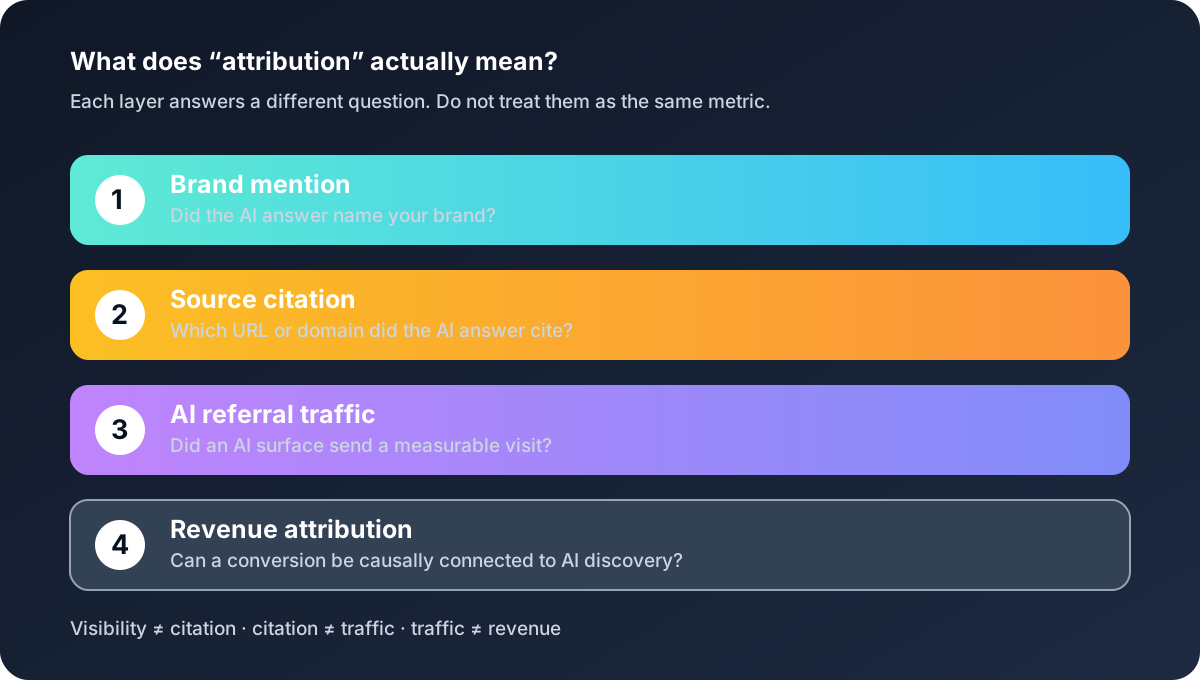
Those are related jobs, but they are not the same measurement problem:
Brand mention ≠ source citation
Source citation ≠ AI referral traffic
AI referral traffic ≠ revenue causality
For most teams whose immediate goal is understanding which sources influence AI answers, Peec AI is the strongest starting point. For broad ongoing monitoring, Otterly.AI is a strong alternative. For connecting citations to content refreshes, GSC, and GA4, AirOps is more suitable. Enterprise teams may prefer Profound, while Scrunch AI is especially useful for crawler and AI referral analysis.
The short answer
| Your main question | Best fit | Why |
|---|---|---|
| Which sources and URLs are AI engines citing? | Peec AI | Strong source and URL analysis, including source-gap workflows |
| Which citations and mentions are changing across many engines? | Otterly.AI | Broad monitoring, stored answers, cited URLs, competitors, and trends |
| How do citations connect to content refresh, GSC, and GA4? | AirOps | Citation intelligence is connected to Page360 and content workflows |
| Which sources influence enterprise brand visibility and competitors? | Profound | Enterprise citation, source, competitor, and authority analysis |
| Which AI crawlers visit my site and do they send traffic? | Scrunch AI | Crawler, agent, and referral-traffic analytics |
| I already use Semrush and want an AI visibility add-on | Semrush AI Visibility Toolkit | Fits existing Semrush workflows and reporting |
These are directional recommendations, not controlled benchmark scores. Feature availability, engine coverage, pricing, and limits change by plan and over time.
What is brand citation tracking?
Brand citation tracking monitors the sources that AI systems reference when producing answers about a category, problem, product, or company.
A citation may be:
- Your own article;
- A product page;
- A documentation page;
- A comparison or review page;
- A news article;
- A forum discussion;
- A directory;
- A government or institutional source;
- A partner or marketplace page;
- A competitor page.
The important point is that an AI answer may cite your content without naming your brand. It may also name your brand while citing someone else’s page.
For example:
Answer A:
The answer names your brand and links to your documentation.
→ brand mention + owned citation

Answer B:
The answer names your brand but links to a third-party review.
→ brand mention + third-party citation

Answer C:
The answer does not name your brand but links to your research page.
→ owned citation without brand mention

Answer D:
The answer names your brand but provides no source link.
→ brand mention without observable citation
These four cases should not be combined into one “visibility” number without preserving the underlying fields.
What is source attribution in AI Search?
In this context, source attribution means identifying the source that an AI engine used or displayed when generating an answer.
A useful source record should include as much of the following as the tool can reliably capture:
- AI engine;
- Prompt;
- Date and time;
- Country and language;
- Full answer text;
- Brand mention status;
- Mention position or prominence;
- Cited domain;
- Cited URL;
- Page type;
- Domain type;
- Whether the source is owned or third party;
- Whether the cited page mentions the brand;
- Competitor presence;
- Sentiment or recommendation context;
- Whether the result was repeated in another run.
The more of this context a tool preserves, the easier it is to turn a citation observation into a research decision.
Why a visibility score is not enough
A visibility score is useful for trend reporting, but it does not explain the mechanism behind the result.
Suppose two tools report that your brand has 18% AI visibility. That number might hide very different realities:
- You appear frequently in branded prompts but not category prompts;
- You are named often but rarely cited;
- Your pages are cited, but third-party pages describe you inaccurately;
- A competitor owns the source pages for high-intent comparisons;
- You appear in one engine and disappear in another;
- Your score is based on a small prompt sample;
- One tool captures Google AI Mode while the other does not;
- The result changed because the model or region changed.
For source attribution, always ask to see the underlying answers and URLs, not just the aggregate score.
How I evaluated the tools
For this comparison, the relevant criteria are:
1. Citation granularity
Can the tool show the specific cited URL, or only the cited domain?
URL-level evidence is generally more actionable because a domain may contain thousands of pages with very different authority, accuracy, and intent.
2. Source-gap analysis
Can the tool identify sources that cite competitors but not your brand?
This is useful for:
- Editorial outreach;
- Review and directory research;
- Partner opportunities;
- Community and UGC research;
- Content updates;
- Source diversification.
3. Answer preservation
Does the tool preserve the full answer and prompt context, or only a derived score?
A source list without the answer can make it difficult to judge whether the citation was positive, neutral, or harmful.
4. Engine and surface coverage
A tool may support ChatGPT, Perplexity, Gemini, Claude, Google AI Overviews, or Google AI Mode differently. Coverage can vary by plan, country, language, and collection method.
5. Traffic and analytics connection
Can citation data be compared with:
- Google Search Console;
- GA4;
- AI referral sessions;
- Conversion events;
- CRM or pipeline data;
- Page freshness;
- CMS actions?
This is where AirOps and Scrunch are more relevant than a citation-only tracker.
6. Actionability
Does the tool help you decide what to do next?
Examples include:
- Refresh a page;
- Correct an inaccurate source;
- Build a comparison page;
- Improve a product fact page;
- Seek inclusion in a cited directory;
- Investigate a Reddit or forum source;
- Add first-party evidence;
- Monitor a competitor source gap.
7. Evidence quality
Can you distinguish:
- Observed citation data;
- Vendor claims;
- Customer case studies;
- User reviews;
- Editorial interpretation;
- Causal business outcomes?
A good tool should help preserve this distinction rather than turning every signal into an ROI claim.
Peec AI: best for source-gap analysis
Peec AI is my first recommendation when “source attribution” means understanding which domains and URLs are influencing AI answers.
Its public documentation distinguishes brand mentions from source citations and describes source analysis across domains and URLs. It also provides gap analysis for sources where competitors appear but your brand does not.
What Peec is good at
- Tracking brand mentions and source citations separately;
- Showing cited domains and URLs;
- Finding sources used for competitor answers;
- Identifying domains or pages where your brand is absent;
- Supporting content, partnership, and outreach research;
- Breaking down visibility by prompts and models;
- Connecting citation observations to source opportunity analysis.
The useful workflow is:
Track category and comparison prompts
→ collect cited domains and URLs
→ compare your brand with competitors
→ identify source gaps
→ classify the opportunity
→ create content, outreach, or correction work
→ rerun the same prompt set
Example use case
Suppose competitors are repeatedly cited from:
- A software directory;
- An independent comparison article;
- A specialist newsletter;
- A Reddit discussion;
- An implementation guide.
Peec can help identify that pattern. Your next action might not be “write another blog post.” It might be to:
- Improve the product documentation that users reference;
- Submit accurate information to a relevant directory;
- Correct a third-party factual error;
- Publish a comparison that answers an uncovered question;
- Build a partner resource that deserves citation.
Peec limitations
Peec does not turn a source citation into proven traffic or revenue attribution. A source may be cited without generating a click. A user may see the citation, remember the brand, and return later through another channel.
Also verify the exact engine, country, language, prompt, and plan coverage before comparing trends.
Sources:
Otterly.AI: best for broad citation monitoring
Otterly.AI is a strong option when the main requirement is ongoing monitoring across many AI search surfaces.
Its public product materials describe tracking across ChatGPT, Perplexity, Google AI Overviews, Google AI Mode, Gemini, Copilot, and Claude, with answer storage, brand mentions, competitor comparisons, sentiment, and cited URLs.
What Otterly is good at
- Broad AI engine monitoring;
- Daily or recurring prompt tracking;
- Cited URL and domain analysis;
- Brand and competitor comparison;
- Mention order and sentiment context;
- Historical citation trends;
- Prompt research;
- Reports and agency workflows;
- Citation-readiness and page analysis.
Otterly is especially useful when the question is:
Did our citation pattern change this week?
Which pages are being cited now?
Which competitors are cited instead?
Did our content update alter the answer?
Otterly versus Peec
| Requirement | Peec AI | Otterly.AI |
|---|---|---|
| Source-gap research | Strong | Good |
| Broad recurring monitoring | Good | Strong |
| Cited URLs | Strong | Strong |
| Engine breadth | Verify by plan | Broad public coverage |
| Third-party source opportunity | Strong | Good |
| Longitudinal reporting | Good | Strong |
| Direct traffic attribution | Limited | Limited |
Otterly is not automatically better than Peec. It is better when monitoring breadth, recurring reports, and cross-engine tracking are the primary jobs.
Sources:
AirOps: best for citation-to-content operations
AirOps is the better fit when citation analysis must lead directly to content work.
AirOps’s Citations documentation describes a view of URLs cited across AI responses, with filters for brand presence, competitors, domain type, and page type. Its Page360 concept combines AI Search signals with Google Search Console, GA4, page freshness, and workflow context.
What AirOps is good at
- URL-level citation discovery;
- Cited-domain and page-type filtering;
- Competitor leaderboard analysis;
- AI answer and prompt context;
- Content refresh prioritization;
- GSC and GA4 context;
- Brand Kits and Knowledge Bases;
- Workflow automation;
- Publishing and CMS operations.
AirOps can support this loop:
Find a cited page
→ compare its GSC and GA4 signals
→ check page freshness
→ identify missing questions
→ create a refresh brief
→ review and publish
→ compare the same signals later
When AirOps is the best choice
Choose AirOps if your organization has:
- A large content library;
- A content operations team;
- A regular refresh program;
- GSC and GA4 data that needs to be connected to AI Search signals;
- A CMS workflow;
- A need to move from insight to production.
AirOps limitations
AirOps is more operationally demanding than a lightweight citation tracker. You need to manage tasks, Brand Kits, Knowledge Bases, workflows, permissions, and quality gates.
Its analytics connection is also not causal attribution by itself. If a cited page gains traffic, the team still needs to separate AI referrals, organic search, direct visits, assisted conversions, and returning users.
Sources:
Profound: best for enterprise citation intelligence
Profound is designed for teams that want a deep visibility and competitive intelligence layer.
Its citation materials describe:
- Which answer engines cite your content;
- Citation frequency across prompts;
- Competitor citation performance;
- Cited page types;
- Source authority;
- Enhanced citation categories;
- Opportunities to act on source patterns.
What Profound is good at
- Enterprise-scale prompt and citation analysis;
- Competitive benchmarking;
- Source authority and category analysis;
- Executive and agency reporting;
- Combining visibility, sentiment, accuracy, and citation research;
- Large-scale answer-engine intelligence.
Profound may be the right choice when the organization has multiple brands, markets, products, or stakeholders and needs a central intelligence platform.
Profound limitations
- Pricing is more likely to suit Enterprise teams;
- Plan-specific engine and source capabilities must be confirmed;
- Some outcome claims are vendor-selected;
- Enterprise breadth can create more setup and governance overhead;
- It is not automatically the best tool for CMS publishing or content production.
Sources:
Scrunch AI: best for crawler and referral attribution
Scrunch AI is useful when “attribution” means observing how AI agents and crawlers interact with your website.
Its public product materials describe a combination of:
- AI visibility monitoring;
- Citation and mention tracking;
- AI crawler analytics;
- Agent traffic;
- AI referral traffic;
- Site maps and machine-readable content;
- Google Analytics connections.
What Scrunch can answer
Which AI crawlers visited?
Which pages did they access?
How much AI referral traffic reached the site?
Which pages are visible to agents?
How does crawler behavior relate to AI visibility?
This is an important complement to citation tracking. A crawler visiting a page does not mean an AI engine cited it, and a cited page does not necessarily create a detectable referral session.
Scrunch limitations
Scrunch is not automatically the best source-gap research tool. It is strongest on the technical and traffic side of the attribution chain.
Use it alongside a citation tool if you need both:
AI answer source analysis
+ AI crawler and referral analytics
Sources:
Semrush AI Visibility Toolkit: best for existing Semrush users
Semrush AI Visibility Toolkit is a reasonable choice for teams already paying for Semrush and wanting AI visibility in the same ecosystem.
It includes workflows around:
- Brand Performance;
- Tracked prompts;
- Competitor research;
- Prompt research;
- AI Search Site Audit;
- AI mentions and cited sources;
- Reporting and exports.
When Semrush makes sense
Choose Semrush when:
- Your SEO team already lives in Semrush;
- You want conventional SEO and AI visibility in one vendor;
- Existing reporting and permissions matter;
- You want to compare AI findings with traditional SEO data;
- The Toolkit’s prompt and page limits fit your use case.
Semrush limitations for source attribution
Semrush is not my first choice if source-gap analysis is the central goal. The plan structure, prompt allowances, additional domain costs, and engine coverage need careful review.
It is also important not to treat the overall Semrush review corpus as independent proof that its newer AI visibility modules improve citation or traffic outcomes.
Tool comparison matrix
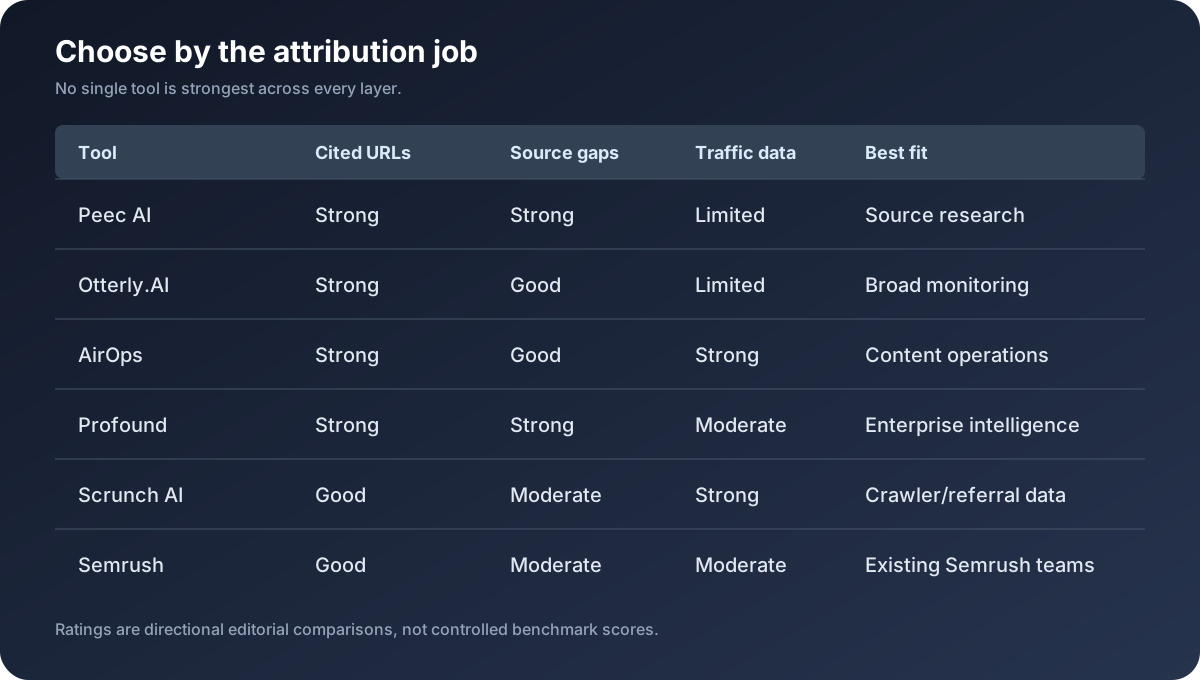
| Tool | Cited URLs | Source-gap analysis | Full answer context | GSC / GA4 connection | Best fit |
|---|---|---|---|---|---|
| Peec AI | Strong | Strong | Verify by plan | Limited | Source research and competitor gaps |
| Otterly.AI | Strong | Good | Strong | Limited | Broad recurring monitoring |
| AirOps | Strong | Good | Strong | Strong | Citation-to-content operations |
| Profound | Strong | Strong | Strong | Moderate | Enterprise intelligence |
| Scrunch AI | Good | Moderate | Verify by plan | Stronger on crawler/referral data | AI agent and referral analytics |
| Semrush | Good | Moderate | Verify by plan | Moderate through Semrush ecosystem | Existing Semrush teams |
This table is a practical editorial comparison. It is not a standardized benchmark: tools use different prompt samples, models, collection schedules, and definitions.
How to choose by team type
Small brand or consultant
Start with Peec AI or Otterly.AI.
Choose Peec if you need to discover source gaps and third-party opportunities. Choose Otterly if you need a simpler recurring monitoring workflow across multiple engines.
Do not start with enterprise tooling unless you already have:
- A stable Prompt Set;
- A clear reporting cadence;
- Someone responsible for acting on source findings;
- A plan for evaluating whether the work affected content or reputation.
Content and SEO team
AirOps is more compelling if citation findings need to become content refreshes, briefs, workflows, or CMS changes.
A lighter combination can also work:
Peec or Otterly for source monitoring
+ existing content workflow for implementation
The right choice depends on whether the team values integrated operations more than a specialized source-analysis interface.
Enterprise brand
Consider Profound or AirOps, then test a representative set of:
- Markets;
- Languages;
- Product lines;
- Customer prompts;
- Competitor prompts;
- Risk and accuracy prompts;
- High-value cited sources.
Enterprise procurement should compare the actual plan and data retention terms, not just the marketing feature list.
Ecommerce brand
Use a combination of citation and product-level visibility where needed. Scrunch may help with agent traffic and site access, while Profound, Peec, or AirOps may be better for source and answer analysis.
Do not treat AI-attributed revenue as proven causal revenue without a clearly documented attribution method.
Agency
Prioritize:
- Prompt and client separation;
- Exportable answer evidence;
- White-label reporting;
- API or workflow integrations;
- Source URL detail;
- Historical comparisons;
- Permission and billing controls.
Otterly, Profound, AirOps, and Peec can each fit an agency workflow, but the best choice depends on whether the agency sells monitoring, source strategy, content execution, or executive reporting.
A reliable citation measurement workflow
Step 1: Build a stable Prompt Set
Include:
- Category prompts;
- Problem prompts;
- Branded prompts;
- Competitor prompts;
- Comparison prompts;
- Alternative prompts;
- Pricing and evaluation prompts;
- Regional prompts;
- Risk and accuracy prompts.
Do not change the Prompt Set every week if you want a meaningful trend line.
Step 2: Capture the answer, not only the score
Store:
- Prompt;
- Engine;
- Date;
- Region;
- Language;
- Full answer;
- Mention status;
- Citation URLs;
- Competitor names;
- Sentiment;
- Position or prominence.
Step 3: Separate owned and third-party sources
Classify cited sources into:
- Owned content;
- Earned media;
- Review sites;
- Community / UGC;
- Directories;
- Partners;
- Government or institutional sources;
- Competitor or marketplace pages.
This helps identify whether the brand’s AI presence depends too heavily on its own marketing pages or on third-party descriptions it cannot control.
Step 4: Check source quality and accuracy
A cited page is not necessarily a good page. Review:
- Accuracy;
- Freshness;
- Brand description;
- Product details;
- Pricing;
- Availability;
- Competitor comparisons;
- Context and sentiment.
Step 5: Connect to traffic carefully
Use GSC and GA4 to observe:
- AI referral sessions;
- Landing pages;
- Engagement;
- Returning users;
- Assisted conversions;
- Branded query changes;
- Direct traffic anomalies.
Do not assign all downstream activity to a citation. AI journeys can include multiple sessions, devices, browsers, and unobservable interactions.
Step 6: Repeat the same test
After publishing or outreach, rerun the same Prompt Set with the same relevant settings. Record the test date and tool configuration.
A change in citation rate is more meaningful when the Prompt Set, engine, region, language, and measurement method remain comparable.
Common mistakes
Mistaking mention rate for citation rate
A brand can be named without its website being used as a source. Track both fields.
Treating cited domains as cited pages
A domain-level citation may hide whether the engine cited a useful product page, an outdated blog post, or an inaccurate profile.
Comparing tools with different Prompt Sets
A tool tracking branded prompts will usually produce different results from one tracking category and comparison prompts.
Treating crawler visits as citations
AI bots can crawl pages that never appear as cited sources. Crawler analytics and answer citations are complementary, not interchangeable.
Treating referral traffic as causal proof
A detected ChatGPT referral is useful evidence, but it may not explain earlier discovery, returning visits, dark social, or offline influence.
Assuming every engine behaves the same way
Perplexity, ChatGPT Search, Google AI Overviews, Gemini, Claude, and Google AI Mode expose sources differently. The same URL may be cited on one surface and ignored on another.
Using overall product reviews as GEO evidence
A high rating for a mature SEO or content platform does not independently prove that its new AI citation module works better than competitors.
FAQ
Which GEO tool is best for tracking brand citations?
For broad recurring monitoring, Otterly.AI is a strong choice. For source and URL gap analysis, Peec AI is the better starting point. For Enterprise intelligence, consider Profound.
Which tool is best for source attribution?
Peec AI is the strongest fit when source attribution means finding the domains and URLs cited by AI answers and identifying competitor source gaps. AirOps is stronger when attribution must connect to content operations and GSC/GA4 context.
Can GEO tools show the exact cited URL?
Several tools advertise URL-level citation tracking, including Peec AI, Otterly.AI, AirOps, and Profound. Verify the exact URL detail, engine coverage, plan, and export behavior before purchase.
Is a brand mention the same as a citation?
No. A brand mention means the answer names the brand. A citation means the answer references a source URL or domain. The source may be owned by the brand, a third party, a partner, or a competitor.
Can these tools prove AI-generated revenue?
No tool should be treated as automatic proof of causal revenue. Some platforms connect AI visibility to referral, analytics, or conversion signals, but the resulting number depends on the attribution method and observable data.
Is Scrunch AI better than Peec for citations?
Not generally. Peec is stronger for source-gap analysis. Scrunch is more differentiated for AI crawler, agent, and referral traffic analysis. They measure different layers.
Is AirOps a citation tracker or a content platform?
Both, but its main differentiation is connecting citation intelligence to Page360, content refresh, workflow automation, Knowledge Bases, Brand Kits, and publishing operations.
Is Semrush the best option if I already use Semrush?
It may be the most convenient option because it fits your existing SEO ecosystem. But compare prompt limits, engine coverage, cited-source detail, extra domain costs, and whether you need deeper source-gap analysis.
How often should I review cited sources?
Run a stable daily or weekly monitoring process for high-value prompts, then conduct a deeper source-quality and accuracy review monthly or after a major content, product, PR, or competitor change.
Final recommendation
If the query is specifically about tracking brand citations and source attribution, I would choose as follows:
Best overall for source attribution
Peec AI
Best when the main job is to identify cited URLs, domains, competitor source gaps, and partnership or content opportunities.
Best for broad monitoring
Otterly.AI
Best when you need recurring, multi-engine monitoring with stored answers, citations, mentions, competitors, and trends.
Best for citation-to-content operations
AirOps
Best when the team wants to connect citations to GSC, GA4, page freshness, content refresh, and publishing workflows.
Best for enterprise intelligence
Profound
Best when source authority, competitor benchmarking, and large-scale reporting matter more than simple self-serve access.
Best for crawler and referral attribution
Scrunch AI
Best when you need to understand how AI agents access your site and whether AI referral traffic is observable.
Best for existing Semrush customers
Semrush AI Visibility Toolkit
Best when convenience, existing Semrush reporting, and ecosystem integration matter more than the deepest source-gap analysis.
The most defensible measurement stack is often not one tool but two layers:
Citation/source tool
+ analytics and referral data
Then report the evidence in separate columns:
Mentioned
Cited
Cited URL
Source type
AI referral
Conversion signal
Confidence
That keeps the analysis useful without claiming more than the data can prove.
Sources
- Peec AI — brand mention, source citation, visibility, position, and sentiment positioning.
- Peec AI documentation — source discovery and citation opportunities.
- Peec AI source analysis — domain, URL, and source-gap workflows.
- OtterlyAI features — prompt research, analytics, citation and competitive monitoring.
- OtterlyAI citation tracking guide — mention/citation distinction and cited URL analysis.
- AirOps Citations documentation — cited URLs, domain/page types, competitors, and source opportunities.
- AirOps Page360 — AI Search, GSC, GA4, freshness, and content-operation signals.
- Profound citation analysis — citations, sources, answer engines, prompts, and authority positioning.
- Profound citation categories — source category and citation analysis context.
- Scrunch pricing — monitoring, citations, agent traffic, and AI analytics positioning.
- Scrunch crawler analytics review — independent discussion of crawler and referral analytics.
- Semrush AI Visibility Toolkit — AICiteKit’s reviewed profile and source notes.
Research checked: August 18, 2026.