Field notes / ai-search
AI Search Answer Freshness SLA: How to Set a Review Cadence for Time-Sensitive Facts
A practical AI Search freshness SLA for pricing, product facts, availability, and other claims that can become stale in AI answers.
The short answer
An AI Search answer freshness SLA is a written rule for how often a team reviews time-sensitive claims, what triggers an earlier check, which first-party source is authoritative, and what evidence must be retained. It is not a promise that every AI answer will update on schedule.
Use this sequence:
inventory claims → score volatility and harm → set review interval → verify source and answer → record the resultA useful policy can say: “Check public pricing weekly and after every plan change; check stable definition pages quarterly; re-run the defined prompt panel after material source edits.” It should not say: “AI Search will reflect our change within seven days.”
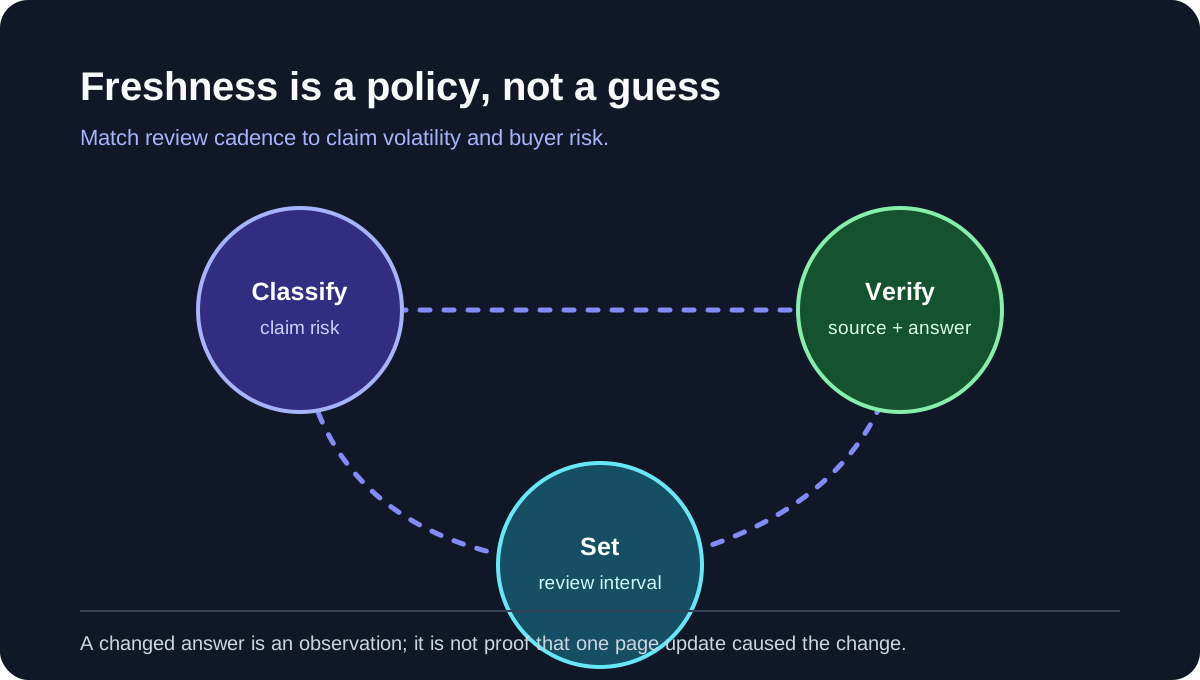
This guide addresses searches such as “how often should I update content for AI Search?”, “how do I stop AI answers from showing old pricing?”, and “what is an AI Search content freshness policy?” It is an operational QA framework, not a guarantee of citations, rankings, traffic, or revenue.
Why “fresh content” is too vague
Freshness can refer to at least four different things:
- Source freshness: when the organization last reviewed or changed the page.
- Crawl freshness: when a search system or intermediary may have fetched it.
- Answer freshness: when an observed answer last reflected the source or its current facts.
- Business freshness: when the fact remains safe for a buyer, user, or operator to rely on.
These clocks are related but not interchangeable. A page can be updated without being retrieved in a later answer. An answer can change without a page edit. A source can be current while a generated statement is still incomplete or wrong.
Google’s documentation for AI features and your website, checked November 3, 2026, describes AI features that may show links to supporting web resources and points site owners to foundational Search practices. It does not define a universal refresh interval or promise that an update will appear in an AI answer.
OpenAI’s web search documentation, checked November 3, 2026, documents web search and citation fields for a particular API tool. That supports recording the evidence exposed by that call; it does not establish that every ChatGPT surface or other answer engine uses the same retrieval schedule.
The HTTP caching standard, RFC 9111, checked November 3, 2026, explains cache freshness and revalidation concepts for HTTP caches. It is useful technical context, but an answer engine’s retrieval, indexing, and presentation process is not reducible to one HTTP cache header.
The independent paper GEO: Generative Engine Optimization, checked November 3, 2026, studies visibility in a defined experimental setting. It is research context, not evidence for a commercial freshness score or a current platform-wide refresh guarantee.
The evidence boundary is simple: a source review proves what your team checked; an answer capture proves what was visible under recorded conditions. Neither alone proves how an answer engine selected, cached, or will later reuse a source.
What belongs in a freshness inventory
Start with claims, not URLs. One page may contain a stable explanation, a volatile price, and a regional availability statement. Give each material claim its own record.
| Claim field | Example | Why it matters |
|---|---|---|
| Claim ID | pricing-pro-01 | Lets reviewers discuss one statement |
| Exact claim | “Pro includes five seats” | Prevents broad page-level assumptions |
| Canonical source | Direct documentation or pricing URL | Names the authority to check |
| Claim class | Price, limit, feature, availability, definition | Supports different risk rules |
| Audience impact | Buyer, user, analyst, low-impact | Makes harm explicit |
| Volatility signal | Launch, contract, policy, seasonal, stable | Explains the proposed cadence |
| Last checked | ISO date and time zone | Makes the record auditable |
| Answer observation | Prompt, surface, model label, result | Separates source review from answer review |
| Owner and escalation | Team or role | Prevents unowned stale facts |
Do not use the page’s publication date as a substitute for the date each claim was verified. Do not infer that a “last updated” label means every sentence was reviewed.
1. Classify claims by volatility and consequence
A practical matrix combines how often a claim can change with what happens if a reader relies on an outdated answer.
| Class | Typical claims | Suggested starting policy | Why it needs judgment |
|---|---|---|---|
| Critical and volatile | Price, eligibility, legal terms, safety, live availability | Check before every material release and on a short recurring interval | A stale answer can mislead a purchase or access decision |
| Important and changing | Limits, integrations, supported models, shipping, service areas | Check on a regular interval plus event-triggered review | Product changes may not be announced in one place |
| Useful and moderate | Workflows, comparisons, implementation guidance | Review on a planned editorial cycle | Facts can remain valid while recommendations age |
| Stable context | Definitions, historical background, methodology | Review periodically and when sources change | Lower volatility does not mean permanent correctness |
These are starting categories, not universal frequencies. A regulated workflow, high-cost purchase, or rapidly changing product may require a stricter rule. Record why the cadence was chosen instead of presenting it as an industry standard.
2. Separate event triggers from calendar checks
A calendar review catches drift that nobody noticed. An event trigger catches known change sooner. Use both.
Useful triggers include:
- A pricing, packaging, or billing change
- A product release that changes limits or integrations
- A documentation migration or redirect
- A regional launch, shutdown, or availability change
- A legal, policy, or security update
- A customer-support escalation about an answer
- A material correction to a source page
- A monitoring observation that repeats a stale claim
A trigger should create a review task, not an automatic conclusion that AI visibility changed. Preserve the old source state, the new source state, and any answer observations separately.
3. Write the SLA as a verifiable contract
A useful SLA has five parts:
scope: public pricing and plan-limit claims
owner: product marketing + documentation reviewer
calendar check: every 7 days
triggers: release, price change, support correction, repeated stale answer
exit evidence: source diff, reviewer, timestamp, prompt result, unresolved risks
Add an explicit exception path. If a page is inaccessible, a pricing table is ambiguous, or an answer surface is unavailable, record blocked or not exposed; do not mark the claim fresh because no contradiction was found.
Also define what “resolved” means. For a source review, it may mean that the first-party page is current and approved. For an answer review, it may mean that a fixed prompt was rerun and the old claim was not observed under the declared conditions. That is evidence of the observation, not proof of universal correction.
4. Test source freshness and answer freshness separately
Use two linked records rather than one blended status.
| Review | Question | Safe conclusion |
|---|---|---|
| Source review | Does the authoritative page currently support the claim? | The source supports, contradicts, or does not expose the claim |
| Retrieval observation | What did the selected surface return for the fixed prompt? | The answer showed or did not show the claim under recorded conditions |
| Citation review | Was a visible source linked to the claim? | The answer exposed a source relationship, if any |
| Change review | Did the observation differ from a prior run? | The recorded outputs differ; cause requires more evidence |
For each answer observation, preserve the exact prompt, surface and mode, displayed model label if available, market and language, timestamp, complete answer where permitted, visible source URLs, and status. Include no-answer, no-source, gated, and failed states in the log.
A source can be current while the answer is stale. An answer can be current-looking while its visible source does not support the exact claim. A citation can be present without proving that a user clicked it or that the cited page caused the answer.
5. Choose a review cadence without fake precision
Start with risk bands, then tune them using your actual change history.
| Risk band | Initial review rule | Event-trigger rule | Evidence to retain |
|---|---|---|---|
| High | Weekly or before a campaign | Immediate task | Source snapshot, reviewer, answer capture |
| Medium | Monthly | Next business-day task | Source check and sampled answer record |
| Low | Quarterly | Next planned editorial review | Claim inventory and reviewer timestamp |
“Weekly” is a policy choice, not a prediction about an answer engine. If a team has no change history, use a conservative interval and revisit it after several review cycles. If changes cluster around launches, add launch-specific checks rather than pretending a monthly average represents the risk.
Do not inflate confidence because a prompt repeated the same answer. Repetition under one surface and date shows repetition under those conditions. It does not establish a permanent index state or a causal effect from a page edit.
6. Build a stale-answer escalation path
A stale-answer report should contain enough information for someone else to inspect it:
- The exact claim and the current first-party source.
- The old answer text or approved transcription.
- The exact prompt and answer surface.
- Timestamp, market, language, model label, and account state when exposed.
- Visible citations and direct URLs.
- Whether the source was changed before the answer was observed.
- Whether the observation was repeated, failed, gated, or unavailable.
- The requested action and its owner.
Possible actions are different: correct the source, add a clearer qualification, publish a dedicated fact page, request a re-crawl where an official channel exists, or continue monitoring. Do not promise that adding text, schema, or a feed will force a particular answer.
Tool-assisted monitoring: what to verify
Tools such as AI Search Console, Otterly.AI, Peec AI, Profound, PromptWatch, and Rankscale may expose different combinations of prompt monitoring, answer history, source URLs, alerts, exports, or derived metrics. Their records are not automatically interchangeable.
During a trial or implementation review, verify:
- Whether an alert points to the exact changed claim or only a score change
- Whether old answer text and direct source URLs remain available
- Whether model, surface, market, language, and timestamp are exposed
- How failed, empty, gated, and no-source runs are represented
- Whether a prompt edit creates a new version or overwrites history
- What refresh interval, prompt, project, credit, and retention limits apply
- Whether exports preserve raw observations or only a freshness metric
- Whether first-party and third-party sources can be separated
A monitoring dashboard can reduce manual work without revealing the complete retrieval process. Inspect a real export and test one deliberately changed source before treating an alert as an auditable freshness result.
A practical 30-day implementation
Days 1–5: inventory
List the claims that matter to buyers and users. Link each claim to its authoritative source, owner, risk band, and last verified date. Start with pricing, plan limits, integrations, availability, and frequently corrected product facts.
Days 6–10: define evidence
Freeze a small prompt panel for the important claims. Write the observation schema before collecting results. Decide how the team records source URLs, answer status, unavailable fields, and permitted retention.
Days 11–20: run the baseline
Review the sources, capture the answers, and record mismatches without guessing at cause. Separate source errors, answer errors, missing citations, and collection failures.
Days 21–30: tune and assign
Compare the inventory with actual changes and escalations. Shorten intervals for claims that changed or caused material confusion. Lengthen them only when the evidence supports doing so. Assign an owner and publish the exception path.
Common mistakes
- Using one site-wide freshness date. A definition and a price do not have the same volatility.
- Treating a page edit as an answer update. The two events require separate observations.
- Calling a repeated answer “stable.” The sample may be narrow or the answer may be cached.
- Counting a citation as claim validation. Check whether the visible source supports the exact sentence.
- Ignoring failed runs. A missing observation is not evidence that no stale answer exists.
- Promising a refresh window. Public documentation rarely supports a universal SLA for generated answers.
- Making the dashboard the source of truth. Keep the first-party claim record and the observation evidence inspectable.
FAQ
How often should I update content for AI Search?
Update a claim when it changes, then review it on a cadence based on volatility and consequence. A weekly check may be reasonable for public pricing in a fast-moving product, while a stable definition may need a less frequent review. There is no evidence here for one universal interval that makes every AI answer current.
Does updating a page make ChatGPT or Google AI update immediately?
No universal immediate-update guarantee should be assumed. A page update, crawl or retrieval event, and generated answer are different stages. Record the update and then test the declared surface under a fixed observation method.
Should I add a “last updated” date to every page?
A visible date can help readers when it accurately describes the page or claim review. It is not proof that an answer engine will prefer the page or that every statement is current. Use it alongside claim-level ownership and verification records.
Can a GEO monitoring tool prove that an answer is fresh?
It can provide observations or alerts under its method. Verify what it captured, how it defines freshness, which surfaces it samples, how it handles failures, and whether raw answers and source URLs are exportable. A derived freshness score is not automatically a universal state of the web.
What should I do when the source is current but an answer is stale?
Preserve both records, confirm the prompt and surface, repeat the observation under the same declared conditions, and escalate the risk according to your policy. Correct or clarify the authoritative source if needed, but do not claim that one edit caused or guarantees an answer change.
Sources and verification
- Google Search Central: AI features and your website — checked November 3, 2026; official boundary for AI-feature links and foundational Search practices.
- OpenAI API: Web search tool — checked November 3, 2026; official documentation for citations and source fields in a particular API tool.
- RFC 9111: HTTP Caching — checked November 3, 2026; independent standards context for freshness and revalidation terminology.
- Aggarwal et al., GEO: Generative Engine Optimization — checked November 3, 2026; independent academic context, not validation of a commercial freshness metric.
Verification note: This article distinguishes first-party source review from observed answer freshness. It does not claim that a page update guarantees a citation, ranking, traffic result, or revenue outcome.