Field notes / ai-search
AI Search Answer Claim Audit: How to Check What a Citation Actually Supports
A practical AI Search answer claim audit for mapping claims to sources, separating mentions from recommendations, and reporting citations without overclaiming rankings, traffic, or revenue.
The short answer
An AI Search answer claim audit checks which claims an answer makes, which source URLs are visibly attached to those claims, whether the sources support the wording and scope, and what remains unverified.
Use this evidence chain:
exact question → answer claims → visible source URLs → source passages → bounded findingA citation is not automatically an endorsement, a ranking, a click, or a business outcome. A page can be cited for one narrow fact while the same answer contains an unsupported comparison, an outdated price, or a recommendation that the cited page does not justify.
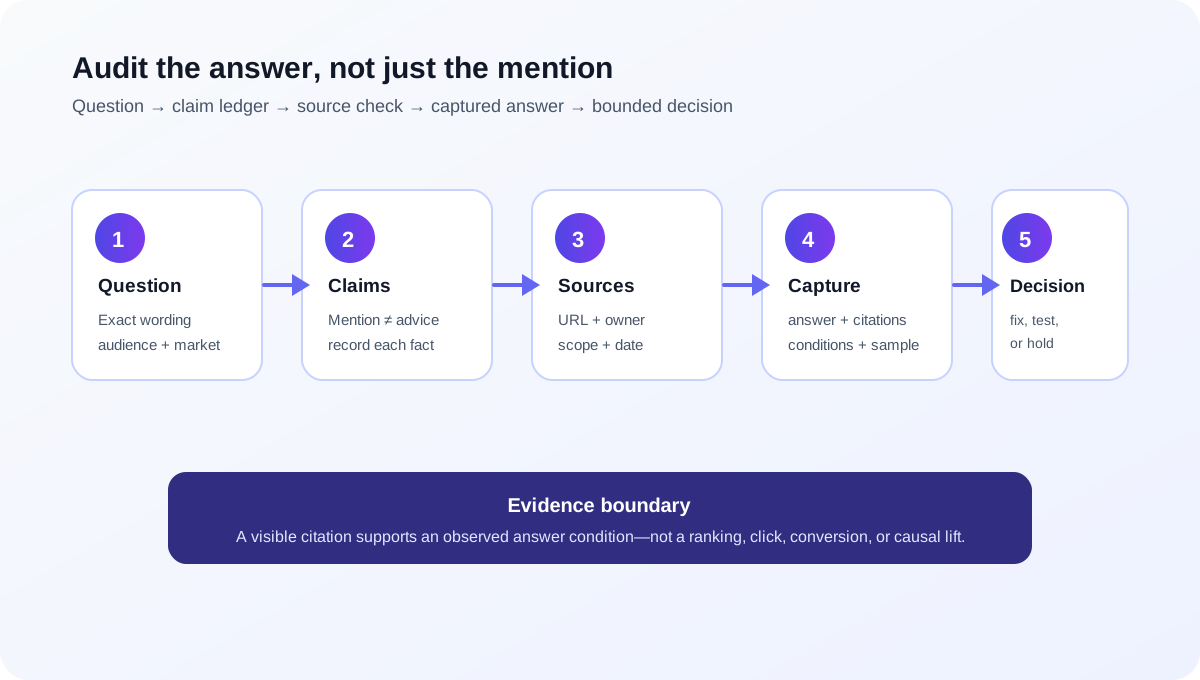
This guide targets searches such as “how do I audit AI Search citations?”, “how can I tell whether a citation supports an AI answer?”, and “what is the difference between a brand mention and a cited source?” The practical answer is a claim-to-source ledger with preserved collection conditions—not a blended visibility score.
Why citation presence is not enough
Google says its AI features may show links to supporting web resources and recommends foundational Search practices (AI features and your website, checked September 30, 2026). OpenAI’s web-search documentation describes a tool that can return citations and source information (Web search, checked September 30, 2026). These are useful product-level descriptions, but neither source publishes a universal rule that a cited page is authoritative for every sentence around the link.
The independent paper GEO: Generative Engine Optimization studies generative-engine visibility in a defined research setting (Aggarwal et al., arXiv, checked September 30, 2026). It is research context, not validation of a commercial dashboard, current platform behavior, traffic attribution, or revenue impact.
Keep these observations separate:
| Observation | What it can support | What it cannot prove |
|---|---|---|
| Brand name appears in an answer | The brand was mentioned under the recorded conditions | That it was recommended or preferred |
| Owned URL is displayed | The URL was visible as a source in that capture | That the source caused the answer or a click |
| A source supports one sentence | That a cited passage is relevant to that claim | That it supports every claim in the paragraph |
| Brand is listed first | The answer used that order in one capture | A stable rank or market preference |
| Citation is followed by a referral | A separately recorded referral occurred | That the citation caused the conversion |
| Answer changes after an edit | Two captures differ after a change | That the edit caused the difference |
The audit goal is not to make an answer look worse or better. It is to identify what can be defended, what needs correction, and what the sample still cannot tell you.
1. Define the question and collection conditions
Start with the exact question a buyer, customer, or researcher would ask. Do not paraphrase it after the answer arrives. Record qualifiers that can change the evidence:
- Market, language, and location
- Audience, company size, or use case
- Budget, plan, platform, or integration requirement
- Surface and mode
- Model or product configuration when disclosed
- Collection date, time zone, and repeat number
A useful capture record is:
Question ID: COMP-012-v1
Exact question: Which AI Search monitoring tools preserve visible source URLs?
Audience: small in-house marketing team
Market/language: United States / English
Surface and mode: recorded at collection time
Collected: 2026-09-30 UTC
Output fields: mention, recommendation, source URL, claim support, unavailable state
A result without its conditions is difficult to compare. A result for a consumer search surface should not silently be presented as a result for an API workflow, and a US-English answer should not be generalized to every market.
For prompt-panel design, see How Many AI Search Prompts Should You Track?. A fixed panel can improve repeatability, but it does not make a biased panel representative of every buyer question.
2. Split the answer into atomic claims
Read the answer sentence by sentence and extract claims that could be checked independently. Do not treat a paragraph as one claim merely because it has one citation marker.
Useful claim families include:
| Claim family | Example audit question | Preferred evidence |
|---|---|---|
| Identity | Is this the correct organization, product, or parent company? | First-party about or documentation page |
| Capability | Does the product support the stated workflow? | Current product documentation and observed behavior |
| Commercial | Is the price, plan, limit, or billing basis correct? | Current official pricing or help center |
| Comparison | Is the stated advantage supported against the named alternative? | Matched product evidence plus independent context |
| Recommendation | Why is this option suitable for this buyer? | Explicit criteria and evidence for the fit |
| Outcome | Does the source actually establish traffic, revenue, or performance? | Controlled or independently documented evidence |
A compact claim ledger might look like this:
Claim C-01: Product A monitors prompts across the named surfaces
Claim C-02: Product A is suitable for a five-person agency
Claim C-03: Product A costs the stated amount each month
Claim C-04: Product A is more accurate than Product B
Claim C-05: Product A increases qualified traffic
These are not equivalent. C-01 may be checked against product documentation. C-02 requires a fit judgment with declared criteria. C-03 is time-sensitive commercial information. C-04 needs a fair comparison method. C-05 requires outcome evidence that a citation alone cannot provide.
3. Map each claim to the actual source
For every claim, record the source URL, source type, relevant passage, scope, and check date. A source list at the bottom of an article is not enough if the reader cannot tell which link supports which statement.
| Claim ID | Visible source | Passage or evidence | Scope | Status |
|---|---|---|---|---|
| C-01 | Exact URL from capture | Feature or workflow description | Product version and date | Supported / partial / unclear |
| C-02 | Exact URL from capture | Audience or use-case language | Buyer and market | Interpretation |
| C-03 | Pricing or billing URL | Amount, currency, interval, limits | Plan and date | Current / stale / conflict |
| C-04 | Multiple sources | Comparable criteria and observations | Same conditions | Unproven unless method is clear |
| C-05 | Outcome study or analytics record | Defined outcome and attribution method | Time window and cohort | Do not infer from citation |
“Cited” and “supported” are different fields. The URL may be displayed but fail to support the claim because it is about a different plan, market, product edition, or date. Conversely, a source may support a claim even when the answer does not visibly cite it; that is a content review finding, not a citation observation.
Source quality is part of the finding
Label source provenance before using it:
- First-party documentation: useful for the product’s stated features, plans, and policies.
- Independent research: useful for methods and broader context, within the study’s scope.
- Review or comparison source: useful for reported workflow observations, with possible commercial or selection bias.
- Editorial interpretation: useful for a conditional recommendation, not proof of product performance.
A vendor-selected customer story can document what the vendor chose to publish. It is not independent proof of the stated outcome. A competitor-authored comparison can identify tradeoffs, but readers should know the commercial relationship before treating it as neutral evidence.
4. Separate mention, recommendation, citation, and referral
These outcomes are often collapsed into one “visibility” metric even though they answer different questions.
| Field | Definition for the audit | Evidence required |
|---|---|---|
| Mention | The brand or product name appears | Exact answer text and matching rule |
| Recommendation | The answer advises a defined audience to choose or consider it | Recommendation wording, criteria, and context |
| Citation | A source URL is visibly attached or displayed | Captured answer and exact URL |
| Source support | The source passage supports the linked claim | Source review and scoped interpretation |
| Referral | A separately observed visit or referral occurred | Analytics or server evidence with attribution limits |
| Conversion | A business event was recorded | Conversion system and attribution method |
A brand can be mentioned negatively. A product can be recommended without its owned URL being cited. A third-party review can be the visible source for a product recommendation. A citation can be visible without a recorded click. Do not use one field as a proxy for the others.
For more on the distinction between presence and selection, see AI Search Mentions vs Recommendations. For source relationships, see AI Search Answer Provenance.
5. Check the claim’s scope and freshness
Many apparent answer errors are scope mismatches. Before calling a statement false, check whether it refers to:
- A different plan, edition, or billing interval
- Another country, language, or service area
- A product version that has changed
- A former company or product name
- A feature in a limited rollout
- A source that was current when published but is now stale
For high-risk facts, maintain a small fact inventory with an owner and a canonical source:
Fact: public team-plan allowance
Source: current first-party pricing or help-center URL
Scope: plan name, currency, market, billing interval
Checked: 2026-09-30
Status: current / conflict / unavailable
Next review: packaging or policy change
The AI Search Answer Freshness Audit covers this workflow in depth. A page’s 200 OK response or a visible citation does not prove that every fact on the page is current.
6. Record unavailable and ambiguous evidence
A rigorous audit preserves uncertainty instead of forcing every answer into pass or fail. Use explicit states such as:
- Supported: source and scope directly support the claim.
- Partially supported: source supports only part of the wording.
- Conflicting: sources disagree or the answer differs from the current canonical fact.
- Unclear: source is missing, inaccessible, or too vague to assess.
- Not observed: the field did not appear in the captured answer.
- Unavailable: the answer or source could not be collected under the declared conditions.
Do not treat “not observed” as “absent everywhere.” A single answer capture is an observation, not a census of all future answers. Keep failed runs in the denominator when reporting a panel, and explain whether an unavailable state reflects the surface, a network problem, a tool limit, or a product behavior.
7. Report findings with denominators and boundaries
A useful report states the sample before the conclusion:
The owned documentation URL appeared as a visible source in 7 of 24 captured US-English answers across the fixed panel collected on September 30, 2026. Four of those citations supported a current product-fact claim after source review; three were relevant but did not establish the broader recommendation. This describes the sample and does not estimate universal AI Search visibility, clicks, or revenue.
Also include:
- Number of unique questions and repeated runs
- Intent cohorts and inclusion rules
- Surface, mode, market, language, and date
- Exact citation and recommendation definitions
- Source URLs and claim relationships
- Failed, unavailable, or ambiguous captures
- Any tool-specific credit or refresh limits
- Changes made before a retest
Avoid a percentage without its count. “7 of 24” communicates more than “29.2%,” and the wording makes clear that the result belongs to a defined sample.
A practical claim-audit workflow
- Freeze the question. Save exact wording, qualifiers, surface, market, and collection date.
- Capture the full answer. Preserve visible citations, source titles, URLs, and unavailable states.
- Extract atomic claims. Split identity, capability, commercial, comparison, recommendation, and outcome statements.
- Match claims to sources. Link each claim to the exact URL and relevant passage.
- Check scope and freshness. Verify plan, market, version, date, and product identity.
- Classify the evidence. Use supported, partial, conflicting, unclear, not observed, or unavailable.
- Separate outcomes. Report mentions, recommendations, citations, source support, referrals, and conversions independently.
- Choose one bounded action. Correct a fact, improve a source page, refine the prompt panel, or hold the conclusion.
- Retest with matched conditions. Preserve the panel and document any change before comparing captures.
Tools such as AI Search Console, Peec AI, Otterly.AI, PromptWatch, Profound, and Rankscale may expose different combinations of answer capture, prompt monitoring, source analysis, or derived metrics. During a trial, verify whether the workflow preserves the raw answer, exact source URLs, claim context, collection conditions, failed runs, and credit definitions. Do not assume that similarly named metrics are interchangeable.
What a claim audit can and cannot prove
| Audit result | Reasonable conclusion | Boundary |
|---|---|---|
| Source passage matches one answer claim | That claim is supported under the recorded scope | Not every nearby statement is supported |
| Product is recommended for a defined audience | The answer made that recommendation | Not universal market preference |
| Owned URL is cited repeatedly | Repeated citation in the defined panel | Not guaranteed future citation or ranking |
| Current page conflicts with answer wording | A factual mismatch was observed | Not proof of why the answer was generated |
| Citation is followed by a visit | A visit occurred after the captured answer | Not proof of causal conversion without attribution evidence |
| Answer changes after a page update | The captured outputs differ | Not proof the edit caused the change |
The evidence boundary is the point of the audit. A narrower, traceable finding is more useful than a large score that hides the question, source, and denominator.
Trial and implementation checklist
Before buying a monitoring or GEO workflow, verify:
- Can it export the exact prompt and complete answer?
- Are visible source URLs retained, not only source domains or counts?
- Can a reviewer attach a claim to a specific source passage?
- Are mention, recommendation, citation, and referral separate fields?
- Are surface, mode, market, language, model label, and collection date recorded?
- Are failed, unavailable, and ambiguous runs retained?
- Can the workflow distinguish first-party, independent, vendor-selected, and competitor-authored evidence?
- Are pricing, credits, refreshes, prompt limits, and plan scopes documented?
- Can a fixed panel be rerun after one bounded change?
- Does the report preserve counts and denominators before blended scores?
FAQ
Does a citation mean the AI answer is correct?
No. It means a source was displayed or attached under the recorded conditions. Review the source passage, scope, date, and exact claim before calling the claim supported.
Is a brand mention the same as a recommendation?
No. A mention can be neutral, negative, or incidental. A recommendation requires language that advises or favors an option for a defined audience or need.
Can I call the first product in an AI answer the top-ranked result?
Not without a defined and reproducible ranking construct exposed by the surface. Synthesis order can reflect answer composition, retrieval, or other conditions rather than a stable rank.
What if the answer cites a third-party review instead of the official site?
Record that source and evaluate its relevance, date, methodology, and commercial relationship. It may be useful independent context, but it can also have selection or affiliate bias. Do not silently convert it into first-party proof.
How many answers do I need before reporting citation coverage?
There is no universal threshold. Define the decision, intent cohorts, surfaces, and repeat rule first. Report the numerator, denominator, panel composition, and conditions; do not present a small convenience sample as market-wide visibility.
Does updating a cited page guarantee more AI Search visibility?
No. Updating a page may correct a factual conflict or improve usefulness, but a later answer change does not by itself establish causation, a ranking improvement, traffic growth, or revenue impact.
Should a tool’s visibility score replace a claim ledger?
No. A score may be useful as a monitoring summary, but buyers should verify the underlying prompt, answer, source, denominator, refresh method, and evidence boundaries. A claim ledger is the review layer that explains what the score can and cannot support.
Sources and verification
- Google Search Central: AI features and your website — checked September 30, 2026; used for the boundary around AI-feature links and foundational Search practices.
- OpenAI Developer Docs: Web search — checked September 30, 2026; used for the distinction between a documented web-search tool, citations, and source information.
- IETF RFC 9309: Robots Exclusion Protocol — checked September 30, 2026; used as standards context for treating technical access signals as scoped observations rather than answer evidence.
- Aggarwal et al.: GEO: Generative Engine Optimization — checked September 30, 2026; independent academic context for generative-engine visibility research, not proof of current commercial outcomes.
Editorial evidence boundary
This article provides a measurement framework and does not claim that any named tool guarantees citations, rankings, traffic, conversions, or revenue. Official documentation supports the behavior and terminology it explicitly describes. Independent research supports only its own study scope. Product-specific limits, pricing, coverage, and export behavior should be rechecked on the relevant tool page and official source before purchase.
Last reviewed: September 30, 2026
Evidence confidence: High for the cited documentation and methodological distinctions; medium for cross-platform generalization because AI Search surfaces expose different answer and source data.