AI Crawler Analytics: What Server Logs Can—and Cannot—Tell You
A practical guide to analyzing AI crawler access, separating retrieval from citation and traffic, and designing a defensible GEO measurement workflow.
The short answer
AI crawler analytics can show that a named automated client requested a URL under a particular logging setup. It cannot, by itself, prove that an AI answer cited the page, that a user saw the answer, or that a conversion was caused by the crawl.
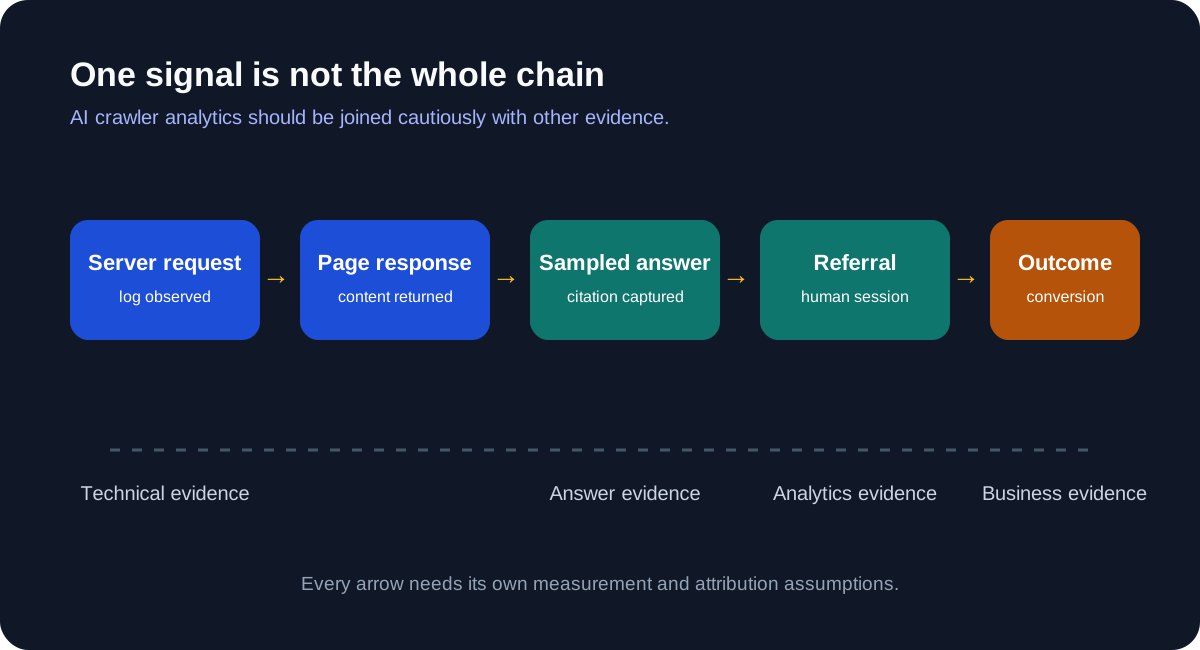
Use this chain instead:
server request → page response → possible retrieval → sampled answer → detectable referral → conversionEach arrow needs separate evidence. PromptWatch is one example of a product that combines crawler and prompt-oriented signals, but the methodology applies whether the data comes from a tool, CDN, or raw logs.
What is an AI crawler?
An AI crawler is an automated client that requests web resources for discovery, retrieval, indexing, training, or other product functions. The useful observation in a server log is a request record: timestamp, URL, status, user agent, IP or provider signal, response size, and sometimes referrer or edge metadata.
Do not treat every user-agent string as verified identity. Names can be spoofed, proxies can obscure origin, and a crawler may access a page without the page later appearing in an answer.
Google’s documentation on Google-Extended and OpenAI’s GPTBot documentation illustrate why crawler identity and access controls should be checked against the relevant vendor documentation rather than guessed from a log line.
The four questions a crawler report should answer
1. Was a request observed?
Report the URL, time window, response status, user agent, and collection source. A request is an observed technical event.
2. Was useful content returned?
A 200 response does not guarantee that the intended content was available. Check redirects, bot challenges, empty shells, robots behavior, cache responses, content type, and rendered versus server-delivered content.
3. Was the page cited or mentioned?
Only an answer capture or citation dataset can answer this. A crawl chart cannot substitute for prompt sampling. AI Search Console and Peec AI represent adjacent answer-monitoring workflows, but their coverage and sampling should be verified separately.
4. Did a person visit or convert?
Use web analytics and CRM or ecommerce records. A crawler request is not a human session, and a citation is not proof of a click.
A defensible collection workflow
Step 1: Define the decision
Decide whether the report is meant to diagnose blocked access, identify important pages being requested, compare crawler activity by section, or connect technical observations with an answer-monitoring experiment. One chart should not answer all four questions.
Step 2: Preserve raw fields
Keep raw logs or an export with:
- Timestamp and timezone
- Requested URL and query string policy
- Status, response bytes, latency, and cache result
- User agent and source metadata
- Hostname, edge location, and request method
- Robots or firewall decision where available
Hash or redact personal data before sharing logs. Retain enough detail to reproduce an aggregate number.
Step 3: Classify cautiously
Use a controlled classification such as verified vendor crawler, likely automated, unknown, or human. Link each verified crawler label to current vendor documentation. Do not silently convert an unverified user agent into a platform name.
Step 4: Join with page and answer data
Map requested URLs to page type, canonical URL, topic, language, and business role. Separately store prompt, model, country, run date, complete answer or capture, cited URL, and mention status.
A useful join asks:
Did pages that were requested more often also appear more often in a defined answer sample?
That is an investigation, not proof of causality. Sampling, retrieval, freshness, and page quality may all confound the comparison.
Step 5: Retest after a bounded change
Choose a small set of pages, document the change, freeze the prompt panel, and compare defined windows. Record whether crawler activity, answer citations, referral sessions, and conversions changed independently.
Security and privacy controls before forwarding server logs
Forwarding access logs to an AI crawler analytics platform creates a new data-processing path. The fact that a field came from a server log does not make it harmless: IP addresses, query strings, cookies, authorization values, referrers, and identifiers can expose personal or confidential information.
Before sending any log data outside your controlled environment, use this checklist.
1. Minimize the dataset
Send only the fields required for the decision you are trying to make. A crawler report usually needs less data than a full observability export.
For example, a technical crawler-access report may need:
- Timestamp rounded to an appropriate precision;
- Hostname or path group rather than the full private URL;
- Request method;
- Response status;
- Response bytes and latency bucket;
- User-agent string;
- Verified crawler classification;
- Cache, robots, firewall, or edge decision;
- Coarse region where it is genuinely needed.
It may not need:
- Full client IP address;
- Session ID;
- Cookie header;
- Authorization header;
- Request body;
- Personal query parameters;
- Email address or customer ID;
- Internal hostnames or infrastructure details.
The GDPR is a legal framework rather than an implementation checklist, but its purpose limitation, data minimization, storage limitation, and security principles are directly relevant when logs contain information relating to identifiable people.
2. Redact before the data leaves your environment
Do not rely on a vendor’s dashboard to remove sensitive fields after upload. Apply a deterministic redaction or pseudonymization step in your CDN, log pipeline, object-storage export, or staging database first.
At minimum, inspect and remove or transform:
Authorization:        remove completely
Cookie:               remove unless specifically required and approved
Set-Cookie:           remove completely
email=...             remove or replace with a non-reversible token
user_id=...           replace or aggregate
session_id=...        remove or rotate into a short-lived internal key
token=...             remove completely
password=...          remove completely
For IP addresses, choose the least precise representation that still answers the business question. Full masking may be appropriate for a crawler-volume report; a coarse country or region may be enough for a regional access comparison. Hashing is not automatically anonymization if the original value can be guessed or the hash is reused as a stable identifier.
3. Treat URLs and referrers as potential sensitive data
A URL can contain search terms, account names, order numbers, invite codes, email addresses, or internal workflow identifiers. Referrers can reveal the page a person came from, including private paths or query parameters.
Before export:
- Parse query strings separately from paths.
- Maintain an allowlist of parameters needed for the report.
- Drop unknown parameters by default.
- Remove fragments, tokens, signed URLs, and invite links.
- Replace customer-specific paths with route templates where possible.
- Keep the original mapping only inside a restricted internal system, if it is needed at all.
4. Confirm the vendor’s processing terms
Ask the platform for current documentation covering:
- Data Processing Addendum (DPA);
- Controller or processor role;
- Subprocessors;
- Data residency and international transfers;
- Encryption in transit and at rest;
- Role-based access control;
- SSO and MFA;
- Audit logs;
- Retention and deletion windows;
- Backup deletion;
- Incident notification;
- Whether customer logs are used for model training;
- Whether support staff can access raw records;
- Export and deletion procedures.
Do not infer these controls from a SOC 2, ISO, or security badge alone. A certification may support part of a security review, but it does not answer what fields the service receives, how long it retains them, or whether the data is used for another purpose.
5. Set a short retention policy
Define separate retention periods for:
- Raw logs;
- Redacted event data;
- Aggregated reports;
- Error logs;
- Backups;
- Exports downloaded by analysts.
Raw request-level records generally need a shorter retention period than monthly aggregate trends. Document the deletion owner and verify that the vendor’s retention setting actually deletes or anonymizes the data rather than merely hiding it from the user interface.
Cloudflare’s Logs documentation illustrates why this must be checked at the product level: log availability, retention, and export behavior depend on the specific logging product and plan. Do not assume that retention rules for your CDN, warehouse, and analytics vendor are identical.
6. Restrict access and create a clean export path
Use a dedicated service account or integration with the minimum permissions needed. Avoid sending a full production bucket or granting a vendor broad read access to application logs.
A safer pattern is:
production logs
→ internal filter and redaction job
→ short-lived sanitized export
→ vendor ingestion
→ aggregate report
→ scheduled deletion
Protect the intermediate export with encryption, access controls, expiration, and an audit trail. Do not place raw logs in a shared folder simply because the analytics platform can import CSV files.
7. Test with synthetic and sampled data first
Before a full production connection:
- Create synthetic requests containing fake tokens, IDs, and private-looking URLs.
- Confirm that the redaction pipeline removes them.
- Send a small sample to the vendor’s test workspace.
- Check what appears in dashboards, exports, support views, and API responses.
- Confirm deletion and access revocation.
- Run a security review before increasing volume.
Sampling is often sufficient for crawler trend analysis. It also reduces the risk and cost of forwarding every request.
8. Separate crawler analytics from answer evidence
Do not send more log data just because a vendor also offers prompt or citation monitoring. Server logs answer technical-access questions; answer captures answer citation questions. If the two datasets can be joined, define the join keys and retention separately.
The minimum safe report should preserve:
sanitized crawler event
+ verified crawler label
+ sampled answer evidence
+ source URL
+ explicit retention and access policy
Security controls reduce data exposure. They do not make crawler activity equivalent to citation or conversion evidence.
Security review questions to ask the vendor
- Can we use a sanitized upload instead of granting direct log access?
- Which exact fields are stored from each event?
- Are IP addresses stored, truncated, or discarded?
- Are query strings and referrers retained?
- Is raw log data used to train models or improve a shared service?
- What is the default and configurable retention period?
- How are backups deleted?
- Can we select region or data residency?
- Do you provide a DPA and current subprocessors list?
- Is SSO/MFA and role-based access available on our plan?
- Can we export and delete all raw records through the UI or API?
- What is the incident-notification process?
- Can we verify deletion after a trial or contract ends?
Metrics and evidence boundaries
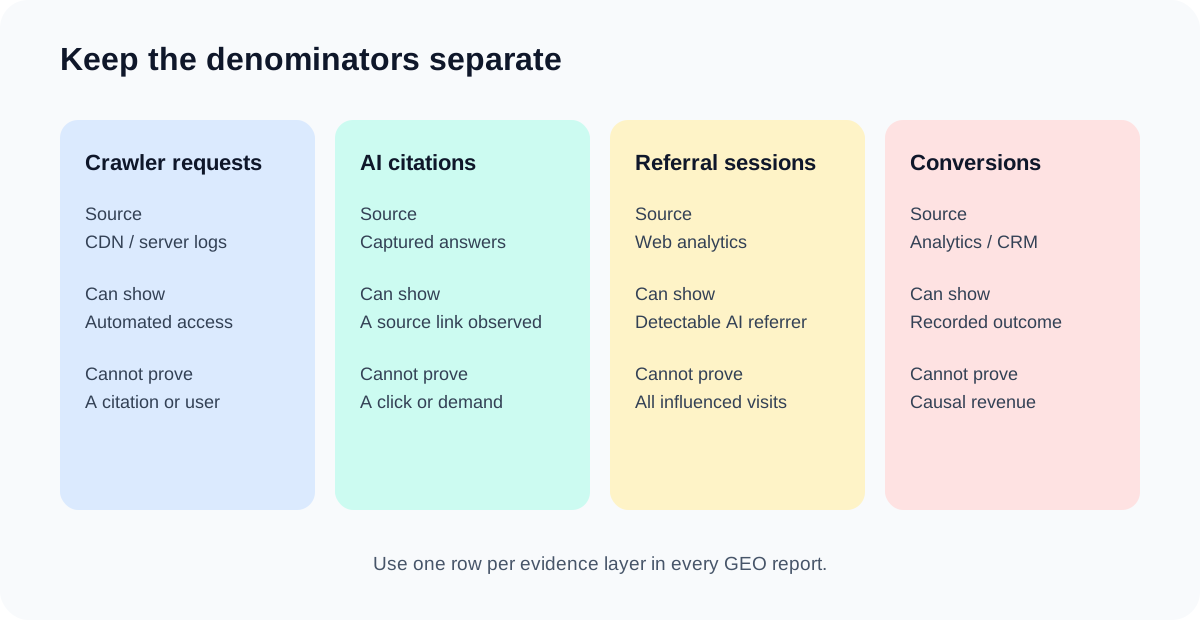
| Metric | Direct evidence source | Supports | Does not prove |
|---|---|---|---|
| Crawler requests | CDN, server, or hosting logs | Automated access observed | Retrieval into an answer or human interest |
| Successful page responses | Logs and response inspection | Content was returned under the setup | That an engine stored or used it |
| AI citation rate | Captured answers and cited URLs | Page appeared as a source in sampled answers | Total citation share or clicks |
| AI referral sessions | Web analytics | Detectable visits from an AI referrer | Unobserved influence or complete attribution |
| Conversions | Analytics and CRM | Recorded outcome under an attribution model | Causal revenue from crawling |
The safest report labels the denominator and date for every rate. “AI visibility increased” is incomplete without prompt set, engine, region, sampling, and comparison window.
robots.txt and access controls
Review Google’s robots.txt documentation and the relevant AI vendor policies before changing access rules. A robots directive is a control signal, not an assurance that every downstream system behaves identically.
Before changing a policy:
- Inventory important pages and APIs.
- Identify verified and unknown automated clients.
- Check whether the content is public, licensed, private, or user-generated.
- Confirm legal, security, and product-owner requirements.
- Test the rule on staging or a narrow path where possible.
- Monitor response codes and answer evidence after deployment.
Do not publish llms.txt or allow a crawler based on the assumption that access creates citations. Test the desired outcome separately.
Tool categories and buying questions
Crawler analytics is often bundled with broader GEO platforms, while other products focus on prompts and citations. Ask vendors:
- Which crawlers are verified, and how are spoofed agents handled?
- Is data sourced from server logs, CDN integrations, JavaScript, or a vendor crawler?
- Are raw requests exportable?
- How are redirects, blocked requests, and cached responses counted?
- Does the product also capture answer text and citations, or only access?
- Can prompt runs be fixed by model, region, language, and date?
- Are AI referral sessions joined to analytics, and what attribution model is used?
PromptWatch is relevant when crawler and referral signals are part of the same workflow. For entity and source accuracy, compare with Kalicube and WordLift; these solve a different source-clarity problem.
What this evidence does not prove
- A crawler request does not prove a page was cited.
- A citation does not prove a click.
- A referral session does not prove the AI answer caused the conversion.
- A blocked crawler does not prove zero AI visibility.
- More crawling does not prove better content quality.
- A single answer or one day of logs does not establish a trend.
Practical checklist
- Define the business question and reporting window.
- Preserve raw log fields and document redaction.
- Verify crawler identities against current vendor documentation.
- Separate requests, responses, citations, referrals, and conversions.
- Freeze a prompt panel before an intervention.
- Record model, region, language, date, and sampling count.
- Report denominators and uncertainty.
- Retest after a bounded technical or content change.
FAQ
Does AI crawler activity mean my page will be cited?
No. It only shows that a request was observed under the logging setup. Citation requires answer-level evidence.
Can Google Analytics measure all AI traffic?
No. It can measure detectable sessions under its implementation and attribution settings. Some influenced visits may have no referrer or be classified elsewhere.
Should a site block AI crawlers?
That is a policy and business decision, not a GEO shortcut. Review the content’s purpose, licensing, security, and the specific crawler behavior before changing access.
What is the minimum viable report?
A useful minimum has a verified request table, page/status summary, a fixed answer sample, referral data with its attribution definition, and an explicit limitations section.
Sources and verification
- Google common crawlers and fetchers — crawler identity and documentation boundaries; checked August 18, 2026.
- OpenAI GPTBot documentation — an example of vendor-published crawler guidance; checked August 18, 2026.
- Google robots.txt documentation — access-control context; checked August 18, 2026.
- GDPR Regulation 2016/679 — official EU text covering data-processing principles and security obligations; checked August 18, 2026.
- Cloudflare Logs documentation — official documentation on log products, exports, and product-specific retention context; checked August 18, 2026.
- AICiteKit PromptWatch review — internal example of combined crawler, prompt, and referral workflow.
This article is a methodology guide, not a claim that any particular crawler or tool produces citations or revenue.