AI Search Citation Gap Analysis: Why Competitors Get Cited Instead
A practical AI Search citation gap analysis for comparing buyer claims, cited sources, competitors, and content evidence without treating one answer as a ranking or revenue result.
The short answer
An AI Search citation gap analysis compares the claims buyers ask about, the sources visible in sampled AI answers, and the evidence available on your own site and across competitors. It is useful when a competitor is cited and your brand is not—but the diagnosis should begin with the claim and source, not with a generic instruction to “add more content.”
Use this sequence:
buyer question → fixed prompt panel → answer and URL capture → claim comparison → bounded retestA citation gap is an observation in a defined sample. It is not proof that a competitor ranks universally, that the model prefers a particular domain for all queries, or that adding a section will produce traffic or revenue.
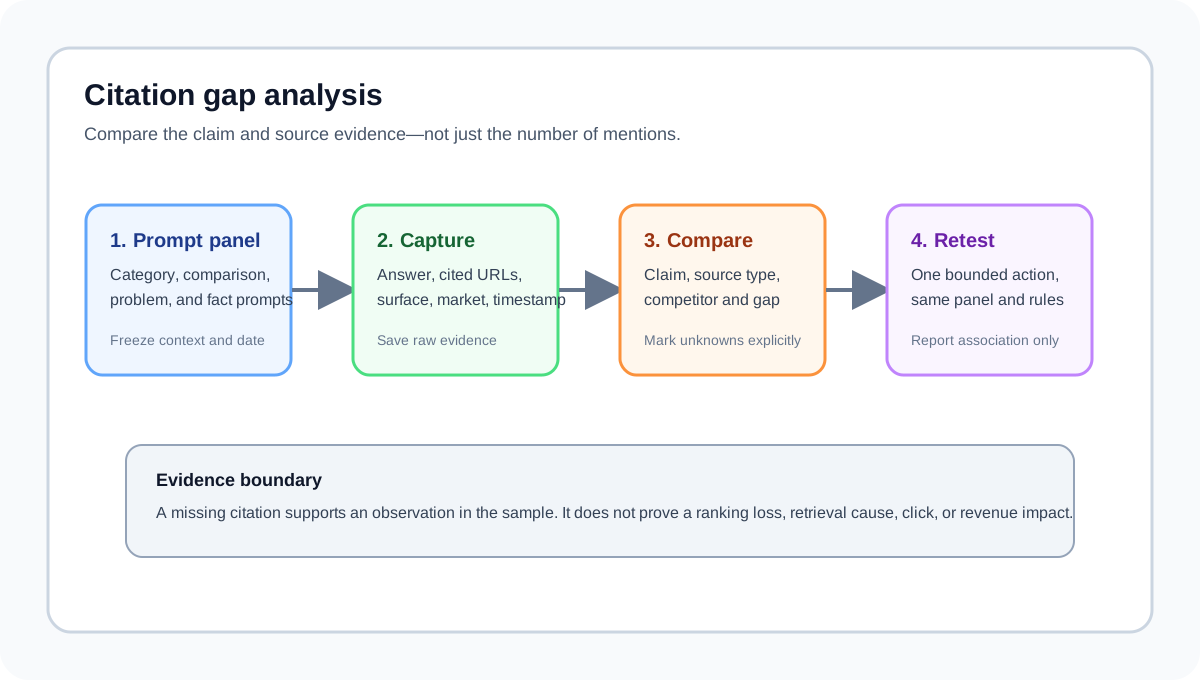
This guide targets searches such as “why is my competitor cited in AI search?”, “how do I find missing AI citations?”, and “how can I improve ChatGPT or Google AI visibility?” The defensible answer is an evidence workflow. No source cited here supports guaranteed citations, rankings, clicks, or business outcomes.
What a citation gap actually means
Define the unit of analysis before collecting results. “We are missing from AI Search” can refer to several different observations.
| Observation | What it supports | What it does not prove |
|---|---|---|
| A competitor URL appears in a captured answer | That URL was visibly used or linked in that answer | That the competitor is preferred across all answers |
| Your brand is mentioned without a link | Brand presence without a captured source link | That your site was not consulted |
| Your page is not cited for a product fact | No citation was observed under the recorded conditions | That the page is inaccessible to the engine |
| A third-party review is cited instead | The review supplied visible context in the sample | That the review is more accurate or authoritative overall |
| A retest changes the source set | The sampled output changed | That your edit caused the change |
Google says AI features in Search can show links to supporting web resources and recommends the same core technical and content practices used for Search (Google Search Central: AI features and your website, checked September 9, 2026). That is official product and webmaster guidance; it is not a public formula for source selection or a citation guarantee.
The research paper GEO: Generative Engine Optimization evaluates visibility in generative-engine responses in an academic setting (Aggarwal et al., arXiv, checked September 9, 2026). It is useful independent research context, but it does not validate a commercial “citation score,” explain every production retrieval system, or establish causality for a content edit.
Start with a decision, not a missing-link count
A useful gap analysis answers one operational question:
- Fact accuracy: Which source is being used for a price, limit, integration, or availability claim?
- Category discovery: Which independent sources appear when buyers ask for options?
- Comparison coverage: Which decision criteria are represented for your product and competitors?
- Regional relevance: Does a local or market-specific source explain the observed answer?
- Content maintenance: Is your canonical page current, accessible, and explicit about scope?
A “citation share” number can be a useful internal descriptive metric, but it should not replace the question behind it. A product page can have fewer citations and still provide the best support for a specific first-party fact. A review can be cited often because it compares products clearly, while its pricing or feature details are outdated.
1. Freeze a balanced prompt panel
Do not build the analysis from a single prompt that happens to produce a competitor list. Record prompt IDs, exact wording, surface or mode, language, market, date, and whether the conversation is new or continued.
A small starting panel might include:
| Prompt group | Example intent | Main evidence question |
|---|---|---|
| Category | “What tools help a small agency monitor AI citations?” | Which brands and sources are named for discovery? |
| Problem | “How can a team audit whether AI answers cite its pages?” | Which explanations and source types are used? |
| Comparison | “Compare three AI visibility tools for prompt monitoring.” | Which criteria and competitors are represented? |
| Fact | “What does [product] support and how is it priced?” | Are current first-party facts cited or paraphrased? |
| Risk | “What should I verify before buying an AI search monitoring tool?” | Are limitations and uncertainty visible? |
| Regional | “Which AI visibility tools serve teams in [market]?” | Does the answer match the defined geography? |
Use the same panel for competitors. Do not add prompts only after seeing a favorable answer, then present the expanded sample as a clean before-and-after comparison. AI Search Console, Peec AI, Otterly.AI, PromptWatch, and Profound represent different monitoring approaches; during a trial, verify how each records prompts, raw answers, cited URLs, markets, timestamps, and changes.
2. Capture the answer and the source trail
A dashboard summary is not enough for a defensible gap analysis. Preserve the evidence fields that are available on the surface:
- Exact prompt and prompt-set version
- AI surface, mode, and model label when disclosed
- Country, language, location, and device context when relevant
- Collection timestamp and run identifier
- Full answer or permitted export
- Every visible citation URL and its link position
- The claim each URL appears to support
- Brand mentions, recommendations, and competitor names
- Whether a URL redirects, is inaccessible, or has changed since capture
If the platform does not expose an internal query, hidden model version, or source-selection reason, record “not exposed.” Do not infer it from a URL or from a vendor score.
Google’s structured-data documentation describes structured data as a way to provide explicit clues about the meaning of a page (Introduction to structured data markup, checked September 9, 2026). It can support machine-readable interpretation, but valid markup does not guarantee inclusion in an AI answer and does not substitute for accurate visible content.
3. Classify the competitor citation by claim
The most useful comparison is claim-level. Create a source ledger rather than copying the competitor’s page structure.
| Field | Example values |
|---|---|
| Buyer claim | Price, limit, integration, use case, comparison criterion |
| Source URL | Exact visible URL, not only the domain home page |
| Source type | First-party, independent review, directory, forum, academic, vendor-selected |
| Support | Direct, partial, contradicted, or unverified |
| Freshness | Current for the recorded scope, stale, undated, or unknown |
| Scope | Product edition, market, date, audience, and eligibility |
| Gap | Missing fact, unclear wording, inaccessible page, weak corroboration, or no observed gap |
| Action | Repair, clarify, corroborate, monitor, or do nothing yet |
A competitor citation may reveal one of several different gaps:
- Canonical fact gap: Your page does not clearly state the fact or its scope.
- Evidence gap: Your claim exists, but independent or corroborating sources are absent.
- Comparison gap: Your product is not evaluated against the criteria buyers ask about.
- Accessibility gap: The relevant page is blocked, redirected, thin, or difficult to parse.
- Measurement gap: The sample is too small or inconsistent to support the conclusion.
Do not assume the fifth gap is a content problem. First check the collection conditions and the exact answer.
4. Compare source quality, not domain prestige
A cited domain is not automatically a good model to copy. Score each observed source qualitatively on four dimensions:
| Dimension | Review question |
|---|---|
| Relevance | Does it answer the exact claim in the prompt? |
| Accuracy | Does the visible text support the answer wording? |
| Freshness | Is the information current for the recorded market and edition? |
| Independence | Is the source vendor-authored, vendor-selected, user-generated, or independent? |
A first-party pricing page is the right source for the vendor’s published plan terms, but not independent proof of customer outcomes. A competitor-authored comparison can identify workflow differences, but its commercial relationship matters. A rating or review count can signal reported experience; it does not prove traffic growth, revenue growth, guaranteed citations, or guaranteed rankings.
For each important dynamic claim, keep a research note with the URL, source type, check date, positive and negative themes, commercial relationship or bias, and confidence. If independent feedback is limited, say so rather than filling the gap with vendor-selected customer evidence.
5. Check the basic retrieval and publishing conditions
Before changing content, run a narrow technical and editorial check:
- Is the canonical URL the page you intend to be cited?
- Does it return a successful response for normal visitors?
- Is the important claim visible in HTML rather than only in an interaction or image?
- Are product name, edition, market, price scope, and date unambiguous?
- Do headings and surrounding text make the claim easy to locate?
- Are redirects, duplicate pages, or stale comparison pages competing with it?
- Are robots, access, or policy controls intentionally limiting some crawlers?
- Is the page supported by relevant independent sources where the claim needs corroboration?
These checks improve verifiability. They do not reveal the full retrieval process or guarantee that a page will be cited. Keep technical inspection separate from answer observation and from analytics attribution.
6. Choose one bounded action
A good gap analysis ends with one testable action, not a wholesale rewrite. Match the action to the observed gap:
| Observed gap | Bounded action | Retest |
|---|---|---|
| Current plan limit is hard to verify | State unit, period, edition, and official source | Same fact prompts and comparison prompts |
| Comparison criterion is omitted | Add a factual, sourced criterion section | Same comparison panel |
| Page is not the canonical source | Consolidate or clearly link the current page | Same product-fact panel |
| Independent context is missing | Seek a genuine third-party source or mark the evidence limited | Same category and risk prompts |
| Region or language is mixed | Separate market-specific facts and prompt runs | Same prompts by market |
| No repeatable observation | Expand the sample before editing | New baseline with a frozen panel |
A content change is not automatically an experiment. To make the result interpretable, record the prior page state, action date, prompt version, collection conditions, and retest window. If sources change afterward, report an association unless the design isolates the cause.
Metrics that keep the gap bounded
Use denominators and define the unit. For example:
competitor citation rate = runs where the named competitor URL appeared ÷ eligible runs
first-party support rate = runs where a current first-party URL supported the target claim ÷ eligible fact runs
source diversity = distinct source domains observed ÷ eligible runs
These are descriptive measures for the specified panel. Report the numerator, denominator, prompt groups, surface, market, date range, missing runs, and URL rules. Decide in advance whether multiple URLs in one answer count once or multiple times.
Keep these measures separate:
- Mention: the brand name appeared.
- Recommendation: the answer suggested the brand for a use case.
- Citation: a visible source link appeared.
- Referral: analytics recorded a qualifying visit.
- Conversion: a business system recorded an outcome.
Google Search Console’s performance documentation describes Search reporting and its dimensions (Search performance report, checked September 9, 2026). Search reporting is useful context, but it is not a transcript of every AI answer and should not be used alone to infer a citation gap.
What this analysis cannot prove
Even a carefully recorded sample cannot establish:
- That a competitor is universally ranked above your brand
- That an unlinked mention means your site was not consulted
- Which hidden query, candidate set, or model decision selected a source
- That a page edit caused a citation or source change
- That a citation caused a click, lead, order, or revenue
- That crawler activity equals a user-facing answer
- That vendor-selected case studies are independent evidence
- That a rating demonstrates business performance
A responsible conclusion may be as narrow as: “In 8 of 20 recorded category runs on the named surface and market, a competitor review URL appeared for the comparison claim; our current page was not visibly linked. The reason is unresolved, and the next test is to clarify the comparison criterion and repeat the same panel.” That is actionable without pretending to explain the entire system.
Who should use a citation gap analysis?
This workflow fits:
- SaaS and ecommerce teams with important product facts
- Content and SEO teams investigating competitor recommendations
- Agencies that need audit trails for client reporting
- Product marketers maintaining comparison and alternative pages
- Local or international teams where scope changes the answer
It is not a replacement for technical SEO, product-data governance, legal review, customer research, or analytics attribution.
Evidence snapshot
| Source | Public signal | What it supports | Confidence |
|---|---|---|---|
| Google Search Central: AI features and your website | Official guidance on AI features, links, and Search fundamentals | AI answers may show supporting web links; no universal citation guarantee | High |
| Google: Introduction to structured data | Official documentation on explicit page meaning and markup | Structured data can clarify content; it does not guarantee AI inclusion | High |
| Google Search performance report | Official Search reporting documentation | Search-performance context must remain separate from answer-level evidence | High |
| GEO: Generative Engine Optimization | Independent academic research paper | Research context for evaluating visibility in generative-engine responses | Medium; not evidence for a vendor metric or causal business result |
| AICiteKit editorial framework | Claim ledger, fixed panel, source classification, and bounded retest in this article | Practical interpretation and workflow | Editorial |
Practical checklist
- The business decision and citation unit are defined.
- Prompts, markets, surfaces, dates, and versions are frozen.
- Raw answers and exact visible URLs are preserved where permitted.
- Each citation is mapped to the claim it appears to support.
- Source type, freshness, scope, and commercial bias are recorded.
- First-party facts are separated from independent evidence.
- Mention, recommendation, citation, referral, and conversion remain separate.
- One bounded action is selected before the retest.
- The conclusion states what the sample cannot prove.
FAQ
Does adding more citations to my page fix a citation gap?
Not necessarily. Links can improve verification for readers, but a citation gap may reflect prompt scope, source competition, page clarity, retrieval variation, or an inadequate sample. Test one change under matched conditions rather than treating citation count as a target by itself.
Should I copy the page a competitor gets cited from?
No. Inspect which claim the source supported, whether the information is current, and whether the source is independent. Borrow the useful evidence structure only when it serves readers and remains accurate; do not copy unsupported claims or vendor-selected proof.
How many prompts do I need?
There is no universal minimum. Start with a panel large enough to cover the decision, disclose the denominator, and expand it when results are unstable or overly dependent on one branded query. A smaller, documented panel is more useful than a larger panel with changing prompts and hidden conditions.
Can AI Search citation tracking prove ROI?
Citation tracking can document answer-level observations and, when joined carefully with analytics, separately observed referrals. It cannot by itself prove that a citation caused a conversion or revenue. Use tagged visits, qualified events, and an explicit attribution model for those claims.
Sources and verification
- Google Search Central: AI features and your website — checked September 9, 2026 for official AI-feature and link guidance.
- Google: Introduction to structured data — checked September 9, 2026 for structured-data scope.
- Google Search performance report — checked September 9, 2026 for Search reporting boundaries.
- Aggarwal et al., GEO: Generative Engine Optimization — checked September 9, 2026 for independent research context.
Last reviewed: September 9, 2026
Data confidence: Medium for the workflow and cited documentation; low for any platform-specific source-selection explanation that is not publicly disclosed.