AI Search Competitor Analysis: How to Compare Recommendations and Sources
A practical AI Search competitor-analysis framework for comparing prompt results, recommendation criteria, cited sources, and product facts without inventing rankings or business outcomes.
The short answer
AI Search competitor analysis is the practice of comparing how named brands are represented in a defined sample of AI answers. A useful analysis records the exact prompt, surface, market, date, answer, recommendation order, and cited URLs. It does not produce a universal ranking of every competitor across every AI system.
Use this sequence:
matched prompts → captured answers → source and claim review → bounded competitive findingCompare the things a buyer actually sees: which products are mentioned, what criteria the answer uses, whether each description is accurate, and which sources appear beside the claims. Keep mentions, recommendations, citations, traffic, and revenue as separate evidence layers.
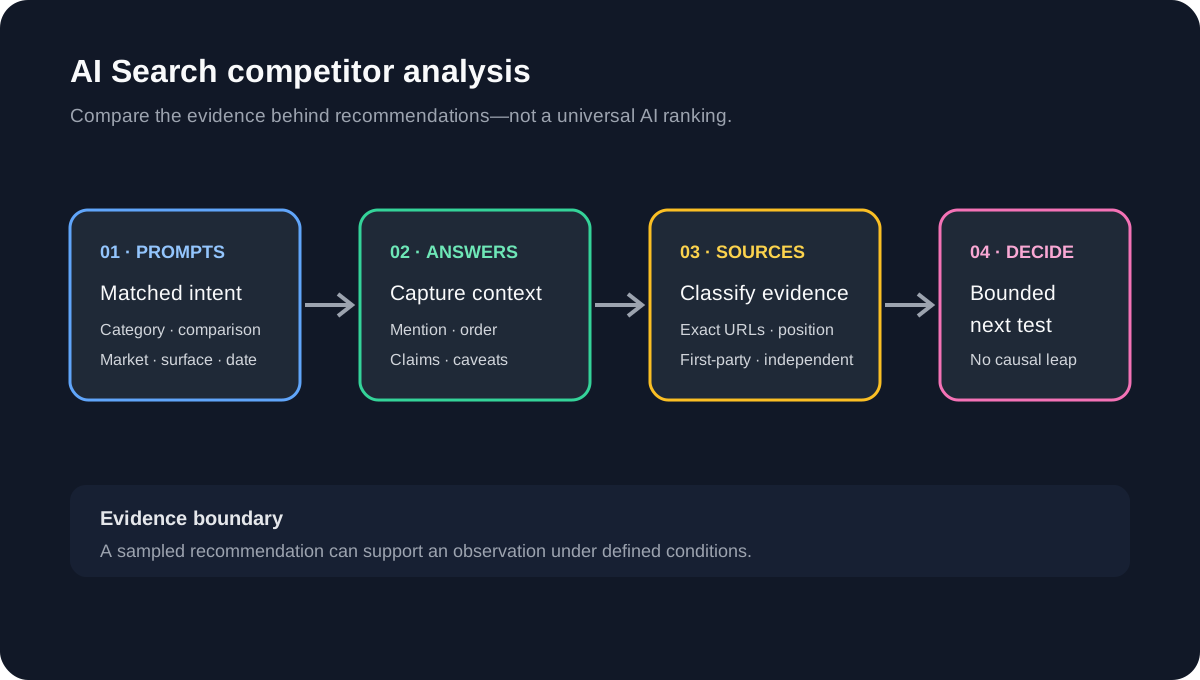
This addresses a practical search intent: a marketing or product team wants to know why a competitor appears in ChatGPT, Google AI features, Perplexity, or another answer surface while its own brand does not. The answer is usually a research workflow, not a single “AI share of voice” number.
What competitor analysis can measure
Name the observation before calculating a score.
| Observation | Example | What it supports | What it does not prove |
|---|---|---|---|
| Mention | Brand appears in a captured answer | Presence in the defined sample | Preference or market leadership |
| Recommendation | Brand is suggested for the stated use case | A recommendation under that prompt | A purchase or universal ranking |
| Position | Brand appears in a defined list position | Relative order in that answer | Stable position across platforms |
| Criterion | Answer associates a product with a capability or tradeoff | The criteria represented in the answer | That the claim is true without verification |
| Citation | Exact URL is linked beside a claim | Source use in the captured answer | A click, endorsement, or conversion |
| Accuracy | Reviewer compares the answer with current facts | A factual issue or accurate description | The reason the model chose the wording |
Google’s guidance says AI features in Search may show links to supporting web resources and points site owners toward ordinary technical and content fundamentals (AI features and your website, checked August 31, 2026). This supports a search-product context; it does not publish a universal competitor ranking or guarantee that a page will be cited.
OpenAI describes ChatGPT Search as a web-search experience that may provide links to sources (ChatGPT search, checked August 31, 2026). This is product-context evidence only. It is not evidence of a rating, market share, traffic lift, or outcome.
1. Start with the buying decision
A competitor report becomes a leaderboard when nobody defines the decision it should support. Choose one primary question:
- Which brands are named for category-discovery prompts?
- Which criteria appear to shape a shortlist?
- Is our product described accurately compared with alternatives?
- Which independent sources are used to explain the category?
- Does the answer differ across a defined market or language?
- Which product facts should we verify or clarify first?
The prompt set, review method, and output should follow the question. A branded prompt can test identity and factual accuracy; it should not inflate a category-discovery result. A source audit can identify cited pages; it cannot by itself establish which page caused a recommendation.
Write the decision in one sentence, for example:
Decide whether our comparison page, product facts, or source coverage deserves the next investigation based on a matched sample of category and comparison answers.
2. Freeze the competitor universe
Write down the comparison set before collecting answers. Record:
- Primary brand and known product-name variants
- Competitors included and the reason for inclusion
- Category definition and customer segment
- Date the list was frozen
- Adjacent products that are explicitly excluded
- Rules for parent brands, product lines, and agencies
- How aliases, misspellings, and merged brands are counted
Do not add a competitor after seeing a surprising answer and quietly recalculate the denominator. Create a new version and explain the change. Otherwise, a different competitor set can look like a visibility change.
A category panel might include five to ten named alternatives, while a problem panel may allow the answer to surface brands outside the original set. Both are valid, but they answer different questions. Label the open-discovery and fixed-universe panels separately.
3. Build a balanced prompt panel
Use customer intent rather than prompts designed to produce a preferred result. A practical panel includes:
| Prompt group | What it tests | Example pattern |
|---|---|---|
| Category | Unprompted discovery | “What tools help a small agency monitor AI citations?” |
| Problem | Relevance to a need | “How can a B2B team audit AI brand visibility?” |
| Comparison | Tradeoffs and shortlist framing | “[Brand] vs [competitor] for citation monitoring” |
| Evaluation | Purchase criteria | “What should I verify before buying a GEO platform?” |
| Branded | Identity and product facts | “What does [brand] do?” |
| Risk | High-impact claims | “Does [brand] support [feature]?” |
| Regional | Market or language context | “Best [category] tools for a UK agency” |
Keep a stable core for trend reporting and a separate exploratory set for new questions. Version wording, intent, language, market, and surface. A translation should be reviewed by someone who understands the local buying context; literal equivalence is not guaranteed.
For each prompt, preserve:
ID: CAT-014 v1
Intent: category discovery
Exact wording: What tools help a small agency monitor AI citations?
Market/language: United States / English
Surface and mode: named surface; web-search mode if disclosed
Competitor set: frozen list v2
Run policy: same collection window; run number recorded
A prompt record improves comparability. It does not make AI answers deterministic.
4. Capture the answer, not only a score
For every run, save the strongest evidence allowed by the platform and tool terms:
- Exact prompt and version
- Product, surface, mode, and model/version when disclosed
- Country, city, language, account state, or other relevant context
- Collection timestamp and run ID
- Full answer, screenshot, or permitted export
- Mentioned brands and recommendation order
- Criteria, caveats, dates, prices, and availability statements
- Exact source URLs and the claim each source appears to support
- Errors, unavailable runs, and parser notes
A dashboard label such as “visibility 40%” is not a substitute for answer evidence. If raw answers are unavailable, record raw answer unavailable and lower confidence. Do not reconstruct a quote from a chart.
The independent paper GEO: Generative Engine Optimization studies visibility in generated-engine responses and proposes optimization methods (Aggarwal et al., arXiv, checked August 31, 2026). It is useful research context for treating generated responses as a distinct measurement problem. It does not validate a vendor score, prove a production causal effect, or guarantee a citation.
5. Audit recommendation criteria
The most useful competitive question is often not “who ranked first?” but “why might the answer have selected or described these options?” Extract the criteria explicitly.
Look for:
- Audience or company size
- Use case and job to be done
- Integrations and implementation effort
- Coverage of engines, markets, or languages
- Reporting, exports, collaboration, or API requirements
- Price or plan claims, if present
- Security, compliance, support, or contract concerns
- Recency and specificity of the sources
Create a criterion ledger rather than inferring hidden model weights:
| Field | Example record |
|---|---|
| Prompt ID | EVAL-006 v1 |
| Answer observation | Three products recommended for an agency workflow |
| Criteria stated | Prompt tracking, exports, team reporting |
| Brand result | Brand mentioned but not described against exports |
| Sources | Exact URLs, position, and associated claims |
| Fact check | Export capability verified against current documentation or marked unknown |
| Interpretation | Possible positioning or source-coverage gap; confidence medium-low |
| Boundary | Does not prove retrieval cause, preference, traffic, or revenue |
Do not claim that a criterion caused a result merely because it appears in the answer. The answer can reveal the visible framing; it does not expose a complete causal model.
6. Separate source coverage from source quality
When a competitor is cited, classify the source before treating it as a strategic signal.
| Source class | Useful for | Important boundary |
|---|---|---|
| First-party documentation | Product facts, capabilities, policies | Vendor-controlled and not independent validation |
| Independent review or research | User experience, comparisons, recurring concerns | Sample, date, and commercial relationship matter |
| Community discussion | Questions, objections, practical experience | Anecdotal and unevenly verified |
| Directory or marketplace | Presence and category language | Inclusion is not quality proof |
| Vendor case study | Named example and reported outcome | Vendor-selected customer evidence |
| Competitor-authored comparison | Workflow tradeoffs and positioning | Commercial bias should be disclosed |
Review each URL for relevance to the exact claim, freshness, specificity, and editorial independence. Count exact URLs separately from domains. A frequently cited domain may contain pages with very different evidentiary value.
A citation is a source-use observation. It is not automatically an endorsement, a quality rating, a click, or a conversion. A crawler request and a Search impression are also different evidence layers.
7. Verify product facts before proposing content work
A competitor answer can be persuasive while still being factually wrong or stale. Check claims against current first-party material and label uncertainty.
Review:
- Product identity and category
- Current features and integrations
- Pricing, billing interval, credits, and limits when mentioned
- Supported platforms, models, markets, or languages
- Availability, trial, and plan restrictions
- Security, compliance, and support statements
- Publication and last-updated dates
Do not copy a competitor’s wording simply because it appears in an answer. If the answer says a product has a capability, verify it at the official source. If the official page is ambiguous or inaccessible, mark the fact unknown.
Likewise, do not use a public rating as evidence of traffic growth, revenue growth, guaranteed citations, or guaranteed rankings. A rating can be a satisfaction signal only within the platform, sample, date, and review scope that produced it.
8. Compare like with like
A fair comparison keeps the following fields constant where possible:
| Control | Why it matters |
|---|---|
| Prompt wording and version | Small changes can alter intent and candidates |
| Surface and mode | Different products expose different retrieval contexts |
| Market and language | Local sources, availability, and terminology differ |
| Collection window | Retrieval and product facts change over time |
| Competitor universe | The denominator changes otherwise identical rates |
| Run policy | One run and repeated runs carry different uncertainty |
| Counting rule | Mention, recommendation, citation, and position are distinct |
| Capture method | Parser summaries may omit answer-level context |
If a field is unknown, record unknown. “Not disclosed” is not equivalent to “unchanged.” If a new run changed the surface, prompt, market, or definition, treat it as a new cohort rather than a clean trend.
A simple set of observations is often safer than one composite score:
mention rate = matched runs with a brand mention ÷ matched runs
recommendation rate = qualifying recommendation runs ÷ matched runs
citation rate = runs with an exact qualifying URL ÷ matched runs
accuracy issue rate = reviewed runs with a verified issue ÷ reviewed branded runs
Report the prompt group, surface, date, denominator, and unavailable runs with every rate. These are sample properties, not probabilities for every user.
9. Turn findings into bounded actions
Use a finding to choose the next investigation, not to promise an outcome.
| Observed pattern | Plausible hypothesis | Bounded next action |
|---|---|---|
| Brand absent from category answers but present in branded answers | Category positioning or source coverage needs review | Inspect one category page and recurring independent sources |
| Competitor described with a capability your page does not explain | Information gap or unclear positioning | Verify the fact and clarify one accurate comparison section |
| Brand is mentioned but key facts are wrong | First-party facts are stale or inconsistent | Reconcile one product fact across primary pages and documentation |
| Source domains differ by market | Local source landscape or terminology differs | Run a labelled regional source review |
| Tool reports a change but raw answers are unavailable | Measurement or parser change is possible | Request exports, version notes, or a matched manual sample |
Change one material variable where possible. Preserve the pre-change panel and define the retest window. If the answer changes afterward, report an observed before/after difference unless the design supports a stronger causal claim.
For monitoring workflows, compare the evidence models of AI Search Console, Peec AI, Otterly.AI, PromptWatch, and Rankscale. These are different products, not a shared measurement standard. During a trial, verify exact prompt export, raw answer access, source URL retention, market controls, historical preservation, and parser-change handling.
Evidence snapshot
| Source | Public signal | What it supports | Confidence |
|---|---|---|---|
| Google: AI features and your website | Official guidance on AI features and supporting links | Search-product context and webmaster fundamentals; not a universal competitor ranking | High |
| ChatGPT search help | Official OpenAI help page describing search and source links | Narrow product-context claim; not ratings, reach, or outcomes | Medium |
| GEO: Generative Engine Optimization | Independent academic research paper | Background on generated-engine visibility research; not validation of vendor metrics or business impact | Medium |
| AICiteKit editorial framework | Defined methods and evidence boundaries in this article | How to structure a repeatable competitor analysis | Editorial |
The evidence for the specific GEO feature of any named monitoring product remains product-specific. Traditional SEO, content, or general software reviews do not automatically validate its AI-answer collection or citation methodology. Check the relevant tool’s current documentation and preserve the date checked.
What this analysis cannot prove
Even a careful competitor panel cannot establish:
- A universal AI Search rank or market share
- That every user sees the same answer
- That a recommendation caused a click, lead, order, or revenue
- That a cited source was trusted or endorsed
- That a content edit caused an answer change without stronger experimental design
- That crawler activity or search impressions equal an answer citation
- That a vendor-selected case study is independent evidence
- That a competitor’s presence means its product is objectively better
These boundaries do not make the analysis useless. They identify which finding is strong enough for a fact correction, which needs more collection, and which should remain an unresolved observation.
A practical monthly workflow
- Freeze the prompt panel, competitor universe, counting rules, and target surfaces.
- Collect the stable panel under documented market and language conditions.
- Preserve answer captures and exact source URLs where permitted.
- Check competitor and brand facts against current first-party documentation.
- Report category, comparison, branded, regional, and risk prompts separately.
- Select one high-impact, well-evidenced issue for investigation.
- Make one bounded content, product-fact, or technical change.
- Retest the same panel and keep the old cohort intact.
- Report observed changes with their denominator and evidence boundary.
FAQ
Is AI Search competitor analysis the same as SEO competitor analysis?
No. SEO analysis often compares pages, queries, links, and search-result positions. AI Search analysis compares captured answers, recommendations, descriptions, and source links under defined conditions. The workflows can inform each other, but one does not substitute for the other.
How many prompts should a competitor analysis use?
There is no universal minimum. Start with enough prompts to cover the decision, customer intents, markets, and risks being studied. Report prompt count, groups, matched runs, and exclusions instead of implying that a small panel represents the whole market.
Should branded prompts be included?
Yes, when you need to check identity and factual accuracy. Keep branded prompts separate from unbranded category and comparison prompts so they do not inflate discovery results.
Why do two GEO tools show different competitors?
They may use different prompts, surfaces, model or mode settings, markets, run policies, answer captures, parsers, or definitions. Inspect the underlying records before deciding that one result is wrong. Tool pages such as Peec AI and Otterly.AI are product-specific evaluations, not a shared benchmark.
Can a competitor citation prove that its page is better?
No. It proves that the URL appeared in the captured answer under the recorded conditions. Review relevance, freshness, independence, and the claim associated with the link before drawing a source-quality conclusion.
Can I turn competitor recommendation rate into expected revenue?
Not without a separate measurement design connecting exposure, detectable referrals, and business events. A recommendation observation is not a traffic forecast or a causal revenue estimate.
What should I do if raw answers are unavailable?
Record that limitation, lower confidence, and avoid quoting or diagnosing the result as if the answer were available. Ask whether the product can provide a compliant export, screenshot, source list, or matched verification sample.
Sources and verification
The official Google and OpenAI pages and the academic paper linked above were checked on August 31, 2026. This article is a vendor-neutral editorial methodology; AICiteKit did not run a cross-platform production competitor benchmark for this article and does not claim that any named tool produces interchangeable results. No claim here guarantees rankings, citations, traffic, conversions, or revenue.