Field notes / ai-search
AI Search Content Cannibalization Audit: When Multiple Pages Answer the Same Question
A practical audit for finding overlapping pages in AI Search, separating genuine intent coverage from duplication, and choosing between keeping, splitting, merging, or redirecting without overclaiming results.
The short answer
AI Search content cannibalization is a source-library problem: multiple pages appear to answer the same buyer question, but differ in scope, evidence, freshness, or audience. The remedy is not automatically to delete pages or force one URL to win. First determine whether the pages serve the same intent, then compare their claims and observed answer evidence.
Use this sequence:
question map → page and claim inventory → overlap diagnosis → bounded URL decision → controlled retestThe four defensible actions are keep separate, clarify and split, merge, or retire/redirect. A page being cited less often is a review signal, not proof that it is redundant. A page being cited is not proof that it is the best or most current source.
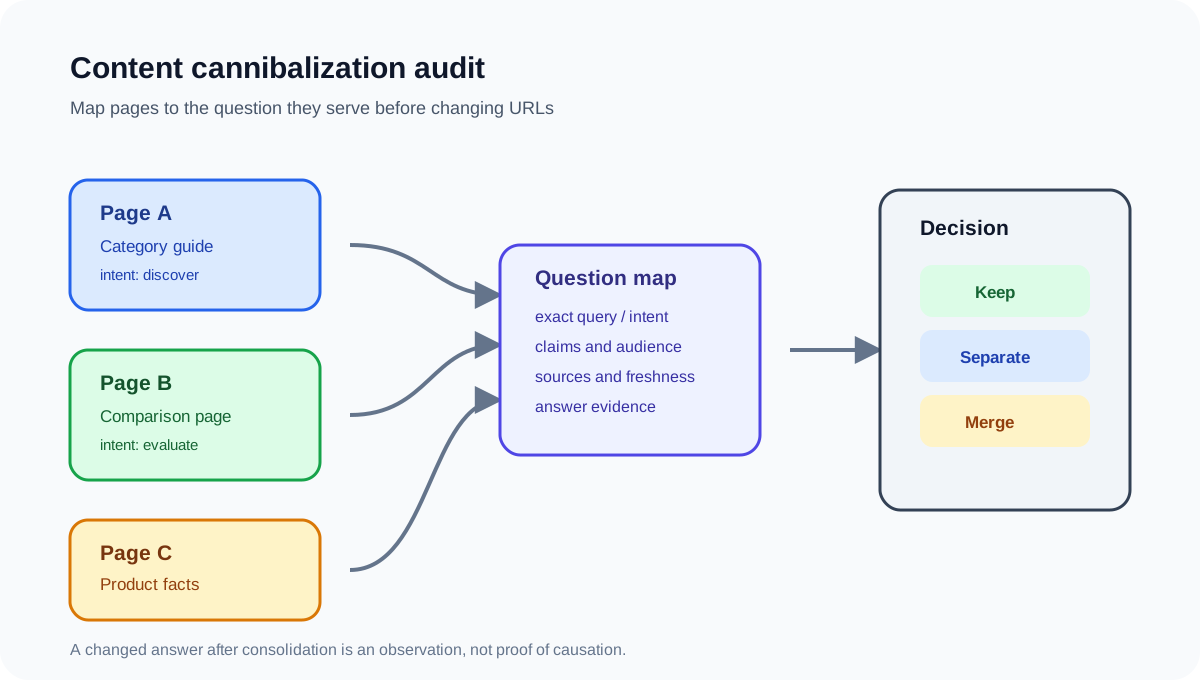
This guide addresses searches such as “why does AI Search cite the wrong page?”, “should I merge similar pages for GEO?”, and “how do I fix content cannibalization for AI search?” It does not claim that consolidation guarantees citations, rankings, traffic, or revenue.
What cannibalization means in an AI Search context
Traditional SEO discussions often use “cannibalization” for multiple URLs competing for a query. AI answers create a related but different question: which page, if any, is used to support a particular claim? An answer may cite one URL, summarize another, or omit both. A dashboard may also collapse URLs into domains or score mentions without exposing the selected passage.
Separate these cases:
| Case | What may be happening | First diagnostic |
|---|---|---|
| Same intent, near-identical pages | Two URLs offer substantially the same job to the reader | Compare purpose, claims, and primary audience |
| Same topic, different intent | A guide, comparison, and product page cover adjacent stages | Keep pages distinct and strengthen links and labels |
| One page has stale facts | A current page and an old page describe different editions or prices | Check dates, canonicals, redirects, and answer sources |
| One page is a specialist source | A narrow technical or policy page supports a claim the main guide does not | Preserve the specialist page if its role is real |
| Dashboard groups URLs differently | The tool reports domain, URL, or source categories under its own rules | Inspect the metric definition and raw evidence |
Google says AI features may show links to supporting web resources and recommends foundational Search practices (AI features and your website, checked October 20, 2026). That supports maintaining accessible, useful pages and inspecting visible links. It does not publish a rule that one canonical URL will always be selected for an AI answer.
Google’s documentation on consolidating duplicate URLs explains that canonicalization helps Search understand a preferred version when duplicate or very similar pages exist (Consolidate duplicate URLs, checked October 20, 2026). This is official Search guidance, not evidence that a canonical tag controls every answer surface or guarantees an AI citation.
The independent paper GEO: Generative Engine Optimization studies visibility in a defined experimental setting (Aggarwal et al., arXiv, checked October 20, 2026). It provides methodological context, not a production diagnosis of a particular site’s page overlap.
The most common false positive
Two pages can mention the same product or topic without being duplicates. A comparison page may answer “which option fits a small team?” while a documentation page answers “how does this integration work?” Shared words do not establish shared intent.
A practical test is the replacement test:
If page A disappeared, could a reader complete the job page B was designed to support without losing an important audience, claim, source, or action?
If the answer is no, the pages may be adjacent rather than cannibalizing. If the answer is yes, inspect whether one page is merely a thinner or older copy of the other.
1. Build a question-to-page map
Start with real questions, not URL names. Use Search Console queries, internal search, sales and support language, product documentation, customer interviews, and captured AI prompts as candidate inputs. A prompt generated by an LLM can find variants, but it is not independent evidence that people ask the question.
For each question, record:
| Field | Example | Why it matters |
|---|---|---|
| Question ID | COMP-07 | Makes retesting reproducible |
| Exact wording | Which AI visibility tools support weekly answer capture? | Prevents vague topic grouping |
| Intent | Category, comparison, implementation, or fact | Separates jobs that should remain distinct |
| Audience | In-house SaaS team, agency, or publisher | Changes useful detail and recommendation criteria |
| Market | US English, October 2026 | Scope for facts and sources |
| Candidate URLs | Guide, comparison, product, documentation | Defines the overlap set |
| Expected evidence | Feature fact, tradeoff, or workflow | Gives the page a job to perform |
| Answer observation | Mention, recommendation, citation, or omission | Keeps output types separate |
Do not call a page “the winner” because it appeared in one answer. Preserve the prompt, surface, date, answer, and cited URL before interpreting the selection.
2. Compare page jobs, not just keywords
Create one row per candidate page and write its intended job in one sentence. If two rows have the same audience, action, scope, and evidence role, they deserve a closer overlap review.
| Page job | Distinct signal | Overlap risk |
|---|---|---|
| Category guide | Defines the problem and evaluation criteria | Becomes a list of vendor claims with no independent evidence |
| Comparison | Applies declared criteria to named alternatives | Duplicates a category guide without decision-specific detail |
| Product detail | Explains one product’s current facts and limits | Copies the comparison’s feature table without scope |
| Documentation | Explains setup, behavior, or implementation | Is replaced by marketing copy that omits technical conditions |
| Editorial research | Provides independent methods or context | Is treated as a product page because it mentions a vendor |
Use the word overlap for a hypothesis until the claim inventory confirms duplication. A title, H1, or URL similarity is not enough.
3. Build a claim and source inventory
For every candidate page, list material claims rather than counting words. Include:
- Product names, categories, and audience statements
- Pricing, credits, limits, integrations, and availability
- Definitions and methodological claims
- Comparisons and recommendation criteria
- Dates, versions, markets, and eligibility conditions
- First-party and independent sources
- The exact paragraph or table that supports each claim
Then classify each claim:
| Claim type | Suitable source | Main boundary |
|---|---|---|
| Current feature or plan | Official documentation or pricing | Does not independently prove usefulness or outcomes |
| User experience | Independent review, community, or research | Sample, date, and product edition may be limited |
| Comparison judgment | Declared criteria plus inspected evidence | Editorial interpretation, not an objective universal rank |
| Citation observation | Captured answer and visible URL | Does not prove selection causality or traffic |
| Business outcome | Analytics or experiment with defined attribution | A before/after association does not prove page causality |
A page that contains more claims is not automatically the better consolidation target. A merge can make a page broader while making every individual claim harder to verify.
4. Diagnose the type of overlap
Classify the problem before changing URLs.
Intent overlap
Both pages answer the same question for the same audience and action. This is the strongest merge candidate, provided one page can retain the useful evidence and links.
Scope overlap
Pages discuss the same subject but one is limited by market, plan, product edition, or implementation context. Clarify the scope instead of merging by default.
Claim overlap
The pages repeat the same facts but serve different jobs. Deduplicate the fact, keep the pages, and link to the source of truth.
Source overlap
Several pages cite the same weak or stale external source. Consolidating URLs will not repair the evidence problem; verify the claim and source independently.
URL or canonical confusion
Redirects, canonicals, alternate-language URLs, parameterized pages, or internal links may make the page relationship unclear. Fix the technical relationship and retest access separately from answer visibility.
Answer-parser uncertainty
The tool may report domains instead of exact URLs, normalize redirects, or classify mentions differently from citations. Mark the diagnosis unknown when raw answer evidence is unavailable.
5. Keep mention, recommendation, and citation separate
An overlap audit fails when a single “visibility” number is used to decide which page to delete.
| Observation | Supports | Does not prove |
|---|---|---|
| Page URL appears beside a claim | The URL was visible under recorded conditions | The page caused the answer or is universally preferred |
| Domain is mentioned | The answer referred to the organization or product | Which page supported the statement |
| Brand is recommended | The answer presented it as a candidate under that prompt | Factual accuracy, click, or purchase |
| Page receives Search clicks | Observable Search activity in the defined report | Every AI answer or citation source |
| Two pages are both cited | Both appeared in sampled answers | That one should be removed |
Tools such as AI Search Console, Peec AI, Otterly.AI, PromptWatch, and Profound may expose different combinations of prompts, answers, URLs, citations, and derived metrics. During a trial, verify whether they preserve exact URLs, answer text, prompt context, timestamps, and the rules used to group pages. Do not treat their scores as interchangeable.
6. Choose the URL action with a decision matrix
| Finding | Safer action | Verification before release |
|---|---|---|
| Same job, same audience, materially duplicated claims | Merge into the stronger source | Map claims, inlinks, citations, redirects, and analytics dependencies |
| Same topic, different buyer stage | Keep separate | Add clear titles, scope, and contextual internal links |
| One page is a stale edition or obsolete offer | Update, redirect, or archive by policy | Check legal, customer, support, and historical requirements |
| One page is thin but has a distinct useful intent | Expand or split | Add original evidence and a precise page purpose |
| Tool shows URL disagreement with no raw answers | Do not consolidate for that reason alone | Reproduce with exact prompts and visible source URLs |
| Duplicate URLs differ only by parameters or alternates | Canonicalize or redirect as technically appropriate | Check rendered content, status, canonical, hreflang, and internal links |
A merge is a release, not a writing edit. Record the old URL, destination, redirect status, canonical, updated links, removed claims, retained sources, and owner. Keep a rollback path when the page has meaningful Search, customer, legal, or support dependencies.
7. Retest with a fixed prompt panel
Before changing the pages, capture a small stable baseline. Include:
- Branded fact prompts that test identity and current product facts.
- Category prompts that test discovery without naming the brand.
- Comparison prompts that expose competing pages and criteria.
- Risk prompts that test stale, unsupported, or ambiguous claims.
- Direct page questions when a specific URL is expected to support an answer.
For every run, record exact prompt wording, surface and mode, market and language, date and time zone, answer text where permitted, visible URLs, page claims, and unavailable states. If a tool has a prompt, credit, refresh, or retention limit, record that commercial constraint separately from the answer result.
After the release, rerun the same panel in a declared window. Keep an exploratory panel separate. A changed answer can reflect retrieval timing, source updates, model or surface changes, account state, or ordinary answer variability. A control cohort helps identify whether the whole environment moved.
What a controlled retest can and cannot show
A retest can show that the captured answers or source URLs differed between two recorded periods. It can help identify a broken redirect, stale claim, missing internal link, or clearer page scope. It cannot by itself show that consolidation caused a higher ranking, more citations, more clicks, or more revenue.
Google’s people-first guidance asks whether content is created to help people and whether a site has a primary purpose (Creating helpful, reliable, people-first content, checked October 20, 2026). That is useful editorial context for deciding whether a merge improves the reader’s task. It is not an AI Search score threshold.
An independent commercial article such as Ahrefs’ keyword cannibalization guide, checked October 20, 2026, can provide practical SEO workflow context. It is a commercial publisher source, not neutral evidence for a particular site’s AI citation behavior. Its traditional Search guidance should not be silently presented as validation of a GEO feature or answer-selection rule.
Practical audit worksheet
Use this compact record for each candidate group:
Question ID: COMP-07
Intent and audience: comparison / small B2B SaaS team
Candidate URLs: /guide/, /compare/, /product/
Primary page job for each URL: documented in one sentence
Material overlap: yes / no / uncertain
Claim conflicts: list exact facts and dates
Source quality: first-party / independent / commercial / missing
Technical state: status, canonical, redirect, internal links
Answer evidence: prompt, surface, date, answer, cited URL
Decision: keep / clarify / merge / retire
Owner and release date: assigned
Retest result: observation only; causation not established
A good audit usually produces a smaller and clearer set of pages, not necessarily fewer pages. Optimize for a reader who can find the right answer and verify it—not for a dashboard number that hides the denominator.
FAQ
Is content cannibalization proven when two pages rank for the same keyword?
No. Shared rankings or mentions can indicate overlap, but they do not establish that the pages serve the same intent. Compare the audience, action, scope, claims, and evidence role.
Should I merge every page that an AI tool does not cite?
No. A page may serve customers, support a narrow question, document a policy, or provide evidence not represented in the sampled prompt panel. Treat non-citation as a review signal and check human value, Search data, technical state, and answer coverage together.
Can a canonical tag make an AI engine cite the preferred URL?
It can communicate a preferred URL to Search in the appropriate technical context, but no source here establishes that a canonical tag controls every AI answer surface or guarantees a citation. Validate the delivered page, redirects, internal links, and answer evidence separately.
How many pages should a merged guide replace?
There is no universal number. Merge only when one page can serve the shared intent without losing a distinct audience, claim, source, legal requirement, or support function. The number of URLs is less important than the clarity of the resulting information architecture.
Which tools can help monitor overlap after a release?
AICiteKit’s pages for AI Search Console, Peec AI, Otterly.AI, PromptWatch, and Profound are useful starting points for comparing monitoring workflows. Verify each product’s prompt coverage, raw answer retention, URL granularity, refresh rules, and metric definitions before relying on it for a consolidation decision.
Does a successful retest prove that the merge worked?
No. It proves that the recorded observations changed. Stronger causal evidence needs a defined control or comparison design, stable conditions, enough repeated observations, and separate analytics analysis. Even then, model and retrieval behavior can limit certainty.
Sources and verification
| Source | Type | What it supports | Evidence boundary |
|---|---|---|---|
| Google Search Central: AI features and your website | Official documentation | AI features may show links to supporting web resources; foundational Search practices remain relevant | Does not publish a universal URL-selection rule or guarantee a citation |
| Google Search Central: Consolidate duplicate URLs | Official documentation | Canonicalization and consolidation considerations for duplicate or similar Search URLs | Search guidance is not proof of control over every AI answer surface |
| Google Search Central: Creating helpful, reliable, people-first content | Official documentation | Reader-focused purpose, usefulness, and reliability as editorial considerations | Not an AI Search scoring formula |
| Aggarwal et al., GEO: Generative Engine Optimization | Independent academic research | Research context for generative-engine visibility experiments | Does not validate a site’s page-level diagnosis or commercial dashboard |
| Ahrefs: Keyword Cannibalization | Commercial third-party guide | Traditional SEO workflow context for identifying and resolving overlapping pages | Commercial publisher; not independent evidence of AI citation behavior |
| AICiteKit editorial framework | Editorial method | Question map, claim inventory, bounded URL decision, and controlled retest | Practical guidance, not an externally validated ranking or citation model |
Last reviewed: October 20, 2026. Data confidence: High for the linked official documentation and academic paper descriptions; medium for the practical audit framework; low for any claim about an unseen engine’s source-selection reason. This article does not claim that consolidation, canonicalization, internal linking, structured data, or any monitoring tool guarantees rankings, citations, traffic, conversions, or revenue.