Field notes / ai-search
AI Search Ecommerce Product Discovery Audit: Product Facts, Feeds, and Citations
A practical audit for ecommerce teams that want to understand how AI Search represents products, prices, availability, and sources without confusing visibility with sales.
The short answer
An AI Search ecommerce product discovery audit checks whether an answer engine can find, understand, and accurately describe a product—and whether the answer shows a source that a buyer can verify.
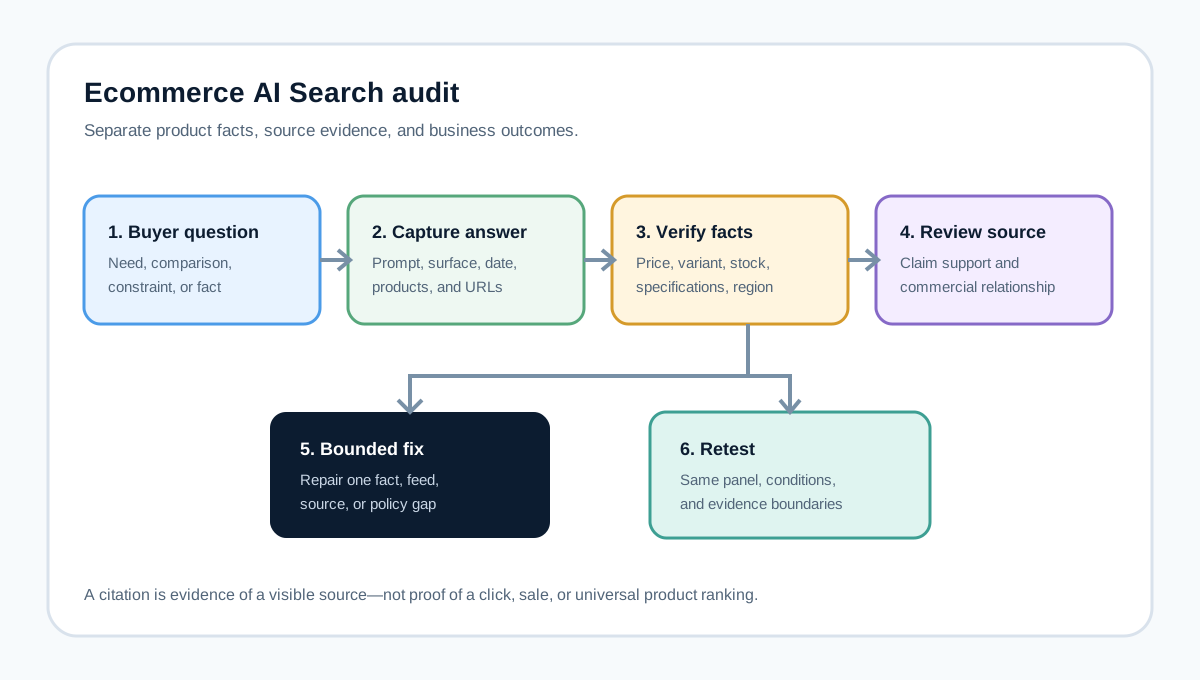
It is not a ranking report and it is not a sales attribution model. A product can be mentioned without being recommended, recommended without being cited, or cited without generating a visit. Audit those events separately:
product question → answer capture → fact check → source review → bounded fix → retestGoogle’s documentation says product structured data can make product information eligible for richer Search results and recommends providing complete, accurate data (Google Search Central: Product structured data, checked October 2, 2026). Google also says its AI features use the same foundational Search practices and may show links to supporting web resources (AI features and your website, checked October 2, 2026). Those are official documentation boundaries—not a promise that an AI answer will select a product page.
OpenAI’s web-search documentation describes a tool that can return citations and source information (OpenAI Developer Docs: Web search, checked October 2, 2026). That describes one implementation. It does not make ChatGPT, Google Search, shopping experiences, and other answer surfaces interchangeable.
This guide targets practical searches such as “which running shoes are good for flat feet?”, “best project management software under $50 per month,” and “where can I buy this product?” The examples are audit patterns, not claims about any brand’s current visibility or conversion rate.
Why ecommerce answers need a different audit
A general brand-visibility check can ask whether a company appears. Product discovery adds facts that can change frequently and can be contradicted across pages or feeds:
- Product name, variant, category, and intended use
- Price, currency, discount, and billing or purchase conditions
- Availability, stock state, delivery region, and returns
- Size, color, material, compatibility, or technical specifications
- Reviews, ratings, and the identity of the review source
- Retailer, merchant, marketplace, or manufacturer relationship
- The URL and claim that an answer actually cites
A model-generated answer may compress several of these into one sentence. Your audit should not. Record one claim at a time so that a correct price does not silently validate an incorrect availability or review statement.
The evidence boundary
| Observation | What it supports | What it does not prove |
|---|---|---|
| Product appears in a defined prompt panel | The product appeared under those conditions | Universal category visibility |
| Product is recommended for a stated need | The answer made that recommendation | Product quality or buyer satisfaction |
| Product page is cited | A URL was visible in the captured answer | That a buyer clicked it |
| Structured data validates | The markup is syntactically or semantically acceptable to the test | Inclusion in an AI answer |
| Feed contains a product | The feed supplied a record to its intended destination | That every answer engine ingested it |
| AI referral is recorded | An identifiable session arrived from a tracked surface | That a citation caused the sale |
| Orders increase after an edit | Two business observations differ | That the edit caused the change |
The academic paper GEO: Generative Engine Optimization studies visibility in a defined experimental setting (Aggarwal et al., arXiv, checked October 2, 2026). It is useful independent research context, but it does not validate a commercial GEO score, a product-feed workflow, or a revenue forecast.
1. Start with real product questions
Do not begin with a list of product URLs. Begin with the questions a buyer asks before choosing, comparing, or purchasing. Use Search Console queries, site search, support tickets, sales conversations, review-platform questions, and merchandising research as candidate inputs.
Build five intent groups:
| Intent group | Example question | Primary audit output |
|---|---|---|
| Need discovery | “What are good noise-cancelling headphones for a shared office?” | Products, criteria, and cited sources |
| Comparison | “Brand A vs Brand B for long flights” | Criteria, product facts, and missing caveats |
| Constraint | “Best standing desk under $600 with a 60-inch top” | Price, dimensions, availability, and recommendation fit |
| Product fact | “Does this laptop have 32 GB RAM and USB-C charging?” | Claim-by-claim accuracy and source |
| Transactional | “Where can I buy this in Canada?” | Retailer, region, stock, and destination URL |
Keep branded, unbranded, category, and retailer questions in separate cohorts. A high rate for “What is Brand A’s return policy?” says something different from a high rate for “best waterproof hiking boots under $200.”
Generated prompts can help find variants, but they are not independent proof of demand. Label the source and collection date of each candidate question. If region, budget, audience, or purchase condition changes, create a separate prompt version.
2. Create a product fact ledger before running prompts
A fact ledger is the reference record against which an answer is reviewed. It should contain the source of truth and the time at which the fact was checked.
product_id:
canonical_url:
variant_id:
product_name:
category:
price:
price_currency:
availability:
region:
key_attributes:
returns_url:
review_source:
first_party_source_checked_at:
feed_or_catalog_source:
owner:
Use a first-party product or policy page for facts the merchant controls. If a marketplace or retailer is the seller, record that relationship rather than treating every page as the manufacturer’s source. If two sources disagree, preserve the conflict and mark the claim needs review; do not choose the more convenient value.
Google’s product structured-data documentation discusses properties such as price, availability, and review information as part of product markup (Product structured data, checked October 2, 2026). It does not say that adding a property guarantees an AI citation or a recommendation.
3. Capture the answer, not just the product name
For every run, preserve:
- Exact prompt and language.
- Surface, mode, and model or version when disclosed.
- Market, location, and currency context.
- New or continuing conversation state.
- Complete answer or an allowed capture reference.
- Visible citations, URLs, and retailer labels.
- Product position and recommendation wording.
- The date, time zone, and panel version.
Then split the answer into atomic claims. For example:
| Answer text fragment | Claim type | Verification question |
|---|---|---|
| “Product A costs $129” | Price | Is the currency, variant, and date correct? |
| “It is in stock” | Availability | In which region and at which seller? |
| “Best for small kitchens” | Recommendation | What stated criteria support that fit? |
| “Customers rate it 4.8/5” | Review | Which platform, count, and date? |
| “Buy it here” | Destination | Is the URL the merchant, retailer, or an affiliate? |
Do not treat a cited URL as support for every sentence in the answer. A source may support a specification while not supporting the recommendation, current stock, or review summary.
4. Audit product data and page consistency
The practical question is not “did we add schema?” It is “can a reviewer reconcile the important product facts across the page, structured data, feed, and cited source?” Check the following layers:
Product page
- The visible product name and variant are unambiguous.
- Price and currency are visible and tied to the correct variant.
- Availability and purchase conditions are current.
- Important specifications use consistent units and labels.
- Shipping, returns, and region restrictions are discoverable.
- Review claims identify the source and date where relevant.
Structured data
- The markup describes the same product shown on the page.
- Variant-level values are not accidentally presented as parent-product values.
- Price, currency, and availability are current at the time of validation.
- Review and aggregate-rating properties are not copied from an unrelated item.
- The canonical URL and product identity are stable.
Feed or catalog
- The submitted identifier maps to the intended landing page.
- Country, language, currency, and availability fields match the market.
- Updates are timestamped and failures remain visible.
- Retired or unavailable products are handled according to the destination’s rules.
- The team knows whether a feed is being audited as a source, a delivery mechanism, or both.
A passing technical check is evidence about the checked artifact. It is not evidence that an answer engine will use the artifact, cite it, or recommend the product.
5. Test the recommendation criteria explicitly
Product answers often hide the selection rule. Ask the same product set under different constraints and record what changes:
- Price ceiling and currency
- Buyer type or experience level
- Intended use and environment
- Size, compatibility, or accessibility requirement
- Delivery region and timing
- Warranty, returns, or sustainability requirement
- Need for independent reviews or retailer availability
A recommendation that changes when a meaningful constraint changes may be behaving as expected. A recommendation that ignores a hard constraint is an accuracy or retrieval issue worth investigating. Neither pattern, by itself, proves a product is objectively better or worse.
For a fixed panel, report counts instead of a single blended score:
Product A appeared in 7 of 20 unbranded US-English category captures collected on October 2, 2026. It was recommended in 3 captures and cited in 2. These counts describe the defined panel and conditions; they are not a market share or sales estimate.
If a tool reports a visibility metric, inspect its denominator, refresh schedule, surface coverage, location handling, and definition of mention versus recommendation. AI Search Console, Peec AI, and Yotpo Discover may support different workflows. Their metrics should not be assumed interchangeable without checking the underlying records.
6. Review citations for buyer usefulness
A citation is valuable when it lets a buyer verify the claim they care about. Classify each visible source:
| Source class | Useful for | Important caution |
|---|---|---|
| Merchant product page | Current first-party facts and purchase path | May be selective about comparisons |
| Manufacturer documentation | Specifications and compatibility | May not show stock or final price |
| Retailer page | Local price, availability, and delivery terms | Can differ by seller or region |
| Independent review | Hands-on observations and tradeoffs | Test conditions and commercial relationships vary |
| Review platform | Review volume and user-reported experience | Rating is not proof of product performance |
| Marketplace listing | Seller and transaction context | Duplicate, stale, or unauthorized listings may exist |
A vendor-selected customer story is vendor-selected customer evidence, not independent proof. A retailer’s editorial buying guide is a commercial source, even when it contains useful observations. Name the relationship so a reader can weigh it.
When the answer cites an independent review, verify that the review actually discusses the product, variant, and criterion in question. When the answer cites a merchant page for a recommendation, treat the recommendation as weaker than the underlying product fact unless an independent source supports the comparison.
7. Choose one bounded fix
After review, choose the smallest change that addresses the observed problem:
- Correct one stale price or availability statement.
- Add a missing variant identifier or specification.
- Clarify the region, currency, or purchase condition.
- Make a returns or compatibility policy easier to verify.
- Repair a canonical or feed-to-page mismatch.
- Add an independent source for a comparison criterion.
- Remove an unsupported rating or recommendation claim.
Do not rewrite an entire catalog because one answer was wrong. First establish whether the error repeats across the fixed panel, appears on one surface, or comes from a source outside your control. A retest can show that the observation changed; it cannot isolate causation if retrieval, competitors, price, inventory, prompt wording, or model configuration also changed.
Tools such as Constructor, Algolia, and Yotpo Discover address different parts of product discovery and merchandising workflows. A product-discovery or search platform is not automatically an AI citation monitor. During evaluation, ask which answer evidence, catalog fields, and source relationships can actually be exported.
A practical ecommerce AI Search audit template
run_id:
prompt_id:
prompt_version:
intent_group:
exact_prompt:
surface_and_mode:
model_or_version:
market_language_currency:
conversation_state:
collected_at:
answer_capture:
product_mentioned:
recommendation_status:
product_position:
cited_urls:
claim_id:
claim_text:
claim_type:
reference_source:
source_class:
source_relationship_or_bias:
verification_status:
feed_page_schema_consistency:
bounded_action:
retest_date:
confidence:
Use not disclosed, not available, and unknown consistently. Missing metadata is a limitation of the observation, not permission to infer a model, location, feed, or commercial relationship.
What this audit can and cannot prove
| Audit result | Reasonable conclusion | Do not claim |
|---|---|---|
| Product facts match across page and structured data | The checked records are consistent | Guaranteed AI inclusion |
| Product appears for a constrained prompt | It appeared under the recorded conditions | Universal recommendation |
| Independent source is cited | That source was visible in the answer | The source caused a sale |
| A product disappears after inventory changes | The captured result changed while inventory differed | Inventory change caused all visibility movement |
| Feed and page disagree | There is a data-consistency problem to resolve | The feed alone caused an AI error |
| AI referral sessions increase | Tracked referrals increased in the chosen analytics setup | A citation alone caused revenue |
FAQ
Does product schema make products appear in AI Search?
No guarantee follows from adding structured data. Google documents structured data as a way to help Search understand product information and qualify for supported result features. An AI answer may use other sources, use a different retrieval path, or omit the product. Validate the markup and then test the actual answer surface separately.
Should ecommerce teams monitor product prompts or category prompts?
Both, but keep them in separate cohorts. Product prompts test fact accuracy and entity recognition. Category prompts test discovery and recommendation under buyer constraints. Combining them into one rate can hide which job is succeeding.
Are AI recommendations the same as product rankings?
No. A recommendation is an observation in a particular answer. It may reflect the prompt, context, available sources, region, date, and surface. Report the exact conditions and do not relabel a sampled recommendation as a universal ranking.
Can a citation be counted as a conversion?
No. A citation is a visible source relationship. A conversion requires a defined analytics and attribution record. Even a tracked referral does not, by itself, prove that the citation caused a purchase.
What should I test before buying an AI Search or ecommerce tool?
Ask for a real export from your own prompts or catalog: exact prompt, answer, cited URL, product or variant identity, market, date, source type, and credit or refresh unit. Confirm whether the product monitors AI answers, manages catalog data, improves onsite search, or combines those jobs. These are different workflows.
Sources and verification
- Google Search Central: Product structured data — official guidance on product markup and supported product information; checked October 2, 2026.
- Google Search Central: AI features and your website — official guidance on AI features and foundational Search practices; checked October 2, 2026.
- OpenAI Developer Docs: Web search — official documentation for one web-search tool and its citation/source behavior; checked October 2, 2026.
- Aggarwal et al., GEO: Generative Engine Optimization — independent academic research context; not evidence for a commercial product metric or business outcome; checked October 2, 2026.
Evidence confidence
Overall confidence: medium. Official sources support the boundaries around product structured data, AI Search guidance, and one documented web-search implementation. The practical audit workflow is AICiteKit editorial guidance. Product-level visibility, recommendation, citation, and commercial outcomes require a defined panel and fresh captures; this article does not claim those outcomes.
Last reviewed: October 2, 2026.