AI Search Pricing Page Audit: Make SaaS Plans Easier to Verify
A practical audit for SaaS pricing pages that separates visible plan facts, structured data, AI Search citations, referrals, and outcomes without promising rankings or revenue.
The short answer
An AI Search pricing-page audit checks whether a buyer, a search crawler, and a human reviewer can find and verify the same commercial facts. It is not a recipe for making an AI system recommend a product.
Use this sequence:
plan facts → visible evidence → structured description → answer sample → retestA strong pricing page states the plan name, price or pricing method, billing interval, included limits, overage rules, audience, and important exclusions in one canonical place. It also dates or qualifies facts that can change. Structured data can describe eligible facts, but it does not force an AI answer to cite the page.
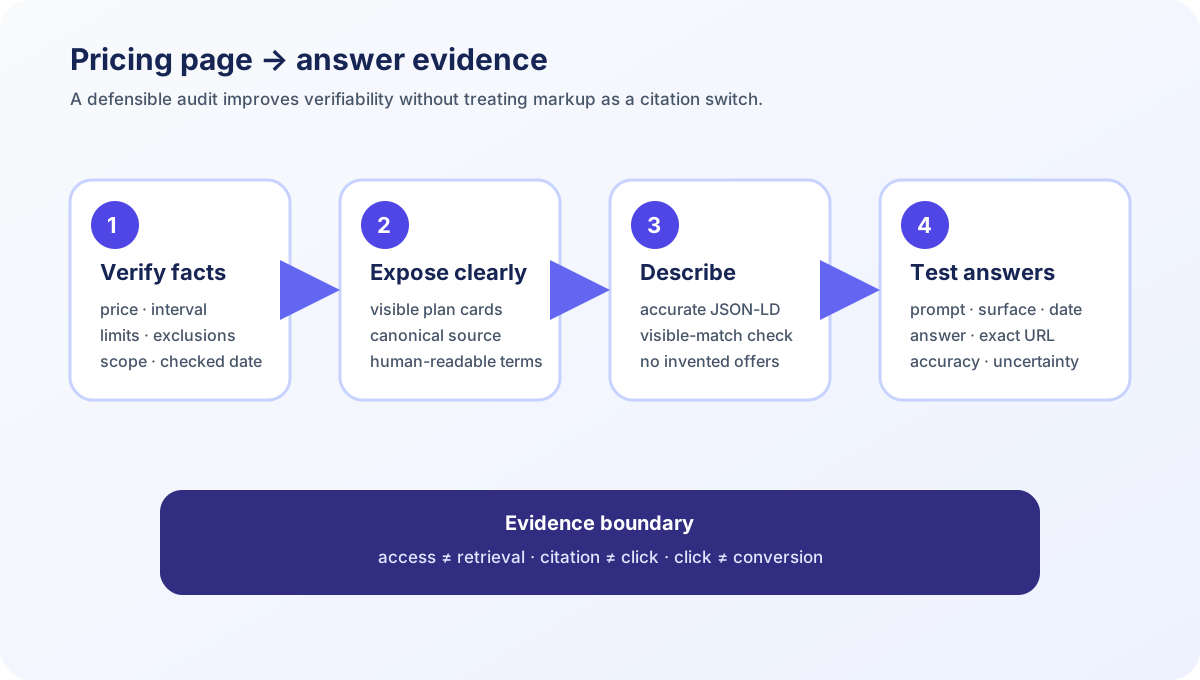
This addresses a high-intent question: “How should I optimize a SaaS pricing page for AI search?” The defensible answer is to improve clarity and verifiability for people first, then measure whether a defined set of answers changes. No page format guarantees rankings, citations, traffic, or revenue.
What a pricing-page audit can measure
Name the observation before calling it AI visibility.
| Observation | Evidence source | What it supports | What it does not prove |
|---|---|---|---|
| Plan fact | Current first-party pricing or contract documentation | The stated commercial term | That every visitor sees or qualifies for it |
| Page clarity | Human review of the rendered page | A buyer can locate and interpret the fact | That a model will retrieve it |
| Structured description | Validated JSON-LD or other markup | The page exposes machine-readable entities or offers | A rich result or citation guarantee |
| Answer mention | Captured answer under defined conditions | The product appeared in the sample | Preference or market share |
| Answer citation | Exact URL shown beside an answer claim | The URL was cited in the sample | A click, endorsement, or conversion |
| Referral | Analytics event with documented attribution | A detectable visit from an AI source | Unobserved influence or revenue |
Google says its AI features use foundational Search requirements and that appearing in them is not guaranteed (AI features and your website, checked September 5, 2026). That makes technical and content hygiene relevant, but Google does not publish a universal “pricing-page score.”
1. Freeze the commercial facts first
Do not begin with schema or copy. Begin with a fact inventory. For each public plan, record:
- Plan name and canonical URL
- Price, currency, and whether the amount is monthly, annual, per seat, or usage-based
- Whether the displayed amount is a starting price, promotional price, or custom quote
- Included seats, credits, requests, projects, storage, or other measurable limits
- Overage, fair-use, rollover, and cancellation terms
- Feature availability and material exclusions
- Trial, demo, or free-plan conditions
- Region, tax, or eligibility qualifiers
- Last checked date and the authoritative source
A pricing page often mixes “from,” annual-equivalent, monthly-billed, and contact-sales language. Those are not interchangeable. If a visitor needs arithmetic to discover the billing interval or included allowance, record that as a clarity issue rather than rewriting the number into a simpler but inaccurate claim.
Create a change record:
Fact: Pro plan includes 10 projects
Value checked: exact current wording from first-party pricing page
Checked: 2026-09-05
Scope: public US-English page
Owner: product marketing
Next review: after pricing or packaging change
The date records research provenance; it does not make a dynamic claim permanently current.
2. Make the answer visible in the page experience
A machine-readable value cannot repair a contradictory or hidden visible page. Put the essential answer near the plan card and repeat it only where repetition helps comprehension.
Minimum visible fields
| Field | Good practice | Common ambiguity |
|---|---|---|
| Price | Show currency and billing basis beside the amount | “$X” without monthly, annual, seat, or usage context |
| Plan scope | State who the plan is for | A feature list with no audience or workload boundary |
| Limits | Use units and a period | “Generous usage” or “unlimited” without a policy |
| Included features | Tie a feature to the plan | Feature names that differ between pricing and docs |
| Exclusions | State material omissions or gates | A comparison table that only lists positives |
| Changes | Provide a visible update or verification note when useful | A stale date presented as current fact |
| Next step | Explain trial, demo, or purchase path | A button without eligibility or contract context |
Use plain language before marketing language. “10 projects per workspace each month” is easier to review than “built for scale.” Keep “custom pricing” as the pricing method when no public amount is available; do not infer a number from an old article, reseller page, or competitor comparison.
Google’s people-first guidance recommends creating useful content for people rather than content made primarily to manipulate search rankings (Creating helpful, reliable, people-first content, checked September 5, 2026). This is relevant editorial guidance, not evidence that a particular wording change will produce an AI citation.
3. Keep one canonical source of truth
Pricing facts drift when the same plan is described differently across the pricing page, help center, product tour, blog, sales deck, and comparison pages. Build a small cross-page consistency check:
| Claim | Pricing page | Documentation | FAQ or blog | Status |
|---|---|---|---|---|
| Billing interval | Current wording | Current wording | Current wording | Match, conflict, or unknown |
| Usage limit | Current wording | Current wording | Current wording | Match, conflict, or unknown |
| Feature gate | Current wording | Current wording | Current wording | Match, conflict, or unknown |
| Trial terms | Current wording | Current wording | Current wording | Match, conflict, or unknown |
Resolve conflicts at the source, not by adding more copy to every page. Retire or redirect outdated pages when appropriate, and link the canonical pricing page from product documentation. A citation to an old comparison page can preserve a stale fact even after the pricing page changes; treat that as a source-maintenance issue, not proof of a ranking penalty.
For structured-data work, Schema App is a relevant implementation category example, while Yext represents a broader entity and digital-knowledge workflow. Their tool pages are product evaluations, not evidence that schema or entity management guarantees AI citations. Verify the exact implementation and validation workflow during a trial.
4. Add structured data only for supported facts
Structured data is a description layer. Google’s structured data introduction says markup helps Search understand page content, while eligibility for a rich result still depends on requirements and does not guarantee display. Treat the markup as a consistency check, not a visibility switch.
For a software product, review whether SoftwareApplication and related properties accurately describe the product. For an offer, use an appropriate Offer representation only when the offer is real, current, and visible to the user. Schema.org’s SoftwareApplication vocabulary is a vocabulary reference, not a Google ranking promise.
Before publishing markup:
- Match the visible plan name, price, currency, billing period, and availability.
- Do not encode a promotional or annual-equivalent amount as a recurring monthly price.
- Do not mark a custom quote as a numeric offer.
- Keep limits and feature claims in visible text if they matter to the buying decision.
- Validate syntax and inspect the rendered HTML, not only a source template.
- Recheck markup after a packaging, currency, or checkout change.
If the schema and visible page disagree, fix the disagreement. Adding more properties is not a substitute for accurate content.
5. Test the page as a retrieval source
A technical audit should answer whether the intended page can be accessed and understood—not whether an answer will use it. Check:
- Canonical URL and redirect chain
- HTTP status, response body, and content type
- Whether important plan facts exist in server-delivered HTML when that matters to the delivery path
- Login, consent, region, or JavaScript dependencies
noindex, robots, firewall, and rate-limit behavior- Duplicate or retired pricing URLs
- Link path from product documentation to the canonical page
- Structured-data validity and agreement with visible content
OpenAI documents its crawler and search-related bot behavior in Overview of OpenAI Crawlers, checked September 5, 2026. A request from a named bot is still only an access observation. It does not establish that the pricing page was later cited in a user answer. Do not block or allow a bot based on an assumed causal link to citations.
6. Build a pricing-focused prompt panel
Use realistic buyer questions and preserve exact wording. Separate product-fact checks from category discovery.
| Prompt group | What it tests | Example |
|---|---|---|
| Direct fact | Current public commercial term | “What does [product] cost for a five-person team?” |
| Limit | Usage boundary | “How many projects are included in [product]’s Pro plan?” |
| Comparison | Tradeoffs between plans or alternatives | “[Product] vs [competitor] pricing for a small agency” |
| Fit | Audience and workload | “Which plan fits a team that needs [documented requirement]?” |
| Risk | Contract or availability uncertainty | “Does [product] require annual billing or offer a free trial?” |
| Category | Unbranded discovery | “What should I compare when choosing a GEO monitoring tool?” |
For each run, record the exact prompt, surface and mode, model or version if disclosed, country, language, timestamp, answer, cited URLs, and whether the answer’s facts were checked against current first-party material. Keep one-answer anecdotes separate from the stable panel.
A simple reporting table is safer than one composite score:
fact accuracy rate = reviewed answers without a verified material error ÷ reviewed fact answers
citation rate = answers showing the canonical pricing URL for a qualifying claim ÷ matched answers
Always report the prompt group, denominator, surface, date, and unavailable runs. These are properties of the sample, not probabilities for every buyer.
7. Audit the answer and the source separately
When an answer includes a plan or price, preserve the claim and compare it with the current page. Classify the result:
- Accurate: the answer matches the checked scope and date.
- Stale: the answer reflects an older price, plan, or limit.
- Ambiguous: the answer omits billing basis, currency, scope, or eligibility.
- Unsupported: the cited or named source does not support the wording.
- Unverifiable: the answer or source capture is unavailable.
Do not “fix” a stale answer by changing the page to match it. First establish the current fact, then decide whether the source landscape needs correction. A third-party comparison may be useful independent context, but it should not silently be treated as first-party pricing evidence.
The independent paper GEO: Generative Engine Optimization studies generated-engine responses in a research setting (Aggarwal et al., arXiv, checked September 5, 2026). It provides academic context for measuring generated answers; it does not validate a vendor metric, prove that pricing-page markup causes citations, or establish a production business outcome.
8. Turn findings into a bounded action
| Finding | First action | Retest |
|---|---|---|
| Price lacks billing basis | Clarify visible currency and interval | Direct-fact prompts |
| Limit differs across pages | Select an owner and reconcile the canonical fact | Limit and risk prompts |
| Markup conflicts with page | Correct or remove the inaccurate property | Technical validation, then answer panel |
| Canonical page is inaccessible | Investigate redirects, access controls, and rendering | Same request conditions |
| Third-party source is stale | Verify the correction and document outreach | Source and fact prompts |
| Answer remains variable | Increase matched runs or mark uncertainty | Same panel, not a new denominator |
Change one material variable where possible. Keep the baseline capture and record launches, model changes, pricing updates, PR coverage, and other events that could explain a later difference.
For monitoring workflows, compare AI Search Console, Peec AI, and Otterly.AI by their evidence model. During a trial, verify raw answer access, exact source URLs, prompt export, location controls, historical preservation, and how the product handles plan or parser changes. Traditional SEO or content reviews do not automatically validate a tool’s GEO collection method.
Evidence snapshot
| Source | Public signal | What it supports | Confidence |
|---|---|---|---|
| Google: AI features and your website | Official guidance on AI features and foundational Search requirements | Search-product context and the absence of a guaranteed appearance claim | High |
| Google: Structured data introduction | Official structured-data guidance | Markup as a description and eligibility aid, not guaranteed display or citation | High |
| Google: People-first content | Official content-quality guidance | People-first editorial context | High |
| OpenAI: Overview of OpenAI Crawlers | Official bot documentation | Narrow crawler and search-access context; not answer citations | Medium-high |
| Schema.org: SoftwareApplication | Public vocabulary reference | Terms for describing software applications; not Google or AI Search ranking evidence | Medium-high |
| GEO: Generative Engine Optimization | Independent academic paper | Research context for generated-engine visibility; not production causal proof | Medium |
| AICiteKit editorial audit | Framework and checklists in this article | A bounded pricing-page review workflow | Editorial |
What this audit cannot prove
Even a careful pricing-page audit cannot establish:
- A universal AI Search ranking or citation position
- That schema caused an answer to use the page
- That a crawler request means a page was cited
- That a citation produced a click, lead, purchase, or revenue
- That a clearer pricing page will outperform a competitor in every market
- That one changed answer was caused by one page edit without a stronger design
- That a vendor-selected customer story is independent evidence
The useful result is narrower: a documented set of facts, page conditions, answer observations, source checks, and next tests.
Practical checklist
- Every public plan has a named owner and checked source.
- Price includes currency and billing basis.
- Limits use explicit units and periods.
- Custom pricing is not represented as an invented number.
- Material exclusions and eligibility conditions are visible.
- One canonical pricing URL is linked from relevant documentation.
- Structured data matches the visible page and is validated.
- Access, rendering, canonical, and robots checks are recorded.
- Prompts include direct fact, limit, comparison, fit, risk, and category intents where relevant.
- Full answers and cited URLs are preserved where permitted.
- Mentions, citations, referrals, and conversions are reported separately.
- A retest uses the same prompt panel and states its evidence boundary.
FAQ
Does adding FAQ or product schema make a pricing page appear in AI answers?
No. Markup can help describe content when it is accurate and supported, but it does not guarantee a rich result, retrieval, citation, or recommendation. Validate the page and test a defined prompt sample instead.
Should SaaS pricing be marked up as a product?
It depends on the actual page, entity, and supported vocabulary. Use only types and properties that accurately describe the visible product or offer. Follow current search-engine documentation and validate the rendered markup; do not add schema solely because a competitor uses it.
What if a model reports an old price?
Record the exact answer and date, verify the current first-party price, and classify the discrepancy as stale, ambiguous, or unsupported. Check relevant third-party pages for the same stale fact. Do not change current pricing to match an unverified answer.
How often should a pricing page be audited?
At every material packaging, price, currency, limit, or checkout change, plus a periodic review appropriate to how quickly the facts change. The visible review date should describe the audit, not imply that all prices remain unchanged afterward.
Can pricing-page citations be used as a revenue KPI?
Not alone. A citation is an answer observation. Revenue requires separately measured visits, conversions, and an explicit attribution method, with its limitations reported.
Sources and verification
The official Google, OpenAI, and Schema.org pages and the independent academic paper linked above were checked on September 5, 2026. AICiteKit did not run a cross-platform production benchmark for this article and did not independently test a markup change on a live SaaS pricing page. This article provides editorial methodology and does not guarantee rankings, citations, traffic, or revenue.