AI Search Retrieval Audit: How to Find Why a Page Is Missing From Answers
A practical AI Search retrieval audit for separating crawl access, document quality, prompt coverage, citations, and business outcomes without turning one answer into a ranking claim.
The short answer
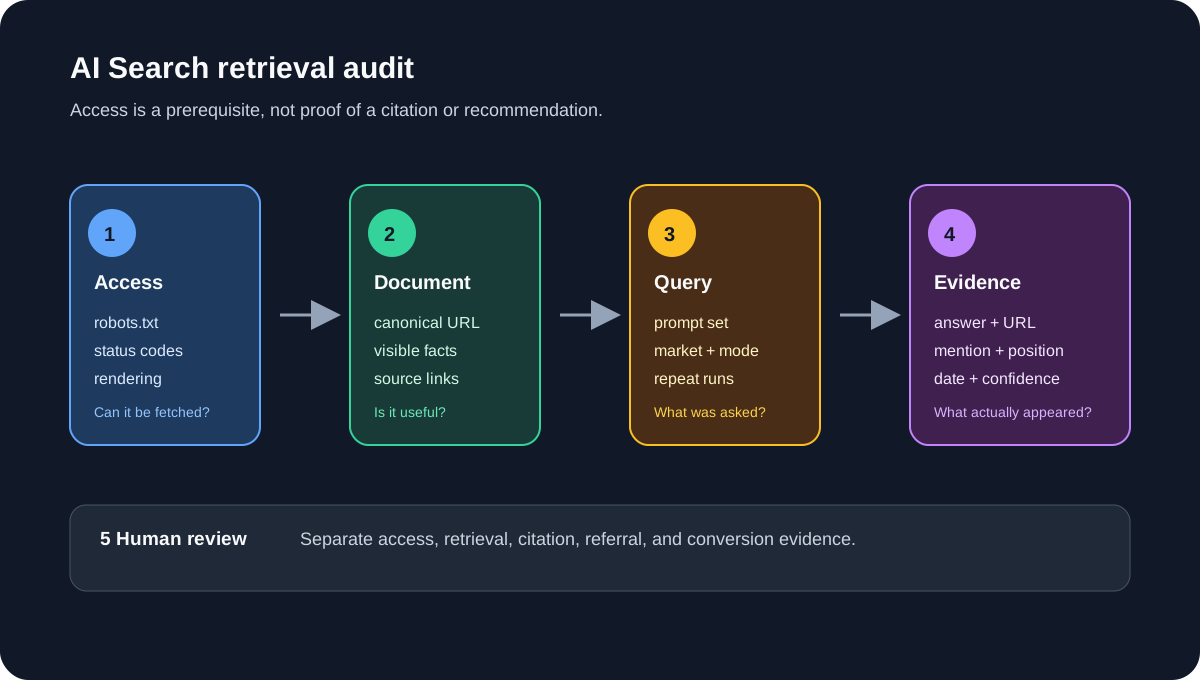
An AI Search retrieval audit asks five separate questions:
- Can the relevant automated system access the page?
- Does the page clearly publish the fact or answer a buyer needs?
- Is the page relevant to the exact prompt and market being tested?
- Did the answer actually mention or cite the page?
- Is there independent evidence of a referral or business outcome?
These are related layers, not interchangeable metrics. A page that permits a crawler is not necessarily retrieved. A retrieved page is not necessarily cited. A citation is not proof of a click, lead, or sale.
This guide addresses the practical search intent behind questions such as “why is my website not appearing in AI search?” and “how do I audit AI citations?” It complements How to Track Whether AI Engines Are Citing Your Brand, AI Crawler Analytics: What Server Logs Can—and Cannot—Tell You, and AI Search Source Quality.
What this audit can and cannot establish
Google says its AI features use the same foundational Search requirements as other Search experiences and that appearing in AI features is not guaranteed (AI features and your website, checked September 3, 2026). That makes technical accessibility worth checking, but it does not provide a formula for being cited.
An audit can establish, for a defined page, prompt set, platform, market, and time window:
- Whether a page responds successfully to the tests you ran
- Whether redirects, canonical signals, or rendering need investigation
- Whether the page visibly answers the relevant question
- Whether a sampled answer included a mention or exact source URL
- Whether analytics or server logs show a separately measured referral signal
It cannot establish from access logs or a small prompt sample alone:
- Universal AI rankings or market-wide visibility
- That a named crawler read the exact passage later used in an answer
- That one content edit caused a changed answer
- That a citation produced a visit
- That an AI-referred visit produced revenue
- That
llms.txt, schema, or keyword repetition guarantees retrieval
The independent paper GEO: Generative Engine Optimization evaluates optimization approaches in a research setting (Aggarwal et al., arXiv, checked September 3, 2026). It provides useful academic context, but it is not evidence that a particular vendor score or site change produces a production outcome.
1. Define the missing-answer observation
Start with a reproducible observation, not a vague statement that “AI does not know us.” Record:
- Exact prompt text and a versioned prompt ID
- Platform and surface, including browsing or search mode where disclosed
- Country, language, device or account context when relevant
- Collection date, time zone, and run number
- Full answer or a permitted export
- Every cited URL and the claim it appears to support
- Whether the issue is absence, factual error, outdated source, or wrong recommendation
Keep branded, category, comparison, and regional prompts in separate cohorts. “What does Brand X do?” tests identity. “Which tools solve problem Y?” tests category discovery. Mixing them can hide a real discovery gap.
A useful issue record looks like this:
Issue: owned comparison page absent from sampled answers
Prompt: COMP-004 v2
Surface: search-grounded AI surface; mode recorded
Market: United States / English
Observed: 3 runs on 2026-09-03; competitor URLs present
Not established: cause, ranking position, traffic, or revenue impact
One answer is a lead for investigation. It is not a stable denominator.
2. Check access without overinterpreting it
Access checks are the technical first layer. Review:
| Check | What to inspect | What it supports |
|---|---|---|
robots.txt |
Rules relevant to the crawler or user agent you are testing | A declared crawl instruction |
| HTTP response | Status, redirect chain, content type, cache behavior | Whether the request received a usable response |
| Authentication | Login, paywall, cookie, or consent dependency | Whether content is publicly accessible in that context |
| Rendering | Important copy present in the delivered or rendered document | Whether the answer is exposed to the test environment |
| Canonical and indexability | Canonical target, noindex, duplicate or retired URL |
Which URL should be treated as primary |
| Rate limiting | 403, 429, challenge, or intermittent failures | A possible access obstacle, not a retrieval result |
Do not treat a request from GPTBot, ClaudeBot, or another user agent as proof that a page appeared in a user-facing answer. Bot identity, purpose, and product behavior are separate questions. Check the relevant first-party documentation before interpreting a log entry; OpenAI documents its crawler user agents and purposes in Overview of OpenAI Crawlers, checked September 3, 2026.
Similarly, do not infer that blocking a training crawler blocks every search or retrieval pathway. Different products, agents, and delivery mechanisms may use different access rules. Preserve the exact user agent, timestamp, response, and URL in the audit record.
3. Inspect the document as a source
If access is not the obvious problem, inspect whether the page is a usable source for the question. Use a claim inventory:
| Document question | Evidence to capture |
|---|---|
| Who is this for? | Explicit audience, use case, and prerequisite |
| What does it do? | Plain-language capability statement tied to the product or service |
| What are the limits? | Scope, exclusions, availability, integrations, or implementation constraints |
| When was it checked? | Visible update date where freshness matters |
| Why trust the claim? | First-party documentation plus appropriately independent context |
| Where should the reader go next? | Canonical URL and useful internal navigation |
This is not a request to add repetitive “AI-friendly” copy. Google’s people-first guidance emphasizes helpful, reliable content created for people (Creating helpful, reliable, people-first content, checked September 3, 2026). Write the direct answer a buyer needs, cite the right source, and remove ambiguity.
Structured data can describe entities and offers when it is accurate and visible in the page experience. Google’s documentation also makes clear that structured data does not guarantee a rich result (Introduction to structured data markup, checked September 3, 2026). Treat it as description and validation support—not a citation switch.
4. Test relevance with a fixed prompt panel
A technically accessible page can still be irrelevant to the question, market, or answer format. Build a small panel that represents the decision:
- Category prompts: what solutions are considered?
- Problem prompts: which approaches address a defined need?
- Comparison prompts: how do named options differ?
- Evaluation prompts: what criteria should a buyer use?
- Accuracy prompts: what does the product actually support?
- Regional prompts: does the answer change by location or language?
Run the same panel under the same documented conditions before and after a change. Preserve failed or empty runs instead of silently dropping them. If the platform, prompt wording, model, region, or answer mode changes, label the result as a new cohort.
AI Search Console, PromptWatch, Peec AI, Otterly.AI, and Scrunch AI represent different monitoring approaches. Their collection methods, coverage, scoring rules, and retention should not be assumed equivalent. During a trial, inspect raw answers and exact URLs rather than relying on a single composite score.
5. Separate retrieval evidence from citation evidence
Use a layered ledger:
| Layer | Example observation | Safe wording |
|---|---|---|
| Access | Page returned 200 to the recorded request | “The page was accessible to this test.” |
| Content | Page states the documented integration limit | “The limit is published on the page.” |
| Answer | Brand appeared in 4 of 12 defined runs | “The brand appeared in this sample.” |
| Citation | Exact URL was listed in 2 of 12 answers | “The URL was cited in this sample.” |
| Referral | Analytics recorded tagged sessions from an AI referrer | “A separately measured referral signal was recorded.” |
| Conversion | CRM or ecommerce system recorded an attributed event | “An attributed business event was recorded under that system’s rules.” |
The last two layers need independent analytics evidence. Even then, attribution rules and confounding channels matter. Do not collapse “cited,” “visited,” and “converted” into one GEO score.
A careful finding might read:
The page was publicly accessible and clearly stated the comparison criteria. In the defined US-English panel, it was cited in 2 of 12 runs during the audit window. This does not identify the retrieval cause, establish a universal rank, or prove traffic or revenue impact.
6. Diagnose the likely bottleneck
After collecting the layers, classify the next action:
Access bottleneck
Fix an incorrect redirect, accidental noindex, blocked asset, authentication dependency, or unstable response—then retest the same request conditions. Do not assume the fix will change an answer.
Document bottleneck
Correct a stale fact, clarify the audience, expose an important limitation, or consolidate duplicate pages. Link to primary evidence where the claim needs verification.
Prompt or market bottleneck
Expand or rebalance the panel if it does not represent the real buying questions. Keep the original baseline intact so expansion does not masquerade as a trend.
Source-context bottleneck
If the page is accurate but the answer relies on third-party context, investigate whether independent sources describe the product or category consistently. A vendor-selected case study is vendor-selected customer evidence, not independent validation.
Measurement bottleneck
If the tool hides raw answers, source URLs, failed runs, model context, or timestamps, the problem may be auditability rather than visibility. Record that limitation in the buying decision.
A practical audit worksheet
Page and canonical URL:
Business question:
Prompt-set version:
Platform / surface / mode:
Market / language:
Collection window:
Access result:
Rendering and indexability notes:
Primary claims checked:
Cited URLs and supported claims:
Mention / recommendation rule:
Referral evidence and analytics source:
Known confounders:
One next action:
What this audit cannot prove:
Use one primary hypothesis per iteration. For example: “The page does not directly state the documented regional availability.” Make that bounded edit, publish it, and rerun the fixed panel. If the result changes, report an association unless the test design can isolate the cause.
Who should use this workflow?
This audit is a good fit for:
- Content and SEO teams investigating a specific missing or incorrect answer
- Agencies that need client reports with inspectable evidence
- Product marketers maintaining pricing, capability, or comparison facts
- Technical teams connecting access logs with answer-level observations
It is not a substitute for:
- A full technical SEO audit
- A representative study of every AI Search user
- A guarantee of citations or recommendations
- Conversion attribution or incrementality testing
FAQ
Does robots.txt control whether AI answers cite my page?
It can affect whether a particular crawler is allowed to fetch a URL, but it does not guarantee retrieval, citation, or recommendation. Record the user agent and consult the relevant product documentation before drawing conclusions.
Does adding llms.txt make a site appear in AI Search?
There is no source cited here that establishes such a guarantee. Treat any proposed convention as an experiment or documentation choice, and do not present implementation as proof of improved visibility without a controlled, documented observation.
How many prompts are enough for an audit?
Enough to represent the decision you are testing, while remaining stable and reviewable. A small balanced panel can diagnose a specific issue; it cannot support a claim about the whole market.
Can server logs prove an AI citation?
No. Logs can show requests under recorded conditions. They do not show that a page was cited in a user-facing answer or that a human saw the answer.
What should I ask an AI visibility tool during a trial?
Ask how it runs prompts, identifies the platform and model, stores raw answers and URLs, handles failures, separates cohorts, and defines mentions, recommendations, citations, and referrals. Compare the export with a manually inspected sample.
Sources and verification
| Source | Public signal | What it supports | Confidence |
|---|---|---|---|
| Google Search Central: AI features and your website | Official guidance on AI features and foundational Search requirements | Access and Search context; no appearance guarantee | High |
| Google Search Central: Creating helpful, reliable, people-first content | Official content-quality guidance | People-first editorial standard; not a GEO ranking formula | High |
| Google Search Central: Introduction to structured data markup | Official structured-data documentation | Markup can help Search understand content; no guaranteed display or citation | High |
| OpenAI: Overview of OpenAI Crawlers | Official crawler descriptions and user-agent context | How to interpret selected OpenAI crawler requests | High |
| GEO: Generative Engine Optimization | Independent academic research | Research context for generative-engine visibility | Medium |
The sources above were checked on September 3, 2026. Official sources support product and platform behavior as documented by their owners; the academic paper supplies research context. AICiteKit has not independently audited the internal retrieval systems of any AI Search platform or the collection methods of the tools named above.
This article is AICiteKit editorial guidance. It does not claim that accessibility, structured data, llms.txt, content changes, or any monitoring tool guarantees rankings, citations, traffic, conversions, or revenue.