AI Search Product Fact Audit: How to Check Pricing, Limits, and Availability
A practical AI Search product fact audit for checking pricing, limits, integrations, and availability claims in AI answers without confusing a citation with a verified business result.
The short answer
An AI Search product fact audit checks whether an AI-generated answer describes a product accurately, whether its visible sources support those claims, and whether the facts are current for the buyer’s market and product edition. It is useful for questions about pricing, credits, integrations, limits, availability, and alternatives.
Use this sequence:
fact inventory → fixed prompt panel → answer and URL capture → first-party check → independent corroborationA fact audit can show that a claim was observed and supported—or that it was stale, incomplete, or unverified. It cannot prove that a product is universally recommended, that a citation caused a click, or that a pricing-page change produced revenue.
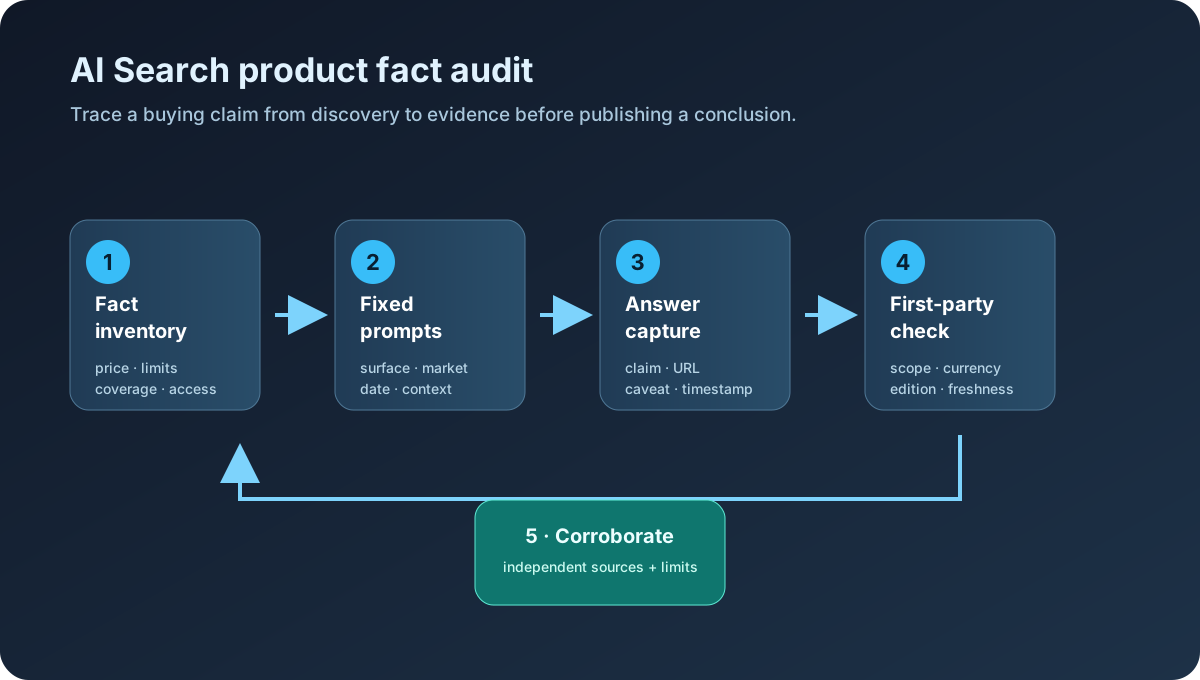
This workflow targets searches such as “is this AI tool worth it?”, “what does this GEO platform cost?”, “which AI visibility tools support my market?”, and “does this product have an API?” The safe answer is not to copy the generated summary. It is to trace each material claim to a source with a defined scope.
Why product facts need their own audit
A product answer often compresses several different claims into one paragraph:
- A monthly price may apply only to annual billing, one workspace, or a limited tier.
- A stated integration may be a native connector, an export, a partner workflow, or a roadmap item.
- A prompt or credit limit may be shared across projects rather than available per brand.
- “Available in Google AI Overviews” may describe a monitored surface, not a guaranteed appearance.
- A review may describe an earlier product edition or a different customer segment.
The first question is therefore not “did the answer mention the brand?” It is “which exact claims would change a buyer’s decision, and what evidence would be sufficient for each one?”
Google’s guidance says AI features can show links to supporting web resources and recommends foundational Search practices (AI features and your website, checked September 10, 2026). That supports inspecting visible links and maintaining useful, accessible pages. It does not publish a universal fact-verification score or guarantee that a page will be shown.
The independent paper GEO: Generative Engine Optimization evaluates visibility in generative-engine responses in an academic setting (Aggarwal et al., arXiv, checked September 10, 2026). It is research context, not proof that a commercial GEO metric measures factual accuracy or that a product-page edit causes a business outcome.
Build a product fact inventory
Start with claims that are both likely to appear in buying journeys and costly to get wrong.
| Fact group | Example claim | Minimum verification |
|---|---|---|
| Pricing | “The entry plan costs $X per month” | Current official pricing page, billing interval, currency, plan scope |
| Usage limits | “The plan includes N prompts” | Official plan or help documentation, unit definition, overage rule |
| Coverage | “The product tracks a named AI surface” | Product documentation, surface definition, region or availability qualifier |
| Integrations | “It connects to analytics or reporting software” | Integration documentation and setup requirements |
| Access | “An API or export is available” | API or export documentation, plan eligibility, retention details |
| Audience | “It is suitable for agencies” | Workflow evidence, workspace terms, reporting requirements |
| Outcomes | “Customers gained traffic or revenue” | Independent evidence; otherwise label as vendor-selected evidence or unproven |
Do not give every fact the same confidence. A current first-party pricing page is strong evidence for published commercial terms. It is not independent evidence that users achieve a business outcome. A rating is a user-experience signal, not proof of traffic growth, revenue growth, guaranteed citations, or guaranteed rankings.
1. Freeze a balanced prompt panel
A single branded question can produce a flattering but incomplete result. Use prompt groups that expose different failure modes:
| Prompt group | Example | What to inspect |
|---|---|---|
| Category | “What tools monitor AI citations for a small SaaS team?” | Inclusion criteria and category framing |
| Fact | “What does [product] include in its entry plan?” | Price, units, billing, and limits |
| Comparison | “Compare [product] with two alternatives for weekly prompt monitoring.” | Criteria, omissions, and source quality |
| Fit | “Which AI visibility tool fits an agency with multiple clients?” | Workspace, reporting, and audience claims |
| Risk | “What should I verify before buying [product]?” | Caveats, stale facts, and uncertainty |
| Regional | “Which plan and integrations are available in [market]?” | Country, currency, language, and eligibility |
Record the exact wording, surface, mode, market, language, date, and conversation state. Keep exploratory prompts outside the stable panel. A changed prompt is a changed observation, not a clean before-and-after measurement.
For recurring collection, products such as AI Search Console, Peec AI, Otterly.AI, PromptWatch, and Profound are relevant comparison points. Their internal metrics should not be assumed interchangeable. During a trial, verify whether each one preserves raw answers, exact source URLs, timestamps, prompt context, and failed runs.
2. Capture the answer, not only the score
A dashboard number or screenshot without context is a weak fact record. Preserve the evidence fields that are available:
- Exact prompt and prompt-set version
- AI surface, mode, and model label when disclosed
- Market, language, location, and account context when relevant
- Collection date and time zone
- Full answer or permitted export
- Every visible citation URL
- The claim each URL appears to support
- Product edition, plan, currency, and date statements
- Mentions, recommendations, caveats, and omissions
- Redirects, unavailable URLs, or changed pages
If the platform does not expose an internal query, hidden model version, or source-selection reason, write not exposed. Do not infer those fields from a vendor label or a URL.
Use a claim ledger like this:
Prompt: FACT-003 v1
Surface: named AI Search surface; search mode recorded when disclosed
Collected: 2026-09-10 UTC
Claim: entry plan includes a stated prompt allowance
Answer wording: captured verbatim where permitted
Source URL: exact visible URL
First-party check: current / stale / unavailable
Independent support: found / limited / not found
Scope: plan, billing interval, currency, market
Conclusion: supported for this scope; no universal product claim inferred
3. Classify every claim by evidence level
A source can be useful and still be insufficient for the claim being made.
| Evidence level | Source | Appropriate use | Boundary |
|---|---|---|---|
| A | Independent reviews, user forums, review platforms, academic research | Reported experience, recurring concerns, research context | Samples may be small or product-specific |
| B | Agency, affiliate, competitor, or commercial comparison | Workflow observations and tradeoffs | Disclose commercial relationship or bias |
| C | Official site, docs, pricing, help center, product demo | Features, plans, limits, integrations | Vendor claims are not independent outcome proof |
| D | AICiteKit editorial judgment | Conditional recommendation and interpretation | Must be labeled as interpretation |
Vendor-selected customer stories should be labeled vendor-selected customer evidence. They may illustrate a reported use case, but they are not independent validation. If independent feedback is sparse, say so explicitly.
For each important dynamic claim, record:
Source URL
Source type
Date checked
Rating and review count, if applicable
Positive themes
Negative themes
Commercial relationship or bias
Confidence level
A citation supports only the claim it actually supports. A review about usability does not automatically validate current pricing. A traditional SEO review does not automatically validate a newer GEO monitoring feature. A vendor case study does not automatically prove revenue impact.
4. Verify the official fact at the right scope
The official source is usually the right place to check what the vendor currently publishes. It is not always the right place to check whether customers experience the claimed outcome.
For pricing and limits, capture:
- Currency and billing interval
- Whether the price is promotional or standard
- Included prompts, credits, seats, projects, or domains
- Overage, rollover, and reset rules
- Annual versus monthly differences
- Feature gates by plan
- Regional or tax qualifiers
- Date checked and page version where available
For platform coverage, capture:
- The exact surface and mode
- Whether the product observes, estimates, or directly integrates
- Supported markets and languages
- Refresh cadence
- Whether raw answers and URLs are retained
- Whether coverage is included or an add-on
Do not silently convert “supports monitoring of” into “controls visibility in.” A monitoring product can record observations; it cannot guarantee that an AI engine will cite a brand.
5. Look for independent corroboration
Independent evidence is most valuable when the claim is about experience, reliability, or outcomes. Search for the exact product and feature rather than relying on a generic brand reputation.
Useful questions include:
- Do independent users describe the same workflow?
- Are recurring concerns about setup, accuracy, limits, or support visible?
- Does the source discuss the specific GEO or AI-visibility feature, or only a different product?
- Is the review current enough for the plan and product edition being assessed?
- Is the source affiliated, sponsored, vendor-selected, or competitor-authored?
If the public sample is too small, the correct conclusion is “independent evidence is limited,” not “users love it.” Avoid manufacturing consensus from one positive review or turning a rating into a causal performance claim.
6. Separate fact accuracy from visibility measurement
These are related but different audits:
| Audit | Safe conclusion | Not established |
|---|---|---|
| Product fact audit | The answer’s claim matched or conflicted with a checked source | The product is best or most popular |
| Citation audit | A URL was visibly linked in the captured answer | The URL caused the answer or a conversion |
| Mention audit | The brand appeared in a defined answer sample | Universal awareness or ranking |
| Referral audit | Analytics recorded a separately defined visit | That the citation caused the visit |
| Outcome audit | A business system recorded an event under its rules | Incremental revenue caused by AI visibility |
A fact can be accurate without being cited. A cited source can be inaccurate or stale. A mention can occur without a link. Keep these states separate in reports.
7. Retest one bounded hypothesis
A fact audit should end in a practical decision. Match the next action to the observed problem:
| Observation | Bounded action | Retest |
|---|---|---|
| Price lacks billing or currency scope | Clarify the official page and visible product copy | Same fact prompts |
| Answer cites a stale comparison | Verify the current source and document the conflict | Same comparison panel |
| Integration claim is unsupported | Add or correct the official integration documentation | Same capability prompts |
| Independent evidence is missing | Mark the evidence limited; seek genuine third-party context | Same risk prompts |
| Results differ by market | Split regional cohorts and scope claims | Matched prompts by market |
| Raw answers are unavailable | Change the measurement workflow or mark confidence lower | Trial evaluation, not a visibility conclusion |
Record the pre-change state, action date, prompt version, surface, market, and retest window. If the answer changes later, report an association unless the design isolates the cause.
Metrics that remain honest
A product fact report can use descriptive measures, but every measure needs a denominator and a rule. For example:
fact support rate = target claims supported by a checked source ÷ target claims reviewed
stale-claim rate = claims contradicted by a current source ÷ claims checked
source availability rate = cited URLs that remained accessible at review time ÷ cited URLs reviewed
Report the prompt cohort, surface, market, date range, claim types, unavailable runs, and whether multiple URLs count once or multiple times. These are properties of the sample, not probabilities for every user.
Do not collapse the result into “AI accuracy” without defining:
- Which product facts were sampled
- Which source types counted as support
- How conflicts were resolved
- Whether the answer was generated in a search or non-search mode
- Whether current plan terms were checked manually
- Which claims were outside the evidence boundary
Who should run this audit?
This workflow is useful for:
- Product marketers maintaining pricing, comparison, and alternative pages
- SEO and GEO teams checking how products are described in AI answers
- Agencies preparing evidence-led client reports
- Buyers comparing AI Search monitoring tools
- Operations teams maintaining product-data accuracy across markets
It is not a replacement for pricing governance, legal review, customer research, technical SEO, analytics attribution, or a full product-quality evaluation.
Evidence snapshot
| Source | Public signal | What it supports | Confidence |
|---|---|---|---|
| Google Search Central: AI features and your website | Official guidance on AI features, links, and Search fundamentals | Visible supporting links can be inspected; no universal appearance guarantee | High |
| Google: Creating helpful, reliable, people-first content | Official content-quality guidance | Usefulness and accuracy as editorial standards; not a product-fact score | High |
| Aggarwal et al., GEO: Generative Engine Optimization | Independent academic research paper | Research context for evaluating generative-engine visibility | Medium; not evidence for a vendor metric or causal business result |
| AICiteKit editorial framework | Claim ledger, scope checks, source classification, and bounded retest in this article | Practical audit method and interpretation | Editorial |
Practical checklist
- The fact inventory includes the claims most likely to affect a purchase.
- Prompts, surfaces, markets, languages, dates, and versions are recorded.
- Raw answers and exact visible URLs are preserved where permitted.
- Each URL is mapped to the claim it appears to support.
- Official facts include billing, unit, edition, market, and date scope.
- Independent evidence is separated from official product claims.
- Vendor-selected customer evidence is labeled and not treated as independent proof.
- Mention, recommendation, citation, referral, and conversion remain separate.
- One bounded action is selected before the retest.
- The report states what the sample cannot prove.
FAQ
Can an AI Search citation prove that a product fact is accurate?
No. A citation identifies a visible source link in a defined answer. Check whether the linked page actually supports the claim, whether it is current, and whether its scope matches the product edition and market.
Should I trust the AI answer or the vendor’s pricing page?
For current published plan terms, verify the official pricing or documentation page and record the date checked. The AI answer can help you discover claims to audit, but it may compress, omit, or stale-date commercial details.
Does structured data guarantee that product facts will be used?
No. Google’s structured-data documentation explains that markup helps Search understand page content, but valid markup does not guarantee a display outcome. Structured data should support accurate visible content, not replace it or serve as a citation guarantee.
How much independent evidence is enough?
There is no universal threshold. Use enough relevant evidence to disclose the sample, source type, date, and recurring themes. If the feature is new or independent feedback is scarce, lower confidence and say so.
Can a fact audit prove that a pricing-page update improved sales?
No. It can document a before-and-after change in observed answer wording or source use. Sales impact requires separately defined analytics, attribution rules, and—where causal claims are needed—a design capable of supporting them.
Sources and verification
- Google Search Central: AI features and your website — checked September 10, 2026 for official AI-feature and supporting-link guidance.
- Google: Creating helpful, reliable, people-first content — checked September 10, 2026 for content-quality guidance.
- Aggarwal et al., GEO: Generative Engine Optimization — checked September 10, 2026 for independent research context.
Last reviewed: September 10, 2026
Data confidence: Medium for the workflow and cited documentation; low for any platform-specific source-selection explanation that is not publicly disclosed.