Field notes / ai-search
AI Search Prompt Intent Clusters: How to Build GEO Tests Around Real Buyer Questions
A practical framework for grouping AI Search prompts by buyer intent, preserving comparable evidence, and avoiding misleading visibility averages.
The short answer
AI Search prompt intent clustering means grouping questions by the decision a searcher is trying to make, then comparing answers only within a defined group. It prevents a branded product question, a category comparison, a local recommendation, and a pricing question from being blended into one misleading “visibility” average.
Use this sequence:
real questions → intent labels → comparable cohorts → recorded answers → bounded decisionA useful report can say:
In the recorded US-English alternatives cohort, the sampled answers mentioned three products and exposed two owned URLs. Product-fact prompts were evaluated separately because they required a different source and freshness standard. This sample does not estimate every user’s answer or prove a ranking change.
That is more actionable than a single percentage with no denominator.
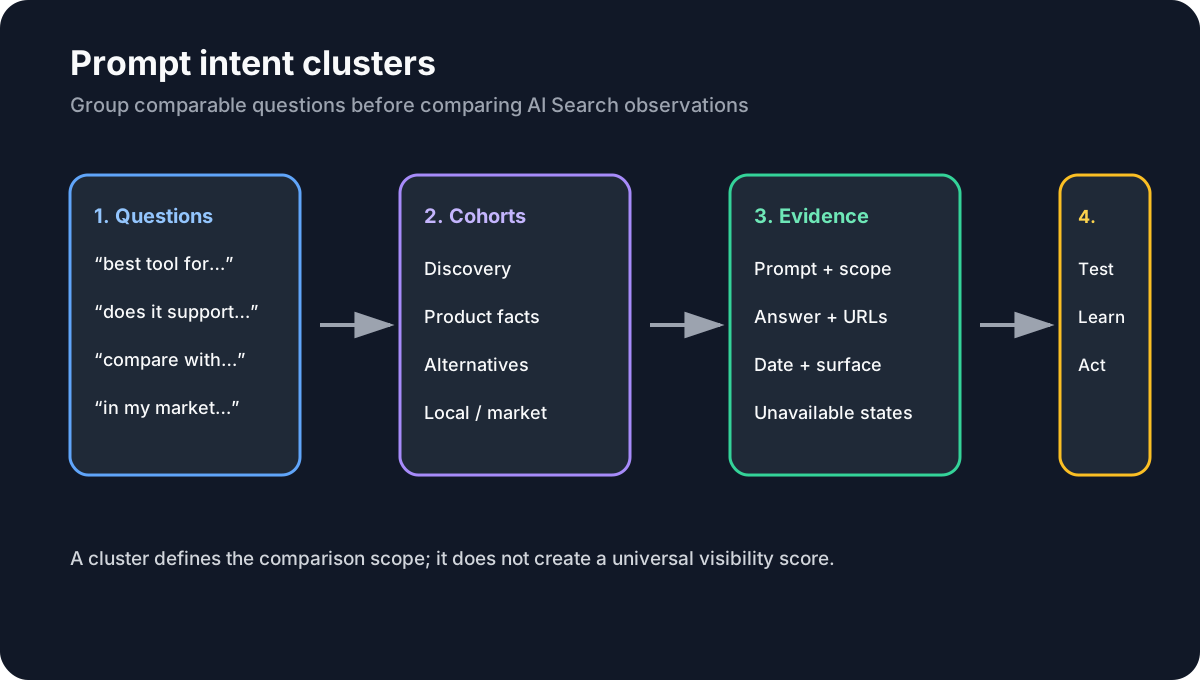
This guide addresses searches such as “how do I track AI Search prompts?”, “how should I measure GEO visibility by intent?”, and “why do AI tools report different visibility?” It is a research and measurement workflow, not a guarantee of citations, rankings, traffic, or revenue.
Why intent matters more than a large prompt count
A prompt is not just a string to monitor. It is an observation of a question, a buyer context, a market, a surface, and a collection time. Two prompts can share a keyword while asking for different evidence. Conversely, two differently worded prompts can express the same decision.
For example:
| Prompt | Likely decision | Evidence requirement |
|---|---|---|
| “What is Tool A?” | Basic discovery | Clear identity and primary product facts |
| “Which GEO tools are suitable for a small agency?” | Category evaluation | Declared criteria and comparable alternatives |
| “Does Tool A export source URLs?” | Product fact | Current documentation or plan evidence |
| “Which GEO tool serves German-language teams?” | Market fit | Locale, language, coverage, and workflow evidence |
| “Tool A vs Tool B for weekly reporting” | Comparison | Same use case, date, scope, and source standard |
A dashboard may place all five in one project. That does not make their mention, recommendation, or citation outcomes interchangeable.
Google’s documentation says AI features may show links to supporting web resources and recommends foundational Search practices (Google Search Central: AI features and your website, checked November 1, 2026). It does not define a universal intent taxonomy or guarantee that a page will appear. OpenAI’s web search documentation, checked November 1, 2026, documents citations and source information for a particular API tool; it does not establish that every consumer surface exposes sources in the same way.
The independent paper GEO: Generative Engine Optimization, checked November 1, 2026, is research context from a defined experimental setting. It is not proof that a current product score, prompt cohort, or content change causes a production business outcome.
What an intent cluster is—and is not
An intent cluster is a documented group of prompts that share a decision, audience, scope, and evidence standard. It should be narrow enough that a reader can understand what the result means.
An intent cluster is not:
- A list of similar keywords with no buyer decision
- A vendor’s opaque category label
- A guarantee that all answers should be identical
- A substitute for recording the exact prompt
- A universal ranking position
- Proof that a cited source generated a click or conversion
Use a cluster ID and a written inclusion rule. For example:
Cluster ID: ALT-AGENCY-US-01
Decision: choose a GEO monitoring workflow for a small agency
Audience: agency operator or consultant
Market/language: United States / English
Required comparison: at least two named alternatives
Exclude: product-fact-only and local-intent prompts
Evidence: answer text, visible URLs, timestamp, surface, and status
The rule makes later changes inspectable. If a prompt is added because it produced a favorable answer, that is a test-design change, not a neutral sample expansion.
1. Start with real search questions
Search intent should come from actual work rather than from a convenient list of brand terms. Useful inputs include:
- Sales and support questions, with personal information removed
- Search Console queries and landing-page themes
- Site search terms and internal knowledge-base questions
- Community discussions and public comparison questions
- Product documentation gaps and recurring objections
- Questions observed in a permitted AI Search research process
Google’s Search Console performance guidance explains that the report can help site owners inspect queries, pages, countries, and other dimensions (Search Console Performance report, checked November 1, 2026). Those queries are evidence of activity in Google Search reporting; they are not automatically AI prompts, and they do not reveal every question asked in an AI interface.
Google Trends documents that its data is sampled and normalized rather than a direct measure of absolute search volume (Google Trends: FAQ about Google Trends data, checked November 1, 2026). Use it for directional topic discovery, not as a claim about the size of an AI Search audience.
Create a raw question inventory before assigning labels:
| Field | Example | Why it matters |
|---|---|---|
| Question ID | Q-014 | Preserves the original record |
| Exact wording | Saved verbatim | Prevents paraphrase drift |
| Source | Support, Search Console, public discussion | Documents provenance |
| Audience | Buyer, user, analyst, agency | Separates decisions |
| Market | US / English | Controls regional differences |
| Date collected | ISO date and time zone | Makes freshness visible |
| Privacy status | Redacted or public | Avoids exposing personal data |
Do not turn one support ticket into a market-wide demand claim. It is a question observed in one source.
2. Label the decision, not just the keyword
A practical first-pass taxonomy can use six decision types:
| Cluster type | Typical question | Primary success observation |
|---|---|---|
| Discovery | What does this category or product do? | Accurate identity and relevant explanation |
| Product fact | Does it support a feature, plan, or limit? | Correct, current, scope-matched fact |
| Alternatives | What should I consider instead? | Comparable products and stated criteria |
| Comparison | A vs B for a defined use case | Fair distinction under the same conditions |
| Local or market | Which option serves this place or language? | Correct eligibility and market context |
| Risk or trust | Is this provider credible or safe to evaluate? | Attributed evidence and explicit uncertainty |
A question can have secondary labels. Keep the primary label tied to the decision that would change what a buyer does next. “Best GEO tool” is incomplete until the audience, use case, market, and constraints are recorded.
Avoid labels that smuggle in a conclusion:
- “High-intent winners” when the prompt merely mentions a brand
- “Commercial prompts” when no purchase action is observable
- “Citation-ready” when source quality has not been checked
- “Qualified leads” when only an answer mention was captured
3. Separate intent from prompt wording
Paraphrases should not automatically become separate tests. Normalize only what is safe to normalize, and keep the original wording beside the normalized record.
| Original prompts | Possible normalized intent | Keep separate when… |
|---|---|---|
| “best GEO tool for an agency” / “AI visibility software for consultants” | Agency category evaluation | Audience, budget, or deliverable differs |
| “does Tool A have exports?” / “can I download source URLs?” | Export capability fact | One asks about a plan or format specifically |
| “Tool A alternatives” / “what competes with Tool A?” | Alternatives discovery | One is a comparison with a named constraint |
| “best tool in France” / “French-language GEO monitoring” | Market or locale fit | Geography and language are not equivalent |
Do not delete qualifiers during normalization. “For an agency,” “on the starter plan,” “in Germany,” and “for weekly reporting” can change the answer and the evidence standard.
Keep these fields separate:
- Exact prompt
- Normalized decision
- Audience and constraints
- Named entities
- Market and language
- Surface and mode
- Prompt version
- Cluster inclusion rule
If a field is not exposed by the interface, record not exposed. Do not infer a hidden model, retrieval query, personalization state, or source-selection reason.
4. Build cohorts that can actually be compared
A cohort is a set of prompts that share enough conditions for one narrow comparison. The more conditions that vary, the weaker the interpretation.
At minimum, decide whether these are fixed:
- Surface and mode
- Model or product label, when disclosed
- Country, language, and location
- Audience and buyer constraint
- Product category and competitor set
- Prompt version and context
- Collection window and time zone
- Run count and retry policy
- Definition of mention, recommendation, and citation
A useful cohort table looks like this:
| Cohort | Include | Exclude | Why it is separate |
|---|---|---|---|
DISCOVERY-01 | Category explanations without a named vendor | Product-plan questions | Measures category framing |
FACT-01 | Feature, price, limit, or availability questions | “Best” and comparison language | Requires current fact verification |
ALT-01 | Alternatives to a named product | Unconstrained category prompts | Starts from a different buyer context |
LOCAL-01 | Market, language, or service-area constraints | Generic global questions | Eligibility is scope-dependent |
Do not calculate a combined rate until the report shows the cohort sizes and explains why combining them is meaningful. Often, the correct report is several small observations rather than one polished average.
5. Capture answers as evidence, not impressions
For every run, preserve the observation before summarizing it. Where permitted by the platform and applicable privacy rules, record:
- Exact prompt and prompt-set version.
- Cohort ID and inclusion rule.
- Surface, mode, and disclosed model label.
- Country, language, location, and account assumptions.
- Collection timestamp and time zone.
- Full answer or an allowed near-raw capture.
- Mentioned brands and products.
- Recommendations and stated criteria.
- Every visible source title and direct URL.
- The sentence or claim each source appears to support.
- Empty, failed, gated, and no-source states.
Treat these as different fields:
| Observation | What it supports | What it does not prove |
|---|---|---|
| Brand mentioned | The brand appeared in that answer | That it was recommended or selected |
| Brand recommended | The answer used recommendation language | That a buyer acted or trusted it |
| URL cited | The URL was visible in that capture | That it caused the recommendation |
| Source supports a claim | The checked passage is relevant | That the whole answer is correct |
| Answer changed on rerun | The sampled output differed | A universal visibility trend |
| Tool reports a score | A metric was calculated under its method | Comparable scores across tools |
A source can support a product fact while failing to support “best,” “most accurate,” or “will increase conversions.” Read the passage rather than inheriting the answer’s confidence.
6. Use a claim ledger inside each cohort
Intent labels make prompts comparable; a claim ledger makes answer quality reviewable.
| Claim ID | Cohort | Answer claim | Source | Status | Boundary |
|---|---|---|---|---|---|
| C-01 | FACT-01 | Product documents source exports | Official documentation | Supported if passage matches | Feature and checked date |
| C-02 | FACT-01 | Exports are on the entry plan | Pricing or plan page | Verify separately | Plan, billing, and market |
| C-03 | ALT-01 | Product is suitable for small agencies | Review or comparison | Partial or editorial | Criteria must be stated |
| C-04 | LOCAL-01 | Provider serves a named country | Official policy or local evidence | Scope-check | Eligibility and date |
| C-05 | Any | Product increased revenue | Vendor case study | Vendor-selected evidence | Not general causal proof |
Use a small status vocabulary:
- Supported: the checked passage supports the claim for the recorded scope and date.
- Partial: only part of the claim is supported, or a qualifier is missing.
- Contradicted: the checked source conflicts with the answer.
- Unavailable: the source or answer evidence cannot be checked.
- Editorial: AICiteKit interpretation rather than an observed fact.
This is especially important for recommendation prompts. A model may provide a recommendation with several citations, but a citation is not automatically evidence for the recommendation criterion, product quality, or outcome.
7. Compare cohorts without inventing a ranking
A cohort report should show the denominator, collection conditions, and missing states. A minimal summary might include:
| Cohort | Prompts | Runs | Mention observed | Recommendation observed | Visible URL | Unavailable |
|---|---|---|---|---|---|---|
DISCOVERY-01 | 8 | 16 | Report count | Report count | Report count | Report count |
FACT-01 | 8 | 16 | Report count | Usually not primary outcome | Report count | Report count |
ALT-01 | 8 | 16 | Report count | Report count | Report count | Report count |
Do not populate a table with invented values. In a real audit, counts should come from the captured run ledger. If the data is not available, report the design without pretending it is a result.
When counts are available, explain the unit:
Observed recommendation rate = runs containing recommendation language / eligible completed runsThat metric is a description of the recorded panel. It is not “share of market,” “rank,” or “probability that all users will see the brand.” Keep failed and unavailable runs visible; silently removing them can make a small panel look more certain than it is.
8. Choose the next action by cohort
Different intent clusters usually call for different work:
| Finding | Reasonable next action | Do not claim |
|---|---|---|
| Product-fact answers cite stale details | Reconcile the current fact page, scope, and date | That the edit guarantees citation |
| Comparison answers use unclear criteria | Publish a transparent comparison framework | That the framework forces recommendations |
| Local answers confuse markets | Clarify eligibility, language, and service area | That one local page fixes every market |
| Discovery answers omit the category context | Improve the explanatory page and entity clarity | That more category text guarantees visibility |
| Results vary across repeats | Expand the declared panel or mark unresolved | That one run proves a trend |
| A tool exposes a score but not raw evidence | Ask for prompt, answer, URL, and calculation details | That the score is comparable by default |
The smallest defensible action is usually better than a broad rewrite. Fix the evidence gap that belongs to the cohort, then retest the same prompt version before changing the interpretation.
Tools can support the workflow, but their cohorts are not automatically equivalent
Products such as AI Search Console, Peec AI, Otterly.AI, PromptWatch, Profound, and Rankscale may support prompt collection, source monitoring, or reporting workflows. Their product pages describe different workflows; they do not make the resulting metrics interchangeable.
During a trial, verify:
- Whether exact prompts and prompt versions are preserved
- Whether the cohort or tag is visible in exports
- Whether raw answer text and direct URLs are retained
- Whether mentions and recommendations are distinct fields
- Which surfaces, models, markets, and languages are actually covered
- How retries, failures, and unavailable answers enter the denominator
- How credits, refreshes, exports, and retention limits work
- Whether the score definition is documented well enough to reproduce
A dashboard can reduce collection work. It cannot remove the need to define the decision and inspect the underlying observation.
Common misreadings
“More prompts always produce a better measurement.”
More prompts can add noise when they mix decisions, markets, and evidence standards. A smaller, well-defined cohort can be more useful for a specific action. The right size depends on the decision and the stopping rule.
“All ‘best’ prompts belong in one cluster.”
“Best for a solo consultant,” “best for an enterprise reporting team,” and “best for a local service business” are different decisions. Preserve the constraint that changes the recommendation.
“A brand mention means the brand won.”
A mention, recommendation, citation, and click are separate observations. Report the field you actually captured.
“The top cited URL is the ranking winner.”
A source order in one recorded answer is not a universal ranking position. Check the surface, prompt, timestamp, repeated runs, and source-display rules before interpreting it.
“Search Console queries are AI prompts.”
Search Console data can inform question discovery, but it is a different measurement surface. Use it as an input to prompt research, not as a direct substitute for AI answer observations.
“A changed answer proves the content edit worked.”
A before-and-after change is an observation. Causality requires a declared test design that controls, or at least records, concurrent changes and environmental differences. Citation visibility still does not prove traffic or revenue impact.
A repeatable weekly prompt-cluster workflow
- Collect real questions from permitted first-party and public sources.
- Redact personal information and preserve provenance.
- Write the buyer decision behind each question.
- Assign a primary intent and retain important secondary qualifiers.
- Create inclusion and exclusion rules for each cohort.
- Freeze prompt text, surface, market, language, and collection window.
- Capture raw answers, visible sources, statuses, and timestamps.
- Split answer text into claims and check source support.
- Report cohort-level observations with denominators and unavailable states.
- Choose the smallest evidence-backed content or research action.
- Retest the same cohort before expanding or relabeling it.
- Archive the prompt-set version so future reports remain comparable.
The useful output is not “our average GEO score went up.” It is a traceable record showing which buyer questions were tested, what answers exposed, which claims were supported, and what remains unknown.
FAQ
How many AI Search prompts should I track?
Enough to cover the decisions that matter, with a declared stopping rule. Start with a small set of prompts per intent cohort, preserve the exact wording, and add runs when material results disagree. There is no universal prompt count that estimates every user or every surface.
Should branded and non-branded prompts be separate?
Usually, yes, when the decision and expected evidence differ. A direct “What is Brand A?” question is not the same as “Which tools should an agency consider?” If you combine them, explain why and show the cohort breakdown.
Can I use keyword volume to choose AI Search prompts?
Search volume can help prioritize topics, but it is not an AI prompt count. Combine it with support questions, product decisions, market constraints, and observed answer research. Label each input source and avoid treating directional trend data as absolute demand.
How do I measure GEO by intent?
Define the intent cohorts first, then capture the same fields for every run: prompt, surface, market, date, answer, mentions, recommendations, visible URLs, and status. Report observations within each cohort and avoid a single combined score unless its denominator and meaning are clear.
Should recommendations and citations share one metric?
No. A recommendation is answer language; a citation is a visible source relationship. A recommendation may have no citation, and a cited source may support only one factual claim. Keep them as separate fields and audit the claim-to-source relationship.
Does intent clustering improve AI Search visibility?
Intent clustering can improve research quality and help teams choose more relevant content actions. It does not, by itself, prove improved visibility, rankings, traffic, or revenue. Test any proposed content change under a declared panel and report the result narrowly.
Sources and verification
- Google Search Central: AI features and your website — checked November 1, 2026; used for the documented boundary around AI-feature links, foundational Search practices, and non-guaranteed appearance.
- Google Search Console: Performance report — checked November 1, 2026; used for the distinction between Search Console query reporting and AI prompt observations.
- Google Trends: FAQ about Google Trends data — checked November 1, 2026; used for the limitation that Trends data is sampled and normalized rather than absolute demand.
- Google Search Central: Creating helpful, reliable, people-first content — checked November 1, 2026; used for the editorial boundary against writing primarily to manipulate ranking systems.
- OpenAI Developer Docs: Web search — checked November 1, 2026; used for the product-specific distinction between a web-search tool, citations, and source information.
- Bing Webmaster Guidelines — checked November 1, 2026; used as additional platform guidance, not as evidence of a universal AI retrieval algorithm.
- Aggarwal et al., “GEO: Generative Engine Optimization” — checked November 1, 2026; used as independent research context from a defined experimental setting.
- AI Search Prompt Mapping — internal companion for turning real questions into a declared GEO test set.
- AI Search Answer Reproducibility — internal companion for rerunning prompts without false precision.
The evidence boundary is deliberate: official sources support documented platform behavior and reporting features; independent research supports research context; third-party tools support workflow comparison only when their methods and limits are inspected; AICiteKit editorial judgment turns those inputs into a conditional process. No source cited here proves a universal intent taxonomy, citation guarantee, ranking improvement, traffic increase, or revenue outcome.