Field notes / ai-search
AI Search Answer Reproducibility: How to Rerun Prompts Without False Precision
A practical AI Search reproducibility workflow for rerunning prompts, preserving answer and source evidence, and separating volatility from meaningful change.
The short answer
AI Search answer reproducibility means that another run can be compared with the first run because the prompt, surface, market, language, timestamp, collection method, and answer evidence were recorded. It does not mean that every run must return identical words or sources.
Use this chain:
freeze conditions → capture raw evidence → repeat deliberately → compare claims and sources → bound the conclusionThe practical question is not “did the AI answer change?” It is “what changed under which recorded conditions, and is the difference large enough to justify an action?” A single rerun cannot establish a universal ranking, a platform-wide citation rate, or causality between a website edit and an answer.
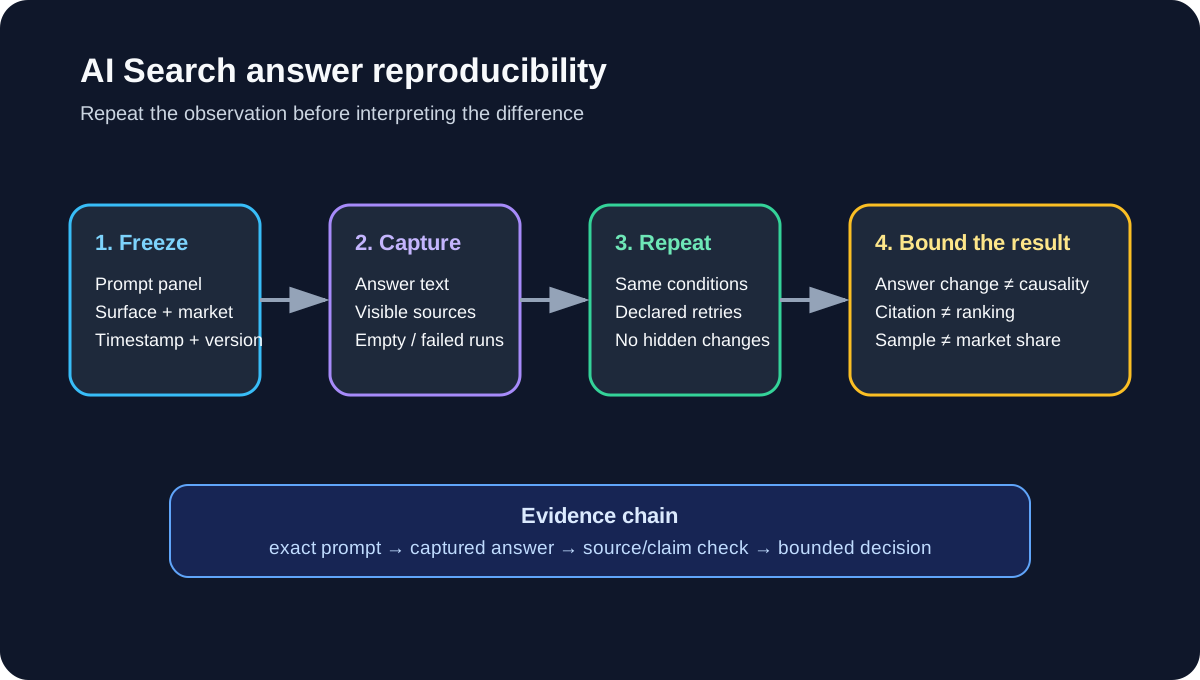
This guide addresses searches such as “why do ChatGPT answers change?”, “how do I make GEO tracking reproducible?”, and “how many times should I rerun an AI Search prompt?” It is a measurement workflow, not a citation or traffic guarantee.
What reproducibility can—and cannot—show
Google’s documentation for AI features, checked October 23, 2026, says that AI features may show links to supporting web resources and recommends foundational Search practices. It does not publish a universal reproducibility protocol or guarantee that a page will appear.
OpenAI’s web search documentation, checked October 23, 2026, documents citations and source fields for a particular API tool. That supports inspecting the fields exposed by that tool; it does not establish that every ChatGPT surface, model, or other answer engine exposes identical evidence.
The independent paper GEO: Generative Engine Optimization, checked October 23, 2026, is useful research context for studying visibility in a defined experimental setting. It does not validate a current vendor score, platform-wide citation rate, traffic forecast, or revenue effect.
| Observation | Safe interpretation | Do not claim from it alone |
|---|---|---|
| Two runs return different wording | The sampled answers differ | The system is broken or your page lost visibility |
| A source appears in one run but not another | Source presence changed in the sample | A universal source ranking |
| An answer repeats across three runs | Repetition occurred under the declared conditions | Permanent eligibility or market-wide preference |
| An owned URL appears after a release | The URL was visible after the release | The release caused the citation |
| A dashboard reports a stable percentage | The product calculated a metric under its method | Comparable visibility across vendors |
| A crawler request was recorded | A request reached the site | The page was used in a user-facing answer |
Keep answer text, mention, recommendation, visible citation, source support, referral, and conversion as separate evidence layers.
Why identical prompts do not guarantee identical answers
A prompt is only one part of an AI Search observation. Record the other variables instead of silently treating them as constant:
- Surface and mode, such as a search result feature, a chat interface, or an API tool
- Model or product label when the interface exposes it
- Country, language, device, account state, and personalization assumptions
- Collection timestamp, time zone, and whether the run was a retry
- Exact prompt text, including punctuation, attached context, and system instructions where applicable
- Retrieval or browsing state, if the surface exposes it
- Answer text, visible citations, source titles, direct URLs, and empty or failed states
- The page version and access conditions at collection time
If a field is not exposed, write not exposed. Do not infer a hidden model, retrieval query, cache state, or reason a source was selected.
A useful observation record looks like this:
| Field | Example value | Why it matters |
|---|---|---|
| Prompt ID | pricing-category-04 | Allows an exact rerun |
| Prompt text | Saved verbatim | Prevents paraphrase drift |
| Surface | Declared interface or API tool | Defines the observation scope |
| Market and language | US / en-US | Controls regional differences |
| Collected at | ISO timestamp with time zone | Makes timing inspectable |
| Run number | baseline-02 | Separates retries from new prompts |
| Answer | Raw or permitted near-raw capture | Preserves what was actually said |
| Sources | Visible title and URL pairs | Enables claim-to-source checks |
| Status | Complete, empty, failed, gated | Prevents silent omission |
1. Define the decision before choosing the rerun count
The number of repetitions should follow the decision. “How many runs are enough?” has no answer without a threshold for action.
Examples:
- Factual accuracy: repeat until a material product fact can be classified as stable, variable, or unresolved.
- Source monitoring: repeat enough to detect whether a source is intermittently visible, not to estimate a universal citation rate.
- Release checking: compare a frozen panel before and after deployment, while preserving unrelated environmental changes.
- Prompt research: sample intent cohorts rather than repeating one branded prompt many times.
A small, predeclared panel can support a narrow operational decision. It cannot support a claim about all prompts, all users, or all AI Search surfaces.
A simple stopping rule
Before collecting, write a stopping rule such as:
- Run each priority prompt twice under the baseline conditions.
- Add a third run only when the first two disagree on a material claim, recommendation, or source.
- Mark the prompt unresolved when the disagreement remains material after the declared retries.
- Do not convert unresolved observations into a visibility percentage.
This is a governance rule, not a statistical law. Teams may choose a different design, but the design should be declared before results are interpreted.
2. Freeze the prompt panel and version it
Do not create the baseline after a change. Save the exact prompt panel first and give every prompt an ID. A panel should represent the decision, not merely the maximum number of queries a tool accepts.
Useful cohorts include:
- Branded: what the company or product does
- Category: which options fit a stated need
- Comparison: how named alternatives differ
- Product fact: pricing, limits, integrations, availability, and eligibility
- Source: which pages support a particular claim
- Regional: questions where market, language, or service area changes the answer
Store the panel in a versioned file or export. If the prompt changes, create a new version; do not overwrite the baseline and call it a rerun.
The existing AI Search prompt sampling guide explains why prompt count alone is a weak answer. For release comparisons, pair this method with AI Search regression testing and AI Search answer volatility.
3. Capture the answer before summarising it
A summary loses evidence. Where collection is allowed by the platform and applicable privacy rules, preserve:
- The exact prompt and panel version.
- The complete answer or an allowed near-raw capture.
- Every visible source title and direct URL.
- Mentioned brands, products, competitors, and recommendations.
- Qualifiers such as date, geography, eligibility, and uncertainty.
- Empty, failed, login-gated, and no-source states.
- Collection conditions and timestamp.
Then split the answer into claims. A useful claim record has:
| Claim | Type | Source shown? | Source supports exact scope? | Status |
|---|---|---|---|---|
| A plan includes a feature | Product fact | Yes / no | Direct, partial, or unclear | Checked / unresolved |
| A tool fits a use case | Recommendation | Yes / no | Criteria and evidence checked | Conditional |
| A company serves a region | Availability | Yes / no | Region and date checked | Checked / stale risk |
| A competitor is “better” | Comparative judgment | Yes / no | Criteria disclosed? | Opinion / unsupported |
A citation beside an answer is not proof that the citation supports every sentence in that answer. The claim-to-source relationship still requires review.
4. Separate variation types
Not every difference is the same. Classify the change before deciding what to do.
Wording variation
The answer uses different words but preserves the same material claims, qualifiers, recommendations, and sources. This may be a low-severity difference for monitoring, though the exact policy depends on the decision.
Claim variation
A price, limit, product capability, eligibility condition, or comparison criterion changes. This deserves a source check, especially when the claim could affect a purchase or compliance decision.
Source variation
The answer cites a different URL or changes the visible source set. Compare whether the new source supports the same claim and whether the source itself changed.
Recommendation variation
The answer recommends a different product or omits one. Do not label this a ranking movement without a defined, repeated study and a disclosed method. Check whether the buyer constraints, market, prompt, and answer criteria remained identical.
Condition variation
The interface, model label, location, language, account, tool settings, or page state changed. This is not a clean repeat; record it as a new condition or exclude it from the comparison.
5. Compare at the right granularity
A character-by-character diff can overstate harmless wording changes. A one-number visibility score can hide a material factual error. Compare at three levels:
- Answer structure: Did the answer type, recommendation, or qualifiers change?
- Claim set: Which material claims were added, removed, or altered?
- Source set: Which visible URLs changed, and do they support the changed claims?
A practical comparison table:
| Prompt ID | Baseline | Repeat | Material difference | Next action |
|---|---|---|---|---|
pricing-01 | Current limit stated | Old limit stated | Yes: product fact | Check first-party source and rerun |
category-03 | Three options | Same three, reordered | No / low | Record ordering only |
source-02 | Owned URL visible | Competitor URL visible | Possibly | Compare claim coverage and conditions |
local-04 | Service area included | Area omitted | Yes: eligibility | Verify market and source freshness |
Avoid collapsing all rows into “visibility up” or “visibility down.” A denominator without the prompt cohort, surface, dates, and collection method is not a reproducible finding.
6. Use tools as evidence collectors, not truth oracles
Products such as AI Search Console, PromptWatch, Peec AI, Otterly.AI, Profound, and Rankscale may support different combinations of prompt monitoring, answer capture, source tracking, crawler context, and reporting. Their metrics are not automatically interchangeable.
During a trial or implementation review, verify:
- Whether the exact prompt, answer, and visible URLs are retained
- Whether model, surface, market, language, and timestamp are exposed
- How retries, failures, empty answers, and changed prompts are represented
- Whether the product deduplicates or groups sources before calculating metrics
- Whether exports preserve raw evidence or only derived scores
- How plan limits, refresh intervals, retention, and credits affect the sample
A tool can make a repeatable workflow easier without making the underlying answer deterministic. The measurement contract still belongs in your records.
7. Interpret repeated observations conservatively
Use language that matches the evidence:
| Evidence | Better statement |
|---|---|
| One answer differs | “The sampled answer differed on this run.” |
| Difference repeats under fixed conditions | “The difference was observed across the declared repeat set.” |
| A source supports one changed claim | “The source supports the claim in this capture.” |
| A website release precedes a difference | “The difference followed the release; causality is unproven.” |
| Analytics records an AI referral | “A referral was recorded under the analytics definition.” |
Do not report “the model now ranks us first” unless you have defined what ranking means, the surface and cohort, the collection method, the observation window, and the limits of the claim. In many AI answers, ordering is not a disclosed ranking system.
A compact reproducibility checklist
Before a rerun:
- Prompt text and panel version are frozen.
- Surface, mode, model label, market, language, and device assumptions are recorded.
- Timestamp and time zone are captured.
- Release, page, and access-policy changes are logged.
- The stopping rule is written before results are reviewed.
For each run:
- Raw or permitted near-raw answer evidence is preserved.
- Visible source titles and direct URLs are saved.
- Empty, failed, gated, and no-source states are retained.
- Claims are split before they are scored.
- Source support is checked for scope, date, and geography.
Before reporting:
- Wording, claim, source, recommendation, and condition changes are separated.
- The denominator and cohort are visible.
- Citation, mention, referral, and conversion are not merged.
- Causal language is removed unless the design supports it.
- Unresolved observations remain unresolved.
FAQ
How many times should I rerun an AI Search prompt?
There is no universal number. Choose a predeclared stopping rule based on the decision. For a narrow operational check, two baseline runs plus a conditional third run may be practical; material disagreement should remain unresolved rather than being forced into a score.
Does a repeated answer prove that the result is stable?
No. It shows repetition under the recorded conditions and sample. It does not prove permanent behavior, universal eligibility, or a market-wide ranking.
Why did the answer change when I used the same prompt?
Possible explanations include surface or mode differences, retrieval state, model or product configuration, location, language, account context, source updates, timing, or ordinary output variation. If the relevant condition is not exposed, record it as unknown rather than guessing.
Can I use answer reproducibility to prove an SEO or GEO change worked?
You can use a controlled before-and-after design to investigate whether an answer or source changed after a release. The result alone does not prove that the release caused the change, increased traffic, generated leads, or improved revenue. Those outcomes need separate evidence.
Should I report a citation percentage?
Only with a clear denominator and method: prompt cohort, surface, market, language, dates, retry policy, source definition, and handling of failures. Even then, present it as a metric for that measurement design, not as universal AI visibility.
Sources and verification
- Google Search Central: AI features and your website — checked October 23, 2026 for documented AI-feature and supporting-link context.
- OpenAI Developer Docs: Web search — checked October 23, 2026 for the fields and citation behavior documented for that API tool.
- Aggarwal et al., GEO: Generative Engine Optimization — checked October 23, 2026 as independent research context; not evidence for current commercial metrics or business outcomes.
Evidence boundary and last reviewed
This article describes a reproducibility and review method. It does not claim that any platform is deterministic, that a vendor metric is universally comparable, or that repeating an answer predicts traffic, rankings, citations, leads, or revenue.
Last reviewed: October 23, 2026
Data confidence: High for the cited documentation and research links; medium for operational recommendations, which are AICiteKit editorial guidance and should be adapted to the tested surface.