Field notes / ai-search
AI Search Prompt Portfolio: How to Measure Brand, Category, and Fit Queries
Build a balanced AI Search prompt portfolio with comparable brand, category, problem, comparison, and risk queries—without turning a small sample into a universal ranking.
The short answer
An AI Search prompt portfolio is a deliberately balanced set of questions used to observe how a brand, product, or category appears across generative search surfaces. It should include more than branded queries. A useful panel combines:
brand recall → category discovery → problem fit → comparison → risk and fact checksRecord the exact prompt, surface, mode, market, language, date, answer, and visible source URLs. Keep a stable panel separate from exploratory prompts. This makes changes easier to inspect, but it does not create a universal AI ranking or prove that a citation caused traffic, leads, or revenue.
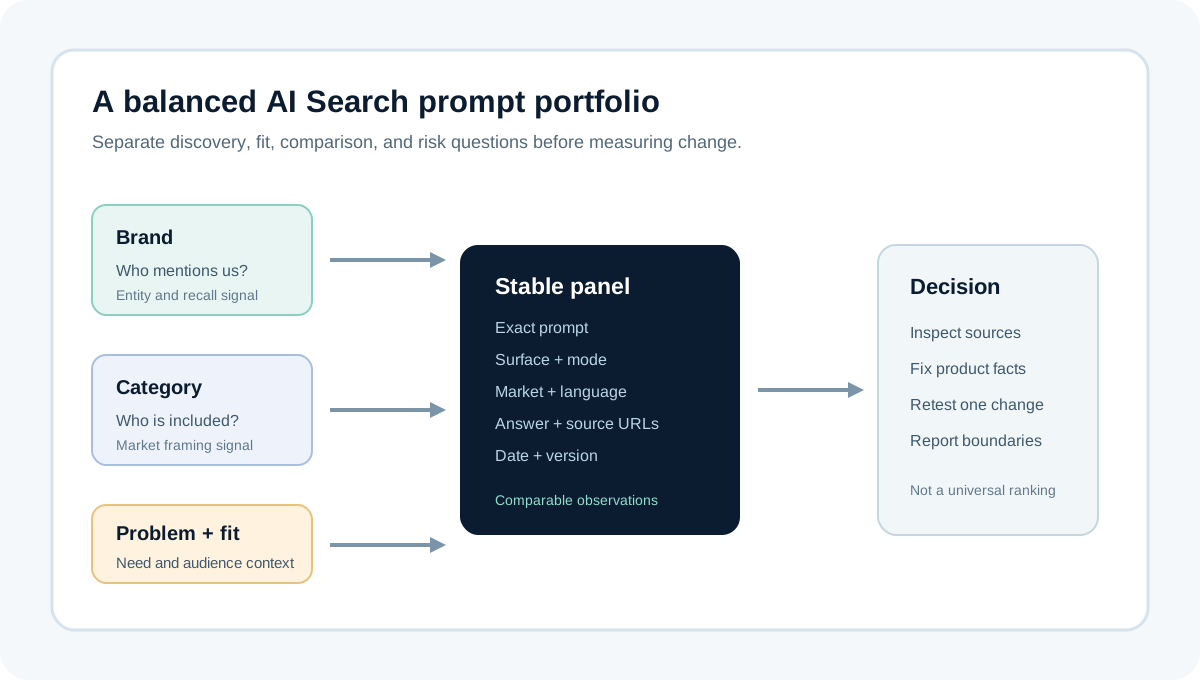
This addresses practical searches such as “what AI Search prompts should I track?”, “how do I measure GEO visibility?”, and “why does my brand appear for branded searches but not category searches?” The answer is not to maximize prompt count. It is to cover distinct decisions with a panel another reviewer can understand.
Why one prompt is not a measurement plan
A branded prompt can confirm that a system recognizes a company. It says little about whether the same system includes that company when a buyer describes a problem, compares alternatives, or asks for a recommendation.
Conversely, a single broad category prompt can overstate or understate visibility because its wording, market, answer mode, and retrieval context are underspecified. Google says AI features may show links to supporting web resources and recommends the same foundational practices for pages appearing in Search (AI features and your website, checked October 21, 2026). That supports making pages useful, accessible, and understandable; it does not publish a universal prompt score or guarantee inclusion.
OpenAI describes ChatGPT search as a web-search experience that can provide links to sources (ChatGPT search, checked October 21, 2026). This supports capturing the source links shown by that experience when they are available. It does not establish that all users see the same answer or that a source link produces a visit.
The independent paper GEO: Generative Engine Optimization studies visibility in generative-engine responses and proposes optimization methods in an academic setting (Aggarwal et al., arXiv, checked October 21, 2026). It is useful research context, but it does not validate a vendor’s proprietary score or prove a causal business outcome for a particular site.
The five prompt groups
Use groups to represent different search intents. The examples below are templates, not universal wording. Replace the bracketed terms with the audience, market, and category you actually care about.
| Group | Example prompt | Main question | Evidence to capture |
|---|---|---|---|
| Brand | “What is [brand] and who is it for?” | Is the entity recognized and described accurately? | Mention, description, source URLs, factual errors |
| Category | “What tools help [audience] with [job]?” | Is the brand included in discovery? | Inclusion rule, alternatives, source composition |
| Problem | “How should [audience] solve [problem]?” | Does the product appear when the need is unbranded? | Need framing, recommended approaches, cited evidence |
| Comparison | “Compare [brand] with [alternative] for [use case].” | Which criteria and tradeoffs are surfaced? | Claims, omissions, product facts, source support |
| Risk and fact | “What should I verify before buying [brand]?” | Are caveats, limits, and current facts visible? | Price scope, availability, limitations, uncertainty |
Do not treat the groups as a funnel with a guaranteed progression. A brand can be well recognized and still absent from a category answer. That is an observation worth investigating, not proof that the brand has no market visibility.
Build a stable panel
Start with a small set that the team can actually review. For each prompt, define:
- A stable ID and exact wording
- Intent group and business decision
- Brand, competitor, and category definitions
- AI surface and mode
- Model or version label when disclosed
- Market, country, language, and location context
- Collection date and time zone
- What counts as a mention, recommendation, citation, or source
- How unavailable, failed, and empty results are recorded
A sample record might look like this:
Prompt ID: CAT-004 v2
Group: category discovery
Surface: named AI Search surface; web-search mode recorded when disclosed
Market: United States; English
Collected: 2026-10-21 14:00 UTC
Prompt: What tools help a small SaaS team monitor AI citations?
Observed: answer captured; exact source URLs preserved
Rule: brand included only when named in the answer text
Confidence: medium; model version not exposed
If a field is unavailable, write not exposed or unknown. Do not infer a hidden model version, query fan-out, or source-selection reason from a dashboard label.
Separate stable and exploratory prompts
A stable panel supports comparison. Exploratory prompts help discover new language, competitors, questions, and failure modes. They serve different purposes:
| Panel | Use | Reporting treatment |
|---|---|---|
| Stable | Repeated observation under documented conditions | Included in trend or before/after comparison |
| Exploratory | Find new questions, wording, and sources | Kept as discovery evidence; not silently added to the baseline |
| Incident | Investigate a suspected error or stale fact | Linked to the incident; not treated as a general market sample |
Adding a successful exploratory prompt to a stable panel can create selection bias. Removing an inconvenient prompt can do the same. Version the panel and record the reason for every change.
Balance the panel without pretending it is representative
A simple starting allocation is one or two prompts per group, then expansion only when the decision requires it. There is no evidence-based universal number of prompts for every company. The right size depends on audience segments, markets, product lines, decision frequency, and the cost of reviewing raw answers.
For a small first panel, ask:
- Does each prompt map to a real buyer or content decision?
- Are branded and unbranded questions both present?
- Does at least one prompt test product facts or limitations?
- Are comparison prompts explicit about audience and use case?
- Can the team inspect every answer rather than only a blended score?
- Are markets and languages separated where the product or audience differs?
Do not average unlike observations without labeling them. A brand-recall prompt and a regional pricing prompt do not measure the same construct. If an aggregate is necessary, publish the included groups, denominator, counting rule, and missing-data treatment.
Define what counts before collecting results
A prompt portfolio becomes difficult to audit when “visibility” changes meaning from one query to the next. Define the observation layer separately:
| Signal | Defensible statement | Not established by itself |
|---|---|---|
| Mention | The brand appeared in the captured answer | Universal awareness or ranking |
| Recommendation | The answer recommended or listed the brand under the recorded wording | Preference of every buyer |
| Citation | A visible source URL was linked in the answer | That the URL caused the recommendation or a visit |
| Source support | The source appears to support a specified claim | That the whole answer is accurate |
| Referral | Analytics recorded a separately defined visit | That the citation caused the visit |
An answer can mention a brand without linking it. A source can be linked without supporting every sentence around it. A citation can be present while a price, limit, or availability statement is stale. Preserve the answer and inspect claims at source level.
Capture answers, not only scores
A score is a summary of a rule. It is not a substitute for the observation behind the rule. Preserve, where the surface and terms permit:
- Exact prompt and panel version
- Full answer or compliant export
- Visible citations and exact URLs
- Claim associated with each URL
- Surface, mode, and model label when disclosed
- Market, language, location, and account context
- Timestamp and collection status
- Mention, recommendation, and citation classifications
- Product facts, dates, caveats, and omissions
- Redirects, inaccessible pages, and parser errors
If only a chart or score is available, label the raw answer as unavailable and lower confidence. Do not reconstruct an exact answer from a metric label or screenshot summary.
Compare changes carefully
When a result changes, first determine whether the observation remained comparable. Check:
- Exact prompt wording and punctuation
- Stable-panel version
- AI surface and mode
- Model or version label, if disclosed
- Market, language, and location
- Conversation or account context
- Collection date and time
- Answer capture and source parsing rules
- Competitor and brand definitions
- Availability of raw answer evidence
If any material field changed, classify the result as a non-matched observation rather than a clean trend. AI answers can vary with wording, retrieval state, account context, and time. A changed answer is evidence of a changed observation; it is not automatically evidence of a content effect or market-wide visibility change.
Use a bounded change loop
baseline → one change → documented wait window → matched retest → interpretationExamples of bounded hypotheses:
- A pricing answer omits billing interval → clarify the official pricing page → rerun the same fact prompts.
- A category answer cites competitor pages but not the relevant guide → inspect claim coverage and source accessibility → rerun the same category prompts.
- A recommendation differs by market → split regional cohorts → compare matched prompts by market.
- A product description is inaccurate → correct the first-party fact source → retest factual prompts, without claiming causality from one later answer.
Report an observed before/after sequence as an association unless the design supports a stronger causal conclusion.
Where tools fit
A monitoring tool can reduce collection and comparison work, but tools may define prompts, citations, visibility, and coverage differently. Existing AICiteKit pages are useful comparison points:
- AI Search Console for prompt and source-oriented workflows.
- Peec AI and Otterly.AI for recurring AI visibility monitoring workflows.
- PromptWatch when prompt evidence is considered alongside analytics or crawler context.
- Rankscale for broader visibility monitoring comparisons.
These products are not interchangeable evidence systems. During a trial, verify the exact prompt list, panel versioning, raw answer access, source URL retention, market and language fields, failed-run handling, export format, and metric definitions. A dashboard can be useful even when it cannot expose every internal retrieval detail; the limitation should be visible in the report.
Evidence levels for prompt-portfolio decisions
Use the source type that matches the claim:
| Level | Source type | Appropriate use | Boundary |
|---|---|---|---|
| A | Independent research, reviews, user discussions | Research context and reported experience | Samples and feature scope may be limited |
| B | Agency, affiliate, competitor, or commercial comparison | Workflow observations and tradeoffs | Disclose bias or commercial relationship |
| C | Official product, help, pricing, or webmaster documentation | Product behavior, published terms, platform guidance | Does not independently prove outcomes |
| D | AICiteKit editorial interpretation | Conditional recommendation | Must remain labeled as interpretation |
Vendor-selected case studies are vendor-selected customer evidence, not independent proof. A rating is a user-experience signal; it is not evidence of traffic growth, revenue growth, guaranteed citations, or guaranteed rankings. Traditional SEO or writing-tool reviews also do not automatically validate a newer GEO monitoring feature.
Metrics that stay bounded
Use descriptive metrics only with their cohort and denominator. For a defined panel, you might report:
mention rate = matched prompts where the brand appeared ÷ matched prompts collected
citation rate = matched prompts with at least one defined brand source ÷ matched prompts collected
fact support rate = target claims supported by a checked source ÷ target claims reviewed
Every report should include:
- Prompt IDs and panel version
- Groups included and group-level results
- Surfaces, modes, markets, languages, and date range
- Inclusion and citation rules
- Successful, failed, unavailable, and non-matched runs
- Exact source URLs and source positions where relevant
- Whether results are answer-level, domain-level, or page-level
Do not call the result “AI market share,” “the universal ranking,” or “probability of being recommended” unless the construct and sampling design genuinely support that language. Most operational prompt panels are sampled observations, not representative surveys of all AI users.
A weekly and monthly operating cadence
Weekly: inspect exceptions
Review new factual errors, missing source URLs, changed recommendations, failed runs, and regional differences. Prioritize pricing, availability, safety, legal, and product-capability claims because errors there can change a buying decision.
Monthly: review the panel
Check whether the prompt set still represents actual decisions. Remove obsolete prompts only with a version note. Add exploratory discoveries to a separate queue. Inspect raw answers for a sample of every group instead of relying only on a blended dashboard number.
After a material release: retest deliberately
Capture a pre-release baseline, record the change, define the observation window, and rerun the same panel. If answers change, preserve both captures and state what remains unresolved. Do not attribute the change to the release merely because it happened afterward.
What a prompt portfolio cannot prove
Even a well-documented panel cannot prove:
- That every user receives the same answer
- A universal ranking across AI products or markets
- That a mention or citation caused a click, lead, order, or revenue
- That a content edit caused a visibility change without stronger design
- That crawler activity means a page appeared in an answer
- That a vendor score is comparable with another vendor’s score
- That a small prompt sample represents the whole category
The evidence boundary is part of the deliverable. “The brand appeared in 6 of 12 matched category observations under the recorded conditions” is more useful than “we have 50% AI visibility” with no panel, denominator, or source rule.
Trial checklist
Before adopting a prompt-monitoring workflow, verify:
- Can you export exact prompts, IDs, and panel versions?
- Are brand, competitor, and category definitions visible?
- Does the export preserve raw answers or compliant answer captures?
- Are exact source URLs retained, not only domains?
- Are surface, mode, model label, market, language, and timestamps recorded?
- Can failed and unavailable runs be separated from negative results?
- Can exploratory prompts stay outside the stable baseline?
- Are mentions, recommendations, citations, and referrals defined separately?
- Can you inspect group-level results rather than only one aggregate score?
- Can a second reviewer reproduce the reported conclusion from the export?
FAQ
How many AI Search prompts should I track?
Start with the smallest panel that covers the decisions you need to make, usually across brand, category, problem or fit, comparison, and risk prompts. There is no universal prompt count. Expand only when additional prompts represent a distinct audience, market, product, or decision.
Should branded prompts be part of a GEO baseline?
Yes, when entity recognition is a decision you care about. But branded prompts should not stand in for category or unbranded discovery. Report the groups separately so strong brand recall does not hide weak category inclusion.
Should I combine ChatGPT, Google AI features, and Perplexity into one score?
Usually not without a clear construct and disclosed weighting. Keep surfaces separate first. If you publish an aggregate, show the surfaces, panel membership, denominators, missing runs, and counting rule.
Is a citation the same as a recommendation?
No. A source URL can support an answer without the answer recommending the linked brand. A recommendation can appear without a visible source. Record the two signals separately.
Can a prompt portfolio prove that content caused an AI Search result?
No. It can support a controlled observation if the prompt and collection conditions are matched. A stronger causal conclusion requires a design that rules out relevant alternatives; one before/after answer is not enough.
Sources and verification
| Source | Public signal | What it supports | Confidence |
|---|---|---|---|
| Google Search Central: AI features and your website | Official guidance on AI features, links, and foundational Search practices | Platform context and discoverability guidance; not a citation guarantee | High |
| OpenAI: ChatGPT search | Official help documentation describing web search and source links | Product-level source-link context; not universal answer behavior | High |
| GEO: Generative Engine Optimization | Independent academic paper on generative-engine visibility | Research context; not validation of vendor scores or business outcomes | Medium |
| Google Search Console performance report | Official Search reporting documentation | Adjacent search-performance context; not a transcript of every AI answer | High |
| Bing Webmaster Guidelines | Official webmaster guidance on discoverability and quality | Search-access context; not a generated-answer guarantee | High |
The official pages and paper above were checked on October 21, 2026. AICiteKit has not independently audited the internal collection methods of the monitoring products named in this article. The cited sources support the stated platform and research context; they do not establish causal effects for a particular site.
This is AICiteKit editorial methodology. It does not claim that any prompt set, tool, or content change guarantees rankings, citations, traffic, or revenue.