AI Search Prompt Localization: How to Measure GEO Across Markets
A practical framework for regional AI Search measurement: keep intent stable, localize context, capture sources, and avoid treating one market's answer as a global GEO result.
The short answer
AI Search visibility is not a single global number. The answer a buyer receives can depend on the prompt language, market, location settings, search surface, model or mode, and collection date. A regional GEO program should therefore compare matched observations—not one blended score.
Use this operating rule:
stable intent + explicit context + complete answer capture = interpretable regional evidenceThe objective is not to force identical answers in every country. It is to find out whether a brand is represented accurately and usefully for the questions that matter in each market.
Why regional AI Search measurement is easy to misread
A dashboard may report that a brand was mentioned in 40% of tracked prompts. That percentage is incomplete unless the team can answer: 40% of which prompts, in which language, on which surface, from which location, and under which citation definition?
Google describes AI features as part of Search and says the same foundational SEO practices remain relevant for pages that may appear there (Google Search Central: AI features and your website, checked August 27, 2026). That guidance is useful, but it does not establish a universal AI answer ranking or guarantee a citation in any country.
The regional problem has several layers:
- Intent changes in translation. A literal translation can sound unnatural or imply a different buying need.
- The market changes the candidate set. Local providers, regulations, currencies, availability, and language sources may alter a useful answer.
- The surface changes the retrieval context. Google AI features and ChatGPT Search are not one interchangeable index.
- The answer changes over time. A comparison made on different dates may reflect source updates or normal answer variation.
- The metric changes the conclusion. Mention, recommendation, citation, position, and factual accuracy are different observations.
A regional result is therefore a contextual sample. It is not proof that every user in that market sees the same answer, and it is not a causal explanation for traffic or revenue.
Start with real regional search intent
Do not begin by translating a list of English keywords. Begin with customer language, sales questions, support tickets, query data, and the product’s actual market scope. Then group prompts by intent.
| Intent group | What to learn | Regional adaptation to record |
|---|---|---|
| Category | Which options are surfaced without a brand name? | Local category term and spelling |
| Problem | Which solutions are considered relevant? | Local pain point, regulation, or workflow |
| Comparison | Which criteria shape shortlists? | Competitor availability and market conventions |
| Evaluation | What would a buyer verify before purchase? | Currency, contract, compliance, support, and implementation |
| Branded | Is the company described accurately? | Local legal name, product name, and language |
| Risk | Are important claims correct? | Regional policy, security, pricing, and eligibility facts |
Keep a stable core panel for trend monitoring and a separate local panel for market discovery. The local panel can contain questions that do not translate cleanly; do not merge it with the stable panel and call the combined percentage “global visibility.”
A prompt record should include
- Prompt ID and intent group.
- Original wording and, when applicable, a human-reviewed translation.
- Market, country, city or location setting, and language.
- Surface, mode, and model/version if disclosed.
- Collection date, time zone, and run number.
- Complete answer capture where permitted.
- Mentioned brands, recommendation order, and descriptions.
- Every cited URL and the claim it appears to support.
- The definitions used for mention, citation, recommendation, and accuracy.
If a platform does not expose a field, record it as unavailable. Do not infer location from a country code or model version from a product name.
Use a matched-panel design
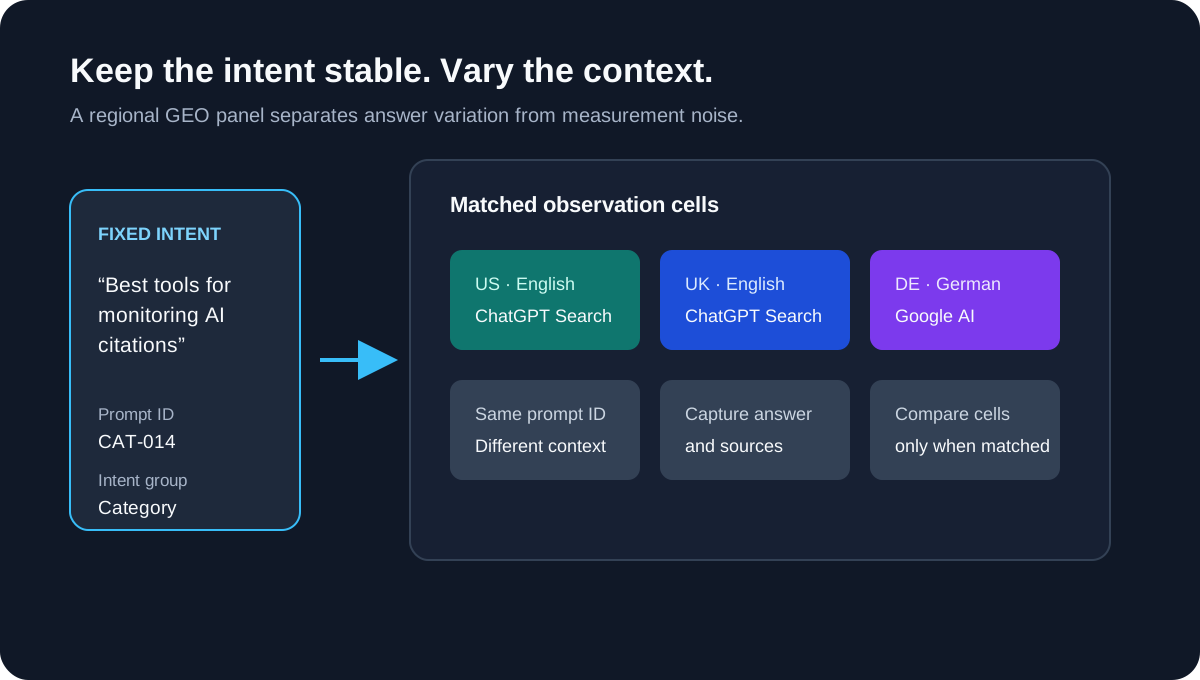
A matched panel is the smallest useful unit for regional comparison. The question intent and business scenario stay stable; context fields are deliberately varied and labelled.
For example, one prompt ID might be:
CAT-014: tools for monitoring AI citationsIts observation cells could be:
| Cell | Language | Market context | Surface | What may be compared |
|---|---|---|---|---|
| A | English | United States | One selected surface | Brand mention, sources, answer framing |
| B | English | United Kingdom | Same selected surface | Only after A and B use matched definitions |
| C | German | Germany | Same or explicitly different surface | Accuracy and local relevance, not raw parity |
The cells are not interchangeable. A German answer that recommends a local provider is not necessarily a worse answer than an English answer with a global provider. The useful question is whether the response fits the regional intent and remains factually defensible.
Freeze what should not drift
Before a retest, freeze:
- Prompt IDs and intent definitions
- Translation and terminology notes
- Surface and mode
- Location and language settings
- Mention and citation rules
- Sampling window and run number
- The page or product facts being tested
If one of these changes, create a new run or mark the comparison as non-matched. This is basic experimental hygiene, not a claim that AI answers can be made deterministic.
Capture answer evidence and source evidence separately
A regional GEO audit needs two linked but separate records.
Answer evidence
Record what the system actually said:
- Was the brand mentioned?
- Was it recommended, merely listed, or used as an example?
- Was its category and audience described correctly?
- Did the answer contain outdated or market-inappropriate facts?
- Which alternatives appeared, and in what order?
Source evidence
Record what the answer linked or named:
- Exact URLs, not only domains
- Source position where available
- The claim each source appears to support
- Whether the source is first-party, independent, user-generated, or vendor-selected
- Publication or update date when available
- Whether the source is relevant to the market and language
A citation does not automatically mean endorsement, trust, a click, or a conversion. A crawler request is also not a citation. Keep technical access, answer evidence, referral data, and business outcomes in separate fields.
Products such as Peec AI, PromptWatch, Otterly.AI, AI Search Console, and Profound represent different monitoring approaches. Before comparing outputs, verify their supported surfaces, geographic settings, prompt sampling, retention, and metric definitions on the current product documentation. Their presence in this workflow is not an endorsement or proof that their measurements are equivalent.
Score accuracy before visibility
A regional mention can be commercially useless—or harmful—if the answer gets the facts wrong. Add an accuracy review before turning a visibility observation into a content task.
| Check | Evidence to compare | Possible result |
|---|---|---|
| Identity | Official company and product pages | Correct, conflated, or unknown |
| Availability | Current regional product and support pages | Available, restricted, or unknown |
| Commercial facts | Official pricing, currency, terms, and dates | Current, stale, or not disclosed |
| Capability | Documentation or product pages | Supported, unsupported, or ambiguous |
| Independent context | Review, community, or trade sources | Corroborated, mixed, or limited |
Structured data can help make accurately marked-up facts explicit, but Google’s structured-data guidance does not promise an AI citation or a particular answer (Google Search Central: Introduction to structured data, checked August 27, 2026). The same boundary applies to translated pages: localization can improve clarity and relevance, but it cannot force selection.
Diagnose regional differences carefully
When one market performs differently, rank explanations instead of jumping to “we need more content.”
A language or terminology gap
The page may use a translation that does not match how buyers describe the problem. Review local customer language, headings, examples, and product terminology. Have a native or domain-qualified reviewer check the wording.
A source coverage gap
The answer may rely on relevant local publishers, directories, communities, or review pages that are absent from the source set available to the model. This is evidence about the observed source landscape—not a guarantee that outreach or a new page will earn a citation.
A factual consistency gap
The site, documentation, listings, and third-party pages may disagree about company name, market availability, pricing, or features. Correct the primary source first and document which independent claims remain uncertain.
A market-fit gap
A globally accurate page may omit local implementation, legal, support, currency, or availability information. Add only facts the business can support and maintain.
A measurement gap
The panels may differ in prompt wording, location, model, date, citation parser, sample size, or answer capture. Resolve this possibility before making a large editorial change.
A single observation can support several hypotheses. The audit should state what evidence would distinguish them.
Turn findings into bounded work
A useful regional workflow connects each observation to one action and one retest.
regional prompt → answer/source ledger → accuracy review → one bounded change → matched retestExamples of bounded actions include:
- Clarify a market-specific product availability statement.
- Add a locally used term to an accurate page heading and explanatory paragraph.
- Correct a stale currency, support, or eligibility fact and add a visible verification date.
- Improve internal links between a regional service page and its authoritative documentation.
- Request correction of an inaccurate third-party description, without treating outreach as a citation guarantee.
Do not change the entire site, translate every page, and alter the prompt panel at the same time. If the answer changes afterward, report an observed difference with its context. Unless the design supports causal inference, do not call it proof that the edit increased AI visibility.
A regional GEO evidence ledger
Use one row per prompt-and-market observation:
| Field | Example |
|---|---|
| Observation ID | CAT-014-US-03 |
| Intent | Category discovery |
| Prompt | Exact text plus translation note |
| Context | US English, named surface, 2026-08-27 |
| Answer result | Brand mentioned; two competitors recommended |
| Source evidence | Exact URLs and claims supported |
| Accuracy | Product category correct; regional availability unknown |
| Diagnosis | Possible local source or terminology gap; medium-low confidence |
| Bounded action | Review one regional product page |
| Retest | Same prompt ID, context, and definitions |
| Boundary | Does not prove causation, traffic, or revenue |
This ledger also makes tool disagreement diagnosable. Two products may produce different results because they use different prompts, markets, surfaces, collection dates, answer parsers, or definitions of citation. A disagreement is a reason to inspect methodology, not to select the larger number.
What to report to stakeholders
A useful regional report has a denominator and a boundary. Include:
- The markets, languages, surfaces, dates, and sample sizes.
- The stable core panel versus exploratory local panel.
- Mention, recommendation, citation, position, and accuracy results separately.
- The most frequently observed source domains and exact URLs.
- Material factual errors and their verification status.
- Missing metadata and non-matched runs.
- One or two bounded actions with owners and retest dates.
- What the sample cannot establish.
Prefer:
“In the matched 12-prompt panel collected in US English and UK English on August 27, the brand was mentioned in different proportions. The samples are contextual observations; prompt, surface, source, and answer variation remain possible explanations. The UK panel also contained one availability claim requiring verification.”
Avoid:
“The brand has 2× lower global AI visibility in the UK.”
The second statement hides the prompt universe, treats unlike contexts as one metric, and implies a stable population-level result the sample may not support.
A 30-minute regional audit checklist
- Choose one decision, such as “Is our UK product description accurate?”
- Build a stable core panel from real customer questions.
- Review translations and local terminology with a qualified person.
- Freeze surface, market, language, date window, and metric definitions.
- Capture complete answers and exact sources where permitted.
- Separate answer, source, access, referral, and business evidence.
- Verify dynamic claims against current first-party sources.
- Label independent, user-generated, vendor-selected, and unknown evidence.
- Make one bounded change.
- Retest the matched cells and report uncertainty.
FAQ
Should every country have a different prompt set?
Not entirely. Keep a stable core panel so trends can be compared, then add a clearly labelled local panel for language and market-specific intent. Combining both without labels makes the result difficult to interpret.
Does a translated prompt test the same search intent?
Not automatically. Literal translation can change nuance, terminology, or commercial meaning. Record the original, translation, reviewer, and intent rationale; treat materially different intent as a separate prompt.
Can regional GEO data prove that a page caused more traffic?
No. Answer and citation observations are not traffic attribution. Use separately defined referral and analytics evidence, and do not infer revenue or causation from a changed answer alone.
Why do two GEO tools show different country results?
Possible causes include different prompt panels, surfaces, locations, models, dates, sampling, answer captures, parsers, and definitions. Compare methodology before comparing percentages.
Is a local citation automatically better than a global citation?
No. Relevance, accuracy, freshness, provenance, and usefulness matter. A local source may be highly relevant for availability but weak for a technical claim; evaluate the claim-source relationship rather than the source’s geography alone.
Sources and verification
- Google Search Central: AI features and your website — official guidance on AI features and the continued relevance of Search fundamentals; checked August 27, 2026.
- Google Search Central: Introduction to structured data — official structured-data guidance and its evidence boundary; checked August 27, 2026.
- GEO: Generative Engine Optimization — independent academic paper that introduced the GEO term and evaluated generative-engine visibility approaches; used as research context, not as proof of a universal ranking formula.
- Peec AI — AICiteKit tool page used to identify a monitoring workflow that should be checked for geographic and sampling details before comparison.
- PromptWatch — AICiteKit tool page used as a related prompt-monitoring reference.
- Otterly.AI — AICiteKit tool page used as a related AI Search monitoring reference.
- AI Search Console — AICiteKit tool page used as a related measurement reference.
- Profound — AICiteKit tool page used as a related enterprise AI-visibility reference.
Evidence boundary: Official documentation supports how a provider describes its search or structured-data systems. The academic paper supports research context. Tool pages describe related products, but neither tool-page inclusion nor a product’s reported metric should be treated as independent proof of rankings, citations, traffic, or revenue.
Verification date: August 27, 2026