AI Search Source Portfolio: How to Build Evidence That Can Support Citations
A practical framework for building a balanced AI Search source portfolio across first-party documentation, independent coverage, and community evidence—without promising citations or rankings.
The short answer
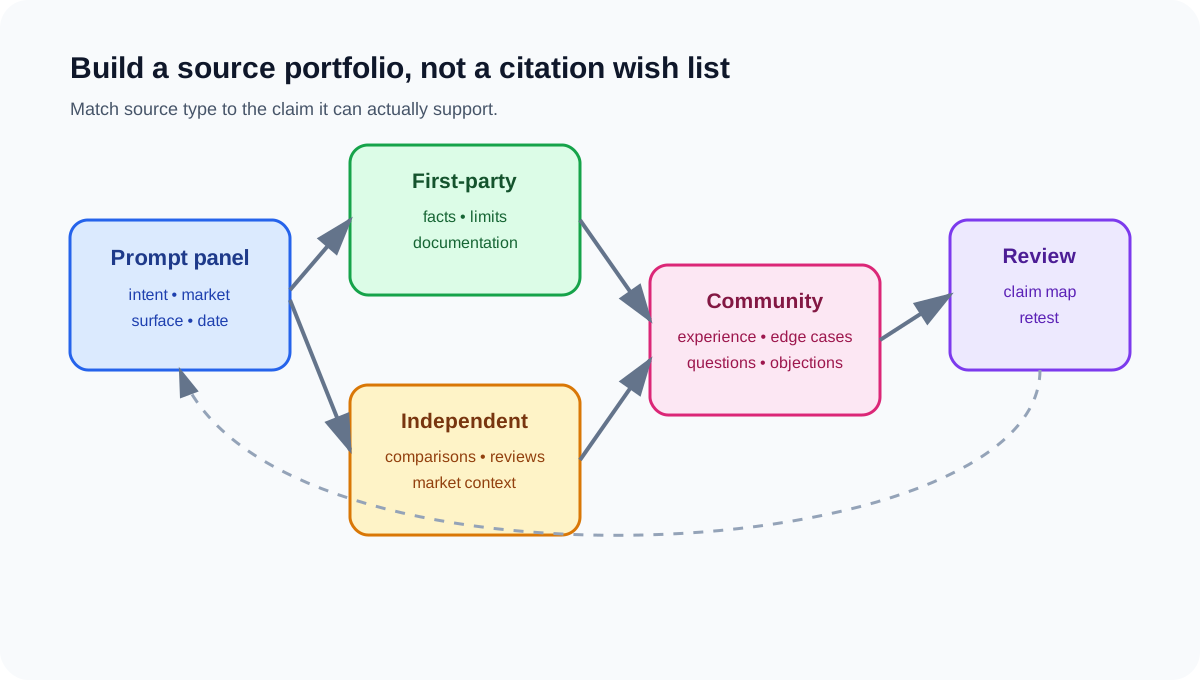
A useful AI Search source portfolio is not a list of pages designed to win a citation. It is a deliberate mix of sources that can support different claims:
- First-party pages establish current facts, limits, policies, and documentation.
- Independent coverage supplies comparison, context, and an outside assessment.
- Community evidence reveals questions, edge cases, and lived experience.
Start with a prompt panel, map the claims appearing in the answers, identify which source type should support each claim, and then retest the same questions. This can improve the quality and inspectability of your evidence. It cannot guarantee a citation, ranking, referral, or revenue outcome.
This guide targets searches such as “how do I get cited in AI Search?”, “what sources influence AI answers?”, and “how should a GEO team build an evidence strategy?” It is an editorial measurement and content framework, not a claim that any source mix is preferred by every model.
Why one source type is not enough
AI answers often combine several kinds of information. A product page may be the right source for an integration name, while an independent comparison explains how buyers distinguish alternatives. A community discussion may expose an implementation problem that the product page does not mention.
These sources are not interchangeable:
| Source type | Strongest use | Important boundary |
|---|---|---|
| First-party documentation or pricing | Current features, limits, policies, setup steps | It is controlled by the vendor and does not independently prove outcomes |
| Independent review or comparison | Workflow observations, tradeoffs, market context | It may be dated, incomplete, affiliate-supported, or commercially positioned |
| Community discussion | Questions, edge cases, recurring friction | Anecdotes are not prevalence estimates or product-wide conclusions |
| Research paper or standards body | Definitions, methods, research context | Experimental findings do not automatically validate a commercial tool |
| Vendor case study | What the vendor says happened in one selected case | Vendor-selected customer evidence is not independent causal proof |
The goal is not to manufacture a favorable source profile. The goal is to make important claims easier to verify and harder to misinterpret.
1. Define the questions before collecting sources
Build a prompt panel around decisions, not around a preferred answer. Include several intent groups:
- Category discovery: Which products or approaches fit a problem?
- Comparison: How do named alternatives differ?
- Evaluation: What should a buyer check before choosing?
- Accuracy: What does a product cost, include, or integrate with?
- Risk: What limitations, exclusions, or implementation concerns matter?
- Regional: Does the answer change by market, language, or local availability?
Record the exact prompt, surface, model or mode when disclosed, location, language, date, and whether the answer was regenerated. AI Search Console, Peec AI, PromptWatch, Otterly.AI, and Profound represent different approaches to monitoring or analyzing AI answers. Their outputs should not be treated as identical measurements without checking their prompt and collection methods.
Google’s documentation says its AI features can show links to supporting web resources and recommends foundational Search practices (Google Search Central: AI features and your website, checked September 13, 2026). That is guidance about appearing in Google’s Search features, not a public promise that a particular source will be selected.
2. Create a claim map from real answers
Capture the answer before deciding what to publish. For each important statement, record:
| Field | Example | Why it matters |
|---|---|---|
| Prompt and intent | “Which AI visibility tools suit an agency?” — comparison | Preserves the decision context |
| Answer claim | “Tool A includes scheduled prompt monitoring” | Separates an observation from a general belief |
| Cited URL | Exact visible URL, if available | Identifies the source actually shown |
| Needed evidence | Feature documentation plus workflow review | Defines the evidence gap |
| Source class | First-party, independent, community, or unclear | Sets the confidence boundary |
| Freshness | Publication or verification date | Dynamic facts decay at different speeds |
| Action | Verify, update, investigate, or no action | Prevents automatic content rewriting |
Do not convert a source count into a quality score without explaining the rule. Ten citations from one vendor-controlled domain are not the same evidence as ten independent sources, and neither proves that buyers trust the answer.
OpenAI’s web-search documentation describes citations and source information returned by its web search tool (OpenAI Developer Docs: Web search, checked September 13, 2026). That documents one implementation. It does not make source behavior in other AI surfaces interchangeable.
3. Fill the first-party evidence layer
The first-party layer should answer the questions only the organization can authoritatively answer:
- What is the product or service?
- Which plans, limits, regions, and integrations are current?
- What does setup require?
- What is excluded or still uncertain?
- Where can a buyer verify the detail?
Use stable, specific pages rather than hiding every fact in a generic landing page. Add dates to dynamic information and link from overview pages to documentation, pricing, policies, and changelogs where appropriate.
A first-party page can establish what the organization says about its own product. It should not be presented as independent evidence of improved traffic, revenue, rankings, or citations. Keep vendor-selected customer stories labelled as vendor-selected customer evidence.
4. Earn or locate independent context without copying it
Independent sources can help an answer explain tradeoffs that first-party pages cannot. Relevant examples include editorial reviews, transparent comparisons, research papers, professional communities, and customer discussions with attributable context.
Evaluate each source for:
- Relevance to the exact prompt and market
- Date and likelihood of stale facts
- Disclosure of sponsorship, affiliate links, or commercial relationships
- Whether the author tested the product or is repeating a vendor claim
- Specificity of the workflow and limitations described
- Whether the source distinguishes observation from outcome
A competitor-authored comparison can still reveal useful workflow differences, but label its commercial relationship. An academic result can inform a method, but it is not proof that a commercial GEO feature works in the same way. The source portfolio should expose these boundaries rather than hide them.
The paper GEO: Generative Engine Optimization provides research context for optimizing visibility in generative-engine responses (Aggarwal et al., arXiv, checked September 13, 2026). It is an academic study, not validation of a universal ranking formula or a business outcome.
5. Use community evidence as a question generator
Community sources are valuable for discovering what product pages omit:
- Repeated setup obstacles
- Unexpected limits or edge cases
- Confusing terminology
- Differences between an advertised workflow and a real workflow
- Questions buyers ask before purchase
Do not treat a handful of posts as a representative user survey. Record the date, context, number of attributable reports, and whether the issue was independently reproduced. Quote sparingly and link directly where publication rights and context permit.
A community pattern can justify a verification task or a clearer FAQ. It does not by itself prove that all users experience the same problem, nor does a positive anecdote prove a tool caused a business result.
6. Choose the smallest evidence action
Use the source gap to choose an action:
| Finding | Bounded action | What to retest |
|---|---|---|
| Answer states an outdated limit | Update the canonical first-party page | Whether the fact is described correctly in the same prompt panel |
| Comparison lacks a buyer criterion | Add a dated, sourced comparison section | Whether the criterion is represented accurately |
| Community reports an unclear workflow | Reproduce it and document the result | Whether the documentation answers the question |
| Independent source contains a factual error | Contact the publisher or publish a correction trail | Whether later answers stop repeating the error |
| Cited sources differ by region | Split the prompt panel by market and language | Whether regional differences remain after scope is fixed |
| No reliable source supports a claim | Mark it uncertain or remove it | Whether the next answer avoids the unsupported claim |
Do not respond to every missing citation by publishing another article. The right action may be a documentation fix, a source correction, a structured-data check, or no action until the observation repeats.
7. Report portfolio coverage honestly
A monthly report can show:
- Prompt groups, markets, surfaces, dates, and sample size
- Answer claims and visible cited URLs
- First-party, independent, community, research, or vendor-selected source classes
- Accuracy and freshness checks
- Actions taken and the exact retest scope
- Uncertainty, missing fields, and competing explanations
Keep these outcomes separate:
- Visibility: the brand appeared in a defined answer sample.
- Citation: a source URL or source label appeared with an answer.
- Referral: analytics recorded a detectable visit from an AI surface.
- Conversion: a defined attribution system recorded an outcome.
A citation is not a click. A click is not proof of causation. A source portfolio can improve evidence quality while producing no measurable traffic change, and traffic changes can have other explanations.
Practical checklist
- The prompt panel includes discovery, comparison, accuracy, risk, and relevant regional intents.
- Exact prompts, surfaces, dates, markets, and available model information are preserved.
- Each important answer claim is mapped to a URL or explicitly marked unsupported.
- First-party, independent, community, research, and vendor-selected evidence are labelled separately.
- Pricing, limits, integrations, and other dynamic facts are checked against current official sources.
- Community themes are not presented as representative survey results.
- Competitor or affiliate relationships are disclosed.
- Actions are bounded and have a retest definition.
- Visibility, citations, referrals, and conversions are reported as different evidence layers.
FAQ
Does a larger source portfolio guarantee more AI citations?
No. It may make relevant claims easier to verify, but citation selection depends on the surface, query, retrieval context, freshness, and other factors that are not fully disclosed. Test a defined prompt panel instead of promising a result.
Should every brand publish more third-party content?
No. First determine whether the gap is missing first-party facts, weak independent context, an inaccessible page, stale information, or sampling uncertainty. Third-party coverage should be relevant and genuinely independent, not manufactured to imitate a citation pattern.
Are community posts reliable AI Search sources?
They can be useful evidence of questions and experiences. They are usually weaker support for universal claims unless the pattern is attributable, repeated, and independently checked. Preserve context and avoid turning anecdotes into prevalence statistics.
What is the difference between a source portfolio and a backlink strategy?
A backlink strategy focuses on links and authority signals. A source portfolio focuses on the evidence needed for specific answer claims across first-party, independent, community, and research sources. The two can overlap, but a citation or link does not automatically validate the claim it accompanies.
Sources and verification
- Google Search Central: AI features and your website — official guidance on Google’s AI features and foundational Search practices; checked September 13, 2026.
- Google Search Central: Creating helpful, reliable, people-first content — official content-quality guidance; checked September 13, 2026.
- OpenAI Developer Docs: Web search — official documentation for one web-search and citation implementation; checked September 13, 2026.
- Aggarwal et al., GEO: Generative Engine Optimization — independent academic research context; checked September 13, 2026.
- AICiteKit: How to Evaluate AI Search Source Quality — related source-review framework.
- AICiteKit: AI Search Evidence Ledger — related recordkeeping method.
Last reviewed: September 13, 2026
This is AICiteKit editorial guidance. It does not guarantee visibility, citations, rankings, traffic, or revenue.