AI Search Evidence Ledger: How to Document Mentions, Citations, and Claims
A practical AI Search evidence ledger for recording prompts, answers, cited URLs, claims, and uncertainty without turning a small sample into a ranking or revenue claim.
The short answer
An AI Search evidence ledger is a structured record of the observation behind a visibility report. For each run, preserve the exact prompt, search surface, model or mode when disclosed, market, date, answer, cited URLs, supported claim, and review decision.
Use this sequence:
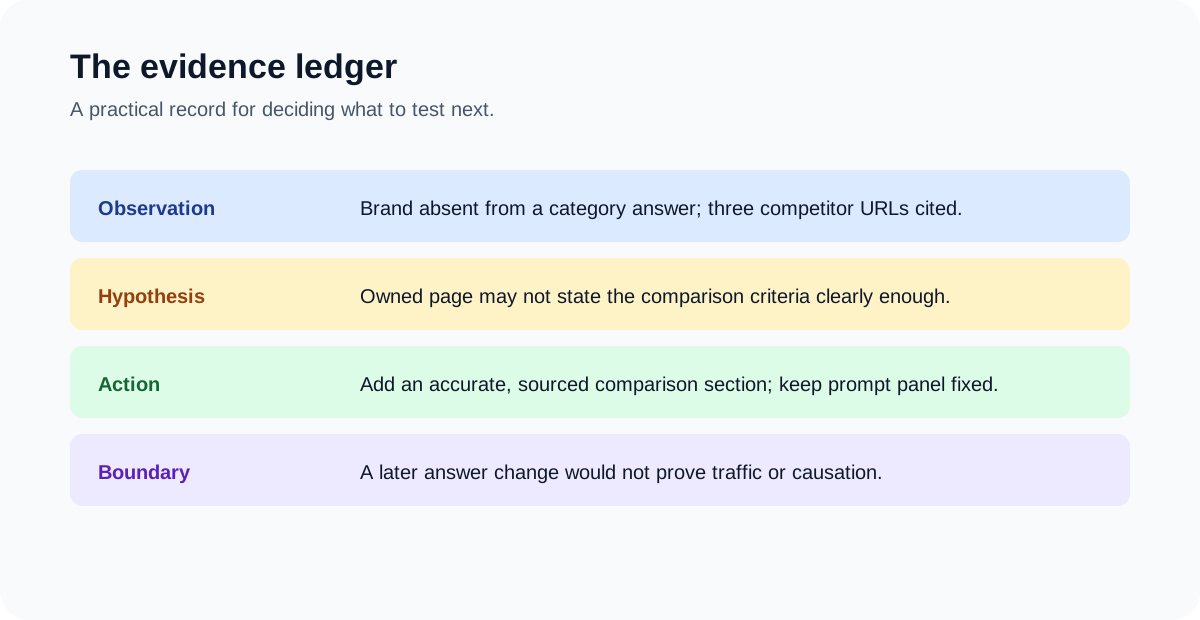
question → context → answer capture → claim/source mapping → review → bounded actionA ledger does not create a ranking position or guarantee a citation. It makes a sampled observation inspectable. That distinction matters because “the brand was mentioned,” “the brand was recommended,” “the brand’s page was cited,” and “the cited page generated a visit” are different events.
This guide targets practical searches such as “how do I track AI citations?”, “how can I document ChatGPT or Google AI answers?”, and “what should a GEO report include?” It is a documentation and measurement framework, not a method for guaranteeing visibility, traffic, or revenue.
Why a dashboard score is not enough
A dashboard can summarize mentions or citations, but a summary cannot answer every question a reviewer will ask:
- What exact prompt produced the result?
- Which AI surface and market were tested?
- Did the answer recommend the brand, merely mention it, or cite an owned URL?
- Which sentence or product claim did each source support?
- Was the source first-party, independent, user-generated, or vendor-selected?
- Was the answer factually correct at the time of collection?
Google says AI features in Search can show links to supporting web resources and recommends the same foundational technical and content practices used for Search (Google Search Central: AI features and your website, checked September 12, 2026). That is official guidance about Search features and site practices. It is not a public formula for citation selection and does not promise inclusion.
OpenAI’s web-search documentation describes a search tool that can return citations and source information (OpenAI Developer Docs: Web search, checked September 12, 2026). That documents one OpenAI search implementation; it does not make results from ChatGPT, Google AI features, or another model interchangeable.
The academic paper GEO: Generative Engine Optimization studies visibility in generative-engine responses in an experimental setting (Aggarwal et al., arXiv, checked September 12, 2026). It provides research context, not validation for a commercial score, a universal retrieval rule, or a causal business outcome.
What belongs in the ledger
Start with one row per prompt run or one row per answer, depending on how much detail the surface returns. Do not collapse several answers into a single percentage before preserving the underlying records.
| Field | Example | Why it matters |
|---|---|---|
| Observation ID | CAT-014-R03 |
Makes a result traceable |
| Prompt version | category-v2 |
Prevents silent wording changes |
| Exact prompt | “Which tools help an agency monitor AI citations?” | Preserves the tested intent |
| Surface and mode | ChatGPT Search, when disclosed | Defines the observation context |
| Model/version | Record when shown; otherwise not disclosed |
Avoids guessing routing |
| Market and language | United States, English | Separates regional evidence |
| Date and time zone | 2026-09-12, UTC+8 | Makes later comparisons interpretable |
| Answer capture | Permitted text or screenshot reference | Allows human review |
| Mention status | absent / mentioned / recommended | Separates presence from preference |
| Cited URL | Full URL where available | Identifies the source actually shown |
| Supported claim | “Lists the product as an option” | Connects source to answer meaning |
| Source class | first-party / independent / community / vendor-selected | Sets an evidence boundary |
| Accuracy decision | supported / outdated / unclear / contradicted | Prevents visibility from becoming trust |
| Reviewer and date | Initials plus review date | Makes editorial QA accountable |
| Next action | verify pricing page; no action; retest | Keeps the record operational |
If a platform or tool does not expose a field, record not available. Missing metadata is a limitation of the observation, not permission to infer it.
1. Define the decision before collecting answers
A ledger is most useful when it supports a decision. Choose one primary question for the run:
- Accuracy: Does AI Search describe the product, price, limits, or integrations correctly?
- Category discovery: Which brands and independent sources appear for non-branded questions?
- Comparison: Which buying criteria and competitors are represented?
- Source development: Which publishers, directories, communities, or documents shape the answer?
- Maintenance: Has a previously cited source become stale or contradictory?
The decision controls what you record. If the question is accuracy, a mention count is insufficient. If the question is source development, a brand recommendation alone is insufficient. If the question is traffic, an answer citation is not a visit log.
2. Version the prompt and its context
Treat a monitored prompt as a measurement contract. Keep a stable panel for trend reporting and a separate exploratory panel for newly discovered questions. If the wording, language, location, surface, or scoring rule changes, create a new version.
A prompt record should include:
- A stable ID and intent group.
- Exact wording and language.
- Market, country, city, and location settings when relevant.
- Surface, mode, and model/version if disclosed.
- Run date, time zone, and run number.
- Whether the conversation was new or continued.
- The rule for mention, recommendation, position, citation, and accuracy.
For example, changing “tools for monitoring AI citations” to “best enterprise AI visibility platforms in the UK” is not a minor edit. It changes the audience, market, and likely candidate set. Record it as a new prompt, not as a continuation of the old trend.
The same discipline applies when using specialist products. AI Search Console may represent a different collection workflow from Peec AI, PromptWatch, Otterly.AI, or Profound. During a trial, verify which fields are preserved rather than treating their headline metrics as identical.
3. Capture the answer before interpreting it
Save the complete answer or a permitted capture before extracting metrics. At minimum, record:
- The answer text or a stable capture reference
- Mentioned brands and recommendation order
- Every visible source URL or source label
- The claim associated with each source
- The answer date and collection context
- Any uncertainty, caveat, or refusal in the answer
Do not record only “competitor cited” or “brand absent.” Those labels lose the context needed to diagnose the observation. A competitor may be cited for a comparison definition while your first-party page is cited for a product limit. Both are useful, but they support different conclusions.
A minimal answer record
| Observation | Answer observation | Source observation | Review decision |
|---|---|---|---|
CMP-006-R01 |
Brand B recommended first; Brand A mentioned second | Independent review linked for category comparison | Check whether the comparison criteria are represented accurately |
FACT-003-R01 |
Brand A price described | First-party pricing URL shown | Verify price and billing interval against the current page |
RISK-002-R01 |
Integration claim is qualified as uncertain | No supporting URL visible | Do not publish the claim until documentation is checked |
These are record formats, not claims about real-world product performance. A useful ledger distinguishes an observed answer from the action a reviewer chooses to take.
4. Map each citation to a claim
A citation is easier to evaluate when the ledger says what it appears to support. Use one row per source-to-claim relationship when an answer contains several claims.
| Claim type | Review question | Common boundary |
|---|---|---|
| Product fact | Does a current first-party page support the feature or limit? | A cited page may be outdated |
| Price | Does the source state the same currency, interval, and conditions? | A mention of a price is not a pricing guarantee |
| Comparison | Does the source explain the criterion used in the answer? | A competitor-authored comparison may be commercially biased |
| User experience | Is the evidence independent and attributable? | A vendor case study is vendor-selected customer evidence |
| Market recommendation | Is the source independent, current, and relevant to the market? | Recommendation frequency is not proof of quality |
| Outcome | Is there a measured visit or conversion record? | A citation does not prove a click or revenue |
Classify source provenance explicitly. Useful labels include:
- First-party: official product, documentation, pricing, or policy page.
- Independent: review platform, editorial publication, community, or research source not controlled by the vendor.
- Commercial comparison: agency, affiliate, competitor, or sponsored comparison with a possible incentive.
- Vendor-selected customer evidence: a case study or testimonial selected and published by the vendor.
- Unclear: provenance or relationship cannot be established from the available record.
This classification does not decide whether a source is correct. It tells the reviewer what kind of evidence it is and what claims it can reasonably support.
5. Separate the evidence layers
Use separate columns for the following observations:
| Layer | What it can support | What it cannot prove by itself |
|---|---|---|
| Visibility | The brand appeared in the defined answer sample | Universal AI ranking or market share |
| Recommendation | The brand was proposed or ordered in a sampled answer | Product quality or buyer satisfaction |
| Citation | A source URL was shown with the answer | That anyone clicked it |
| Crawler access | A known automated agent requested a page, if logs identify it | That an answer used or cited the page |
| Referral | An identifiable session arrived from an AI surface | Total AI audience or causation for a sale |
| Conversion | A defined attribution system recorded an outcome | That the citation alone caused the outcome |
This separation is the central reason to keep a ledger. If a report begins with a citation row and ends with a revenue claim, the intermediate evidence must be shown rather than implied.
For crawler work, How to Use AI Crawler Analytics Without Misreading Bot Traffic is a useful companion. For attribution boundaries, see AI Visibility vs AI Citations vs AI Traffic. Neither crawler requests nor citations should be silently relabeled as human visits.
6. Review source quality without copying the source
A cited page can be relevant and still be inaccurate, stale, or commercially biased. Review it on four dimensions:
- Relevance: Does it answer the intent in the prompt?
- Accuracy: Can the specific claim be verified?
- Freshness: Is the information current for the collection date?
- Actionability: Does it provide evidence a buyer or editor can use?
Then compare the source with primary documentation and independent evidence. Do not rewrite a page merely because another page was cited. First ask what claim the source supplied and whether your own evidence is missing, unclear, inaccessible, or outdated.
For example, an independent review may explain how several tools differ, while an official pricing page is the better source for current billing terms. A community discussion may reveal a recurring workflow problem, but it does not establish that every user has the same experience. A vendor case study can document what the vendor says happened, but it is not independent proof of a general outcome.
7. Turn ledger patterns into bounded actions
A single answer can be useful for fact checking, but it is weak evidence for a broad content strategy. Look for repeated, well-defined patterns:
- The same inaccurate product fact appears across several runs.
- Independent sources repeatedly explain a buyer criterion that your page omits.
- A citation disappears after the source becomes unavailable or stale.
- The prompt panel changed, making an apparent trend non-comparable.
- Different surfaces produce different source sets for the same intent.
Choose one bounded action, such as:
- Correct one factual statement on the canonical page.
- Add a clearly sourced comparison criterion.
- Replace an outdated pricing reference.
- Improve the page’s entity name, scope, or documentation links.
- Ask an independent publisher to review an inaccurate public claim.
- Run the same versioned prompt panel again after a defined interval.
Record what changed and what did not. A retest can show that the sampled answer changed after an edit; it still does not isolate causation if the model, sources, date, or prompt context also changed.
A practical ledger template
Copy this structure into a spreadsheet or database and add fields required by your team:
observation_id:
prompt_id:
prompt_version:
intent_group:
exact_prompt:
surface_and_mode:
model_or_version:
market:
language:
location_context:
collected_at:
answer_capture:
mentioned_brands:
recommendation_order:
cited_url:
claim_supported:
source_class:
source_relationship_or_bias:
accuracy_status:
review_notes:
change_made:
retest_date:
confidence:
Use unknown, not disclosed, or not available consistently. Do not fill a missing model, location, or commercial relationship with a guess.
Confidence is about the record, not the outcome
A high-confidence row means the prompt, answer, source, and review decision are well preserved. It does not mean the product will be cited again or that the action will increase traffic.
A simple internal scale can be:
- High: complete answer and source capture, stable context, claim verified against a current source.
- Medium: answer and context captured, but a key field or source relationship is incomplete.
- Low: summary metric only, incomplete answer, unknown context, or a single unreplicated observation.
Document why the confidence was assigned. Confidence should fall when the evidence boundary is unclear, not rise because the result is favorable.
What an evidence ledger can and cannot show
A well-maintained ledger can show:
- Which questions were tested and when.
- How answers described or recommended a brand.
- Which URLs were visibly cited for which claims.
- Whether the source was first-party, independent, commercial, community, or vendor-selected.
- Which facts were supported, outdated, unclear, or contradicted.
- Whether a later sample changed under a recorded context.
It cannot show by itself:
- A universal ranking across AI systems.
- Every answer a market sees.
- Guaranteed future citations or recommendations.
- That a crawler request was an answer citation.
- That a citation generated a visit.
- That an answer change caused a conversion or revenue result.
FAQ
Is an AI Search citation the same as a mention?
No. A mention is text that names or describes a brand. A citation is a source link or source reference shown with an answer. A brand can be mentioned without an owned URL being cited, and a source can be cited without the brand being recommended.
How many prompts should an evidence ledger contain?
There is no universal minimum. Start with a small panel that covers the decision’s important intent groups, then preserve the exact denominator and context. More prompts do not fix a poorly defined intent, mixed markets, or missing answer captures.
Should I track every AI model in one score?
Only if the score is explicitly labelled as an aggregate and the underlying surfaces, prompts, weighting, and missing fields are documented. For diagnosis, keep surface-level records separate; a blended number can hide disagreement between systems.
Can a citation prove that my page drove traffic?
No. A citation records a source shown in a sampled answer. Traffic requires a separate visit measurement with an attribution definition. Even a detectable referral does not automatically prove that the citation caused a conversion.
Should I copy the structure of pages that AI Search cites?
Not automatically. First identify the claim the source supported, assess its relevance and accuracy, and check for commercial bias. Improve your own evidence where a real gap exists rather than copying a page because it appeared once.
Sources and verification
The following sources were checked on September 12, 2026:
- Google Search Central: AI features and your website — official guidance on AI features in Search and foundational site practices; it does not publish a universal citation formula.
- OpenAI Developer Docs: Web search — documentation for an OpenAI web-search tool and its citation/source fields; it does not establish equivalence with other AI Search surfaces.
- Aggarwal et al., “GEO: Generative Engine Optimization,” arXiv — academic research context for generative-engine visibility; not evidence of a commercial tool score or guaranteed outcome.
Last reviewed: September 12, 2026. Data confidence: High for the cited official and academic source descriptions; medium for the operational framework, which is AICiteKit editorial guidance and should be adapted to the fields each platform actually exposes.