AI Search Content Refresh: A Practical Workflow for Updating Pages Without Chasing Citations
How to refresh content for AI Search with a stable prompt panel, source and fact checks, bounded edits, and evidence that separates observations from causality.
The short answer
An AI Search content refresh should begin with an observed problem, not a request to “add GEO keywords.” Capture the same prompts before and after the change, inspect the answer and source evidence, then update the smallest set of facts or explanations that address a verified gap.
Use this loop:
observe → classify → verify → edit one layer → retest → report boundariesA citation, mention, or recommendation is an answer-level observation. It is not automatically a ranking, click, conversion, or revenue result. The refresh process is valuable because it preserves those distinctions while still giving a content team a practical next action.
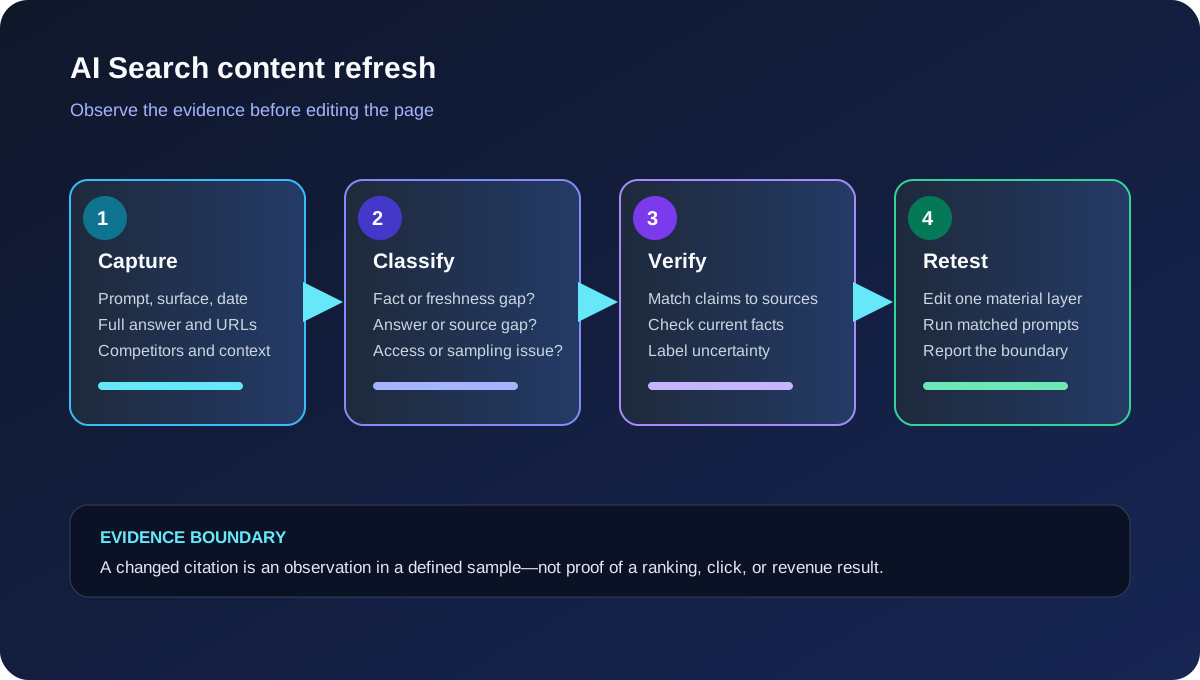
This guide addresses a practical search intent: how to update a page when AI answers omit it, cite an old URL, describe the product incorrectly, or rely on competitors. It complements How to Build an AI Search Measurement Baseline Before You Optimize, AI Search Source Decay, and AI Search Content Optimization: From Answer Insights to a Testable Brief.
What a content refresh can—and cannot—fix
A page refresh can improve the clarity, freshness, and verifiability of the information a page publishes. It may also make a page easier for people and automated systems to understand. Google’s guidance says AI features in Search use the same foundational requirements as Search generally and that appearance is not guaranteed (AI features and your website, checked September 2, 2026). That is a discoverability baseline, not a promise of an AI citation.
An update cannot, by itself, prove:
- A universal AI ranking or “share of voice”
- That a model read the changed passage
- That a citation caused a visit
- That a visit caused a lead, order, or revenue
- That the edit caused a later answer change without stronger controls
- That adding structured data or keywords will produce a recommendation
The independent paper GEO: Generative Engine Optimization studies visibility in generated-engine responses (Aggarwal et al., arXiv, checked September 2, 2026). It is useful research context, but it does not validate a vendor score or establish a production outcome for a particular page.
1. Start with the observed answer problem
Do not begin with a page inventory and assume every page needs “optimization.” Start with a captured observation and name the decision it should support.
| Observation | Useful question | First evidence to preserve |
|---|---|---|
| Page was cited, then absent | Is the comparison matched and repeatable? | Prompt, surface, date, exact URL |
| Brand is mentioned incorrectly | Which product fact is wrong or ambiguous? | Answer sentence and current primary source |
| Competitor is recommended | Which criteria and sources appear in the answer? | Full answer, order, criteria, cited URLs |
| Old URL is cited | Is the old page redirected, canonical, or still accurate? | URL history, redirects, page status |
| Page is never cited | Is there a real content or source gap, or only a small sample? | Stable prompt panel and run count |
A single answer is a lead for investigation. It is not enough evidence to rewrite a page or announce a visibility loss.
2. Freeze the before snapshot
Before editing, save the measurement context. At minimum record:
- Exact prompt wording and stable prompt ID
- Intent group: category, problem, comparison, branded, evaluation, or regional
- AI surface and mode; model/version when disclosed
- Country, language, and other relevant location context
- Collection timestamp and run number
- Full answer or a platform-permitted export
- Mentioned products and recommendation language
- Exact source URLs and the claims they appear to support
- Failed, empty, or non-comparable runs
Keep branded prompts separate from category prompts. “What does our product do?” tests identity and factual accuracy; it does not answer whether an unbranded buyer would discover the product.
A useful before record is explicit about uncertainty:
Prompt: EVAL-006 v2
Surface: named AI Search surface; mode recorded when disclosed
Collected: 2026-09-02 10:00 UTC
Observation: competitor included; owned page absent from cited sources
Evidence: full answer and three exact source URLs preserved
Confidence: medium; model version unavailable
Hypothesis: comparison criteria are better represented in third-party sources
3. Classify the gap before editing
Factual or freshness gap
The page has an outdated price, plan, integration, capability, availability statement, author detail, or product identity. Verify the current fact against an appropriate first-party source before changing copy. If the source is ambiguous, mark the fact unknown rather than filling the gap with an inference.
Answer gap
The page contains the information somewhere, but it does not directly answer the buyer’s question. A comparison page may list features without stating the practical tradeoff. A product page may describe capabilities without clarifying audience, limits, or prerequisites.
Source gap
The page makes a useful claim but lacks relevant, independent context. First-party documentation is appropriate for product facts; it is not independent validation of user satisfaction or business outcomes. A third-party article can provide context, but disclose commercial relationships and check whether it is current.
Entity or identity gap
The name, product line, parent company, URL, or category is unclear. Check the visible page, canonical destination, navigation, organization details, and consistent naming across authoritative sources. Structured data can describe facts, but it does not guarantee selection by an AI system.
Access or measurement gap
A blocked request, failed collection, changed parser, altered prompt, region switch, or new source definition may explain the observation. Technical access evidence is separate from answer evidence. A crawler request is not proof that a page appeared in an answer.
4. Verify claims with the right source
Use the source type that matches the claim rather than citing one page for everything.
| Claim | Preferred verification | Boundary |
|---|---|---|
| Feature, plan, limit, or integration | Official product documentation or help center | Vendor-controlled fact |
| Price or billing interval | Official pricing page checked on the same pass | Prices can change; record date |
| Search eligibility and fundamentals | Google Search Central guidance | No appearance guarantee |
| User experience or recurring concern | G2, Capterra, TrustRadius, Reddit, or an identified independent review | Sample and bias matter |
| Technical or market context | Academic paper, standards body, or reputable third-party analysis | Context is not product proof |
| Traffic or revenue effect | Controlled study or independently documented analysis | A case study alone is not causal evidence |
Google’s structured-data documentation says markup can help Search understand page content but does not guarantee a rich result (Introduction to structured data markup, checked September 2, 2026). Use structured data to describe accurate entities and offers where appropriate—not as a citation tactic.
When a cited source is a vendor page, call it first-party evidence. When it is a vendor-selected customer story, label it vendor-selected customer evidence. When it is a competitor-authored comparison, disclose the commercial perspective.
5. Write the smallest useful change
A refresh should have one primary hypothesis. Examples:
- “The page does not state which team size the workflow fits.”
- “The cited URL contains an old integration description.”
- “The product comparison omits a documented limitation.”
- “The answer associates the brand with a feature the official docs do not support.”
Then make one material change layer:
- Correct a verified product fact.
- Add a direct explanation for the buyer’s question.
- Clarify a comparison tradeoff with same-date evidence.
- Replace or annotate a stale source.
- Improve internal linking so related concepts and entities are easier to navigate.
- Fix an access, redirect, canonical, or rendering problem discovered during review.
Avoid copying competitor language, repeating a claim unnaturally, or adding unsupported “AI-friendly” prose. Google’s helpful-content guidance emphasizes creating reliable, useful content for people (Creating helpful, reliable, people-first content, checked September 2, 2026). That supports a people-first editorial standard; it does not establish a formula for being cited.
6. Retest with the same prompt panel
After publication, rerun the stable panel under the documented conditions. Preserve both answer records and compare:
- Whether the page or brand was mentioned
- Whether it was recommended and how the answer phrased that recommendation
- The exact cited URLs and source positions
- Product facts, prices, dates, and limitations in the answer
- Competitor set and stated decision criteria
- Collection failures or changes in surface, mode, or model
Use exploratory prompts separately. If the prompt, market, surface, or definition changed, call it a new cohort rather than a clean before-and-after test.
A careful result sounds like this:
After the comparison page clarified its documented integration limits, the page appeared in more answers in the defined sample over three follow-up runs. The result is an observed association; it does not isolate the edit’s causal effect or establish additional traffic or revenue.
If the page does not reappear, that is also a valid result. Check whether the answer changed, whether the cited source mix changed, and whether the hypothesis was wrong before making a second edit.
7. Keep the evidence layers separate
| Layer | What to report | Do not infer automatically |
|---|---|---|
| Answer visibility | Brand or page appeared in the sampled answers | Total AI audience |
| Recommendation | Product was suggested under a defined prompt | Universal rank or buyer intent |
| Citation | Exact source URL appeared beside an answer | Endorsement or click |
| Crawler activity | Automated request was observed in logs | Citation or human visit |
| Referral traffic | Analytics recorded a visit under its attribution rules | Revenue caused by one answer |
| Conversion | A business event was recorded | Causal impact of the content edit |
AI Search Console, Peec AI, and Otterly.AI can represent different monitoring workflows. PromptWatch and Qwairy are additional comparison points when teams want to connect prompt observations with broader analysis. Their scores, collection methods, and definitions should not be assumed interchangeable. During a trial, inspect raw answers, exact URLs, prompt versions, failure states, and historical behavior after parser changes.
A refresh brief you can hand to an editor
Page:
Observed problem:
Prompt and surface:
Before capture date:
Evidence URLs:
Verified fact or gap:
Primary hypothesis:
One material change:
Owner and publication date:
Retest window:
Success observation:
Known confounders:
What the result cannot prove:
This format keeps an editorial task connected to its evidence. It also prevents a dashboard number from becoming an unreviewable rewrite request.
What to prioritize first
Refresh high-risk factual pages before low-stakes visibility pages:
- Pricing, plans, and availability
- Security, privacy, legal, and compliance claims
- Product capabilities and integrations
- Comparison and “alternatives” pages
- Buyer-facing definitions and implementation guidance
- General thought leadership and category content
The order is an AICiteKit editorial recommendation. It reflects the potential harm of an incorrect fact, not evidence that these page types receive more citations.
FAQ
Should I refresh content every time a citation disappears?
No. First check prompt comparability, answer variation, source changes, page access, and repeated observations. A single missing source is a weak basis for a rewrite.
What should I change to improve AI Search visibility?
There is no universally proven edit. Start with a verified gap: stale facts, unclear answers, missing context, poor source coverage, identity confusion, or technical access. Make one bounded change and retest.
Do more keywords make a page more likely to be cited?
No reliable source establishes that keyword repetition guarantees an AI citation. Write clearly for the buyer, state accurate facts, and support claims with appropriate sources.
Is structured data enough for GEO?
No. Structured data can describe page entities and offers when implemented accurately, but it does not guarantee a citation, recommendation, or ranking. Visible, accessible, useful content remains important.
Can a citation prove that the refresh worked?
It can show that a source appeared in a defined answer sample after the change. It cannot, without stronger design, prove that the edit caused the result or produced a business outcome.
Sources and verification
| Source | Public signal | What it supports | Confidence |
|---|---|---|---|
| Google Search Central: AI features and your website | Official guidance for AI features in Search and foundational practices | Search and AI-feature context; not a citation guarantee | High |
| Google Search Central: Creating helpful, reliable, people-first content | Official content-quality guidance | People-first editorial standard; not a GEO ranking formula | High |
| Google Search Central: Introduction to structured data markup | Official structured-data documentation | Markup can help Search understand content; not guaranteed display or selection | High |
| GEO: Generative Engine Optimization | Independent academic research paper | Research context for generative-engine visibility; not vendor validation or causal proof | Medium |
| Bing Webmaster Guidelines | Official webmaster guidance | Discoverability, quality, and technical context; not an answer guarantee | High |
The official documentation and research paper above were checked on September 2, 2026. AICiteKit has not independently audited the internal collection methods of the tools named in this article. Public documentation supports the stated methodology and boundaries; it does not establish causal effects for a specific site.
This is AICiteKit editorial methodology. It does not claim that any tool, content refresh, structured-data implementation, or source change guarantees rankings, citations, traffic, conversions, or revenue.