How to Evaluate an AI Search Visibility Tool Before You Buy
A practical trial framework for comparing AI Search and GEO tools by prompt coverage, raw evidence, source attribution, reproducibility, and decision fit—not dashboard polish.
The short answer
An AI Search visibility tool should be evaluated as a measurement workflow, not as a collection of attractive scores. Before buying, test whether it can answer one bounded business question with a defined prompt sample, preserve enough raw evidence to audit the result, and show the limits of what its data proves.
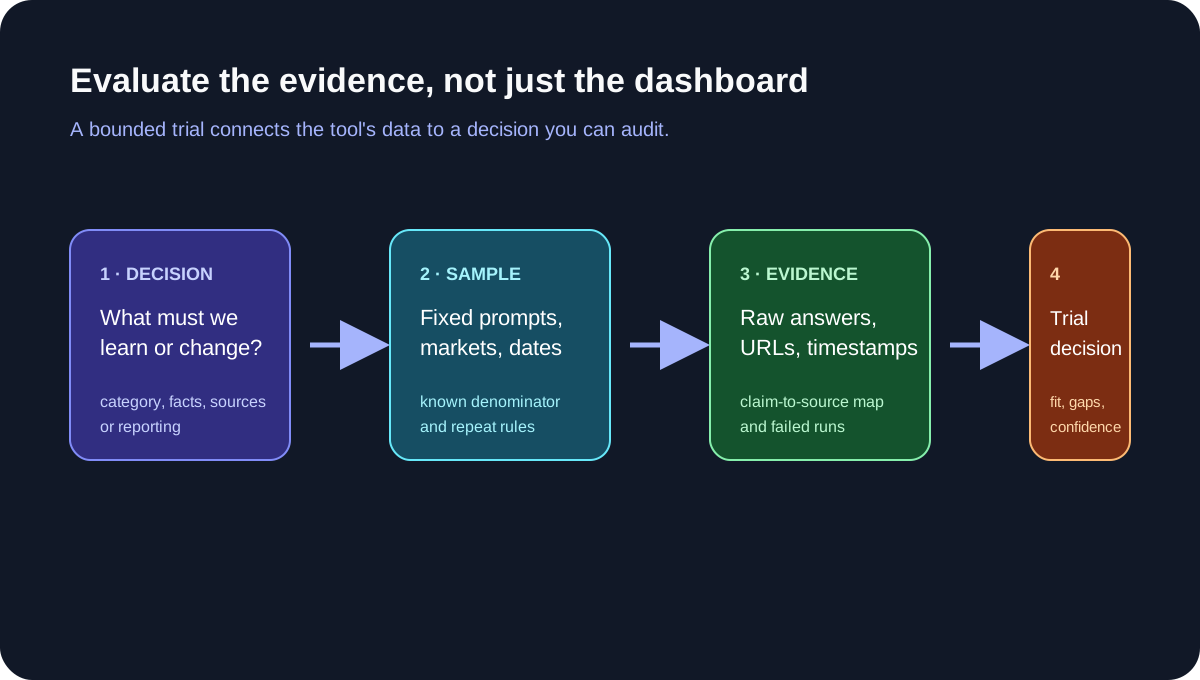
Use this sequence:
business decision → fixed sample → raw answer evidence → reconciliation → trial decisionA tool may be useful for monitoring mentions, recommendations, citations, or competitors while being weak for another job. A dashboard score is not automatically a ranking, a citation, a visit, or a business outcome.
This guide targets searches such as “which GEO tool should I use?”, “how do I compare AI visibility platforms?”, and “what should I check in an AI Search tool trial?” The answer is not a universal leaderboard. It is a repeatable evaluation contract.
First define the job
“AI visibility” can refer to several different observations. Write down the job before comparing vendors.
| Job | Minimum useful observation | What it does not establish |
|---|---|---|
| Prompt monitoring | Answer captured for a saved prompt on a named surface and date | Every answer an engine generates |
| Mention tracking | Brand appears under a stated counting rule | That the brand was recommended |
| Recommendation analysis | Brand is suggested for a defined use case | Market-wide preference |
| Citation tracking | Exact source URL is visible in the captured answer | That the URL caused a click |
| Source analysis | Domains or pages associated with sampled answers | Editorial authority or causal influence |
| Competitor comparison | Same prompt contract applied to named competitors | A stable cross-engine rank |
| Content workflow | An observation becomes a brief or assigned action | That the edit will create visibility |
Google describes AI features in Search as experiences that can show links to supporting web resources (AI features and your website, checked September 11, 2026). OpenAI describes ChatGPT search as a web-search experience that may provide links to sources (ChatGPT search, checked September 11, 2026). These official descriptions support checking surfaces and source links; they do not define one universal cross-platform visibility metric.
The independent GEO: Generative Engine Optimization paper studies visibility in generative-engine responses in an academic setting (Aggarwal et al., arXiv, checked September 11, 2026). It is useful research context, not proof that any commercial dashboard predicts traffic, revenue, or citations.
What to ask during a trial
1. Can you freeze the prompt contract?
A result is difficult to interpret if the tool silently changes the prompt, market, model, or collection rules. Ask whether the export records:
- Exact prompt text and prompt-set version
- Surface, mode, and model label when disclosed
- Market, language, device, and location context where relevant
- Collection date, time zone, and refresh cadence
- Brand and competitor spelling variants
- Rules for counting mentions, links, and positions
- Failed, unavailable, or partially collected runs
A tool can legitimately use a sampling method. The issue is whether the method is visible enough for you to understand the denominator and reproduce a comparison.
2. Can you inspect the answer behind the score?
A score without answer-level context is a weak audit trail. Ask for a permitted export or view containing:
- The captured answer or a faithful answer excerpt
- Visible citation URLs and domains
- The claim associated with each source when available
- Mention, recommendation, and citation states separately
- Source position or prominence if the product measures it
- Timestamp and prompt context
- Product or plan limits affecting the observation
If the tool exposes only a derived score, record that as a limitation. Do not infer the missing answer from a chart.
3. Does the tool define “citation” precisely?
One product may call a linked page a citation; another may count a named domain, a source card, or a retrieved document. Request the vendor’s definition and test the same answer manually.
A useful comparison asks:
- Is the source an exact URL or only a domain?
- Is it visibly linked or merely named?
- Is it attached to a particular claim?
- Does the system count duplicate links once or multiple times?
- Are unavailable, redirected, or canonicalized URLs preserved?
- Can first-party and third-party sources be separated?
Do not compare “citation rate” between tools until these rules are aligned.
4. Can it separate observation from interpretation?
A good product may provide interpretation, recommendations, or content briefs. Those can be useful, but they should remain distinguishable from collected evidence.
Look for separate fields for:
- Observed: what appeared in the captured answer
- Verified: what a reviewer checked against a source
- Inferred: what the product or analyst believes may explain it
- Recommended: the proposed next action
This separation is especially important when a tool describes why an engine selected a source. Unless the platform exposes that mechanism, “reason” is an interpretation, not a directly observed fact.
Build a small, balanced test panel
Do not begin with hundreds of prompts. Start with a panel large enough to represent the decision and small enough to inspect manually.
| Prompt group | Example | Why include it |
|---|---|---|
| Category | “What tools help a small SaaS team monitor AI citations?” | Discovery without a brand name |
| Problem | “How can an agency audit AI visibility for clients?” | Use-case relevance |
| Comparison | “Compare three tools for weekly AI Search reporting.” | Criteria and omissions |
| Brand fact | “What does [product] include and who is it for?” | Accuracy and positioning |
| Alternative | “What are alternatives to [product]?” | Competitive framing |
| Risk | “What should I verify before buying an AI visibility tool?” | Caveats and evidence quality |
| Regional | “Which AI Search monitoring tools support teams in [market]?” | Market and language variation |
Freeze the panel before comparing vendors. If you add a prompt after seeing a favorable result, create a new panel version rather than silently changing the denominator.
For each run, keep a simple ledger:
Prompt: CAT-004 v1
Surface: named surface; mode recorded when disclosed
Collected: 2026-09-11 UTC
Observation: brand mentioned and two visible source URLs recorded
Definition: mention ≠ recommendation; URL counted once
Evidence: answer export, source URLs, timestamp
Limit: model or retrieval state not fully exposed
Decision use: compare source coverage, not traffic
Compare the dimensions that affect trust
Coverage is not the same as quality
A vendor may list many AI surfaces but provide different refresh rates, answer formats, geographic availability, or evidence depth for each one. Ask for a surface-by-surface matrix.
| Dimension | Trial question |
|---|---|
| Surface | Which exact product, mode, and answer type are monitored? |
| Model | Is the model named, inferred, or not exposed? |
| Geography | Can the market and language be fixed and exported? |
| Cadence | What is collected daily, weekly, on demand, or sampled? |
| History | How far back are raw answers and URLs retained? |
| Reliability | Are failed runs and unavailable sources visible? |
| Limits | What caps apply to prompts, brands, projects, seats, or exports? |
| Access | Is there an API, CSV, warehouse connector, or only a UI? |
“Supports ChatGPT” is not a sufficient comparison statement. It should be expanded into the surface, mode, prompt method, date, region, and evidence available.
Reproducibility is a product feature
Run a small repeat test. Submit the same panel twice under the tool’s documented rules and compare:
- Whether prompts stayed identical
- Whether the answer context was preserved
- Whether source URLs were normalized consistently
- Whether a changed answer was marked as changed
- Whether the dashboard recalculated historical values
- Whether the export has stable identifiers
A changing answer does not mean the tool is wrong. AI Search results can change. The question is whether the product makes that change inspectable instead of presenting an unexplained new score.
Data portability matters
Before purchase, export a sample and check whether another analyst can understand it without access to the dashboard. Prefer records that retain raw or near-raw evidence, stable IDs, timestamps, prompt versions, and source URLs.
For an agency, test whether one client’s data can be separated cleanly from another’s. For an internal team, test whether exports can join with content inventories, analytics, or a ticketing workflow without manual retyping.
Use a weighted decision matrix carefully
A matrix makes tradeoffs explicit, but the weights are editorial choices. Do not present the result as an objective market ranking.
Example:
| Criterion | Weight | Pass condition |
|---|---|---|
| Prompt and context control | 20% | Prompt, surface, date, and market are recorded |
| Answer-level evidence | 25% | Answers and visible URLs can be inspected |
| Definitions | 15% | Mention, recommendation, and citation rules are documented |
| Reproducibility | 15% | Repeat runs and failures are visible |
| Workflow fit | 15% | Findings can reach the team’s next action |
| Portability | 10% | Export is usable outside the UI |
A product that scores well for prompt monitoring may still be a poor choice for content production, enterprise governance, or attribution. Keep the final decision tied to the job you defined.
How AICiteKit tool pages fit into the comparison
AICiteKit maintains detail pages for different product categories and maturity levels, including AI Search Console, Peec AI, Otterly.AI, PromptWatch, Profound, and Rankscale.
Use those pages as research starting points, not as interchangeable test results. A fair comparison still requires checking each vendor’s current documentation, plan scope, data definitions, and trial behavior. An official feature claim supports what the vendor says the product does; it does not independently prove accuracy or business impact.
Evidence boundaries
Keep these claims separate:
| Evidence observed | Safe conclusion | Unsupported leap |
|---|---|---|
| A tool captured a linked URL | The URL was visible in that sample | The URL caused the answer or a click |
| A brand appeared in 40 of 100 runs | The brand appeared under that panel and rule | 40% of all AI answers mention it |
| A dashboard score increased | The reported score changed | Traffic or revenue increased because of it |
| A source was recommended | It was selected in the captured answer | The source is universally authoritative |
| A content brief was generated | The tool proposed an action | The edit will create citations |
| A crawler requested a page | A technical request was observed | The page was cited or read by a person |
Ratings and testimonials should also be scoped. User feedback can inform usability and support questions, but it does not validate a GEO-specific metric unless the source discusses that feature directly. Vendor-selected customer evidence is not independent outcome proof.
Evidence snapshot
| Source | Public signal | What it supports | Confidence |
|---|---|---|---|
| Google Search Central: AI features and your website | Official guidance on AI features and supporting links | Inspect the surface and source links; no universal visibility guarantee | High |
| OpenAI Help: ChatGPT search | Official product-context documentation | ChatGPT search can provide web sources; not a cross-tool metric definition | Medium-high |
| Aggarwal et al., GEO: Generative Engine Optimization | Independent academic research | Research context for generative-engine visibility experiments | Medium; not validation of a commercial dashboard |
| Schema.org: Getting started | Independent open vocabulary documentation | Structured descriptions and data modeling context when relevant | Medium; not evidence of citation selection |
| AICiteKit trial framework | Editorial method in this article | How to compare evidence, definitions, and workflow fit | Editorial |
A practical 7-day trial plan
Day 1: Write the decision contract
Name the business question, included competitors, surfaces, markets, prompt groups, and success conditions. Record what the trial will not attempt to prove.
Day 2: Import a small panel
Use category, problem, comparison, fact, and risk prompts. Freeze the text and version it.
Day 3: Inspect raw evidence
Open individual results. Check answer context, visible URLs, timestamps, source definitions, and failed runs.
Day 4: Reconcile one cohort manually
Compare a sample of tool results with the underlying answer. Record false positives, missing links, duplicate handling, and stale URLs.
Day 5: Test export and permissions
Give the export to someone who did not configure the trial. Ask whether they can reproduce the conclusion and identify the denominator.
Day 6: Test the next action
Send one finding to the actual workflow: content brief, technical ticket, client report, or fact correction. Measure effort and ambiguity, not promised visibility.
Day 7: Decide with explicit gaps
Write a short decision memo:
- Best-supported use case
- Important missing evidence
- Limits that affect scale or cost
- Manual work remaining
- Confidence in the observed findings
- What must be rechecked before renewal
Who should buy a tool?
A paid platform is more defensible when a team has recurring prompts, enough decision volume to justify structured collection, and a workflow for acting on findings. Agencies should prioritize client separation, exports, permissions, and report reproducibility. In-house teams may prioritize source inspection, history, integrations, and fact accuracy.
A tool may not be justified when the team has no stable prompt set, cannot define the decision, needs guaranteed rankings, or expects the dashboard to replace customer research, analytics, technical SEO, or editorial judgment. In that situation, build the measurement contract first and run a smaller manual baseline.
FAQ
Is the tool with the most AI platforms automatically the best?
No. Coverage is meaningful only when the surface, mode, geography, cadence, and evidence format are clear. A smaller set with inspectable answers may be more useful than a larger list with opaque scores.
Should I choose a tool that gives one visibility score?
Only if the score is defined for your use case and you can inspect its components. Ask for the denominator, counting rules, missing-data handling, prompt context, and historical behavior. Otherwise treat it as a directional product metric, not a universal ranking.
Can an AI Search tool prove that SEO changes caused more revenue?
Not by itself. It may document changes in sampled answers, mentions, or source links. Traffic, conversion, and causal revenue claims require separate analytics definitions and an appropriate measurement design.
Do I need raw AI answers?
For high-stakes reporting, raw or near-raw answer evidence is strongly preferable. If it is unavailable, lower confidence and state that the result is a vendor-derived observation that cannot be independently reconciled at the answer level.
How many prompts should I use in a trial?
There is no universal number. Use enough prompts to cover the decision’s important use cases and enough repeated observations to expose obvious instability. State the sample and do not generalize beyond it.
Should tool ratings decide the purchase?
No. Ratings can inform usability or support questions, but they are not proof of citation accuracy, traffic growth, rankings, or revenue. Check the review count, date, feature discussed, source independence, and whether the feedback applies to the specific GEO workflow.
Sources and verification
- Google Search Central: AI features and your website — checked September 11, 2026 for official guidance on AI features and supporting links.
- OpenAI Help: ChatGPT search — checked September 11, 2026 for official product-context language about web search and sources.
- Aggarwal et al., GEO: Generative Engine Optimization — checked September 11, 2026 for independent research context.
- Schema.org: Getting started — checked September 11, 2026 for open vocabulary and structured-data context.
Last reviewed: September 11, 2026
Data confidence: Medium for the evaluation framework and cited documentation; low for any vendor-specific metric unless independently reconciled during a current trial.