Why Two GEO Tools Can Rank the Same Brand Differently
A practical framework for explaining disagreement between AI visibility tools by comparing prompt sets, models, regions, sampling, citations, and score calculations.
The short answer
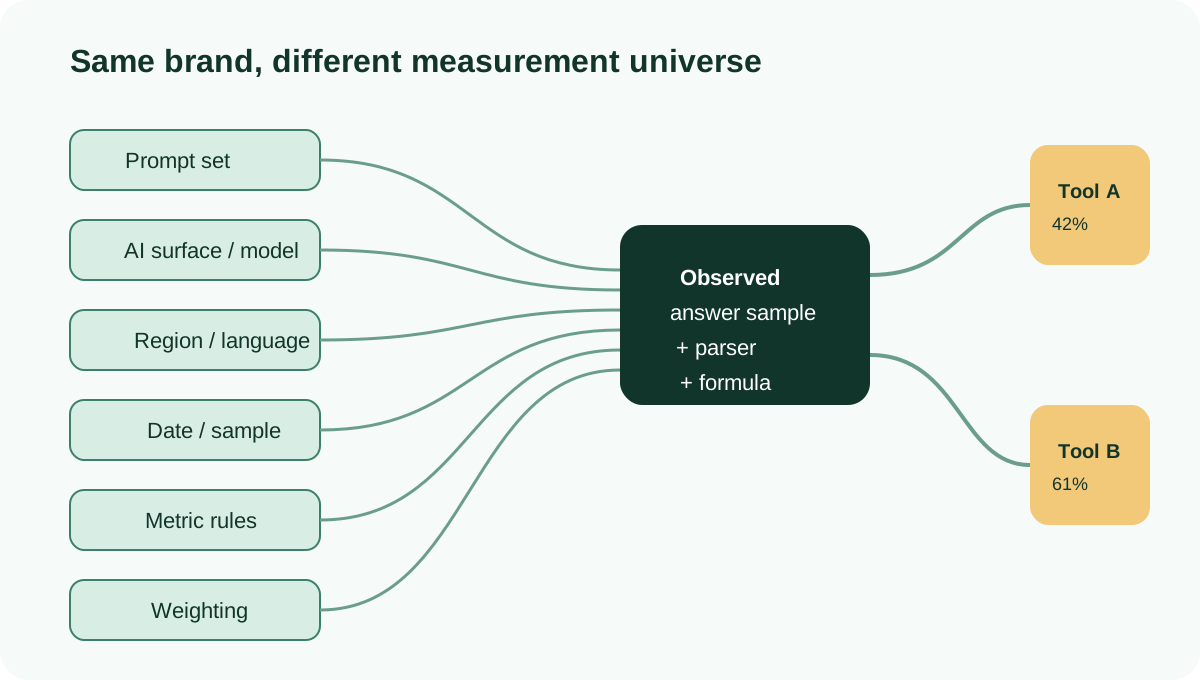
Two GEO tools can report different visibility or ranking results for the same brand without either product being technically broken. They may be measuring different prompts, engines, regions, dates, samples, citation rules, or score formulas.
The first diagnostic question should not be which dashboard is right? It should be:
Are the two tools measuring the same observation universe?
If not, their scores are different measurements. A useful comparison holds the universe constant, inspects answer-level evidence, and reports disagreement as a methodology finding rather than silently choosing the more flattering number.
Why the comparison matters
AI answers are not a stable ten-blue-links ranking. Wording, retrieval context, model version, geography, language, account state, freshness, and sampling can all change what a system says. A visibility platform then applies its own definitions to those answers.
That means a result such as “Brand A has 42% visibility” is incomplete unless the report also identifies:
- Which prompts were run
- Which AI surfaces and models were sampled
- Where and when the sample was collected
- How many observations were included
- What counted as a mention, recommendation, position, or citation
- Whether the score was weighted by prompt, volume, or another rule
The same discipline applies when comparing a content-oriented product such as Frase, a prompt and crawler analytics platform such as PromptWatch, or monitoring products such as Peec AI and AI Search Console. Product categories overlap, but their measurement contracts may not.
1. Compare the prompt sets first
Prompt selection is often the largest hidden difference. One tool may use a short list of branded questions; another may emphasize category, comparison, and recommendation prompts.
Build a crosswalk like this:
| Prompt group | What it tests | Common distortion |
|---|---|---|
| Branded | Identity and factual accuracy | Can make a brand look visible while hiding weak discovery |
| Category | Unprompted discovery | Results vary heavily with wording and market |
| Comparison | Positioning against named alternatives | Brand order may be treated as rank without a shared rule |
| Recommendation | Whether a product is suggested | “Mentioned” and “recommended” are not equivalent |
| Problem | Relevance to a use case | Broad prompts may have many valid answers |
| Regional/language | Local market visibility | Translation and local retrieval can change sources |
Export or manually recreate the prompt IDs, exact wording, intent group, and brand/competitor definitions. If a tool does not expose its prompt list, mark the comparison as low reproducibility.
A small branded sample should not be used to make a broad category-visibility claim. For a reusable prompt methodology, see How to Build a Reliable AI Search Prompt Set.
2. Match the AI surface and model
“ChatGPT,” “Google AI,” and “Perplexity” are surfaces, not always complete model specifications. A vendor may access a particular API model, a web-enabled mode, a search result feature, or a sampled answer endpoint. The behavior may change as the provider changes routing or model versions.
Record, where available:
- Surface and product mode
- Model name and version
- Web search or retrieval setting
- Tool/vendor collection method
- Answer timestamp
- Whether the answer was regenerated
A result from Frase’s AI visibility workflow should not be assumed to be directly comparable with a result from a specialist tracker unless the surface, model, and collection method align. Likewise, crawler activity in one system is not citation evidence in another.
3. Match region, language, and context
The same prompt can produce different sources in the US, UK, Germany, or another market. Language is not merely a translation switch: local publishers, products, regulations, currency, and entity names can change the answer.
A controlled test records:
- Country and, when relevant, city or market.
- Language and locale.
- Logged-in or anonymous state, if material.
- Device or browser context when using a live search surface.
- Date and time zone.
If one tool samples US English and another samples UK English, do not average their scores as if they were repeated measurements of one market.
4. Check date and sampling strategy
A single answer is an observation, not a durable rank. Tools may run prompts daily, weekly, on demand, or only when a user opens a report. They may also sample one answer or several regenerations.
Ask each vendor:
- How many runs support the displayed score?
- Are repeated answers deduplicated?
- Is the score an average, latest value, maximum, or weighted aggregate?
- How are outages and empty answers handled?
- What is the retention period for raw answers and source URLs?
- Can the same prompt be rerun on demand?
A tracker with more observations is not automatically more accurate, but a documented sample is easier to audit. Store answer text or permitted captures, cited URLs, prompt metadata, and timestamps where possible.
5. Align definitions before comparing numbers
Terms that sound interchangeable are not:
| Metric | Narrow question | Does not prove |
|---|---|---|
| Mention rate | Did the brand appear? | That it was recommended or cited |
| Recommendation rate | Was it suggested for the request? | That a user clicked or purchased |
| Position | Where did it appear under a tool’s rule? | A universal AI ranking |
| Citation rate | Did an answer link to a domain/URL? | That the citation caused traffic |
| Sentiment | How was the answer classified? | Objective brand truth |
| Share of voice | How much of a defined sample was attributed to the brand? | Total AI audience or market share |
| Visibility score | A product-specific aggregate | A standardized industry metric |
Before comparing, write a measurement contract. For example: “A recommendation is counted only when the brand is presented as a solution, not merely named in a source list; citation means a visible link to the defined domain; each prompt contributes equally.”
Two tools using different contracts can legitimately produce different rates from the same answer.
6. Reconcile the underlying answers
The most valuable comparison is an answer-level reconciliation, not a side-by-side screenshot of summary scores.
Create a sample of prompts and build a table with one row per answer:
| Field | Tool A | Tool B | Comparison decision |
|---|---|---|---|
| Prompt ID and wording | Exact match? | ||
| Surface/model | Same retrieval context? | ||
| Region/language | Same market? | ||
| Answer timestamp | Same window? | ||
| Brand present | Shared rule? | ||
| Recommended | Separate from mention? | ||
| Domain cited | Same URL/domain definition? | ||
| Competitor order | Same position rule? | ||
| Raw evidence link/capture | Inspectable? |
Classify every mismatch as one of five types:
- Universe mismatch: prompts, surfaces, regions, dates, or samples differ.
- Parser mismatch: the same answer exists, but one tool misses a mention, link, or competitor.
- Definition mismatch: the tools use different rules for position, sentiment, or citation.
- Timing mismatch: answers changed between collection runs.
- Unknown: raw evidence is not available to diagnose the result.
Unknown is a valid outcome. It is better than attributing disagreement to a vendor without evidence.

A controlled comparison protocol
Use this six-step protocol when a buying decision or client report depends on the difference:
- Freeze the panel. Choose a balanced set of branded, category, comparison, recommendation, problem, and regional prompts.
- Freeze context. Record surface, model, country, language, date window, competitors, and collection permissions.
- Run parallel samples. Use the same prompt IDs and as similar a time window as the products permit.
- Export raw evidence. Preserve answers, sources, timestamps, and the tools’ labels.
- Recalculate simple metrics. Compute mention, recommendation, citation, and position under one written rule.
- Explain residual disagreement. Separate universe, parser, definition, timing, and unknown causes.
If a platform cannot provide raw answers, compare its score only at the level of directional signal and label the result accordingly.
What disagreement can tell you
Disagreement is not only a procurement nuisance. It can reveal a measurement risk:
- A large gap on branded prompts may indicate identity or parsing differences.
- A large gap on category prompts may indicate prompt sampling or engine context differences.
- A citation gap may reflect URL normalization, source filtering, or different definitions of a citation.
- A position gap may be caused by whether source lists count, whether ties are allowed, or whether only recommendations are ranked.
- A trend gap may indicate different refresh schedules or answer retention.
The appropriate action depends on the diagnosis. Do not respond to a sampling mismatch by publishing content, or to a parser mismatch by changing a page.
What the evidence does not prove
Even a carefully matched comparison cannot prove:
- A universal AI ranking
- That one vendor’s score predicts all future answers
- That a higher citation rate caused more clicks
- That AI visibility caused revenue growth
- That a crawler request became a citation
- That a content change caused the observed result without controlling for other events
Keep the layers separate: visibility, citation, crawler activity, detectable referral traffic, and conversions answer different questions. See AI Visibility vs AI Citations vs AI Traffic for the attribution boundary.
Buying checklist
Before selecting a GEO or AI-search tool, ask:
- Can I see the exact prompts and intent groups?
- Are model, surface, region, language, and dates recorded?
- Can I inspect answer-level text and cited URLs?
- Is the score formula documented well enough to reproduce?
- Are mention, recommendation, position, sentiment, and citation separate fields?
- How many observations are included in a trend?
- What are the prompt, domain, user, API, export, and retention limits?
- Can I rerun a fixed baseline after one bounded content or technical change?
- Does the product cover the AI surfaces relevant to my market?
- Does the vendor distinguish visibility evidence from traffic and revenue claims?
FAQ
Does a higher GEO score mean the tool is better?
Not by itself. A higher score may reflect a different prompt panel, engine, weighting rule, or parser. Compare evidence quality and fit for the decision you need to make.
Should I average scores from multiple tools?
Usually not before aligning their measurement universes. If they cannot be aligned, keep the series separate and explain what each one measures.
How many prompts are needed for a comparison?
There is no universal number. The panel should cover the buying journey and important regions, products, and risks. A smaller balanced sample is more useful than a large undocumented branded sample.
Can two tools use the same prompt and still disagree?
Yes. Model routing, retrieval timing, answer regeneration, URL parsing, citation rules, and score definitions can still differ.
What should an agency put in a client report?
Include the prompt panel, engine and region scope, observation count, definitions, raw examples, changes made, and uncertainty. Report visibility and citation as observations, not guaranteed traffic or revenue outcomes.
Related AICiteKit tools
- Frase — content research, optimization, GEO, and AI visibility in one workflow.
- Peec AI — visibility, position, sentiment, and citation analysis.
- PromptWatch — visibility, crawler, API, and MCP-oriented workflows.
- Rankscale — broad multi-engine visibility tracking.
- AI Search Console — prompt, competitor, source, and citation tracking.
Sources and verification
- Google Search Central: AI features and your website — context on AI search features and website eligibility; checked August 21, 2026.
- Frase pricing — example of plan-specific AI visibility and content limits; checked August 21, 2026.
- Frase AI Visibility documentation — vendor-described workflow; checked August 21, 2026.
- Google Analytics campaign URL guidance — attribution context; checked August 21, 2026.
- How to Build an AI Search Measurement Baseline Before You Optimize — related AICiteKit methodology.
This is AICiteKit editorial methodology. It does not claim that any tool guarantees rankings, citations, traffic, or revenue.