How Agencies Should Report AI Visibility to Clients
A practical framework for agency AI Search reporting: define the prompt sample, preserve answer evidence, separate visibility from citations and traffic, and turn findings into accountable actions.
The short answer
An agency AI Search report should make its measurement scope visible before it presents a score. Show the prompt set, engines, locations, dates, answer evidence, citations, technical signals, actions, and limitations in separate sections.
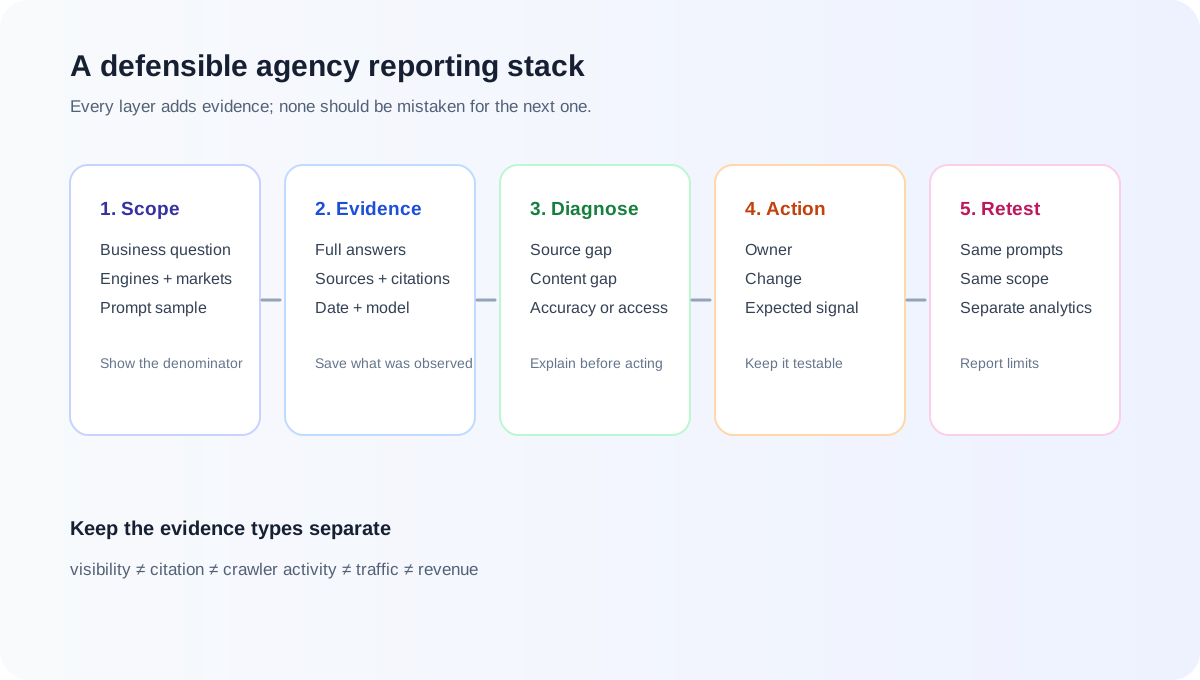
A defensible reporting chain is:
business question → prompt panel → answer evidence → diagnosis → action → retestDo not collapse these into one “AI performance” number:
visibility ≠ citation ≠ crawler activity ≠ traffic ≠ revenueConductor is one example of an enterprise platform that combines AEO/SEO reporting with website monitoring and AI-crawler log analysis. The reporting method in this article is broader than any one vendor and should also work with specialist tools such as Otterly.AI, Rankscale, PromptWatch, or Profound.
Client-ready and white-label reporting: what agencies should verify
“Client-ready” and “white-label” are not the same thing. A client-ready report can be clear, evidence-backed, and easy to present while still showing the vendor’s interface or name. A white-label report is designed to be delivered under the agency’s identity, often with custom branding, client workspaces, and vendor details removed or minimized.
Vendors with explicit public white-label claims
Based on public vendor documentation checked on August 19, 2026, two platforms in this comparison explicitly describe white-label capabilities rather than only generic agency reporting:
- LLM Pulse — its official agency documentation says agencies can use custom branding and domain, multi-client dashboards, unlimited seats, and client-facing reports under the agency identity. Its public materials distinguish partial white-label from full white-label and describe a custom-domain option with no LLM Pulse branding. These are vendor claims and should still be verified in a trial or sales demo.
- GrackerAI describes an agency workspace with client projects, logo and color configuration, white-label reports, and partner onboarding. Its public agency page is evidence of the advertised workflow, not independent proof of product execution or reporting quality.
Other products should not be described as confirmed white-label vendors without stronger evidence:
- Otterly.AI explicitly says it does not currently offer a native white-label option. Its Looker Studio connector can support branded dashboards, but that is an external reporting workaround.
- AthenaHQ publicly describes agency programs, client management, and AI-ready reporting, but the materials checked do not establish a full white-label portal, custom domain, or zero-vendor-branding workflow.
- AirOps has Brand Kits and agency-oriented workflows, but brand context for content generation is not the same as white-label client reporting.
This distinction matters when a client asks whether the agency can “put its name on” the platform. A branded PDF, a custom dashboard, a client portal, and a fully rebranded SaaS interface are four different capabilities.
Before choosing a platform, ask the vendor to demonstrate the exact report a client will receive—not just the internal dashboard. Verify:
- Agency logo, colors, and report cover;
- Custom title, date range, and executive summary;
- Agency name and contact details;
- Custom domain or email sender, if required;
- Client-specific workspaces and permissions;
- Separate brands, domains, countries, and prompt sets;
- Scheduled PDF, slide, CSV, or live-link delivery;
- Export of answer captures and cited URLs;
- Notes, recommendations, owners, and due dates;
- Historical snapshots and change annotations;
- API or webhook access for an agency data warehouse;
- Removal or disclosure of the underlying vendor brand;
- Whether white-label features require a higher plan or enterprise contract.
A polished PDF is not automatically a defensible report. The client should be able to see what was measured, which answers support the conclusion, what action is recommended, and what remains unknown.
A minimum white-label report structure
A practical agency template can use five layers:
- Executive summary — the business question, important change, recommendation, and limitation.
- Measurement scope — prompts, engines, models, markets, language, dates, and sample size.
- Evidence appendix — answer captures, cited URLs, competitor examples, and accuracy notes.
- Action plan — priority, owner, deliverable, deadline, and acceptance test.
- Measurement follow-up — next run date, comparison window, and attribution definition.
If a vendor’s export removes the prompt, date, engine, or cited URL, the agency may still have a presentable slide deck, but it has lost the evidence needed to defend the recommendation.
Questions for an agency demo
Ask the vendor to perform these actions live:
- Create a new client workspace;
- Add a client logo without exposing another account;
- Run or import a defined prompt set;
- Open a cited answer and show the source URL;
- Add an agency interpretation and client-facing recommendation;
- Export a branded report;
- Schedule a recurring delivery;
- Restrict a user to one client;
- Delete or revoke the client workspace;
- Explain which features are unavailable on the quoted plan.
This is more useful than accepting “white-label reporting” as a feature-list checkbox. Commercial, vendor-selected, or affiliate descriptions should be labeled as such until the workflow is tested.
Why agency reporting needs more context
AI answers are sampled observations, not a stable results page. The same question can produce different answers by model, date, country, language, account state, and retrieval context. A report that omits those variables is difficult for a client to reproduce or challenge.
Agencies also work across different evidence systems:
- Answer monitoring observes whether a brand appears and how it is described.
- Citation analysis records links, named sources, and source positions.
- Crawler analytics observes automated requests in logs.
- Web analytics observes detectable human visits and conversions.
- CRM or ecommerce data records business outcomes under a chosen attribution model.
Each system answers a different question. A crawler hit is not a human visit, and a citation does not prove a click.
1. Start with a client question, not a dashboard
Before selecting a tool or building a chart, agree on the decision the report should support. Good questions include:
- Are competitors being recommended for category prompts instead of the client?
- Are AI systems describing current pricing and product limits accurately?
- Which third-party sources shape the category narrative?
- Are important pages accessible to relevant crawlers?
- Are detectable AI referrals producing qualified sessions?
- Did a defined content or technical change alter the sampled answers?
The question determines the evidence. A crawler-log chart cannot answer whether a competitor was recommended. A visibility score cannot answer whether a lead came from an AI surface.
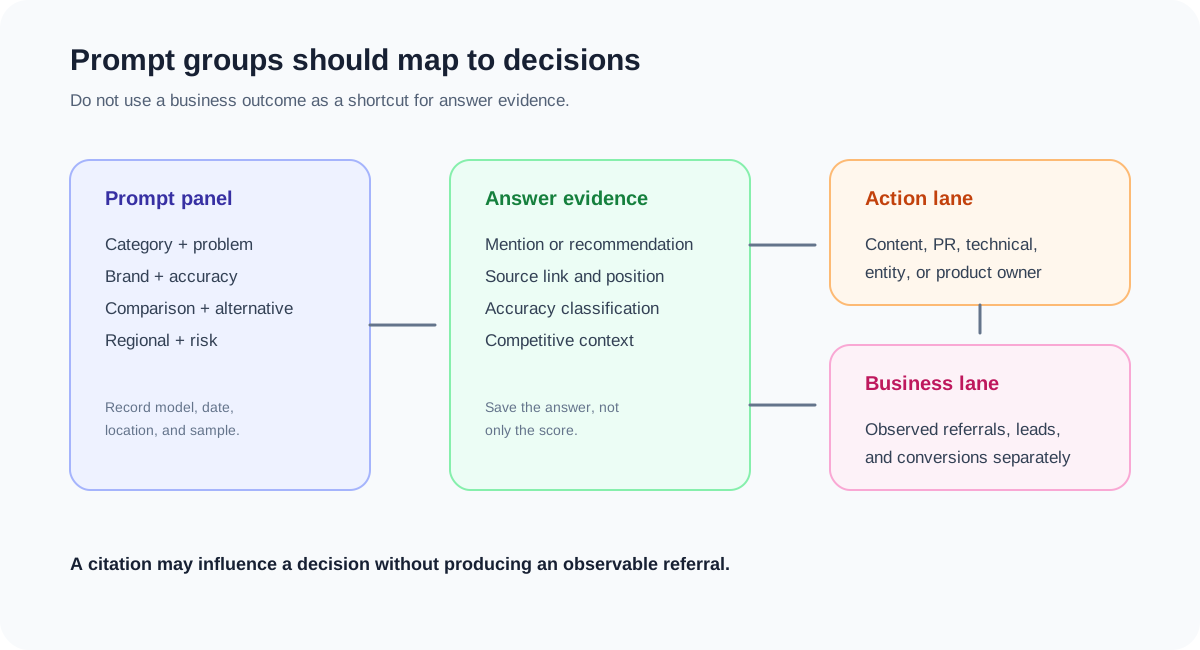
2. Define the prompt panel
A client report should list the prompt methodology, even if it does not publish every sensitive query. At minimum, record:
- Prompt text or a stable prompt identifier
- Intent group
- Brand and competitor names included
- Engine or model
- Country and language
- Run date and frequency
- Sampling count
- Rules for mention, recommendation, position, sentiment, and citation
A balanced panel should include branded, category, problem, comparison, alternative, evaluation, regional, and risk prompts. Branded prompts are valuable for accuracy, but they should not dominate a claim about category visibility.
For a deeper construction method, see How to Build a Reliable AI Search Prompt Set.
A practical scope statement
Use a sentence such as:
This report covers 80 prompts across ChatGPT and Perplexity, sampled weekly in the US and UK in English from July 1–31. Visibility means a brand mention in the captured answer; citation means a visible source link to the client domain. Results do not represent all AI conversations or prove traffic impact.
That sentence is more useful than a percentage without a denominator.
3. Preserve answer-level evidence
A score should link to the underlying observations. Save or export, where the product and platform allow it:
- Complete answer text or a capture
- Source URLs and domains
- Mentioned brands and competitors
- Citation position and linked page
- Prompt, engine, location, and date
- Accuracy and sentiment notes
- Any follow-up context
ZipTie and AI Search Console illustrate answer and source-oriented workflows, while Peec AI and Otterly.AI support recurring visibility analysis. Different products collect different evidence; explain the boundary instead of treating their scores as interchangeable.
A useful client appendix includes three examples:
- A positive answer where the client is recommended and cited.
- A missed category answer where a competitor is recommended.
- An inaccurate or outdated answer requiring a correction workflow.
4. Separate the report into evidence layers
Use a consistent table so clients can see what is observed and what is inferred.
| Layer | What it measures | Example statement | What it does not prove |
|---|---|---|---|
| Visibility | Brand appearance in the sampled answers | “Appeared in 24 of 80 responses” | Total market visibility or demand |
| Citation | Link or named source in an answer | “Client domain linked in 11 responses” | That anyone clicked |
| Accuracy | Correctness and completeness of the description | “Price was outdated in 3 answers” | That a correction will change every model |
| Crawler activity | Automated requests in server logs | “A named AI crawler requested 120 URLs” | Human views or citations |
| AI referral | Detectable human sessions from an AI source | “GA4 recorded 34 sessions” | Unobserved AI influence |
| Conversion | Recorded lead, sale, or other action | “4 conversions followed attributed sessions” | Causal revenue impact |
The AI Visibility vs AI Citations vs AI Traffic article explains why each transition loses information.
5. Diagnose before recommending work
A useful agency report does not stop at “visibility fell.” It identifies a plausible, testable reason and assigns an owner.
Source gap
A competitor is repeatedly supported by an authoritative review, publisher, or community source while the client has no equivalent coverage. The action may involve digital PR, review management, or better first-party documentation.
Content gap
The client page does not clearly answer the question, state the entity, explain a comparison, or provide evidence. The action may involve a page refresh, comparison section, FAQ, or product documentation.
Accuracy gap
The answer contains an incorrect price, outdated feature, false limitation, or confused product identity. The action may require first-party corrections, structured data, public documentation, or third-party source remediation.
Technical access gap
Logs show blocked, failed, or inefficient automated access to important pages. The action belongs with engineering or technical SEO. Do not claim that improved crawling automatically creates citations.
Sampling or volatility
Only one or two answers changed, or the prompt, model, location, or competitor set changed. The action may be to continue monitoring rather than publish immediately.
6. Report changes without overclaiming causation
When a client changes a page or technical setting, keep the prompt panel and environment stable where possible:
- Capture a baseline over several runs.
- Record the exact change and publication date.
- Keep prompts, models, locations, and competitor definitions stable.
- Continue sampling for a defined observation window.
- Compare answer evidence, citations, accuracy, and traffic separately.
- Note other events such as model updates, campaigns, PR, or site migrations.
A careful conclusion might say:
After the comparison page was updated, the brand appeared in more of the defined category sample during the next four weekly runs. The observation is directionally encouraging, but the dataset does not isolate causation or establish additional traffic or revenue.
That is stronger than claiming the page “increased AI rankings by 35%.”
7. Build the executive summary last
The first page should answer five questions:
- What was measured?
- What changed?
- What evidence supports the change?
- What action is recommended?
- What remains unknown?
A compact executive summary can use this format:
| Section | Example content |
|---|---|
| Scope | 80 prompts, 2 engines, 2 countries, weekly July sample |
| Observation | Category visibility rose from 21 to 24 responses |
| Evidence | 7 answer captures, 4 new source links, 2 accuracy fixes |
| Action | Refresh comparison page; request review-source correction |
| Limitation | Sample volatility; no claim about total AI demand or revenue |
Keep traffic and conversions in an analytics section with its own attribution definition. Never fill a revenue column with a visibility metric.
8. Choose tools by reporting job
| Reporting job | Useful capability | Questions to verify |
|---|---|---|
| Lightweight recurring monitoring | Prompt and citation tracking | Prompt limits, engines, history, exports |
| Broad specialist visibility | Multi-engine answer analysis | Sampling, regions, scoring, raw-answer access |
| Enterprise AEO + technical reporting | AEO, SEO, monitoring, log analysis | Quote, implementation, log retention, governance |
| Crawler and referral analysis | Log and analytics connections | Bot identification, referral definitions, data joins |
| Brand accuracy audit | Answer capture and factual review | Custom prompts, alerts, source evidence, workflow assignment |
Conductor publishes a plan comparison that includes AEO/SEO reporting, website monitoring, and AI crawler log analysis, but its dollar pricing and detailed quotas require confirmation. That transparency limitation is itself something an agency should include in a client-tool selection memo.
What an agency report must not claim
Do not present any of the following as established merely because a dashboard changed:
- Guaranteed AI rankings
- Guaranteed citations
- Total AI audience size
- Guaranteed organic traffic growth
- Revenue caused by a visibility score
- Crawler requests as human interest
- A vendor case study as independent proof
- A broader product rating as proof of a newer GEO module
A report can be commercially useful while remaining cautious. Clients need decisions they can defend, not a larger number with a weaker evidence chain.
Client-ready checklist
- The business question is explicit.
- Prompt groups represent discovery, evaluation, competition, and accuracy.
- Engine, model, country, language, date, and sample size are shown.
- Visibility, citation, accuracy, crawler activity, traffic, and conversion are separate.
- At least three underlying answer examples are preserved.
- Every recommendation has an owner and a testable next step.
- Before-and-after comparisons use stable prompt definitions where possible.
- Sampling volatility and attribution gaps are stated.
- Vendor-selected evidence and commercial sources are labeled.
- No score is described as guaranteed ranking, citation, traffic, or revenue.
FAQ
What does white-label AI visibility reporting mean?
It means the agency can present the report under its own identity, usually with custom branding, client workspaces, permissions, and exports. The exact scope varies: some vendors only allow a logo on PDFs, while others support custom domains, scheduled delivery, API access, and removal of vendor branding. Confirm the feature on the quoted plan and test the actual client-facing output.
How often should an agency send an AI visibility report?
Monthly is often a reasonable executive cadence, with more frequent monitoring for high-risk accuracy or rapidly changing products. The right frequency depends on prompt volatility, client risk, engine coverage, and whether the team can act on findings.
Should agencies report one AI visibility score?
A summary score can be a compact trend indicator if its prompt set, denominator, engines, and calculation are stable and visible. It should be accompanied by answer evidence and should not replace citation, traffic, accuracy, or conversion reporting.
Should AI crawler activity be included in the client report?
Include it when the client has useful log data and a technical question. Label it clearly as automated access, show the crawler definition, and keep it separate from human AI referrals and citations.
Can agencies promise more AI citations after optimization?
No. Agencies can propose actions intended to improve factual clarity, source coverage, accessibility, or relevance, then retest a defined sample. They should not promise a guaranteed citation or ranking outcome.
Which tool should an agency choose?
Choose based on the reporting job, not the largest feature list. Compare prompt and answer capture, engine coverage, raw evidence, crawler and analytics data, exports, client workspaces, limits, and total cost. The AICiteKit tool directory can help compare individual products by category.
Sources and verification
- Conductor platform — official AEO, SEO, monitoring, analytics, and agent-connectivity positioning; checked August 19, 2026.
- Conductor pricing — official public plan comparison, usage-based pricing language, visible limits, and AI crawler log-analysis availability; checked August 19, 2026.
- Google Analytics campaign URL guidance — official context for tagged referral measurement; checked August 19, 2026.
- Google Search Central: AI features and your website — official context for maintaining foundational SEO practices; checked August 19, 2026.
- Google Search Central: Creating helpful, reliable, people-first content — content-quality context; checked August 19, 2026.
- LLM Pulse agency solution — official claims about custom branding, domains, client portals, and white-label delivery; checked August 19, 2026.
- GrackerAI agency platform — official claims about agency workspaces, white-label reports, branding, and partner onboarding; checked August 19, 2026.
- Otterly.AI white-label documentation — official statement that native white-label is unavailable and Looker Studio is the practical alternative; checked August 19, 2026.
This article is AICiteKit editorial guidance. It does not claim that any tool or reporting method guarantees visibility, citations, traffic, rankings, or revenue.