How to Turn AI Search Findings Into a Content Optimization Workflow
A practical, evidence-led workflow for moving from AI Search observations to content briefs, approvals, publishing, and retesting without treating visibility as guaranteed traffic or revenue.
The short answer
An AI Search observation becomes a useful content task only after you connect it to a defined prompt, answer evidence, diagnosis, owner, and retest. Do not jump directly from “our visibility fell” to “publish more AI content.”
Use this chain:
prompt panel → answer capture → diagnosis → brief → review → publish → retestThe result you can defend is a documented change in a defined sample. It is not automatically a ranking, citation, traffic, or revenue result.
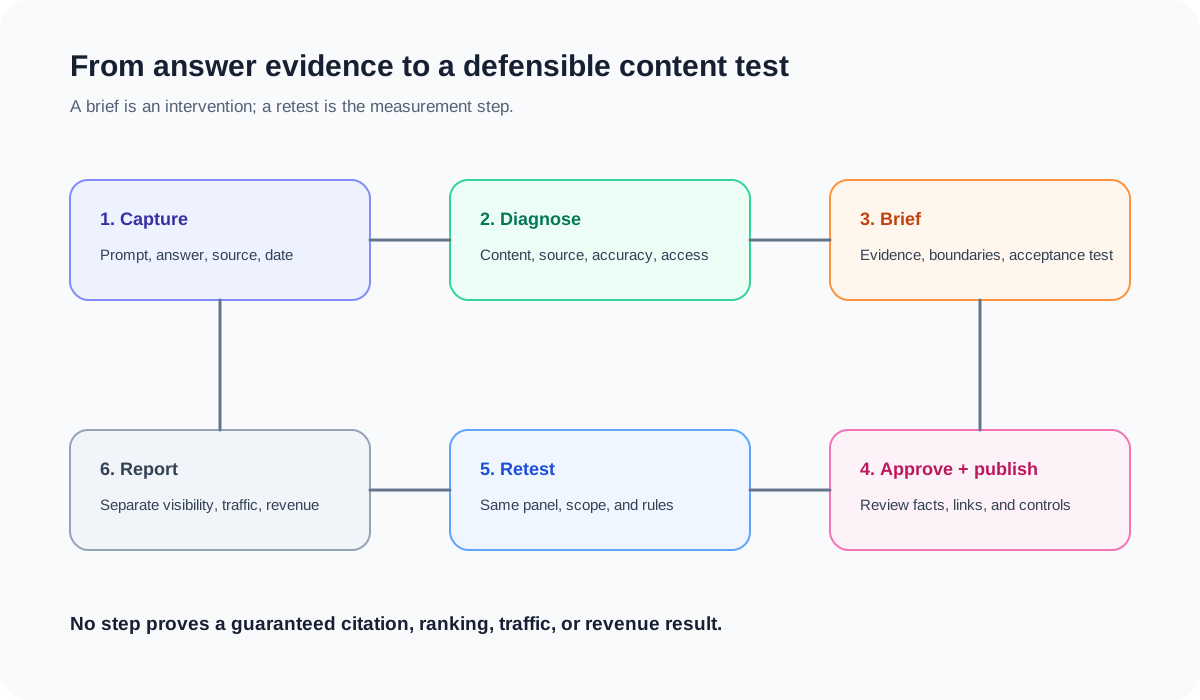
Why dashboards do not make content briefs
A visibility dashboard can show a mention rate, competitor presence, citation source, sentiment label, or prompt trend. Those observations still need interpretation. A competitor citation may indicate a content gap, a stronger third-party source, a different prompt sample, or ordinary answer volatility.
Keep these questions separate:
- Observation: What did the sampled answer contain?
- Diagnosis: What plausible gap or uncertainty explains it?
- Intervention: What exactly will the team change?
- Outcome: What changes in the same sample or in analytics afterward?
Peec AI and Surfer AI Tracker illustrate different parts of the monitoring and optimization category. The method here is vendor-neutral and should be applied whether evidence comes from a specialist tracker, a traditional SEO platform, or manual captures.
1. Freeze the measurement scope
Before creating a brief, record:
| Field | Example |
|---|---|
| Business question | Which project-management tools fit a 20-person remote team? |
| Prompt group | Category, comparison, evaluation, risk |
| Engines and models | The exact surfaces and versions available to the team |
| Country and language | US, English |
| Run dates | August 1–14, 2026 |
| Sample | 40 prompts, two captures per prompt |
| Mention rule | Brand name appears in the answer body |
| Citation rule | Client domain is linked or named as a source |
A scope statement prevents a common error: changing the prompt set and then attributing the changed denominator to content performance.
Branded prompts can be useful for accuracy, but they should not dominate a claim about category discovery. Add problem, comparison, alternative, regional, and risk prompts where relevant. See How to Build a Reliable AI Search Prompt Set for a fuller construction method.
2. Preserve the answer, not only the score
Save the answer text or a screenshot where permitted, cited URLs, prompt, engine, date, location, and the page or product mentioned. A percentage without its underlying observations is difficult to audit.
Classify each finding:
- Content gap: The page does not answer the question clearly or completely.
- Source gap: A publisher, review, community, or directory is repeatedly cited instead.
- Accuracy gap: The model states an outdated price, feature, policy, or identity.
- Access gap: A technical issue may prevent a relevant page from being fetched.
- Sampling uncertainty: Too few observations or changing conditions to support a fix.
A citation from a third-party source is not automatically a reason to publish a similar page. First determine what evidence the source supplies and whether the client can provide a genuinely better or more current answer.
3. Build a brief around the gap
A useful GEO-aware content brief contains more than keywords and word count.
Required brief fields
- Question and intent — quote the prompt family and the user decision.
- Audience and constraints — budget, location, industry, compliance, or product limits.
- Facts to establish — names, definitions, dates, prices, specifications, and ownership.
- Evidence to add — first-party documentation, methodology, examples, reviews, or citations.
- Comparison boundaries — what the page can claim and what it cannot prove.
- Structured answer design — headings, tables, definitions, FAQs, and concise direct answers.
- Internal links — related guides, product pages, documentation, and the next decision.
- Acceptance test — the exact prompts and factual checks to repeat after publication.
The goal is not to write text that “sounds like AI.” The goal is to make the page clear, accurate, useful, and easy for people and retrieval systems to interpret.
Frase and MarketMuse are examples of content-optimization products that can inform research and topic planning. Their traditional content or SEO capabilities should not automatically be treated as proof of the effectiveness of a newer GEO feature.
4. Add evidence before adding volume
More pages are not always the answer. Select the smallest intervention that addresses the diagnosed gap:
| Diagnosis | Possible intervention | Acceptance test |
|---|---|---|
| Missing definition | Add a clear definition and scope | The page answers the target question in the first section |
| Weak comparison | Add criteria, tradeoffs, and dated facts | The answer reflects the comparison without invented certainty |
| Outdated price | Update first-party pricing and date | Manual checks no longer find the stale fact |
| Missing source authority | Improve documentation or pursue relevant third-party coverage | The page or source is discoverable and accurate |
| Thin product detail | Expand specifications, use cases, limits, and FAQs | The answer contains the facts a buyer needs |
| Blocked access | Investigate robots, status codes, rendering, and links | Crawlers can request the intended page |
Technical access is a prerequisite, not a citation guarantee. A crawler visit does not prove that a model will cite the page.
5. Set approval gates for generated content
A content generator can accelerate research, drafting, refreshes, and internal links. It cannot replace a subject-matter owner. Before publication, check:
- Every price, feature, limit, date, and model claim against a current source.
- Names, product identities, locations, and comparison claims.
- Quotations, statistics, and references.
- Legal, medical, financial, safety, or warranty language.
- Links, redirects, canonical tags, schema, and analytics parameters.
- Whether the page adds original value instead of paraphrasing competitors.
Sight AI is an example of a platform that combines AI visibility checks with content generation, CMS connectors, and indexing workflows. Its public credit model makes an important operational point: monitoring, research, writing, and outreach can draw from the same budget. Buyers should measure actual credit consumption rather than assuming a nominal monthly allowance equals prompt capacity.
6. Publish with a change record
Record the intervention in a simple log:
URL:
Prompt family:
Baseline dates:
Change made:
Source checks:
Owner:
Publication date:
Retest dates:
Other events:
Other events matter. Model updates, PR coverage, product launches, site migrations, seasonality, and competitor changes can all affect answers during the observation window.
Use Writesonic GEO Suite as another category example when comparing content generation and AI Search workflows, but inspect plan limits, raw evidence, and the boundary between the broader writing product and its GEO module.
7. Retest the same question
A practical retest should preserve the prompt wording, engine or model, market, language, and interpretation rules where possible. Run enough observations to distinguish a repeatable pattern from one changed answer.
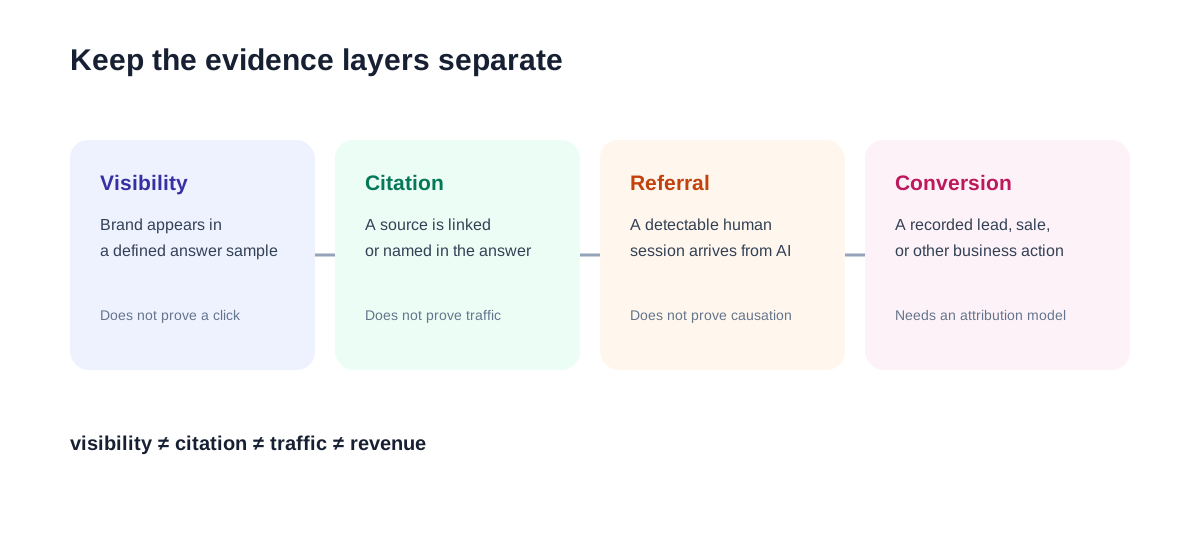
Report layers separately:
- Visibility: appearance in the defined answer sample.
- Citation: link or named source in that answer.
- Accuracy: whether the description is correct and current.
- Referral: detectable human sessions from an AI source.
- Conversion: a recorded action under a stated attribution model.
The sequence is useful, but it is not a causal funnel by default. Visibility does not equal citation, citation does not equal traffic, and traffic does not equal revenue.
What to put in the content team’s report
A monthly workflow can use this compact structure:
- Scope and sample changes.
- Three representative answer captures.
- Top content, source, accuracy, and access findings.
- Published changes with owners and dates.
- Retest observations.
- Analytics and conversion data in a separate section.
- Uncertainty, competing explanations, and next test.
Avoid a single “AI content ROI” number unless the team can explain exactly how it was calculated and what it omits. Vendor-selected customer stories are useful context, but they are not independent causal evidence.
Checklist
- The business question is explicit.
- Prompt groups include non-branded discovery and comparison queries.
- Model, engine, location, language, date, and sample are recorded.
- Full answers and cited URLs are preserved where possible.
- The finding is classified before a brief is written.
- The brief lists evidence, boundaries, owner, and acceptance test.
- Generated content passes factual and editorial review.
- Publication and indexing are logged separately from answer outcomes.
- Retests use a stable panel and disclose volatility.
- Visibility, citations, traffic, and revenue remain separate claims.
FAQ
Does GEO content need to mention an AI model?
No. Write for the user’s question and provide clear, accurate, well-supported information. Model-specific wording is not a substitute for usefulness or evidence.
How many prompts should a content team retest?
There is no universal number. Use a panel large enough to represent the decision and intent groups that matter, then keep it stable enough to compare periods. Document the denominator rather than presenting a bare score.
Should every missing citation trigger a new article?
No. First check whether the issue is a source gap, factual problem, access issue, or normal sampling variation. A relevant documentation fix or third-party correction may be more appropriate than another page.
Can generated content improve AI visibility?
It may address a content gap, but the outcome is empirical and context-dependent. Test the change against a defined sample and do not promise citations, rankings, traffic, or revenue.
Sources and verification
- Google Search Central: AI features and your website — foundational guidance for sites appearing in Google’s AI features; checked August 25, 2026.
- Google Search Central: Creating helpful, reliable, people-first content — content quality and people-first context; checked August 25, 2026.
- Google Analytics campaign URL guidance — context for detectable referral measurement; checked August 25, 2026.
- Sight AI pricing — official credits, workflow, and plan information; checked August 25, 2026.
- AICiteKit: AI Search Prompt Set — related editorial methodology.
This is AICiteKit editorial guidance. It does not guarantee visibility, citations, rankings, traffic, or revenue.