AI Search Answer Freshness Audit: How to Find Stale Facts Before They Get Cited
A practical AI Search freshness audit for detecting stale prices, limits, availability, and product facts while separating citations from rankings, traffic, and revenue.
The short answer
An AI Search answer freshness audit checks whether the facts that could shape an answer are current, scoped, and supported by inspectable sources. It is especially useful for prices, usage limits, product capabilities, availability, legal terms, local service areas, and “best tool” comparisons.
Use this sequence:
fact inventory → source check → matched answer capture → bounded retestA stale page can remain accessible and still be a poor source for a current answer. But a changed answer is not, by itself, proof that a page lost rankings or that a content edit caused a business result. Preserve the conditions of the observation and keep freshness, citation, traffic, and conversion as separate evidence layers.
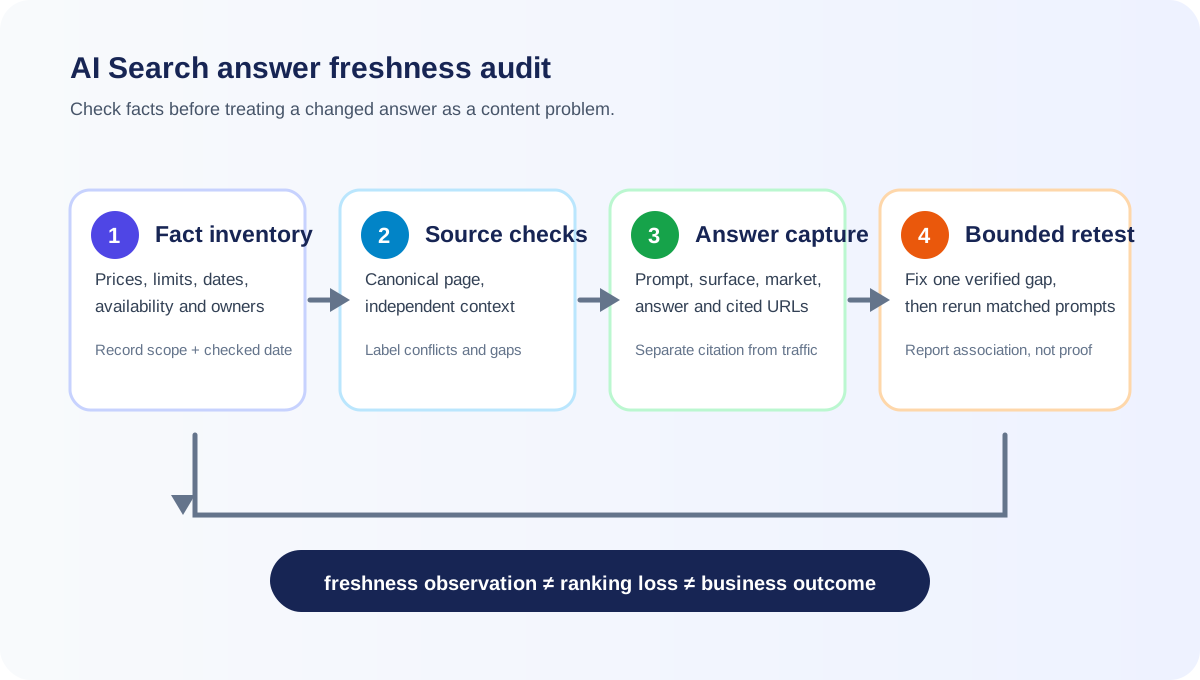
This guide addresses practical searches such as “how do I check if AI Search uses outdated information?”, “how can I monitor stale product facts in AI answers?”, and “does updating a page improve AI citations?” The defensible answer is an evidence workflow—not a freshness trick or citation guarantee.
What freshness means in AI Search
Freshness is not one universal score. For an audit, define it as the relationship between a claim, its scope, its authoritative source, and the date on which the claim was checked.
| Observation | What it supports | What it does not prove |
|---|---|---|
| A pricing page changed on a recorded date | The first-party page contains a new commercial statement | That every AI answer has updated |
| An answer cites an older page | The older URL appeared in that captured answer | That the platform prefers stale sources universally |
| A product is described with an old feature set | A potentially stale claim was observed | Why the answer selected it |
| A matched retest shows a different source | The sampled answer or source set changed | That one edit caused the change |
| Analytics records a referral after a citation | A separately measured referral occurred | That the citation caused all later business activity |
Google’s documentation says AI features may show links to supporting web resources and recommends foundational Search practices; it does not publish a universal freshness score or guarantee that a page will appear (Google Search Central: AI features and your website, checked September 8, 2026). Treat that as product and webmaster context, not as evidence that an update will produce a citation.
Why stale facts are a high-risk GEO issue
A stale article is inconvenient. A stale price, availability statement, compliance requirement, or product limit can mislead a buyer. The risk is higher when an answer compresses several sources into a confident recommendation and the reader does not inspect every link.
Prioritize claims using three questions:
- How costly is the error? Pricing, eligibility, safety, legal, and availability claims deserve earlier review.
- How quickly can the fact change? Usage limits and product packaging may change more often than a durable definition.
- Can a reviewer verify it? A claim with a clear canonical source is easier to check than an unsupported promise repeated across pages.
Do not label an answer “hallucinated” merely because it differs from your preferred wording. First determine whether the answer is factually wrong, scoped to another market or edition, using a former name, or drawing from a source that has since changed.
1. Build a fact inventory before checking answers
Start with the claims a buyer or customer is likely to ask about. A compact inventory makes freshness review repeatable.
| Fact family | Minimum fields | Freshness risk |
|---|---|---|
| Price | Amount or pricing method, currency, billing basis, scope | Promotional and annual-equivalent wording can be confused with recurring price |
| Limits | Unit, period, seat or workspace scope, overage rule | “Unlimited” or “generous usage” can hide policy boundaries |
| Capability | Feature name, edition, prerequisites, documentation URL | Product releases and plan gates change |
| Availability | Market, language, device, rollout or eligibility condition | A feature may be available only to some users |
| Organization | Current name, ownership, location, service area | Rebrands and parent-company relationships can lag externally |
| Policy | Effective date, region, exception, canonical policy URL | Older help pages can remain discoverable |
For each row, record an owner, authoritative URL, last checked date, scope, and the exact wording that is safe to publish. A date is provenance; it is not a permanent guarantee that the claim remains current.
A useful record looks like this:
Fact: Team plan includes the documented monthly allowance
Source: current first-party pricing or help-center URL
Scope: public US-English page; plan name recorded
Checked: 2026-09-08
Owner: product marketing
Status: current / conflict / unavailable
Next review: after packaging or policy change
If no public source supports a claim, mark it unverified. Do not infer current pricing from an old review, affiliate comparison, screenshot, or vendor-selected case study.
2. Audit the source graph, not only the homepage
A model or buyer may encounter more than the page you intended to be canonical. Review the pages that repeat or qualify the fact:
- Current pricing and plan pages
- Product documentation and release notes
- Help-center articles and changelogs
- Comparison and migration pages
- Legal, policy, and availability pages
- Press releases and rebrand notices
- Independent reviews and directories
- Local or regional profiles where location matters
Create a conflict ledger:
| Claim | Canonical source | Other public source | Conflict | Action |
|---|---|---|---|---|
| Billing interval | Current pricing page | Old comparison page | Yes or unknown | Correct, redirect, or qualify |
| Feature availability | Current documentation | Review or directory | Scope differs | State edition and date |
| Company relationship | About or legal page | Independent profile | Relationship unclear | Clarify ownership and naming |
| Service area | Current location page | Directory listing | Region mismatch | Limit the geographic claim |
Google’s people-first guidance recommends content that helps people rather than content made primarily to manipulate rankings (Creating helpful, reliable, people-first content, checked September 8, 2026). In a freshness audit, that means resolving a real factual conflict and documenting the evidence—not adding a date or keyword without checking the claim.
Bing’s webmaster guidance is a useful independent platform context for discoverability and quality considerations (Bing Webmaster Guidelines, checked September 8, 2026). It does not establish how every AI answer engine selects or refreshes sources.
3. Capture answers under fixed conditions
A freshness observation is only interpretable when the collection conditions are recorded. Save, where the platform permits:
- Exact prompt and prompt-set version
- Surface and mode; model or version when disclosed
- Country, language, and location context
- New conversation or follow-up context
- Collection date, time zone, and run number
- Full answer or permitted export
- Mentioned products and recommendation wording
- Exact cited URLs and the claim each URL appears to support
- Whether a source was unavailable, redirected, or checked on a different date
If a platform does not expose a field, write “not exposed” or “unavailable.” Do not fill in an assumed model version, hidden retrieval query, or source-selection reason.
A minimal answer record might be:
Prompt: PRICE-003 v2
Surface: named AI Search surface; mode recorded when available
Market: United States / English
Collected: 2026-09-08 UTC
Observed: answer cited an older comparison URL for a plan fact
Current source check: first-party page differs; scope still being reviewed
Conclusion: stale-source observation in this run; cause unresolved
AI Search Console, Peec AI, Otterly.AI, and PromptWatch represent different monitoring workflows. During a trial, verify whether each preserves raw answers, exact URLs, prompt context, timestamps, failed runs, and source history. A dashboard label such as “freshness” or “visibility” is not a standard shared metric.
4. Grade the claim, not just the URL
A current URL can still fail to support the claim attached to it. Review the source at the claim level.
| Check | Question | Safe result |
|---|---|---|
| Relevance | Does the page answer this exact buyer question? | Direct, partial, or unrelated |
| Accuracy | Does the visible text support the answer wording? | Supported, contradicted, or unverified |
| Freshness | Is the fact current for the recorded market and edition? | Current, stale, undated, or unknown |
| Scope | Does the claim apply to the user’s plan, region, and date? | Matched, narrower, broader, or mismatched |
| Provenance | Is the evidence first-party, independent, user-generated, or vendor-selected? | Label the source type |
A vendor page is appropriate evidence for the vendor’s published plan terms, but it is not independent proof of customer outcomes. An independent review can illuminate workflow or usability, but it may describe an older product version. A rating does not prove traffic growth, revenue growth, guaranteed citations, or guaranteed recommendations.
The academic paper GEO: Generative Engine Optimization provides research context for measuring and influencing visibility in generative-engine responses (Aggarwal et al., arXiv, checked September 8, 2026). It does not validate a vendor freshness score, establish a universal retrieval mechanism, or prove that updating a page causes a production business outcome.
5. Choose one bounded freshness action
Once the issue is confirmed, make the smallest useful change that repairs the evidence:
- Correct a plan limit and state its unit and period.
- Add the market or product edition to a capability claim.
- Link an outdated comparison page to the current canonical source.
- Retire a superseded policy page or clearly label its historical scope.
- Add a visible “last checked” note where the date helps the reader.
- Ask an independent directory or reviewer to correct a factual conflict, without assuming the request will be accepted.
Avoid rewriting a page merely because a single answer used another source. A source change may reflect normal answer variation, a market difference, a parser change, an index update, or a prompt mismatch.
Define the retest before publishing:
| Hypothesis | Bounded action | Matched retest |
|---|---|---|
| The answer used a stale plan limit | Correct the visible canonical fact | Same plan and comparison prompts |
| The answer mixed two editions | State edition and eligibility | Same branded and capability prompts |
| A third-party page repeats an old fact | Publish a current source and document outreach | Same source-observation panel |
| Market scope was omitted | Add region and availability qualifiers | Same prompts by market, reported separately |
If the answer changes after the action, report an association unless the design can isolate the cause. Do not turn a before-and-after citation into a causal ranking or revenue claim.
Freshness metrics that stay bounded
Use metrics with a denominator and a defined sample. For example:
current-fact support rate = sampled answers whose cited source supports the current fact ÷ sampled answers reviewed
stale-source rate = sampled answers citing a source outside the accepted freshness rule ÷ sampled answers with a relevant citation
The freshness rule must be explicit. “Older than 90 days” may be sensible for a fast-changing product but inappropriate for a durable definition; the threshold is an editorial or operational choice, not a universal AI Search standard.
Report:
- Prompt IDs and versions
- Surface, mode, market, and language
- Collection dates and matched runs
- The exact accepted-freshness rule
- Current, stale, unavailable, and non-matched observations
- Exact URLs and claim-level support
- Whether historical results were recalculated by the monitoring product
Keep these measures separate from brand mentions, recommendations, rankings, referrals, and conversions. Search Console reporting can provide Search performance context, but it is not a transcript of every AI answer (Google Search Console performance report, checked September 8, 2026).
What a freshness audit cannot prove
Even a careful audit cannot establish:
- That every user sees the same answer or source set
- A universal freshness score across AI surfaces
- That a cited URL was the only source used internally
- That a changed citation means a ranking loss
- That an update caused the answer change without stronger experimental design
- That a citation caused a click, lead, order, or revenue
- That crawler access proves a page appeared in a user-facing answer
- That a vendor-selected case study is independent evidence
The useful conclusion may be narrow: “One of five matched answers cited a source whose plan fact conflicted with the current first-party page.” That is actionable without pretending to explain the entire retrieval system.
Who should use this workflow?
This audit is a good fit for:
- SaaS and ecommerce teams with frequently changing commercial facts
- Product marketers maintaining comparisons, packaging, or capability pages
- Agencies reporting AI Search observations to clients
- Technical SEO teams connecting source maintenance with answer captures
- Local and international teams where availability or naming differs by market
It is not a substitute for product release management, legal review, analytics attribution, or a representative study of every AI Search user.
Evidence snapshot
| Source | Public signal | What it supports | Confidence |
|---|---|---|---|
| Google Search Central: AI features and your website | Official guidance on AI features, links, and Search fundamentals | Product context and the absence of a universal appearance guarantee | High |
| Google: People-first content | Official content-quality guidance | Editorial standard for useful, accurate, non-manipulative updates | High |
| Bing Webmaster Guidelines | Official webmaster guidance | Discoverability and quality context; not a universal AI freshness rule | Medium-high |
| Google Search Console performance report | Official reporting documentation | Search-performance context separate from answer-level evidence | High |
| GEO: Generative Engine Optimization | Independent academic research paper | Background on generative-engine visibility research and evaluation | Medium; not evidence for a vendor metric or causal outcome |
| AICiteKit editorial framework | Fact inventory, source ledger, and matched-retest method in this article | A bounded operating workflow | Editorial |
Practical checklist
- High-risk facts have an owner, canonical URL, scope, and checked date.
- Pricing, limits, availability, and edition qualifiers are explicit.
- Conflicting pages and third-party claims are recorded rather than silently merged.
- Prompt, surface, market, language, date, and answer context are captured.
- Exact cited URLs are linked to the claims they appear to support.
- Vendor facts, independent evidence, and editorial interpretation are separated.
- “Current,” “stale,” “unavailable,” and “not checked” have explicit definitions.
- A single bounded action is chosen before the retest.
- Mention, citation, referral, conversion, and freshness are not collapsed into one score.
- The conclusion states what the sample cannot prove.
FAQ
Does updating a page make AI Search cite it?
No. An update can repair a factual problem or improve clarity, but no source here supports a guarantee that the page will be retrieved or cited. Test a defined panel and report the observation with its conditions.
How often should a pricing or product page be checked?
Use the change rate and risk of the claim to set the cadence. Review high-risk, fast-changing facts after packaging or policy changes; do not use an arbitrary schedule as proof of freshness everywhere.
Is an old citation automatically wrong?
No. It may still support a durable fact, or it may be stale for the relevant plan, market, or product edition. Compare the cited passage with the current authoritative source and record the scope.
Can a last-updated date improve AI visibility?
A date can help a human understand provenance when it is truthful and maintained. It does not prove that a retrieval system will prefer the page or that a citation will result.
Are AI crawler logs evidence that a page was cited?
No. A crawler request shows access under recorded conditions. Answer-level capture is needed to show that a source link appeared, and even that observation is limited to the tested surface, prompt, time, and method.
Sources and verification
The official guidance and research paper linked above were checked on September 8, 2026. AICiteKit has not independently audited the internal retrieval, sampling, parser, or historical-recalculation methods of the monitoring tools named in this article. Public sources support the stated platform and research context; they do not establish causal effects for a specific site.
This is AICiteKit editorial methodology. It does not claim that any tool, markup, date label, or content update guarantees rankings, citations, traffic, or revenue.