Field notes / ai-search
AI Search Answer Evaluation: A Human Review Rubric for GEO Teams
A practical AI Search answer evaluation rubric for checking claims, sources, recommendations, and evidence boundaries without turning one sampled answer into a ranking claim.
The short answer
AI Search answer evaluation is a structured human review of a captured answer: what it says, which claims matter, what sources are visible, whether those sources support the wording, and what evidence is still missing.
Use this sequence:
capture → split claims → check sources → score evidence → choose a bounded actionThe goal is not to award a vague “good answer” score. It is to make observations reproducible enough that a content or SEO team can decide whether to correct a fact, investigate a source, rerun a prompt, or leave the page unchanged.
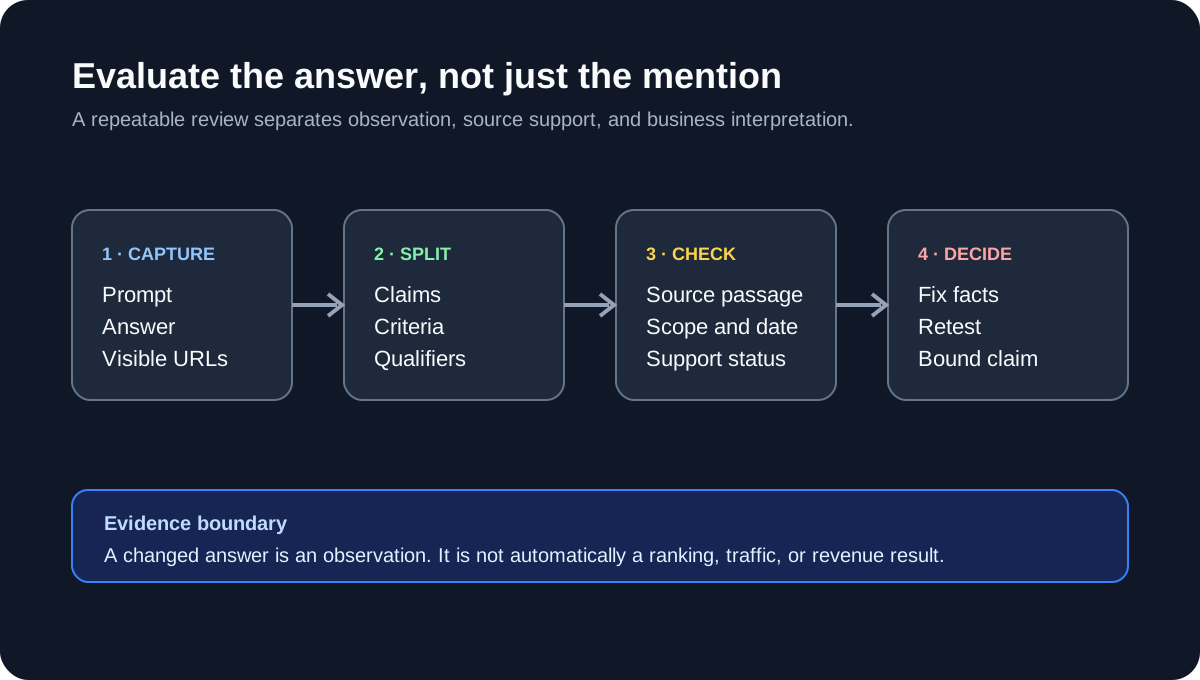
This guide addresses searches such as “how do I evaluate AI search answers?”, “how do I audit ChatGPT citations?”, and “what should a GEO reporting rubric include?” It is a review method, not a promise of rankings, citations, traffic, leads, or revenue.
What answer evaluation can show—and what it cannot
Google’s AI features documentation, checked October 16, 2026, says AI features may show links to supporting web resources and points site owners toward foundational Search practices. It does not define a universal quality score or guarantee that a page will appear.
OpenAI’s web search documentation, checked October 16, 2026, documents citations and source fields for a particular API tool. That is useful when those fields are exposed in the tested context; it is not evidence that every consumer surface exposes or selects sources in the same way.
The independent paper GEO: Generative Engine Optimization, checked October 16, 2026, provides research context for studying generative-engine visibility. It does not validate a commercial dashboard’s score or prove that a particular content edit causes a business result.
| Observation | Safe interpretation | Do not claim from it alone |
|---|---|---|
| The answer mentions a brand | The brand appeared in this capture | The brand is broadly visible or preferred |
| A URL is shown beside a paragraph | The URL was visible in this capture | The URL supports every sentence |
| A recommendation changed on a repeat run | The sampled recommendation changed | The website edit caused the change |
| A source supports one product fact | That fact has a checked source relationship | The source proves the recommendation is correct |
| A reviewer gives the answer a high score | It met the declared rubric in that review | Users will have the same experience |
| A tool reports a visibility metric | The tool calculated a metric under its method | The metric is comparable with another tool |
Keep answer quality, citation presence, source support, referral, and conversion as separate fields.
1. Define the decision before reading the answer
A rubric is only useful when it answers a decision. “Is this answer good?” is too vague. Better questions include:
- Does the answer state the current plan limit correctly?
- Does a recommendation satisfy the buyer constraints in the prompt?
- Does each important product fact have a source that supports its scope?
- Does the answer distinguish two similarly named companies?
- Does a regional answer preserve the market and eligibility qualifier?
Record the review context before opening the capture:
- Exact prompt and panel version
- Intent: branded, category, comparison, product fact, local, or risk
- Surface and mode; model label only when disclosed
- Country, language, device, and account context when relevant
- Collection timestamp and time zone
- Run number and whether it was a retry
- Expected decision and material claims to check
If a field is not exposed, record not exposed or unavailable. Do not infer a hidden model, retrieval query, or reason a source was selected.
2. Preserve the answer before summarising it
A summary is an interpretation, not the observation. Where collection is allowed by the platform and applicable privacy rules, preserve:
- The exact prompt and panel version.
- The complete answer or an allowed near-raw capture.
- Every visible source title and direct URL.
- Mentioned brands, products, competitors, and recommendations.
- Stated decision criteria and qualifiers.
- Empty, failed, login-gated, and no-source states.
- Collection conditions and timestamp.
A minimum record might look like this:
Review ID: EVAL-014 v2 / run 03
Prompt: Which AI visibility tool fits a small agency that needs source exports?
Intent: comparison
Surface: named surface; mode recorded if disclosed
Market: United States / English
Collected: 2026-10-16 UTC
Answer status: qualifying capture
Visible URLs: 5
Do not remove failed runs because they make the report less tidy. Availability and collection failures are part of the evidence boundary.
3. Split the answer into claim units
Reviewing a whole answer with one score hides important differences. Split compound sentences into units that can be checked independently.
Answer: Tool A tracks prompts, supports agency reporting,
and includes source exports on the starter plan.

Claim 1: prompt tracking is documented
Claim 2: an agency reporting workflow is described
Claim 3: source exports exist
Claim 4: source exports are included on the starter plan
Claims 1 and 3 may be supported by product documentation. Claim 4 usually needs a current plan or pricing source. Claim 2 may be a workflow interpretation rather than a directly documented fact.
Use smaller units when the sentence combines:
- Feature plus plan
- Price plus billing interval
- Recommendation plus audience
- Availability plus location
- Mention plus quality judgement
- Current fact plus historical comparison
A useful claim unit includes the subject, predicate, object, and qualifiers. “Supports exports” is weaker than “the documented Standard plan lists CSV export for source URLs, checked on October 16, 2026.”
4. Score claims with a transparent rubric
A rubric should be simple enough for two reviewers to apply consistently. The following five dimensions are a starting point, not a universal industry standard.
| Dimension | 0 | 1 | 2 |
|---|---|---|---|
| Relevance | Does not answer the prompt | Partly addresses the intent | Addresses the stated intent |
| Factual support | Material claim is unsupported or contradicted | Some claims have support; scope is incomplete | Material claims have checked support for the recorded scope |
| Source traceability | No usable source relationship | A source is visible but mapping is unclear | Relevant direct sources are mapped to the claims they support |
| Qualifier accuracy | Important date, plan, market, or condition is wrong or missing | Some qualifiers are present | Material qualifiers are preserved |
| Recommendation fit | Recommendation ignores the buyer constraints | Some criteria are matched | The recommendation explains its fit and tradeoffs |
A score is useful only with the row-level notes. A 9/10 answer can still contain one dangerous pricing error. Report both the dimension scores and material exceptions.
Do not add dimensions after seeing a result. Version the rubric and record which version was used.
Suggested interpretation
- Green: no material unsupported claim found in the checked scope; follow-up is routine.
- Amber: useful answer, but one or more claims need qualification, source checking, or a repeat run.
- Red: a material fact is contradicted, a recommendation ignores the prompt constraints, or the answer cannot be audited from the available capture.
These labels describe the reviewed answer. They do not estimate all answers from the same engine or market.
5. Check source support claim by claim
A URL near an answer is not automatically evidence for every sentence. Create one row for each claim-to-source relationship.
| Claim ID | Answer claim | Source | Source type | Status | Boundary |
|---|---|---|---|---|---|
| C-01 | Product documents prompt tracking | Direct product documentation | Official | Supported / partial / unavailable | Feature and checked date |
| C-02 | Feature is in the entry plan | Current pricing or plan page | Official | Supported / partial / unavailable | Plan, billing, currency |
| C-03 | Best for small agencies | Review or comparison | Independent or commercial | Interpretive | Buyer context and source bias |
| C-04 | Customers achieved a named outcome | Case study | Vendor-selected evidence | Attributed claim | Not independent proof |
Use a small status vocabulary:
- Supported: the checked passage supports the wording and recorded scope.
- Partial: the source supports only part of the sentence or misses a qualifier.
- Contradicted: the checked source conflicts with the claim.
- Unverified: a relevant passage was not found or the relationship is unclear.
- Unavailable: the answer or source could not be inspected under the collection rules.
For dynamic facts, check price, billing interval, usage limits, plan, market, currency, and date separately. For model or platform coverage, check whether the claim applies to the base plan, an add-on, a beta, or a vendor statement about future availability.
6. Treat recommendations as criteria, not truth
Recommendation answers need a second layer of review. First check whether the answer’s facts are accurate. Then check whether its choice follows from the buyer’s stated constraints.
| Review question | Evidence to record |
|---|---|
| Did the answer identify the buyer’s must-have constraints? | Exact constraint and answer passage |
| Did the recommended product meet each constraint? | Claim-to-source rows and plan scope |
| Were tradeoffs or missing capabilities disclosed? | Qualifier and limitation notes |
| Were alternatives compared on the same criteria? | Comparison matrix, not just brand order |
| Is “best” merely the answer’s language? | Mark as editorial or answer judgement |
A tool appearing first is not proof that it is objectively best. A recommendation can be relevant and well-supported while still being unsuitable for a different buyer.
For teams investigating tool workflows, AI Search Console, PromptWatch, Otterly.AI, Peec AI, Profound, and Rankscale may expose different combinations of prompt tracking, answer capture, citation analysis, or reporting. Their metrics should not be compared until you verify panel design, surfaces, refresh method, counting rules, retention, and exportable raw evidence.
7. Use two reviewers for material answers
Human review is subjective, but it can be made more auditable. For a material report:
- Give both reviewers the same prompt, capture, rubric version, and source set.
- Ask each reviewer to score independently.
- Compare disagreements at the claim-row level, not only the total score.
- Resolve differences by citing the passage or mark the claim unverified.
- Keep the original scores and the adjudicated result.
Do not report an agreement percentage from a tiny sample as if it were a stable measurement. State the number of answers, reviewers, rubric version, and whether disagreements were adjudicated.
Common disagreement causes include:
- Treating a topical source as support for a precise claim
- Missing a plan or regional qualifier
- Confusing vendor-selected evidence with independent evidence
- Scoring polished prose as factual accuracy
- Treating a recommendation as a verified product fact
The disagreement log is often more useful than a single aggregate score because it shows which rules need clarification.
8. Report findings with an evidence boundary
A useful report has four layers:
| Layer | Question | Example output |
|---|---|---|
| Answer | What appeared? | The product was named in 7 of 10 captures |
| Claim | Which statements were checked? | 22 claims: 14 supported, 4 partial, 2 contradicted, 2 unavailable |
| Source | What evidence was visible? | 31 URLs, mapped to 18 claim relationships |
| Action | What should happen next? | Correct the plan qualifier and rerun the product-fact cohort |
Say what the denominator is. “72% supported” is incomplete unless the reader knows whether it means supported claim-source relationships, answers with at least one supported claim, or weighted expert scores.
A defensible conclusion sounds like this:
We reviewed 20 qualifying captures from the fixed comparison panel. Fourteen of 22 material claims had a source that supported the recorded scope; four were partial, two contradicted by the checked primary source, and two unavailable. The sample identifies factual and evidence gaps to investigate. It does not estimate every user’s answer or prove that any page caused selection.
Do not convert a higher answer score into traffic, rankings, trust, or revenue. Those require separate measurements and, for causal claims, stronger designs.
9. Turn a red or amber result into a bounded action
Choose the smallest action that addresses the observed problem:
- Factual contradiction: reconcile the current first-party page, date the change, and rerun the same fact prompt.
- Missing qualifier: make plan, market, edition, or date explicit in the source and check the answer again.
- Weak source mapping: preserve direct URLs and inspect the passage rather than adding more citations.
- Recommendation mismatch: rewrite the comparison criteria or prompt context; do not assume the recommendation is a ranking defect.
- Unavailable capture: improve collection logging or mark the result unavailable.
- Repeated volatility: increase the run count and preserve the control prompts before calling it a trend.
A content edit may be sensible, but a post-edit answer change remains an observation unless the test design supports a stronger inference.
Practical AI Search answer evaluation checklist
- State the decision and intended claim scope.
- Version the exact prompt and rubric before review.
- Preserve the answer, visible URLs, conditions, and failed states.
- Split compound prose into discrete claims.
- Check source passages, not just domains or URL counts.
- Verify date, plan, market, currency, and qualifier scope.
- Score recommendation fit separately from factual support.
- Record reviewer disagreements and adjudication.
- Report denominators and unavailable evidence.
- Choose one bounded follow-up and rerun the same panel.
FAQ
Is an AI Search answer with citations automatically high quality?
No. A citation can be visible without supporting every claim, matching the current date, or satisfying the buyer’s constraints. Check the claim-to-source relationship and scope.
Should I use a single score for GEO answer quality?
A score can help triage, but a single number hides which claim failed and how the score was assigned. Pair dimensions with row-level notes, denominators, rubric version, and material exceptions.
How many answers should a human review?
There is no universal number. Choose a panel that represents the decision’s intent classes and report its size. Repeat runs are more informative when the prompt, surface, market, and collection rules remain comparable.
Can a human review prove that an SEO change improved AI visibility?
Not by itself. It can show a difference in the reviewed captures. Causal or business conclusions need controls, repeated observations, compatible analytics, and a clearly defined outcome.
Which sources count as independent evidence?
User reviews, community discussions, independent research, and independent tests can provide independent signals. Agency, affiliate, competitor, and sponsored comparisons are commercial sources and may still be useful, but disclose the relationship. Vendor-selected case studies support only the attributed customer claim, not a general outcome.
Sources and verification
- Google Search Central: AI features and your website — official guidance on documented AI features and supporting links; checked October 16, 2026.
- OpenAI Developer Docs: Web search — official documentation for citations and sources in the specified web-search tool; checked October 16, 2026.
- Aggarwal et al., GEO: Generative Engine Optimization — independent research context; it does not validate a current production score or causal business result; checked October 16, 2026.
- AI Search Claim Coverage — AICiteKit methodology for mapping answer claims to source support.
- AI Search Citation Attribution Audit — AICiteKit methodology for separating visible sources from unsupported attribution.
Last reviewed: October 16, 2026
Evidence confidence: Medium for the evaluation framework; low for any conclusion drawn from a small, surface-specific answer sample.