AI Search Answer Provenance: How to Verify Claims, Sources, and Context
A practical AI Search provenance workflow for checking which claims an answer makes, what its cited URLs support, and where the evidence stops.
The short answer
AI Search answer provenance is the record connecting an answer’s individual claims to the visible sources, retrieval context, and collection conditions used to inspect them. It is not the same as saving a screenshot or counting how often a domain appears.
Use this chain:
answer → claim segments → cited URLs → source passages → context and date → confidenceThe objective is modest but useful: determine what the captured answer says, whether its links support those statements, and what remains unverified. A provenance record does not reveal every hidden retrieval step, prove that a model “understood” a page, establish a universal ranking, or attribute a sale to a citation.
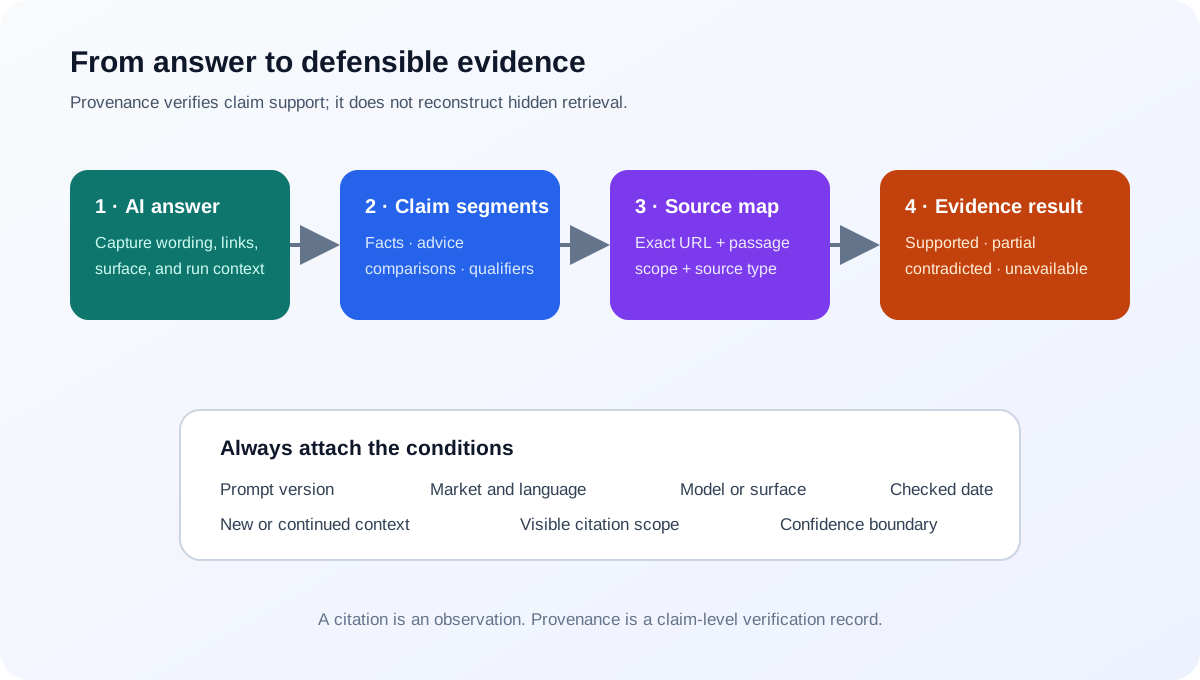
This guide addresses searches such as “how do I verify AI Search citations?”, “how can I audit sources in an AI answer?”, and “does a citation prove an AI answer is accurate?” It complements AI Search Evidence Ledger, AI Search Retrieval Audit, and How to Track Whether AI Engines Are Citing Your Brand.
Why a citation is not the same as provenance
A visible link tells you that a surface displayed a link in the captured response. Provenance asks a narrower question: which part of the answer does that link support, under which conditions, and with what level of confidence?
| Observation | What it supports | What it does not prove |
|---|---|---|
| A URL appears beside an answer | The surface displayed that URL in the run | That every sentence came from it |
| A source passage supports one claim | That passage supports the claim under the checked scope | That it caused the answer or was the only source used |
| Several URLs are shown | Multiple sources were exposed to the reader | Their relative importance or hidden retrieval order |
| A page is fetched by a crawler | An automated request occurred | That a user-facing answer cited the page |
| A retest changes a source | The sampled output changed | That one page edit caused the change |
Google’s AI features documentation, checked September 17, 2026, says AI features may show links to supporting web resources and recommends foundational Search practices. It does not define a universal provenance format or guarantee that a page will appear.
OpenAI’s web search documentation, checked September 17, 2026, documents source and citation fields for an OpenAI API tool. That is useful product-specific context, but it should not be generalized to every ChatGPT experience, model, or other answer engine.
1. Define the answer unit before collecting evidence
An answer can contain several different units:
- Claim: a factual statement, such as a plan limit or product capability.
- Recommendation: a judgment that an option fits a stated need.
- Comparison: a relationship between two or more options.
- Qualification: a condition, exception, date, market, or uncertainty marker.
- Citation: a visible source relationship exposed by the surface.
Do not evaluate a paragraph as if it were one claim. Split it where the truth conditions change. For example:
Answer: Tool A supports daily tracking, is suitable for agencies,
and costs $X per month.

Claim 1: daily tracking
Claim 2: agency fit
Claim 3: current price and billing basis
Each claim needs a separate verification path. A source that supports the feature may say nothing about the price or audience. If the answer combines them, record the combined wording and the individual checks.
A practical claim record
Answer ID: GEO-014 / run 03
Claim ID: GEO-014-C03
Text: “Tool A includes daily prompt tracking.”
Role: capability
Visible citation: exact URL captured
Scope: public product documentation; plan not specified
Checked: 2026-09-17 UTC
Status: supported / partial / contradicted / unavailable
Confidence: medium
Notes: documentation describes frequency, but not every plan
The status describes the evidence you checked, not the model’s internal confidence.
2. Preserve answer context
The same prompt can produce different outputs when the surface, account, country, language, model, search setting, or conversation history changes. Provenance without context can create false comparisons.
Capture at least:
- Exact prompt text and prompt-set version
- New conversation or prior-turn context
- Platform, surface, and mode
- Model or version when disclosed
- Country, language, device, and account state when relevant
- Collection date, time zone, and run number
- Full answer or an allowed near-raw representation
- Every visible cited URL and its location in the answer
- Tool, browse, or search state when exposed
If a field is not exposed, write not disclosed or not available. Do not fill it with a presumed model name, hidden query, or inferred retrieval order.
A minimal context record might be:
Prompt: Which GEO monitoring tool fits a small agency?
Surface: AI answer with web search enabled
Market: United States / English
Run: 3 of 5
Model: not disclosed
Prior context: new conversation
Visible sources: 6
Hidden retrieval trace: not exposed
3. Map claims to source passages
Open each material URL and locate the passage that supports the claim. Record the smallest useful excerpt or a stable section heading, subject to the source’s terms and your own copyright policy. The goal is inspectability, not copying an entire article.
| Claim field | Example | Review question |
|---|---|---|
| Answer wording | “Supports CSV export” | What exactly is being asserted? |
| URL | Exact canonical URL | Can another reviewer open the same source? |
| Passage | Heading plus short supporting text | Does the source actually say this? |
| Scope | Plan, market, date, product edition | Are the conditions aligned? |
| Source type | Official docs, independent review, directory | What evidence boundary applies? |
| Result | Supported, partial, contradicted, unavailable | What did the check find? |
| Checked date | 2026-09-17 | Could the fact have changed? |
A nearby keyword is not enough. A pricing page may support the existence of a plan while failing to support an answer’s exact monthly amount. An independent review may support a workflow observation while saying nothing about current feature coverage.
4. Classify the source before trusting it
Source quality and source relevance are separate dimensions. A first-party page is usually the right place to verify a vendor’s current product fact, but it may be promotional. An independent review can describe practical friction, but it may be old or commercially affiliated.
| Source class | Appropriate use | Boundary |
|---|---|---|
| Official docs or pricing | Features, terms, limits, integrations, availability | Vendor-controlled; check scope and date |
| Independent review platform | User experience and recurring complaints | Review sample, incentives, and product edition matter |
| Academic or standards source | Definitions, methods, research context | May not describe current production behavior |
| Competitor or affiliate article | Workflow observations and tradeoffs | Disclose commercial bias; do not treat as neutral |
| Vendor case study | What the customer and vendor selected to report | Vendor-selected customer evidence, not independent proof |
| AICiteKit analysis | Conditional buying guidance and interpretation | Editorial judgment, not experimental validation |
The GEO research paper by Aggarwal et al., checked September 17, 2026, provides independent academic context for generative-engine visibility experiments. It does not validate a particular commercial “citation score,” guarantee production visibility, or establish that one optimization caused traffic or revenue.
5. Score support, not visibility
A useful provenance review can report support rates for the claims it actually checked:
support rate = supported claims ÷ claims reviewedReport the numerator, denominator, claim definitions, source availability, prompt cohort, market, surface, and date range. Exclude unavailable URLs explicitly rather than silently treating them as unsupported or supported.
You may also report:
- Citation presence: qualifying answers with at least one visible citation.
- Target citation rate: qualifying answers showing the exact target URL.
- Claim coverage: material claims with a mapped source passage.
- Source freshness: mapped sources checked within the declared time window.
- Conflict rate: claims where first-party and third-party sources disagree.
These are sample statistics. They are not probabilities for every user, and they are not rankings unless the metric has a documented ranking definition.
For recurring monitoring, products such as AI Search Console, Peec AI, Otterly.AI, PromptWatch, and Profound may provide different combinations of prompt, answer, citation, and reporting data. Their dashboards are not interchangeable. During a trial, verify whether the export preserves raw answer text, exact URLs, timestamps, prompt context, failed runs, and model or surface labels.
6. Resolve common provenance failures
The URL is cited but does not support the claim
Mark the claim partial or contradicted, quote the relevant source passage internally, and check whether another visible URL supports the wording. Do not call the entire answer a hallucination because one citation is weak.
The source is unavailable
Record the URL, failure type, and checked date. A timeout, paywall, robots response, deleted page, or login wall means the claim remains unverified in your audit. It does not prove the answer was wrong.
The source is current but the answer is stale
Check product edition, market, date, and whether the answer used a cached or older source. Correct the authoritative page if it is wrong, then rerun a fixed prompt panel. A changed retest is an observation, not proof that your edit caused it.
Several sources repeat the same unsupported statement
Repetition is not independent corroboration when the pages copy one another. Trace the earliest or most authoritative source you can identify and label the rest as derivative or unverified.
A crawler request is treated as answer evidence
Keep access logs separate from answer captures. AI Crawler Analytics: What Server Logs Can—and Cannot—Tell You explains why a request can show access without proving a user-facing citation or referral.
Recommended workflow
- Write the decision. Is the audit about accuracy, source quality, brand citation, product comparison, or traffic?
- Version the prompt. Preserve qualifiers and use a stable panel for retests.
- Capture the answer. Save visible source links and all relevant context.
- Segment the claims. Separate facts, recommendations, comparisons, and qualifications.
- Verify the sources. Check exact passages, scope, date, and commercial relationship.
- Classify outcomes. Use supported, partial, contradicted, unavailable, and not applicable.
- Report boundaries. State what was observed and what remains hidden.
- Retest one change. Keep the panel and conditions stable; report association unless causality is isolated.
Who should use this workflow?
This is useful for SEO and content teams reviewing AI answers, product marketers checking commercial facts, agencies that need defensible client reports, and technical teams joining answer captures to source audits.
It is not a substitute for a vendor’s hidden retrieval trace, a representative study of all AI Search users, independent fact-checking of every web page, or conversion attribution. Teams without recurring prompts should begin with a small manual baseline rather than buying a dashboard for an undefined question.
FAQ
Does a citation prove an AI answer is accurate?
No. It proves only that the surface displayed a source relationship in the captured response. Accuracy requires checking whether the source supports the particular claim and scope.
Should I trust official sources more than independent sources?
Use the source suited to the claim. Official pages are usually the starting point for current product terms; independent sources are useful for user experience and practical tradeoffs. Neither class automatically proves every statement.
Can provenance reveal the model’s hidden search queries?
Usually not. Record hidden queries as not exposed unless the product explicitly provides them. Visible citations and server logs do not reconstruct the complete retrieval trace.
Is a citation rate a ranking metric?
Only if the metric has a defined ranking construct, sampling method, and comparable conditions. Otherwise call it a citation rate for a named prompt cohort and date range.
Does improving source provenance guarantee more citations?
No. Clear, current, supportable pages may improve the quality of evidence available to readers and systems, but the sources checked here do not establish a universal citation guarantee.
Evidence snapshot
| Source | Public signal | What it supports | Confidence |
|---|---|---|---|
| Google Search Central: AI features and your website | Official guidance on AI features and supporting links | Product context and the absence of a guaranteed appearance formula | High for documented guidance |
| OpenAI Developer Docs: Web search | Official API documentation for source and citation fields | Product-specific context for exposed web-search citations | High for the API documentation; not every OpenAI surface |
| Aggarwal et al., GEO | Independent academic paper | Research context for generative-engine visibility evaluation | Medium; not a commercial metric validation |
| Google Search Central: Creating helpful, reliable, people-first content | Official content guidance | Editorial boundary against manipulating answers with unsupported copy | High for the guidance |
| AICiteKit editorial framework | Claim-level ledger and review workflow in this article | Practical interpretation and buying questions | Editorial |
Sources and verification
The following sources were checked on September 17, 2026:
- Google Search Central: AI features and your website — official guidance on AI-feature links and foundational Search practices.
- OpenAI Developer Docs: Web search — official documentation for an OpenAI API web-search tool and its citation fields.
- Aggarwal et al., “GEO: Generative Engine Optimization,” arXiv — independent academic research context.
- Google Search Central: Creating helpful, reliable, people-first content — official content-quality guidance.
Last reviewed: September 17, 2026
Data confidence: High for the linked official and academic source descriptions; medium for the operational framework, which is AICiteKit editorial guidance and depends on the fields each AI Search surface exposes.
This article does not guarantee citations, recommendations, rankings, traffic, or revenue.