Field notes / ai-search
AI Search Citation Deduplication: How to Count Sources Without Inflating Visibility
A practical AI Search citation deduplication workflow for separating URLs, pages, domains, claims, and outcomes before reporting GEO visibility.
The short answer
AI Search citation deduplication is the process of deciding what counts as one source before calculating citation or source-coverage metrics. The same destination can appear as several URLs because of redirects, tracking parameters, fragments, language paths, syndicated copies, or different page versions. Conversely, two URLs on one domain may be genuinely different sources.
Use this sequence:
raw answer → retain URLs → normalize carefully → classify unit → report denominator and boundaryThe objective is not to make a visibility number look larger or smaller. It is to make the number reproducible. A URL citation, a canonical page, a domain mention, a claim-supported source, a referral, and a conversion are different evidence events.
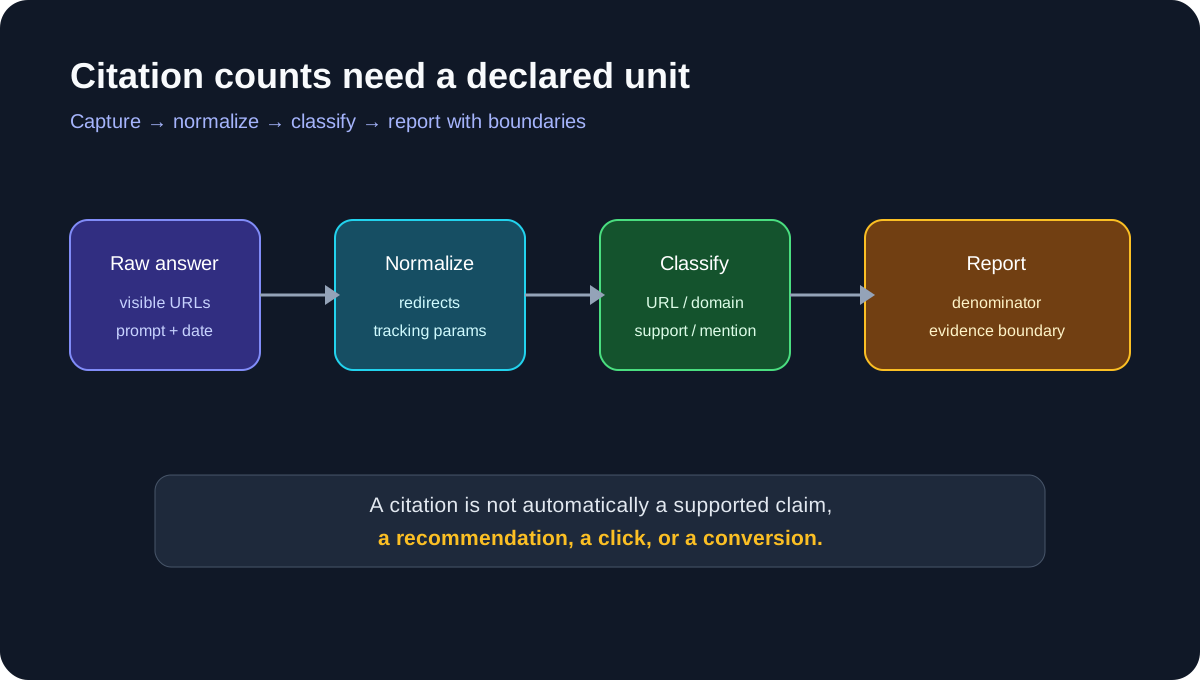
This guide addresses searches such as “how should I count AI citations?”, “why do GEO tools show different citation totals?”, and “should multiple URLs from one domain count once?” It is a measurement and QA workflow, not a guarantee of retrieval, rankings, traffic, or revenue.
Why citation totals disagree
Two reports can both be internally consistent and still show different totals because they answer different questions:
| Counting rule | What it counts | What it must not be called |
|---|---|---|
| Raw URL | Every visible URL string in captured answers | Unique sources without normalization |
| Normalized URL | URLs after a declared technical cleanup | Supported claims |
| Canonical page | A destination after redirect/canonical review | Domain visibility |
| Domain | One or more pages grouped by host | Page-level citations |
| Claim-supported source | A source that supports a defined claim | Any citation beside an answer |
| Referral | A detectable visit from an answer surface | Citation or recommendation |
A tool may count URLs, domains, answer occurrences, or prompt-level presence. None is automatically the “correct” GEO metric. The correct unit depends on the decision. A technical source audit may need exact URLs; a domain-diversity report may intentionally group pages; a claim audit needs the source passage and scope.
Google’s documentation for AI features, checked October 27, 2026, explains that AI features may show links to supporting web resources and recommends foundational Search practices. It does not define a universal citation-deduplication rule or promise inclusion.
OpenAI’s web search documentation, checked October 27, 2026, describes source and citation fields for a particular API tool. That supports preserving and inspecting the fields that implementation exposes; it does not establish that every ChatGPT surface or commercial monitor uses the same source unit.
Perplexity’s Search API quickstart, checked October 27, 2026, documents returned search results and source information for its API context. It is product-specific documentation, not a cross-platform counting standard.
The independent paper GEO: Generative Engine Optimization, checked October 27, 2026, provides research context for studying generative-engine visibility. It does not validate a current vendor metric or prove that a citation caused a business outcome.
1. Preserve the raw citation before cleaning it
Never overwrite the captured URL with a normalized value. Store both. At minimum, retain:
- Exact prompt text and prompt-panel version.
- Surface, mode, and model label when exposed.
- Country, language, device, and location assumptions when relevant.
- Timestamp and time zone.
- Complete answer or a permitted near-raw capture.
- Source title, displayed URL, and link target when different.
- Position or order, if shown.
- Mention, recommendation, citation, and claim-support status.
- Empty, blocked, failed, and no-source states.
A record that says only example.com cannot answer whether the source was /pricing/, /docs/export/, or a third-party review. A record that says only “three citations” cannot be independently re-counted.
A minimal observation might look like this:
Prompt ID: COMP-04
Surface: named interface; mode recorded when exposed
Collected: 2026-10-27 UTC
Raw source: https://www.example.com/docs/export/?utm_source=answer#csv
Displayed title: Export documentation
Source position: 2
Support status: partial; plan condition unresolved
“URL not exposed” is not the same as “no URL existed.” “No source captured” can mean no source was shown, the collector failed, or the export omitted it. Preserve the distinction.
2. Normalize only what you can justify
Technical normalization can improve repeatability, but aggressive normalization can destroy meaning. Use a documented rule set and retain an exception field.
Usually safe to inspect
- Lowercase the hostname, because hostnames are case-insensitive.
- Remove a fragment when it changes only the display location and not the fetched resource.
- Resolve a confirmed redirect and retain the redirect chain.
- Separate tracking parameters from content parameters after checking the site behavior.
- Standardize a trailing slash only if the server treats both forms as the same resource.
The WHATWG URL Standard, checked October 27, 2026, describes URL parsing and serialization behavior. It does not tell a GEO analyst which parameters are safe to discard for a particular site or answer engine.
Do not silently merge
- Different language or country paths.
- Product, documentation, pricing, and review pages on the same host.
- Mobile and desktop destinations when the content differs.
- URLs with query parameters that change filters, products, plans, or versions.
- Syndicated copies merely because their text looks similar.
- Different hosts because they appear to belong to the same company.
A canonical tag is useful evidence about a publisher’s preferred URL, but it is not proof that an answer engine treated two URLs as one source. Record the canonical relationship as a field rather than rewriting history.
3. Choose the unit for the decision
Ask what the report is meant to decide before selecting the aggregation level.
| Decision | Recommended primary unit | Useful secondary fields |
|---|---|---|
| Fix an owned page | Exact or normalized URL | Redirect, canonical, claim, freshness |
| Compare source diversity | Domain plus page count | Host type, source role, repeated prompts |
| Check product facts | Claim-supported page | Passage, plan, date, support status |
| Compare answer engines | Prompt-level presence under matched rules | Raw URLs, positions, surface, retries |
| Investigate referrals | Analytics session or landing URL | Timestamp, referrer, campaign, consent |
Do not report a domain-level metric as page-level visibility. Do not report prompt-level presence as answer-level share if multiple prompts or runs were collapsed. State whether one prompt with five URLs contributes five citations, one source event, or one covered answer.
4. Separate source identity from source support
Deduplication answers “which observations refer to the same destination?” It does not answer “does the destination support the claim?” After grouping, create a claim ledger:
| Claim | Source unit | Evidence check | Status |
|---|---|---|---|
| The page lists CSV export | Exact page | Relevant passage and date | Supported / partial |
| The plan includes export | Pricing or plan page | Plan, interval, and conditions | Supported / unresolved |
| The answer recommends Tool A | Captured answer | Wording and alternatives | Observed / unclear |
| The source caused a lead | Analytics record | Referral and attribution design | Not established by citation |
A source can be deduplicated correctly and still be stale, promotional, or irrelevant to the sentence. A first-party product page is often appropriate for a current feature fact; it is not independent proof that the feature is useful. A third-party review may inform workflow tradeoffs; it is not automatically current or representative.
Keep these layers separate:
- Mention: a brand or page was named.
- Recommendation: the answer proposed or preferred an option.
- Citation: a visible source URL was attached.
- Support: the source covers the material claim.
- Referral: an identifiable visit arrived.
- Conversion: a separately defined analytics system recorded an outcome.
5. Report both raw and deduplicated views
A defensible report does not hide the effect of its rule. Show enough information for another analyst to reproduce it:
Prompt cohort: 40 prompts × 3 recorded runs
Qualifying answers: 108; failed or blocked runs: 12
Raw visible URL occurrences: 286
Normalized URL occurrences: 241
Unique normalized pages: 119
Unique domains: 67
Claim-supported source events: 154
Definition: one event per source URL per answer; repeated URLs within an answer deduplicated
Boundary: sample-specific; not a universal visibility or traffic estimate
The numbers above are a reporting template, not an AICiteKit measurement. Replace them with observed data; never present template values as results.
Useful companion metrics include:
- Raw URL occurrences per qualifying answer — descriptive, sensitive to repeated links.
- Unique normalized pages per answer — useful for page-level source analysis.
- Domain presence rate — whether a domain appeared in at least one answer under the declared sample.
- Claim-support rate — the proportion of reviewed claims with a source that supports the stated scope.
- Normalization collision rate — how many raw records were merged and why.
Do not average these into a single “visibility truth.” They measure different objects.
6. Compare GEO tools by evidence path, not just totals
Products such as AI Search Console, Peec AI, Otterly.AI, PromptWatch, and Profound may support overlapping prompt-monitoring or source-tracking workflows. Their outputs are not automatically interchangeable.
During a trial or demo, ask each product to show the same six things:
- The original prompt and panel version.
- The captured answer or a faithful permitted excerpt.
- Raw source URLs and any normalized destination separately.
- Whether repeated links in one answer are deduplicated.
- How redirects, parameters, subdomains, language paths, and syndicated pages are treated.
- The numerator, denominator, exclusions, and export fields behind the metric.
Also verify whether the product distinguishes a domain mention from an exact citation, and whether it preserves failed or empty runs. A polished chart can still be impossible to audit if the raw observation and counting rule are unavailable.
The evidence boundary matters: a dashboard’s number describes its collection and aggregation method. It does not automatically prove that one tool is more accurate across all answer surfaces.
Common mistakes
Counting every URL as a separate source
This can overstate source diversity when tracking variants or redirects resolve to the same page. Preserve the raw count, then publish the normalization rule and collision list.
Collapsing an entire domain into one citation
This hides whether an answer used a documentation page, a pricing page, a review, or a forum thread. Use domain grouping for domain questions, not as a replacement for page-level evidence.
Treating canonical URLs as answer-engine truth
A publisher’s canonical preference is not a disclosed retrieval rule. Record it, but do not infer how an engine selected or grouped the source.
Counting citations as recommendations
A source may be attached for factual support without being preferred. Review the answer wording and comparison context separately.
Removing failures from the denominator
An empty, blocked, or failed run is a property of the observation process. Excluding it may be appropriate for a defined metric, but the exclusion must be visible.
Turning a normalized count into an outcome claim
Neither a unique source count nor a claim-support rate proves a click, lead, ranking, or revenue. Join to analytics only in a separate, explicitly scoped analysis.
A reusable citation-deduplication worksheet
Observation ID:
Prompt / panel version:
Surface / mode / model label:
Market / language / location:
Collected at:
Run status: qualifying / empty / blocked / failed / partial
Raw displayed URL:
Link target, if exposed:
Redirect chain:
Normalized URL:
Canonical URL, if observed:
Domain grouping rule:
Parameter treatment:
Same-answer duplicate: yes / no / unclear
Claim checked:
Source passage and checked date:
Mention: yes / no / unclear
Recommendation: yes / no / unclear
Citation: yes / no / unclear
Support: direct / partial / contradicted / unavailable
What this supports:
What this does not support:
Reviewer and date:
AICiteKit interpretation
Deduplication is valuable when it makes a measurement decision more inspectable, not when it produces a more favorable number. Teams fixing pages need URL- and claim-level records. Teams studying source diversity need domain and source-role fields. Teams measuring referrals need analytics evidence. A single metric cannot stand in for all three.
The practical recommendation is to publish a two-layer report: keep raw answer observations available for audit, then present a clearly labeled normalized view with the collision rule, denominator, exclusions, and evidence boundary. If a vendor cannot explain those fields, treat its total as a product-defined signal rather than a directly comparable market fact.
FAQ
Should multiple URLs from one domain count as one AI citation?
Not by default. If the decision concerns domain diversity, group them at the domain level. If it concerns which page supported a claim, keep the URLs separate. Report both views when the audience may confuse them.
Should URL parameters be removed before counting?
Only when you have checked that they are tracking or presentation parameters and do not change the resource. Keep the raw URL, the normalized URL, and the rule used. Product, filter, language, and version parameters may be material.
Does a canonical tag make two citations identical?
It is evidence of the publisher’s preferred URL relationship, not proof of an answer engine’s internal grouping. Use it as a field in the audit rather than silently merging the records.
Why do two GEO tools show different citation counts?
They may use different prompt panels, answer surfaces, retry rules, source extraction, URL normalization, duplicate handling, or denominators. Compare raw observations and definitions before interpreting the totals as a product-quality difference.
Does more deduplicated visibility mean more traffic?
No. A normalized source count describes captured answer evidence. Traffic requires a detectable referral, and revenue requires a separate business measurement and attribution design. Do not infer either outcome from citation totals alone.
Sources and verification
- Google Search Central: AI features and your website — official context for links in AI features and the limits of appearance guarantees; checked October 27, 2026.
- OpenAI Developer Docs: Web search — product-specific source and citation fields; checked October 27, 2026.
- Perplexity Search API quickstart — product-specific result and source-return context; checked October 27, 2026.
- WHATWG URL Standard — independent technical reference for URL parsing and serialization; checked October 27, 2026.
- GEO: Generative Engine Optimization — independent academic context for generative-engine visibility; checked October 27, 2026.
Last reviewed: October 27, 2026. Data confidence: High for the linked documentation and URL-standard descriptions; medium for the editorial measurement framework; low for any claim about an answer engine’s undisclosed source-selection or deduplication behavior. This article does not claim guaranteed retrieval, citations, traffic, conversions, or revenue.