Field notes / ai-search
AI Search Citation QA: A Pre-Publication Workflow for Claims and Sources
A practical AI Search citation QA workflow for checking claim support, source scope, freshness, and confidence before publishing GEO content or reporting a citation.
The short answer
AI Search citation QA is a claim-by-claim review that checks whether a visible source actually supports the wording around it. The workflow is:
claim → source URL → relevant passage → scope check → confidence label → release decisionUse it in two places: before publishing content that you hope answer engines can understand, and after capturing an AI answer that appears to cite your page or a competitor. A citation is not automatically proof of the whole answer, a recommendation, a click, or a business outcome.
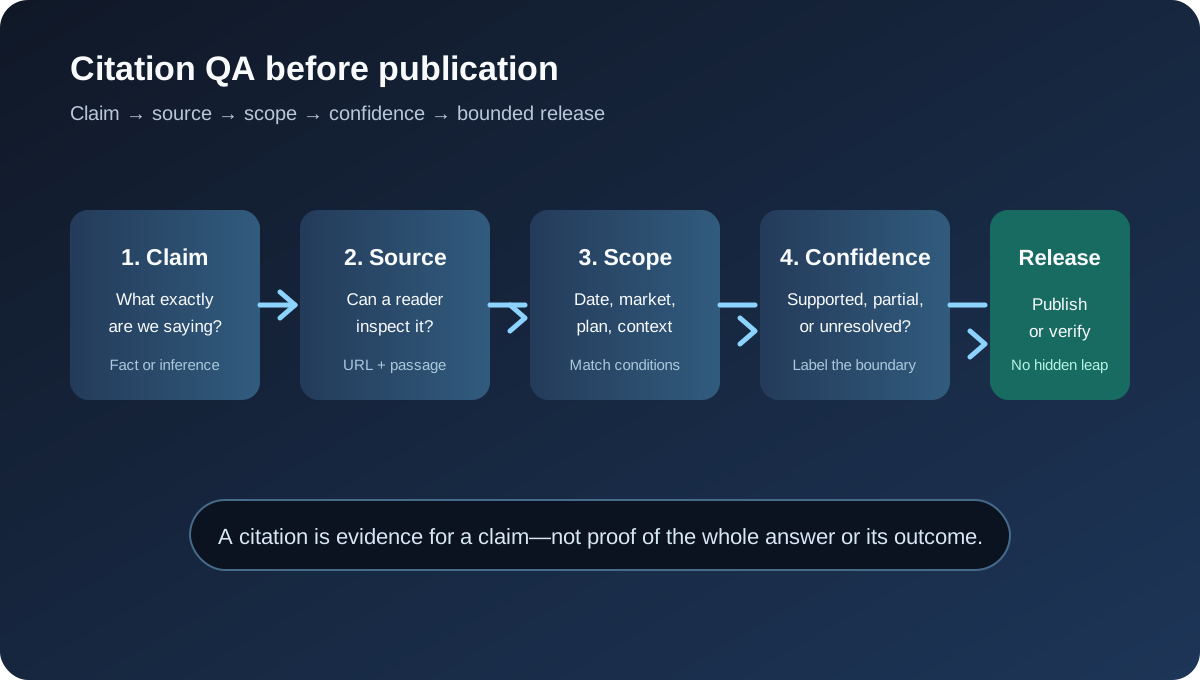
This guide addresses searches such as “how do I check AI Search citations?”, “how can I verify whether a citation supports an answer?”, and “what should a GEO content review include?” It is an editorial verification method, not a guarantee of retrieval, citation, ranking, traffic, or revenue.
Why citation QA matters
AI answers can place a source beside several sentences. The source may support one narrow fact while the surrounding answer adds an unsupported recommendation, stale price, or broader causal claim. A URL is therefore an observation to review, not a substitute for reading the source.
Google’s guidance for AI features, checked October 26, 2026, says AI features may show links to supporting web resources and points site owners toward foundational Search practices. It does not publish a universal citation formula or guarantee inclusion.
OpenAI’s web search documentation, checked October 26, 2026, documents citations and source information for a particular API tool. That supports inspecting the fields exposed by that implementation; it does not establish that every ChatGPT surface or other answer engine behaves identically.
The independent paper GEO: Generative Engine Optimization, checked October 26, 2026, provides research context for generative-engine visibility. It does not validate a commercial visibility score or prove that a content edit caused a business result.
What citation QA can—and cannot—show
| Observation | Safe conclusion | Do not claim from it alone |
|---|---|---|
| A URL appears beside an answer | The URL was visible in that captured answer | The source supports every sentence |
| A page contains the same fact as the answer | The fact may be supported within the checked scope | The page caused retrieval or recommendation |
| A citation disappears after an edit | Two captured observations differ | The edit caused the change |
| A competitor page is cited | That page was visible under recorded conditions | The competitor is universally preferred |
| A source is first-party | It may be the right source for a product fact | It is independent proof of outcomes |
| A review is independent | It can inform user experience or tradeoffs | Its claims are current or representative without checking |
Keep these evidence layers separate:
- Mention: a brand or page was named.
- Recommendation: the answer proposed or preferred an option.
- Citation: a visible source URL was attached to an answer.
- Support: the source actually covers the claim.
- Referral: an identifiable session arrived from an AI surface.
- Conversion: a separately defined analytics system recorded an outcome.
1. Freeze the claim before checking the source
Do not review a vague sentence such as “this tool is the best choice.” Rewrite it as the smallest material claim:
- “The documentation lists CSV export.”
- “The pricing page shows a monthly plan under stated conditions.”
- “An independent review describes setup as time-consuming.”
- “The captured answer linked this URL for the integration claim.”
Then classify the claim:
| Claim type | Preferred evidence | Common boundary |
|---|---|---|
| Feature or limit | Current official documentation | A feature may depend on plan, version, or region |
| Price or billing | Official pricing page | Currency, interval, taxes, credits, and conditions matter |
| User experience | Independent review platform, community, or attributable review | One review is not prevalence |
| Comparison | Transparent independent or disclosed commercial comparison | Commercial relationships can affect framing |
| Recommendation | Declared criteria plus relevant evidence | Frequency is not proof of quality |
| Outcome | Defined analytics or experiment | Visibility does not prove causality |
If the wording combines several claims, split it. “Tool A is affordable, easy to use, and increases citations” needs at least three different evidence checks, and the last claim requires outcome evidence rather than a product page.
2. Preserve the answer and its conditions
Before opening a source, save the strongest permitted record of the answer. A useful observation includes:
- Exact prompt and prompt-set version.
- Surface, mode, and model or version when disclosed.
- Country, language, location, account state, and date when material.
- Complete answer or a compliant capture.
- Every visible source title and direct URL.
- The sentence or claim each source appears to support.
- Empty, blocked, failed, and no-source states.
If a field is not exposed, write not disclosed or not available. Do not infer a hidden retrieval query, model route, ranking reason, or personalization state.
This is where monitoring products differ. AI Search Console, Peec AI, Otterly.AI, PromptWatch, and Profound may expose different combinations of prompts, answers, citations, source tracking, crawler data, and derived scores. During a trial, verify whether raw answers and exact URLs are exportable before treating their headline metrics as equivalent.
3. Locate the supporting passage
A citation QA review should answer four questions:
- Identity: Is this the source that was actually shown?
- Directness: Does it state the claim, or does the reviewer have to infer it?
- Scope: Does it cover the same product, plan, market, date, and audience?
- Completeness: Does it support the full wording or only part of it?
Use a claim ledger:
| Claim ID | Claim wording | Source URL | Relevant passage | Relationship | Decision |
|---|---|---|---|---|---|
| C-01 | “The tool supports weekly prompt monitoring.” | Direct URL retained | Feature or documentation section | Direct, scope checked | Publish with source |
| C-02 | “The plan includes API access.” | Pricing URL retained | Plan table, if stated | Partial or unresolved | Verify plan condition |
| C-03 | “Users find setup difficult.” | Independent review URL | Attributable review passage | Supports one experience | Attribute, do not generalize |
| C-04 | “The edit increased citations.” | No outcome record | None | Unsupported causal claim | Remove or redesign test |
Do not upgrade a partial relationship to direct because the page uses similar words. “Exports reports” does not necessarily support “exports raw answer evidence.” “Integrates with analytics” does not necessarily support a particular attribution workflow.
4. Check source provenance and bias
Source type is part of the evidence record. Label it rather than flattening every URL into “trusted.”
| Source class | Useful for | Boundary |
|---|---|---|
| First-party documentation | Features, setup, current limits, policies | Vendor-controlled; not independent outcome proof |
| Official pricing | Public commercial terms | Can change; capture date and conditions |
| Independent review or community | Workflow observations and recurring concerns | May be dated, anecdotal, or non-representative |
| Commercial comparison | Practical tradeoffs and category framing | Affiliate, agency, competitor, or sponsor bias may apply |
| Research or standards source | Definitions and methodology | Does not validate a vendor feature automatically |
| Vendor-selected customer evidence | What the vendor reports about one selected customer | Not independent causal proof |
Use the exact label vendor-selected customer evidence for vendor case studies. A case study can document what the vendor says happened, but it cannot independently prove general traffic, revenue, rankings, or citation outcomes.
For user feedback, record the platform, rating and review count when available, date checked, positive and negative themes, and any commercial relationship. If independent feedback is sparse, report that scarcity instead of writing a consensus.
5. Apply a confidence label
Confidence describes the record and claim relationship, not the likelihood that an answer engine will cite the page again.
| Label | Use when | Example |
|---|---|---|
| High | Exact source, relevant passage, current scope, and complete capture are available | Current official limit matches the published wording |
| Medium | Source is credible but one condition or passage is incomplete | Independent review supports a workflow concern, but sample is small |
| Low | Source is indirect, stale, inaccessible, or commercially interested | A comparison repeats an uncited feature claim |
| Unresolved | Evidence is missing or conflicting | Two current pages state different plan limits |
A high-confidence product fact can still be irrelevant to a buyer’s question. Confidence is not a recommendation score.
Evidence snapshot
| Source | Public signal | What it supports | Confidence |
|---|---|---|---|
| Google Search Central: AI features and your website | Official guidance on links to supporting resources | Context for AI-feature links and foundational Search practices | High for the documented guidance; not a citation formula |
| OpenAI Developer Docs: Web search | Official documentation for one web-search API implementation | Source and citation fields in that implementation | High for the implementation; not universal |
| Perplexity Search API quickstart | Official documentation for returned search results and sources | Product-specific source-return context | High for the documented API; not all surfaces |
| Aggarwal et al., GEO | Independent academic paper | Research context for generative-engine visibility | Medium; not validation of a commercial metric |
| AICiteKit editorial workflow | Claim ledger and confidence framework in this article | A bounded QA process | Editorial |
The public evidence supports inspecting visible sources, checking claim scope, and preserving uncertainty. It does not establish a universal ranking, retrieval cause, citation probability, or business impact.
6. Decide whether to publish, qualify, or hold
Turn the review into a release decision:
- Publish: the claim is directly supported and its conditions are visible.
- Qualify: the evidence supports a narrower statement, an attributed observation, or a defined sample.
- Hold: the source is missing, stale, inaccessible, contradictory, or too weak for the wording.
- Retest: the answer changed, but the observation needs matched prompts and context before interpretation.
Examples:
| Review result | Better action |
|---|---|
| Official page supports the feature but not the “all plans” wording | Remove “all plans” or verify each plan |
| A review reports a setup problem | Attribute it to the review; do not say “users generally struggle” |
| A source is cited for a price checked six months ago | Recheck official pricing before publication |
| A brand was cited once after a page edit | Record the observation; do not claim the edit caused it |
| A dashboard shows a visibility percentage without raw answers | Ask for the denominator, prompt set, and export path |
A narrow, accurate claim is usually more useful than a broad claim whose source relationship cannot be inspected.
7. Use QA for GEO content, not just citations
Before publishing a GEO or AI Search article, review:
- Does each dynamic price, plan limit, model, integration, and review count have a current source?
- Are official facts separated from independent experience?
- Are competitor-authored or affiliate sources labeled?
- Are vendor-selected case studies identified as such?
- Does every internal competitor link map to a real AICiteKit tool page?
- Does the article say what its evidence does not prove?
- Are figures, tables, and examples clearly labeled as examples rather than observations?
- Is the visible review date aligned with the research date?
Do not add a citation merely to decorate a paragraph. Add it where a reader can verify the material claim.
What citation QA does not prove
Even a careful review cannot establish from a cited answer alone:
- That a page caused retrieval or citation.
- That the cited page was the best or most authoritative source in every context.
- That a citation generated a click, lead, subscription, or revenue.
- That one answer represents all users, prompts, markets, models, or AI surfaces.
- That a content, schema, internal-link, or
llms.txtedit caused a later answer change.
For traffic, join answer observations to declared analytics records. For conversions, use a separately defined attribution method. For factual accuracy, inspect the source and the claim directly.
A practical pre-publication checklist
- Split compound statements into material claims.
- Record the exact source URL and relevant passage.
- Check date, plan, market, language, and product scope.
- Separate mention, recommendation, citation, support, referral, and conversion.
- Label first-party, independent, commercial, community, research, and vendor-selected evidence.
- Include rating and review count when citing a review platform.
- Mark partial, stale, conflicting, inaccessible, and unresolved evidence.
- Use qualified language for sampled observations.
- Verify every new internal tool link against
src/content/tools/. - Add a visible last-reviewed date for dynamic research.
- Keep examples and editorial interpretations distinct from collected observations.
FAQ
What is AI Search citation QA?
It is a claim-level review of a visible AI answer source: preserve the answer, identify the claim, open the source, check the relevant passage and scope, classify the evidence, and decide whether to publish, qualify, hold, or retest.
Does a citation prove that a source is authoritative?
No. It proves that the source was shown in the captured answer. Authority, relevance, freshness, and claim support require a separate review.
Should every AI Search article have many citations?
No. It should have enough direct, relevant sources for its material claims. More URLs do not automatically make an answer accurate or useful.
Can a GEO monitoring tool replace citation QA?
A tool can collect prompts, answers, sources, and derived metrics, depending on its implementation. It does not replace human review of claim scope, freshness, source provenance, and unsupported causal language.
Does better citation support guarantee AI Search visibility?
No. Better source support can improve inspectability and editorial accuracy. It does not guarantee retrieval, citation, recommendation, traffic, or revenue.
Sources and verification
- Google Search Central: AI features and your website — official context for links in AI features; checked October 26, 2026.
- OpenAI Developer Docs: Web search — source and citation behavior documented for one API implementation; checked October 26, 2026.
- Perplexity Search API quickstart — product-specific source-return documentation; checked October 26, 2026.
- Aggarwal et al., GEO: Generative Engine Optimization — independent research context; checked October 26, 2026.
Last reviewed: October 26, 2026. Data confidence: High for the linked official documentation and academic paper descriptions; medium for the editorial QA framework; low for any claim about an unseen engine’s source-selection reason. This article does not claim guaranteed retrieval, citations, traffic, conversions, or revenue.