Field notes / ai-search
AI Search Citations to Website Visits: A Measurement Handoff That Holds Up
A practical way to connect an AI Search citation to an observable website visit without confusing visibility, referral traffic, or conversion evidence.
The short answer
An AI Search citation and a website visit are different observations. A citation record shows that a source URL was displayed in a captured answer. A visit record shows that a browser or other client reached your site. To connect them responsibly, preserve the answer, identify the exact cited URL, define the collection window, and compare it with separately measured referral or landing-page data.
Use this handoff:
answer capture → cited URL → landing-page request → session/referral → business eventEvery arrow needs its own evidence. A citation does not prove a click, a server request does not prove a person saw the answer, and a visit does not prove that the citation caused it.
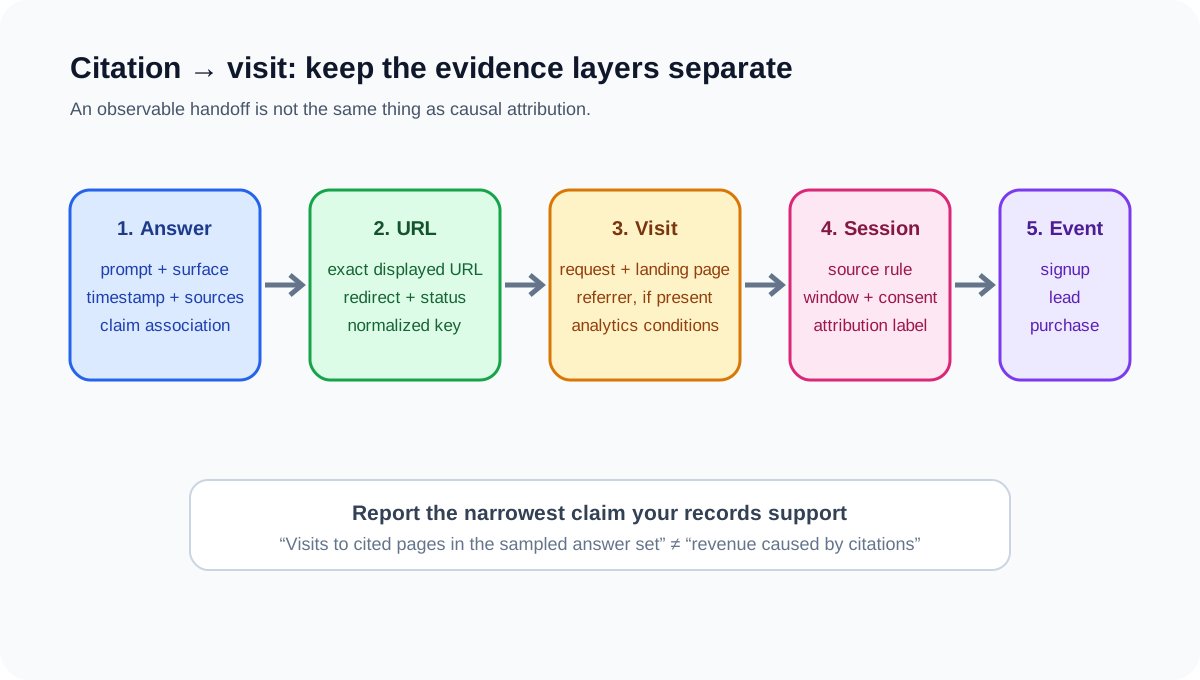
This guide addresses searches such as “how do I track traffic from AI Search citations?”, “can a citation be attributed to a website visit?”, and “how should GEO reports connect visibility to conversions?” It is a measurement framework, not a promise that citations create traffic or revenue.
Why the handoff is easy to overstate
AI answers can mention a brand without linking to its site. They can display a URL that a reader never opens. Analytics can record a visit from an AI surface without proving which answer, prompt, or citation preceded it. Cookies, redirects, privacy controls, referrer policies, app browsers, and attribution windows can also remove or alter the joining information.
Google’s guidance for AI features, checked October 30, 2026, says AI features may show links to supporting web resources and points site owners toward foundational Search practices. It does not define a universal citation-to-click rate or guarantee inclusion. OpenAI’s web search documentation, checked October 30, 2026, documents citations and source information for a particular API tool; it does not establish identical behavior across every consumer surface or answer engine.
Keep these terms separate:
| Layer | What was observed | What it does not prove |
|---|---|---|
| Mention | A brand or page name appeared | That a link was available or followed |
| Recommendation | The answer proposed an option under stated conditions | That the reader accepted the recommendation |
| Citation | A source URL was shown in a captured answer | That anyone clicked it |
| Visit | A web property received a measurable request or session | Which answer caused the visit |
| Conversion | A defined event was recorded in analytics or a backend | That a citation caused the event |
The separation is not pedantry. It tells a stakeholder what can be audited and prevents a dashboard from turning a sampled answer observation into a causal business claim.
1. Freeze the answer-side evidence
Start with the answer, not analytics. For each observation, preserve:
- Exact prompt and prompt-set version.
- Surface or mode, plus model or version when disclosed.
- Country, language, location, account state, and collection timestamp when material.
- Full answer or a permitted near-raw export.
- Every visible source title and direct URL.
- The sentence or recommendation associated with each URL.
- Empty, blocked, failed, and no-source states.
A useful citation record is narrow:
Prompt ID: GEO-014 v3
Surface: named search-enabled AI surface
Market/language: US / English
Collected: 2026-10-30 13:20 UTC
Answer claim: Tool category recommendation
Cited URL: https://example.com/guide
Citation position: visible source; position definition recorded
Click observed in answer capture: not available
If the platform does not disclose a model, hidden query, or click state, write not disclosed or not available. Do not infer it from the answer.
Tools such as AI Search Console, Peec AI, Otterly.AI, PromptWatch, and Profound can expose different combinations of prompts, answers, sources, citations, and derived metrics. During a trial, verify whether the product preserves the raw answer, exact URL, timestamp, prompt conditions, and export path. A headline visibility number is not automatically a citation-to-visit dataset.
2. Normalize the cited URL without losing the original
Store both the exact displayed URL and a normalized landing-page key. The original is needed for auditability; the normalized key is needed for joining.
Check, but do not silently rewrite:
- HTTP versus HTTPS
- Hostname and trailing slash
- Redirect destination
- URL fragments
- Tracking parameters
- Locale or market path
- Product, plan, or documentation version
A redirect from /guide to /guide/ may be the same landing page. A redirect from /pricing to /contact-sales is a materially different destination. A source URL on a third-party review site is not equivalent to a visit to the vendor’s own site.
Keep a URL ledger:
| Citation URL as displayed | Normalized key | Landing response | Join decision |
|---|---|---|---|
https://site.test/guide | /guide/ | 200 after one redirect | Eligible for page-level comparison |
https://site.test/pricing?ref=answer | /pricing | 200; parameter retained separately | Eligible; do not claim parameter caused visit |
https://review.test/tool | External review URL | Not a first-party landing page | Keep as a source observation, not a product-site visit |
Normalization can make records comparable. It cannot prove that two records came from the same user or answer.
3. Measure the visit independently
Use the analytics and server systems already responsible for measuring visits. A useful visit record may include:
- Landing-page path and hostname
- Timestamp and timezone
- Referrer, when supplied
- Campaign parameters, when legitimately present
- Device or session identifier under your privacy rules
- New or returning session classification
- Consent and attribution state
- Whether the request was a human session, bot, preview, or unknown
Do not add campaign parameters to a citation URL after the fact and call resulting visits proof of historical clicks. A campaign tag can help measure a controlled link you own; it cannot retroactively label an untagged citation or identify every reader who came from an AI answer.
Google Analytics documentation on campaign parameters, checked October 30, 2026, explains how UTM parameters can identify campaign traffic. This supports a controlled tagging workflow where the link is under your control. It does not prove that an AI platform preserves parameters, that an untagged visit came from a citation, or that campaign traffic is incremental.
Server logs and analytics are complementary. Logs can show requests and response paths; analytics can show sessions and events subject to implementation, consent, and identity limits. Neither system contains a universal record of what answer a visitor read before arriving.
4. Define the join before looking for a result
A join should have an explicit key and time rule. A timestamp alone is weak: many visitors and automated systems can reach the same page, and an answer can be read long before a later visit.
Choose one of these evidence levels:
| Join level | Minimum evidence | Safe wording |
|---|---|---|
| Page association | Same cited URL and a visit in a declared window | “Visits to pages cited in the sample” |
| Campaign association | A controlled link with a preserved campaign identifier | “Visits carrying this campaign identifier” |
| Session-level attribution | A declared source, session, and consented analytics path | “Sessions attributed by this analytics implementation” |
| Answer-to-user link | Platform or research system exposes a valid answer-to-click relationship | “Clicks linked to captured answers in this dataset” |
| Causal effect | Controlled experiment or stronger causal design | Only the tested causal scope |
Most teams can reach page association or campaign association. The stronger levels require product instrumentation or a study design that is not available in ordinary answer captures.
A defensible association record might look like:
Citation observation: GEO-014 v3
Cited page: /guide/
Answer capture: 2026-10-30 13:20 UTC
Visit window: 2026-10-30 13:20–2026-10-31 13:20 UTC
Analytics source: declared property and report
Matching visits: reported as page-level association
Direct citation click: not observed
Causal effect: not tested
The words page-level association matter. They prevent a report from implying that every visit was generated by the captured answer.
5. Report a denominator that a reader can inspect
A useful report separates the populations:
Prompt observations collected: 80
Answers with a visible target citation: 19
Distinct target URLs cited: 7
Visits to those URLs in the declared window: 42
Visits with an identifiable AI referrer: 11
Citation-to-user click relationship: not available
Conversions from the page cohort: 3
Causal incrementality: not tested
The figures above are a reporting template, not an AICiteKit measurement. Replace them with your own observed counts or leave fields unavailable. Do not convert a template into a result.
Report at least:
- Prompt cohort and version
- Surface, market, language, and collection dates
- Citation definition
- URL normalization rule
- Visit source and analytics property
- Attribution window and timezone
- Excluded bots, previews, and failed records
- Number of unavailable or unjoined records
- Conversion definition and event source
Avoid “AI traffic from citations” unless the underlying system can actually identify that relationship. Prefer “visits to pages cited in the sampled answer set” when that is what was measured.
6. Treat conversion as a separate handoff
A visit can be associated with a cited-page cohort and still not be caused by a citation. For a business outcome, define:
- The event: signup, qualified lead, purchase, or another declared action.
- The source system: analytics, CRM, billing, or backend database.
- The attribution rule: first touch, last non-direct, data-driven, or another documented method.
- The observation window and exclusions.
- Missing, consent-denied, duplicate, and offline outcomes.
The GEO research paper by Aggarwal et al., checked October 30, 2026, provides independent academic context for generative-engine visibility. It does not prove that a citation creates a visit, conversion, or revenue outcome for a particular site.
Vendor-selected customer evidence can be useful context about what one customer reports, but label it vendor-selected customer evidence. It is not independent proof of general traffic, revenue, rankings, or citation outcomes. Similarly, one analytics report may describe an attribution result without establishing incrementality.
Common interpretations that fail
| Tempting statement | Safer interpretation |
|---|---|
| “We were cited, so the answer sent traffic.” | The answer displayed the cited URL; traffic requires separate visit evidence. |
| “AI referrals converted better, so citations caused revenue.” | The measured referral cohort had a different observed conversion rate; causality is untested. |
| “The citation link had UTM parameters, so every visit was attributable.” | Visits carrying those parameters matched the campaign rule; parameter integrity still needs review. |
| “No referrer means no AI visit.” | The referrer was absent or unavailable; source cannot be identified from that record. |
| “A cited page received a visit the same day.” | A page-level temporal association was observed; the answer did not necessarily cause it. |
| “The tool’s AI traffic metric equals GA4 AI traffic.” | Two products expose metrics with definitions that must be reconciled field by field. |
A practical implementation checklist
- Freeze the answer prompt, surface, market, language, and collection time.
- Save every displayed source URL and the claim it appears to support.
- Keep the original URL alongside any normalized landing-page key.
- Verify redirects, status codes, locale paths, and third-party destinations.
- Define the analytics property, timezone, attribution window, and bot exclusions.
- Label page association, campaign association, session attribution, and causal evidence separately.
- Report denominators, failed observations, unavailable fields, and missing referrers.
- Do not add tracking parameters retrospectively to historical citations.
- Join conversions from a declared system rather than inferring them from visibility.
- Describe association as association unless the study supports a causal conclusion.
Who should use this framework?
This method is useful for SEO and content teams, agencies, product marketers, and analytics teams that need to connect AI Search research to site measurement without overstating what a citation means. It is especially useful when a stakeholder asks for “AI-generated pipeline” but the available evidence only contains prompt captures and page traffic.
It is not a substitute for a platform’s private click logs, a representative study of AI users, a properly instrumented campaign, or an incrementality experiment. Small teams can begin with a versioned prompt panel, a URL ledger, and a clearly labeled page-cohort report before buying a broader monitoring product.
Evidence snapshot
| Source | Public signal | What it supports | Confidence |
|---|---|---|---|
| Google Search Central: AI features and your website | Official guidance on links in AI features and foundational Search practices | Context for visible supporting links; not a click or outcome guarantee | High for the documented guidance |
| OpenAI Developer Docs: Web search | Official documentation for one web-search API implementation | Product-specific citation and source fields; not universal behavior | High for the API documentation |
| Google Analytics Help: Campaigns and traffic sources | Official UTM and campaign-parameter guidance | Controlled campaign labeling and its implementation boundary | High for the documented parameters |
| Aggarwal et al., GEO | Independent academic research on generative-engine visibility | Research context for evaluating visibility; not causal traffic evidence | Medium |
| AICiteKit editorial framework | Citation-to-visit handoff and evidence ledger in this article | Practical measurement boundaries and reporting language | Editorial |
The public evidence supports keeping answer captures, cited URLs, analytics visits, and business events as separate datasets that can be compared under declared rules. It does not establish a universal citation click-through rate, referral attribution method, or revenue effect.
FAQ
Does an AI Search citation prove a website visit?
No. It proves only that the source was displayed in the captured answer. A visit needs separate web or analytics evidence.
Can GA4 identify every visit from an AI answer?
No. Analytics can identify traffic under its implementation and available source signals. Referrers may be absent, rewritten, blocked, or unavailable, and a standard session record usually does not contain the exact answer a visitor read.
Should I add UTM parameters to AI citation URLs?
Only when you control the link or a platform explicitly supports the parameter. Do not add tags retrospectively and treat them as proof of historical citation clicks. Test redirects and parameter preservation first.
What is the safest metric to publish?
Publish the narrowest metric your records support, such as “visits to pages cited in the sampled answer set during the declared window.” Include the prompt cohort, URL rules, dates, and unavailable fields.
Do GEO tools measure citation-driven conversions?
Products expose different data and definitions. Ask whether the tool has raw answer captures, exact URLs, click instrumentation, analytics integration, conversion joins, and an exportable denominator. Do not assume that “AI traffic” means citation-driven traffic.
Does more AI visibility mean more revenue?
Not from visibility evidence alone. Revenue requires separately defined business data, and causal impact requires a stronger design than a before-and-after correlation.
Sources and verification
- Google Search Central: AI features and your website — official AI-feature link context; checked October 30, 2026.
- OpenAI Developer Docs: Web search — citation and source fields for one API implementation; checked October 30, 2026.
- Google Analytics Help: Campaigns and traffic sources — UTM and campaign-parameter guidance; checked October 30, 2026.
- Aggarwal et al., GEO: Generative Engine Optimization — independent research context; checked October 30, 2026.
Last reviewed: October 30, 2026. Data confidence: High for the linked official documentation; medium for the academic context; editorial for the handoff framework. This article does not claim guaranteed citations, clicks, traffic, conversions, or revenue.