How to Build an AI Search Measurement Baseline Before You Optimize
A practical AI Search baseline framework: define prompts, preserve answer evidence, separate visibility from citations and traffic, and retest changes without overclaiming impact.
The short answer
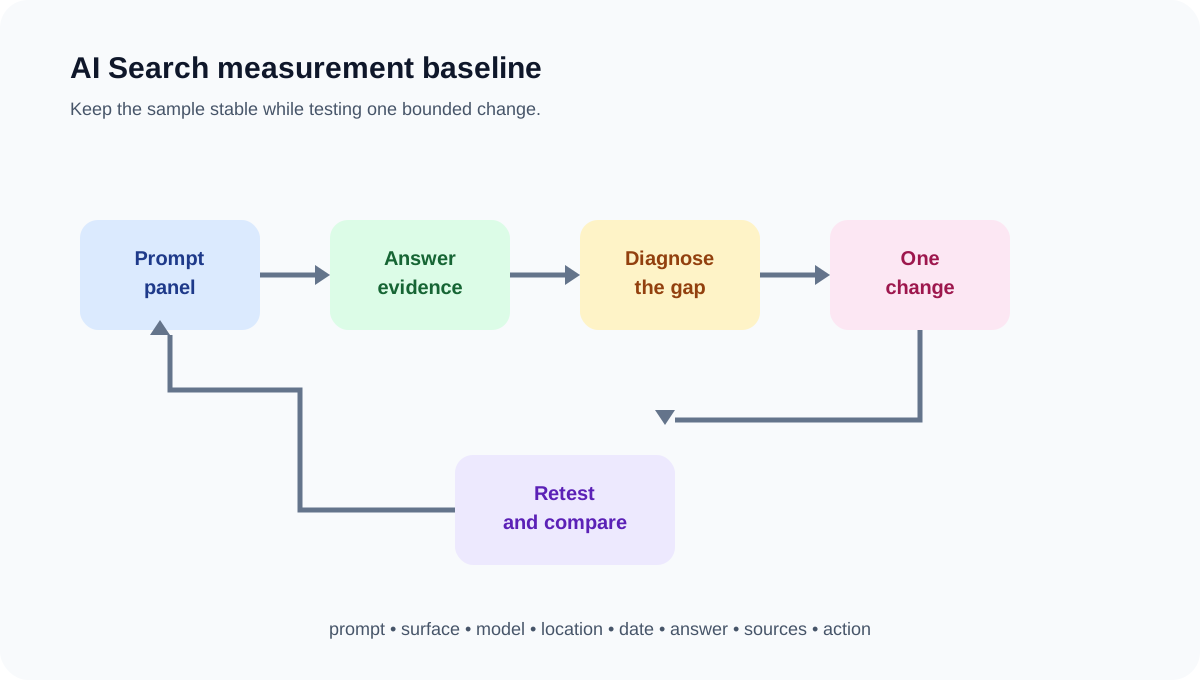
Before optimizing for AI Search, build a baseline that records the exact prompt, AI surface, model when available, country, language, date, answer, sources, and scoring rules. Then repeat the same sample after a defined change.
A defensible baseline is not one dashboard score. It is a small, reproducible evidence set:
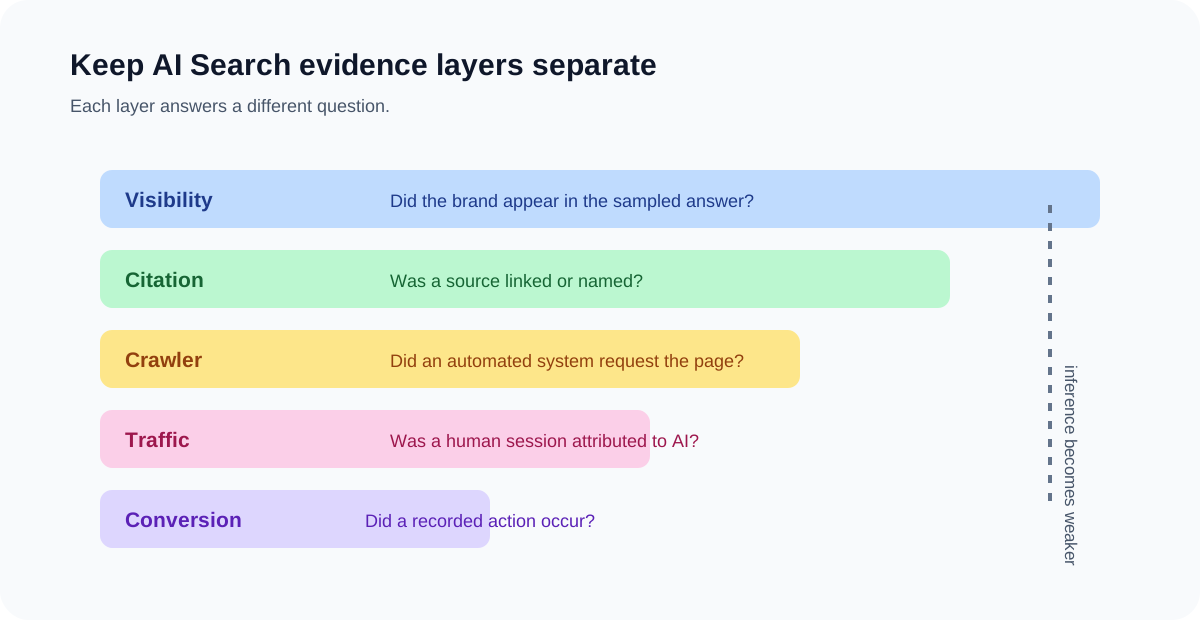
prompt panel → answer capture → source classification → diagnosis → change → retestThis matters because visibility is not citation, citation is not traffic, and traffic is not revenue. A baseline helps a team measure each layer without silently turning one observation into a causal business claim.
Why a baseline comes before optimization
AI answers can vary with prompt wording, model, retrieval context, date, location, language, account state, and sampling. If those variables change between two reports, a score difference may reflect a new measurement universe rather than a real product or content change.
The same discipline applies whether you use a specialist platform such as Qwairy, a prompt and crawler analytics product such as PromptWatch, or a recurring visibility system such as Peec AI and Otterly.AI. Tools can automate collection, but they do not remove the need to define the sample.
A baseline should answer:
- Where does the brand appear in the selected answers?
- How is it described, recommended, or compared?
- Which owned and third-party sources are cited?
- Which claims are inaccurate or outdated?
- Which technical, content, source, or sampling issue should be investigated next?
It should not promise to measure every AI conversation or predict revenue from a visibility score.
1. Define the decision the baseline must support
Start with a decision, not a metric. Examples include:
- Should we update a comparison page because competitors are repeatedly recommended?
- Do AI systems describe our current pricing and product limits accurately?
- Which third-party sources shape the category narrative?
- Are important pages reachable by relevant crawlers?
- Can detectable AI referrals be separated from ordinary direct traffic?
The decision determines the evidence. A crawler log cannot answer which competitor was recommended. A citation list cannot prove a click. A traffic report cannot show how an answer described the brand.
2. Build a balanced prompt panel
Use prompt groups that represent the buying journey rather than only branded questions. A starting panel can include:
| Prompt group | What it tests | Example pattern |
|---|---|---|
| Category | Discovery without a brand name | “What tools help a small team monitor AI citations?” |
| Problem | Need and use-case relevance | “How can an agency audit AI brand visibility?” |
| Branded | Correctness and identity | “What does [brand] do?” |
| Comparison | Positioning against alternatives | “[Brand] vs [competitor] for AI Search measurement” |
| Evaluation | Purchase criteria | “What should I verify before buying a GEO platform?” |
| Risk / accuracy | False or outdated claims | “Does [brand] offer feature X?” |
| Regional | Market and language variation | “Best [category] tools in the UK” |
Branded prompts are valuable for accuracy, but they should not dominate a claim about category visibility. For a reusable method, see How to Build a Reliable AI Search Prompt Set.
3. Freeze the measurement context
Create a baseline record for every run. At minimum, store:
- Prompt text or a stable prompt ID
- Intent group
- AI surface and model, when disclosed
- Country, city, and language
- Run date and time zone
- Sampling count and refresh frequency
- Brand and competitor definitions
- Rules for mention, recommendation, position, sentiment, and citation
- Tool version or collection method
If a platform does not expose all of these fields, record the gap. Missing metadata is a limitation, not permission to imply a universal result.
4. Preserve answer-level evidence
A summary score is useful only when a reviewer can inspect the observations behind it. Save, where the product and platform permit:
- Complete answer text or a permitted capture
- Source URLs and domains
- The claim associated with each source
- Mentioned brands and competitor order
- Accuracy notes and reviewer decision
- Prompt, engine, location, and date
AI Search Console and Peec AI represent different kinds of monitoring workflows; compare what they actually preserve rather than assuming their scores are interchangeable. If using Qwairy, ask the vendor to open the underlying answer and source record during the demo.
A useful evidence row looks like this:
| Prompt ID | Surface | Observation | Source evidence | Next action |
|---|---|---|---|---|
| C-04 | ChatGPT, US English | Competitor recommended; brand absent | Three publisher sources cited | Compare source coverage and update category page |
| A-02 | Perplexity, UK English | Brand mentioned, price outdated | Brand domain cited | Correct first-party pricing and retest |
5. Classify the gap before changing content
Do not jump from “visibility fell” to “publish more content.” Classify the observation:
Content gap
The page does not answer the question clearly, explain the entity, state a comparison, or provide supporting evidence.
Source gap
AI answers repeatedly rely on a publisher, review site, community, or directory that does not contain an accurate equivalent view of the brand.
Accuracy gap
The answer contains an outdated price, wrong feature, confused identity, or unsupported claim. A negative answer can be accurate; the problem is the false or misleading detail.
Technical access gap
Logs show blocked, failed, or inefficient automated access to important pages. Better crawler access does not automatically create a citation.
Sampling gap
The prompt, model, region, date, or competitor set changed. Continue sampling before assigning a content cause.
6. Make one bounded change and retest
A baseline becomes useful when the intervention is explicit. Record:
- The page, source, technical setting, or documentation changed.
- The exact publication date and change summary.
- The stable prompt panel and measurement context.
- The observation window and number of follow-up runs.
- Other events such as model updates, campaigns, PR, or migrations.
Then compare separate outcomes:
- Brand mention or recommendation rate
- Citation frequency and cited source mix
- Accuracy of important facts
- Crawler activity
- Detectable AI-referred sessions
- Conversions under a stated attribution model
A careful conclusion might be:
After the comparison page was updated, the brand appeared in more responses in the defined sample over four weekly runs. The observation is encouraging, but it does not isolate causation or prove additional traffic or revenue.
That conclusion is more useful than claiming that a GEO score caused a fixed percentage of sales.
What the baseline does not prove
A baseline cannot establish:
- Total AI audience size
- A universal AI ranking
- Guaranteed future citations
- That a crawler request was a human visit
- That a citation produced a click
- That an attributed session was caused only by AI Search
- That a content change caused a conversion or revenue increase
For the attribution boundary, read AI Visibility vs AI Citations vs AI Traffic. For agency delivery, see How Agencies Should Report AI Visibility to Clients.
A practical baseline checklist
- The business decision is explicit.
- Prompts cover category, branded, comparison, evaluation, accuracy, and regional intent.
- Surface, model, country, language, date, and sample size are recorded.
- Mention, recommendation, citation, and accuracy rules are defined separately.
- Complete answers and cited URLs are preserved where allowed.
- Each observation is classified as content, source, accuracy, technical, or sampling gap.
- Only one bounded change is made before the first retest.
- Visibility, citation, crawler, traffic, and conversion data remain separate.
- Volatility, missing metadata, and attribution gaps appear in the report.
FAQ
How many prompts should a baseline contain?
There is no universal number. Start with enough prompts to cover the buying journey, then expand by market, product, and risk. More prompts do not automatically create a better baseline if the taxonomy is unbalanced or the sampling method is undocumented.
Should branded prompts be included?
Yes. They are important for brand accuracy, product facts, and identity confusion. Keep them separate from category and recommendation prompts so a strong branded result does not disguise weak discovery visibility.
Is AI crawler activity part of the baseline?
It can be a separate technical layer. Record bot identity, URL, status, timestamp, and infrastructure context. Do not present crawler activity as human traffic or citation evidence.
Can a baseline prove that GEO work increased revenue?
No. It can document a before-and-after observation and combine it with analytics under a stated attribution model, but model volatility, concurrent campaigns, and unobserved AI influence limit causal conclusions.
Which tool should I use to build the baseline?
Choose based on the evidence you need: prompt and citation monitoring, crawler and referral analytics, answer-level captures, agency reporting, or content execution. Compare raw evidence, coverage, limits, exports, and reproducibility rather than selecting the largest score.
Sources and verification
- Google Search Central: AI features and your website — foundational guidance for sites appearing in AI features; checked August 20, 2026.
- Google Analytics campaign URL guidance — context for tagged referral measurement; checked August 20, 2026.
- Qwairy — public product positioning; checked August 20, 2026.
- Qwairy LinkedIn company page — public first-party audit and AI-surface claims; checked August 20, 2026.
- How to Build a Reliable AI Search Prompt Set — related AICiteKit methodology.
This is AICiteKit editorial methodology. It does not claim that any tool or baseline guarantees visibility, citations, traffic, rankings, or revenue.