AI Search Prompt Drift: How to Keep GEO Monitoring Comparable
A practical guide to detecting prompt drift in GEO monitoring, versioning changes, preserving answer evidence, and avoiding false visibility trends.
The short answer
AI Search monitoring becomes difficult to interpret when the prompt or its context changes without a new version. A revised phrase, a different search mode, a new model, a changed location, or a new citation parser can make two runs look like a trend when they are actually different observations.
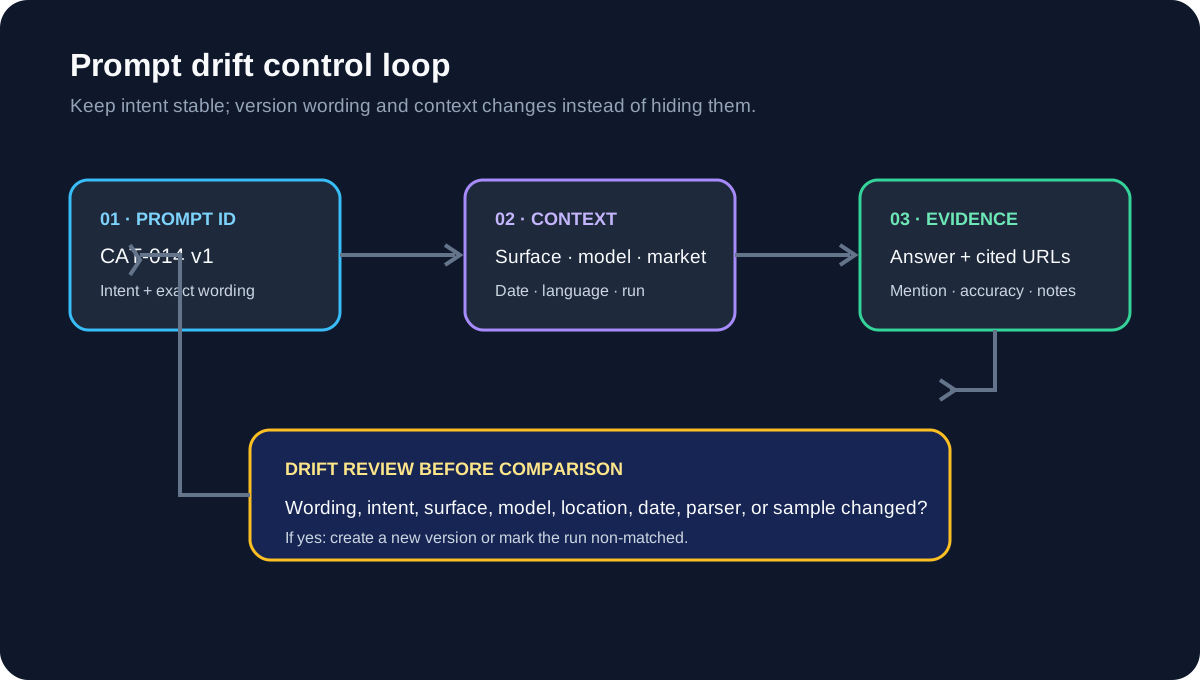
Treat every monitored prompt as a versioned measurement contract:
stable intent + recorded context + preserved answer evidence = comparable GEO observationKeep a small stable panel for trend reporting. Put newly discovered questions in an exploratory panel. When wording or context must change, version the prompt and explain why; do not silently overwrite the old one.
Why “the same prompt” is often not the same observation
An AI answer is produced in a context, not in a vacuum. Google describes AI features as part of Search and says they may show links to supporting web resources; its guidance still points site owners to ordinary technical and content fundamentals (Google Search Central: AI features and your website, checked August 28, 2026). OpenAI likewise documents ChatGPT Search as a web-search experience that can provide links to sources (ChatGPT search, checked August 28, 2026).
Those documents describe product behavior and webmaster guidance. They do not establish a universal answer-ranking system, a fixed citation rate, or a guarantee that a page will be selected.
For GEO reporting, the phrase “we ran the prompt again” is incomplete unless the team can also identify:
- Exact wording and language
- Prompt intent and any hidden assumptions
- AI surface and mode
- Model or version, when disclosed
- Country, city, and location settings
- Collection date, time zone, and run number
- Account or personalization state, when relevant and available
- Sample size and regeneration policy
- Rules for mentions, recommendations, position, and citations
A changed field does not make the new result useless. It changes what can be compared.
What prompt drift means
Prompt drift is an untracked change in the question or its measurement context that can alter the observed answer. It includes more than a typo.
Wording drift
Examples include changing “best tools for monitoring AI citations” to “best AI visibility platforms for agencies,” adding a budget, naming a market, or turning an open question into a comparison. These may be sensible editorial improvements, but they test different intent.
Intent drift
A category prompt asks what options exist. A branded prompt asks how one company is described. A recommendation prompt asks which option should be chosen. If a panel gradually replaces category questions with branded questions, its visibility score may rise simply because the test became easier for that brand.
Context drift
The surface, web-search mode, location, language, model routing, or date may change. A result collected from one surface should not be described as a result for “AI Search” generally.
Evidence drift
The answer may be captured differently over time. One run stores complete source URLs; another stores only domains or a parsed mention count. A new parser can change the reported citation total even when the underlying answer is unchanged.
Panel drift
Prompts can be added, removed, renamed, or reweighted without a visible denominator. This is especially risky when a headline percentage is compared across months.
1. Define a prompt contract
Before adding a prompt to a recurring panel, record the decision it supports. A prompt contract should be short enough to review and specific enough to protect the intent.
| Field | Example | Why it matters |
|---|---|---|
| Prompt ID | CAT-014 | Keeps the observation addressable after wording changes |
| Intent | Category discovery | Prevents category and branded results being blended |
| Exact wording | “What tools help an agency monitor AI citations?” | Makes reruns auditable |
| Language | US English | Translation can change meaning and sources |
| Market | United States | Availability and source context can differ by market |
| Surface/mode | Named product mode, if disclosed | Search-enabled and non-search answers are not interchangeable |
| Brand set | Brand plus defined competitors | Prevents silent changes to the comparison universe |
| Mention rule | Brand named anywhere in the answer | Separates mention from recommendation |
| Citation rule | Exact URL visibly linked to a claim | Separates source evidence from a domain count |
| Owner | Growth or content lead | Gives drift review a responsible person |
The contract does not make answers deterministic. It makes changes visible.
2. Build a stable core and an exploratory panel
A single prompt list usually has two incompatible jobs:
- Trend monitoring: answer whether a stable set of important questions changed.
- Discovery: find new language, competitors, use cases, and sources worth investigating.
Use separate panels:
| Panel | Changes allowed | Reporting use |
|---|---|---|
| Stable core | Only controlled, versioned changes | Matched trend observations |
| Exploratory | New questions and local variants | Hypothesis generation |
| Risk | High-impact product, pricing, security, or policy facts | Accuracy review |
| Regional | Market- and language-specific intent | Local relevance, not global parity |
Do not combine the panels into one “visibility” number unless the report shows the denominator and the weighting. A discovery panel is allowed to evolve; it is not a clean time series.
This separation also helps when comparing products such as Peec AI, PromptWatch, Otterly.AI, AI Search Console, and Profound. Their workflows may overlap, but buyers should verify which prompts, surfaces, collection methods, answer fields, and scoring rules each product exposes. Tool output is not automatically comparable because the product names sound similar.
3. Detect drift before calculating a trend
Run a drift check before calculating month-over-month changes. The check can be a simple review table or a small script comparing the stored prompt records.
A practical drift checklist
- Is the prompt ID unchanged?
- Is the exact text unchanged, including punctuation and qualifiers?
- Is the intent label unchanged?
- Is the language and market unchanged?
- Is the surface and mode unchanged?
- Is the model/version known and comparable?
- Is the run policy unchanged, including regeneration and sample count?
- Are the mention, recommendation, position, and citation definitions unchanged?
- Is the answer capture format unchanged?
- Did the competitor list or product facts change during the window?
Classify the result as one of three states:
| State | Meaning | Reporting action |
|---|---|---|
| Matched | Relevant fields are held steady | May be compared, with normal answer uncertainty stated |
| Versioned | A deliberate field changed and has a new version | Compare as separate cohorts; explain the change |
| Non-matched | A field changed or is unknown | Do not present as a clean trend |
A missing field is not evidence that nothing changed. Mark it unknown.
4. Separate prompt drift from answer variation
Even a perfectly preserved prompt can produce different answers. A changed answer is not automatically prompt drift, and stable wording is not proof of a stable retrieval process.
Keep two columns in the ledger:
Measurement inputs
- Prompt text and intent
- Surface and mode
- Model/version, if disclosed
- Location and language
- Date and time zone
- Run number and sample policy
- Parser and metric definitions
Answer observations
- Exact answer or permitted capture
- Mentioned brands and recommendation order
- Cited URLs and source positions, where shown
- Product description and factual accuracy
- Notable omissions or changes
This distinction lets a reviewer say: “The prompt and context matched, but the answers varied,” rather than incorrectly blaming the page or claiming a ranking movement.
The independent GEO research paper by Aggarwal and colleagues proposed optimizing content for generative-engine responses and evaluated generated-answer visibility as a research outcome (GEO: Generative Engine Optimization, arXiv, checked August 28, 2026). It is useful background for why AI-answer visibility is a distinct research problem. It does not validate any particular vendor score, guarantee citations, or show that a production content edit causes traffic or revenue.
5. Preserve answer and source evidence
A number without its underlying observation is hard to audit. For each run, preserve the strongest evidence the platform and terms permit:
- Full answer text or a compliant screenshot/export
- Exact cited URLs, not only source domains
- The claim each source appears to support
- Mention, recommendation, and position labels
- Accuracy notes and reviewer decision
- Prompt version and context fields
- Collection timestamp and run identifier
A citation is not automatically an endorsement, a click, or a conversion. A crawler request is not a citation. A brand mention is not a recommendation. These are different evidence layers.
If answer capture is unavailable, write “raw answer unavailable” in the record and lower confidence. Do not reconstruct a quote from a dashboard label.
6. Handle prompt changes without destroying the time series
When a prompt needs improvement, use a version transition:
CAT-014 v1 → CAT-014 v2Record:
- The old wording.
- The new wording.
- The reason for the change.
- The intent difference, if any.
- The date the new version entered collection.
- Whether v1 remains in the stable panel.
- The first run in which v2 is eligible for trend reporting.
If the intent is genuinely unchanged, run both versions for an overlap period. Compare their answer and source evidence before deciding whether they can represent one cohort. If the intent changed, keep them separate even if the subject looks similar.
Never silently rename “category discovery” to “purchase evaluation” because the second prompt produces a more useful answer. Keep both: one for continuity and one for the new decision.
7. Report trends with denominators and boundaries
A responsible GEO report should show more than a percentage:
- Stable prompt count and prompt IDs
- Version changes and excluded runs
- Surfaces, modes, markets, languages, and dates
- Number of observations per cohort
- Definition of mention, recommendation, and citation
- Answer-level examples and source URLs
- Unknown or unavailable fields
- Alternative explanations for changes
Prefer:
“The stable 16-prompt US-English panel recorded fewer brand recommendations in the August 28 run than in the July 31 run. Prompt wording and surface were held constant where recorded; answer variation, retrieval changes, and model routing remain possible explanations.”
Avoid:
“Our GEO visibility fell 25% because the algorithm changed.”
The second sentence hides the panel, treats a diagnosis as a fact, and implies a causal explanation the observation does not establish.
Google Search Console can provide Search performance data for eligible Search features, but its documentation should not be treated as a universal transcript of every AI answer (Search Console performance report, checked August 28, 2026). Likewise, Bing’s webmaster guidance is useful for search discoverability and site quality, not a promise that a page will appear in a generated answer (Bing Webmaster Guidelines, checked August 28, 2026).
A prompt-drift evidence ledger
Use one row for each prompt version and run:
| Field | Example |
|---|---|
| Observation ID | CAT-014-US-2026-08-28-03 |
| Prompt version | CAT-014 v1 |
| Intent | Category discovery |
| Exact prompt | Stored verbatim in the run record |
| Context | Named surface/mode, US English, 2026-08-28 |
| Drift status | Matched; model version unavailable |
| Answer result | Brand mentioned; recommendation order recorded |
| Source evidence | Exact URLs and associated claims |
| Accuracy | Product category correct; price not evaluated |
| Diagnosis | Possible answer variation; confidence medium-low |
| Action | No content change until repeated evidence exists |
| Retest | Same prompt version and context where possible |
| Boundary | Does not prove universal visibility, causation, traffic, or revenue |
This ledger is also useful when a client asks why two dashboards disagree. Inspect the prompt versions, context, source capture, and parser definitions before selecting one score.
Recommended workflows by team
In-house content team
Maintain a stable core of category, comparison, branded, and risk prompts. Review the answer and cited URLs before opening a content ticket. A ticket should name one observed gap and one retest condition.
Agency
Freeze the client’s panel at the start of the reporting period. Put new questions in an appendix labelled exploratory. Show non-matched runs instead of silently excluding them from a favourable result.
Ecommerce team
Version prompts when product availability, region, price, or attributes are included. Keep the product catalog snapshot separate from the AI answer. A recommendation observation does not prove an order.
Tool buyer
During a trial, ask to inspect the exact prompt list, answer capture, source URLs, run metadata, historical versioning, and metric definitions. Verify whether exports preserve enough evidence for another reviewer to reproduce the report.
What to test before buying a GEO monitoring product
- Can the product export exact prompts and stable IDs?
- Can you see prompt or query history after wording changes?
- Which surface, mode, model, market, and language fields are recorded?
- Does it preserve complete answers or only parsed metrics?
- Are exact cited URLs available for review?
- How are mentions, recommendations, positions, and citations defined?
- What happens when a model, surface, or parser changes?
- Can stable and exploratory prompts be reported separately?
- Are historical results recalculated after definition changes?
- Can your team annotate an observation as unknown instead of forcing a diagnosis?
If the answer to several questions is “not available,” the product may still be useful for directional monitoring. The evidence boundary should be visible in every report.
What this method cannot prove
Prompt versioning and answer capture improve comparability, but they cannot prove:
- That every user sees the same answer
- A universal AI ranking for a brand
- That a citation caused a visit
- That a visible or missing mention caused a sale
- That an editorial change caused a visibility change without stronger experimental controls
- That crawler activity means an answer used the page
- That a vendor-selected case study is independent evidence
For adjacent methods, see How to Build an AI Search Measurement Baseline Before You Optimize, How to Turn AI Search Observations Into a GEO Experiment Backlog, and Why Two GEO Tools Can Rank the Same Brand Differently.
FAQ
Is prompt drift the same as AI answer volatility?
No. Prompt drift is an untracked change in the question or measurement context. Answer volatility is variation observed when the recorded prompt and context are held as steady as possible. Both can occur in the same dataset, so they should be logged separately.
Should a prompt ever be changed?
Yes. Customer language, product scope, markets, and business decisions change. Version the prompt, document the reason, and keep the old version long enough to understand whether the new wording still represents the same intent.
Can I compare two GEO tools if they use different prompts?
Not as one clean score. You can compare their workflows or create a matched crosswalk using identical prompts and contexts where each product permits it. Keep each product’s native panel visible as a separate measurement.
How many prompts belong in a stable panel?
There is no universal number. Use enough prompts to represent the decision and important intent groups, then keep the panel small enough to preserve and review answer-level evidence. A documented panel is more useful than a large, changing list.
Does a citation prove that content optimization worked?
No. A citation shows source evidence in an observed answer, subject to the platform and capture method. It does not by itself prove that a page edit caused the citation, a click, or a business outcome.
Related AICiteKit tools
- Peec AI — prompt-level visibility, competitor, sentiment, and citation workflows.
- PromptWatch — visibility, crawler, API, and answer-evidence workflows.
- Otterly.AI — recurring prompt and brand visibility monitoring.
- AI Search Console — prompts, competitors, sources, and citations.
- Profound — AI Search visibility and source-analysis workflow.
Sources and verification
| Source | Public signal | What it supports | Confidence |
|---|---|---|---|
| Google Search Central: AI features and your website | Official guidance on AI features, links to supporting resources, and Search fundamentals | Platform/webmaster context; not a ranking or citation guarantee | High |
| ChatGPT search | Official OpenAI help documentation | ChatGPT Search product and source-link context; not a universal answer model | High |
| GEO: Generative Engine Optimization | Independent academic research paper hosted on arXiv | Background for generative-engine visibility research; not validation of vendor metrics or business outcomes | Medium |
| Google Search Console performance report | Official reporting documentation | Search performance reporting context; not a transcript of every AI answer | High |
| Bing Webmaster Guidelines | Official webmaster guidance | Discoverability and quality context; not a generated-answer guarantee | High |
All sources were checked on August 28, 2026. The independent research cited here informs the methodology but does not establish causal effects for any specific site or tool. AICiteKit has not independently audited the internal collection methods of the tools named in this article.
This is AICiteKit editorial methodology. It does not claim that any tool or content change guarantees rankings, citations, traffic, or revenue.