Field notes / ai-search
AI Search for Publishers: How to Audit News Citations Without Confusing Visibility With Trust
A practical AI Search and GEO audit for publishers: capture cited articles, verify claim support, preserve update context, and measure referrals without treating a citation as editorial proof.
The short answer
Publishers should treat AI Search visibility as an evidence and provenance workflow, not as a new trust score. Capture the exact question, surface, date, answer, and source URLs. Then check whether each cited article actually supports the claim beside it, whether the article was current at the time, and whether any referral was recorded separately in analytics.
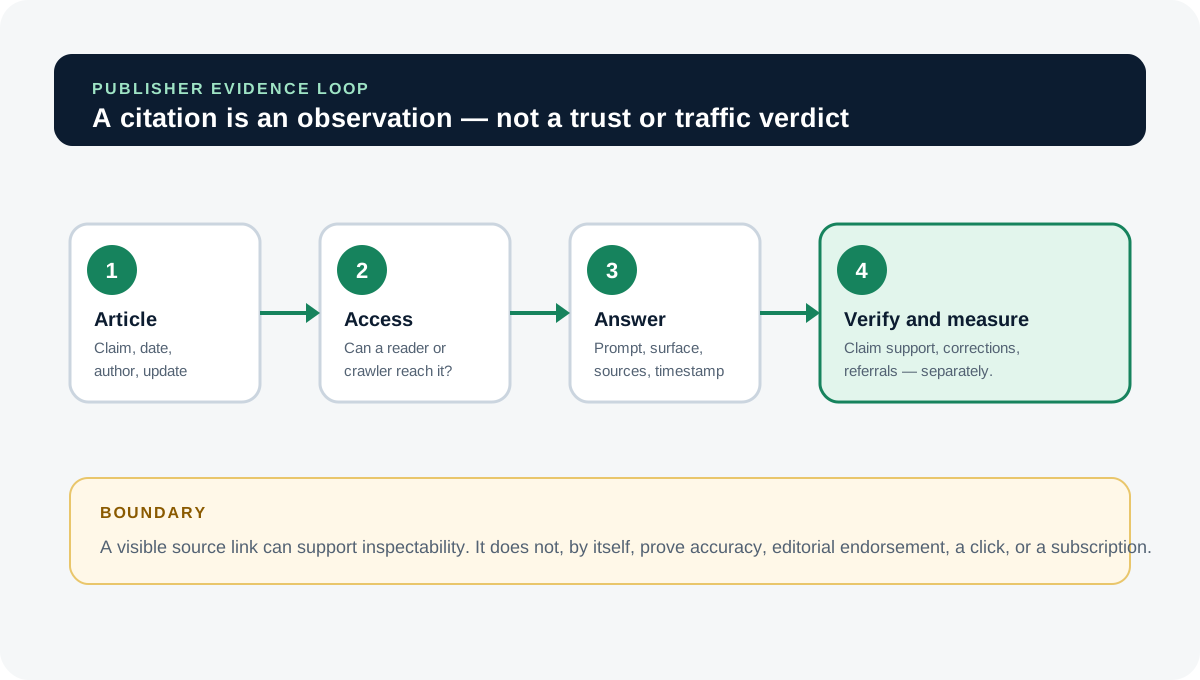
Use this sequence:
article context → access check → prompt capture → claim verification → outcome measurementA source link in an AI answer can make an article inspectable. It does not, by itself, prove that the article is accurate, that the publisher endorsed the answer, that a reader clicked, or that a subscription resulted.
This guide addresses searches such as “how do publishers track AI citations?”, “does ChatGPT citation mean my article is trusted?”, and “how can a news site audit AI Search visibility?” It is an editorial measurement framework, not legal, journalistic, platform-policy, or audience-revenue advice.
Why publisher citations need a stricter boundary
A publisher’s article can be cited for many different reasons: a reported fact, a date, a quote, a definition, a ranking, or a perspective. Those are not interchangeable. A source can be reputable and still fail to support the exact claim made in an answer. A current article can also become stale when an event, policy, price, office-holder, or scientific finding changes.
Google’s documentation says AI features in Search may show links to supporting web resources and recommends the same foundational practices for making content accessible and useful (Google Search Central: AI features and your website, checked September 25, 2026). This supports checking the relevant Search surface and visible links; it does not publish a universal citation-retention metric or guarantee inclusion.
OpenAI describes ChatGPT Search as a web-search experience that can provide links to sources (OpenAI Help: ChatGPT search, checked September 25, 2026). That is product-context evidence, not proof that every user sees the same answer, that a cited article caused a visit, or that a source link is an endorsement.
The Reuters Institute’s Digital News Report 2025, checked September 25, 2026, provides independent industry context about changing news discovery and audience behavior. It is useful for understanding the environment publishers operate in; it does not validate a specific publisher’s AI visibility, traffic, or subscription outcome.
The research paper GEO: Generative Engine Optimization, checked September 25, 2026, studies visibility in a research setting. It is relevant methodology context, not evidence that a commercial platform’s score predicts citations, clicks, or revenue.
What a publisher audit can establish
For a declared sample and collection context, an audit can establish:
- Whether an answer mentioned the publisher or linked to a particular article.
- Which claim the source appeared to support, based on the answer and the surrounding article context.
- Whether the article was accessible and what version or update date a reviewer observed.
- Whether the source mix changed between comparable prompt runs.
- Whether tagged or otherwise identifiable referrals appeared in the publisher’s analytics.
It cannot establish from one answer, one crawler request, or a dashboard score alone:
- A universal position across AI Search products or users.
- That the cited article was the internal cause of an answer.
- That the publisher’s article is correct merely because it was cited.
- That a citation produced a visit, engaged session, registration, subscription, or revenue.
- That a content edit, schema change, or
llms.txtfile caused a visibility change.
1. Define the editorial decision first
A prompt panel is only useful when its decision is explicit. Keep news discovery, fact verification, and opinion or perspective questions separate.
| Question group | What to observe | Do not infer from it alone |
|---|---|---|
| Breaking event | Which sources and dates appear in a time-bounded answer | That the newest or cited source is complete |
| Explainer | Whether the answer links to reporting that supports its definitions and context | That a citation validates every sentence |
| Topic discovery | Which publishers and source types appear for a non-branded question | Market-wide audience share |
| Publisher lookup | Whether the outlet is named and which pages are linked | Brand trust or editorial endorsement |
| Fact check | Whether a source is presented beside a claim and whether the source supports it | That the answer itself is reliable |
Write the decision before choosing a tool. “Monitor our AI rank” is too vague to audit. “Check whether five defined policy prompts cite current reporting from our site and record the cited URL” is testable.
2. Build a versioned publisher prompt panel
Use real reader questions, not only queries that contain the publication name. A compact panel can include:
- Topic discovery: “What are the main developments in [topic] this week?”
- Source comparison: “Which sources should I read to understand [topic]?”
- Article lookup: “What has [publisher] reported about [topic]?”
- Claim verification: “What evidence supports [specific claim]?”
- Local or audience context: “How does [development] affect [market or audience]?”
- Freshness check: “What changed about [topic] since [date]?”
Keep each prompt with an ID, intent, language, market, date range, and version. Do not silently replace a question after an answer changes. If a breaking-news panel must change, record the reason and start a new version.
3. Capture the answer as evidence
For every run, preserve the fields that make the observation reviewable:
| Field | Why it matters |
|---|---|
| Exact prompt | Prevents a paraphrase from being treated as the same test |
| Surface and mode | Consumer search, chat search, API, and browser modes are not automatically equivalent |
| Collection date and time zone | News answers are time-sensitive |
| Location, language, and account context when relevant | These can change retrieval and presentation |
| Full answer or permitted export | A citation count without answer context loses meaning |
| Exact source URLs and displayed titles | Domain-level counts hide article-level changes |
| Mention, recommendation, or citation label | These are different observations |
| Article date and update date | Freshness can matter to interpretation |
A useful record is deliberately plain:
Prompt: NEWS-07 v3
Surface: named AI Search product, web-search mode
Collected: 2026-09-25 09:00 UTC
Publisher URL: https://example.org/reporting/topic
Observed: cited beside the paragraph describing the policy date
Article checked: 2026-09-25; update label visible
Referral: not inferred; analytics check pending
Do not paste a fabricated example URL into a production evidence ledger. The record above is a schema illustration only.
4. Audit claim-to-source fit
The key review is not “was our domain cited?” It is “what did the source appear to support?” Open the exact URL and compare the answer’s claim with the smallest relevant passage.
Classify the relationship:
- Direct support: the article states or clearly documents the material claim.
- Partial support: the article supports part of the claim but not its scope, certainty, date, or conclusion.
- Context only: the article is related but does not support the asserted proposition.
- Contradiction or stale context: the article says something different, or the answer used an outdated version.
- Unresolved: the captured answer or page could not be inspected sufficiently.
This classification is an editorial QA signal, not a score for the AI system. Keep corrections and escalation separate from optimization work. If a citation misrepresents an article, preserve the capture, review the article and answer context, and follow the publisher’s correction process.
5. Treat freshness as a field, not a slogan
News and reference publishers should record at least:
- Publication date and visible update date.
- The event or policy date being discussed.
- Whether the article is live, corrected, redirected, paywalled, or archived.
- Whether the answer’s wording implies a current state.
- Whether a newer primary or official source exists.
A missing citation is not automatically source decay. It may reflect a changed prompt, a different answer, a new event, a parser change, or a source list that was never stable. Compare matched runs before changing the article.
6. Separate discovery from referral measurement
AI Search answer evidence and web analytics answer different questions. A cited URL can receive no measurable visit. A visit can arrive through a search surface without a clean way to attribute the answer. A crawler request is not a reader session.
Use separate columns for:
| Layer | Example observation |
|---|---|
| Answer visibility | Article URL appeared in a captured answer |
| Source support | Reviewer classified support as direct or partial |
| Technical access | Page returned the expected response to the permitted test |
| Referral | Analytics recorded a session with a documented source signal |
| Audience outcome | Registration, subscription, or other event was recorded |
Never roll these into a single “AI revenue” claim without a documented attribution method. The evidence is strongest when the answer capture, URL, analytics signal, and business event can be inspected independently.
Choosing a GEO or AI Search tool
Tools can reduce collection work, but their output is only as comparable as their definitions and sampling. When evaluating a platform, ask:
- Does it preserve the raw answer and exact cited URLs, or only a score?
- Can the panel store prompt versions, language, market, and collection date?
- Are mention, recommendation, citation, source position, and domain presence separate fields?
- Which surfaces and modes are actually supported today?
- Can a reviewer export evidence for a correction or editorial audit?
- How are parser changes and historical recalculations disclosed?
- Does the vendor distinguish answer observation from traffic or revenue attribution?
AICiteKit’s pages for AI Search Console, Peec AI, Otterly.AI, PromptWatch, and Profound can help compare stated workflows. Their product pages are not substitutes for a trial using the publisher’s own prompts, surfaces, and evidence requirements. Verify current plans and coverage on each official site before purchase.
A 30-day publisher audit workflow
Week 1: scope and baseline
- Select one beat, audience, or publisher property.
- Define 15–30 prompts across discovery, explainer, lookup, and freshness intents.
- Record exact surface, language, market, and collection conditions.
- Capture answers, cited URLs, article dates, and support classifications.
Week 2: source and access review
- Inspect every cited article at the exact URL.
- Check redirects, canonical targets, visible dates, corrections, and paywall context.
- Separate direct support from related-but-insufficient citations.
- Record unresolved cases instead of forcing a pass/fail label.
Week 3: controlled change
Choose one bounded editorial action, such as clarifying an update label, correcting a factual error, or improving a source note. Do not make multiple unrelated changes and then attribute a later answer difference to one edit.
Week 4: matched retest
- Re-run the same prompt version under the same declared conditions.
- Compare exact URLs, claims, dates, and source composition.
- Check analytics separately for identifiable referrals.
- Report observations, uncertainty, and the next test—not a guaranteed outcome.
Common mistakes
Counting domains instead of articles
A domain can remain visible while the cited URL, article date, or supporting passage changes. Preserve exact URLs.
Treating a citation as an endorsement
A link can be retrieved for context without validating the answer’s wording. Review claim-to-source fit.
Using only branded prompts
Branded questions measure recognition and lookup. They do not show how an outlet appears in unbranded topic discovery.
Treating crawler activity as audience demand
Access logs may show a request, not a person reading, a citation, or a subscription. Keep server evidence and audience analytics separate.
Changing the prompt after an unfavorable result
A new wording creates a new test. Version it rather than rewriting history.
FAQ
Does an AI citation mean a publisher is trusted?
No. It means a source link was observed under a particular answer and collection context. Trust, accuracy, editorial standards, and audience behavior require separate evidence.
Should publishers optimize every article for AI Search?
Not as a blanket rule. Start with reader value, accuracy, accessibility, clear context, and an audit decision. Test whether a defined set of real questions produces useful, inspectable answers before expanding the program.
Can a publisher prove that AI Search caused a subscription?
Only with a carefully defined attribution design and appropriate analytics evidence, and even then the result may be partial. A citation or crawler request alone cannot prove causality.
How often should a publisher rerun prompts?
There is no universal cadence. Breaking-news panels may need event-based checks; evergreen panels can use a documented periodic schedule. Keep the prompt version and collection conditions stable enough to compare.
Are AI Search tool scores interchangeable?
No. Compare definitions, prompt samples, surfaces, model or mode coverage, location, dates, source parsing, and raw evidence availability before comparing numbers.
Sources and evidence boundaries
- Google Search Central: AI features and your website — official guidance checked September 25, 2026 for AI-feature and supporting-link context; it does not guarantee inclusion or define a universal citation metric.
- OpenAI Help: ChatGPT search — official product-context source checked September 25, 2026 for web-search and source-link language; it does not prove uniform answers or referrals.
- Reuters Institute: Digital News Report 2025 — independent industry research checked September 25, 2026 for news-discovery context; it does not validate a specific publisher’s AI results.
- Aggarwal et al., GEO: Generative Engine Optimization — independent academic research checked September 25, 2026 for experimental visibility context; it is not evidence for a commercial tool’s current score or business impact.
- AICiteKit editorial framework — the audit workflow, classifications, and interpretation in this article; editorial guidance, not a platform specification.
Final takeaway
For publishers, the useful question is not “what is our AI rank?” It is “when a defined answer cites our article, what claim does the link appear to support, was the article current, and can any reader outcome be measured independently?” Preserve the answer, inspect the source, disclose uncertainty, and keep visibility, provenance, referrals, and subscriptions as separate evidence layers.
This article does not guarantee citations, recommendations, rankings, traffic, subscriptions, or revenue.