How to Track Whether AI Engines Are Citing Your Brand
A practical guide to building a prompt set, recording AI answers and sources, measuring citations, and turning AI Search evidence into useful content and reporting decisions.
Why manual spot-checking is not enough
Typing a few prompts into ChatGPT and eyeballing the results feels like monitoring, but it is not a reliable measurement system. AI answers can change when the prompt, model, location, account context, retrieval state, or date changes.
A proper citation-monitoring workflow needs repeated, structured prompt runs and a record of the underlying answers. The goal is not to find one impressive answer. The goal is to understand whether a brand is consistently present, accurately represented, and supported by useful sources across a defined sample.
This distinction matters because:
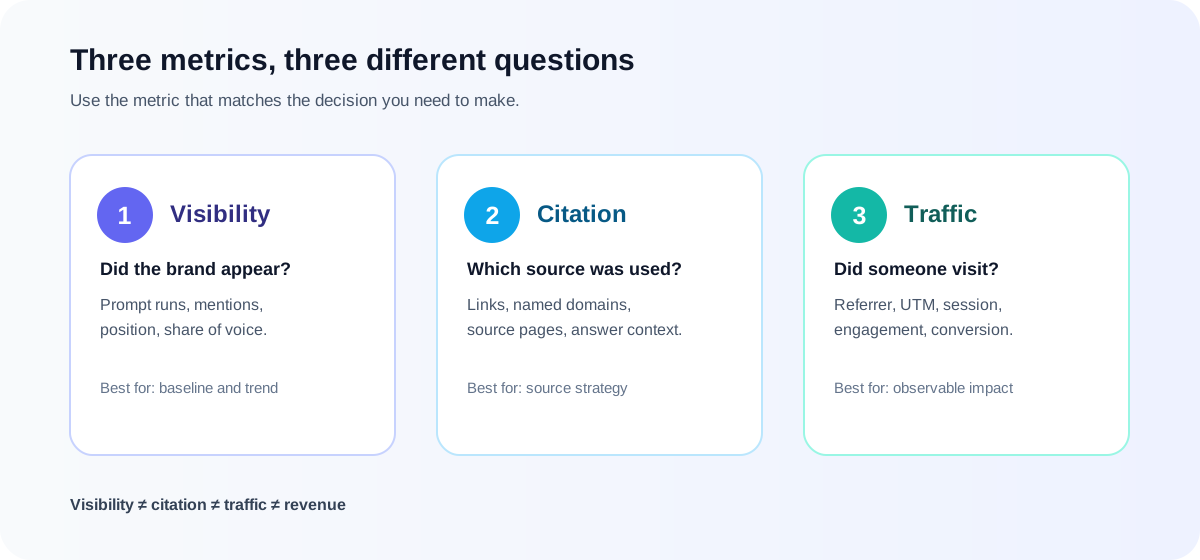
A mention is not necessarily a citation.
A citation is not necessarily a click.
A click is not necessarily a conversion.
For the broader distinction between metrics, read AI Visibility vs AI Citations vs AI Traffic.
What counts as an AI citation?
Different AI platforms and tools use the word “citation” differently. A source signal may be:
- A direct link attached to an answer
- A source listed below or beside the response
- A named website, document, video, or publication
- A page that appears to support a specific statement
- A third-party source used instead of the brand’s own website
Do not record only cited: yes. A useful evidence record includes:
- The complete AI answer
- The source URL or domain
- The statement associated with the source
- The source’s position or prominence
- Whether the source is owned by the brand
- Whether the description is accurate
- Whether a click was observable in analytics
- The prompt, model, region, language, date, and response context
The OpenAI ChatGPT Search help documentation and Google’s AI features guidance are useful official references for understanding how AI search surfaces can present information and links. They do not provide a universal cross-platform citation methodology.
Building a prompt set
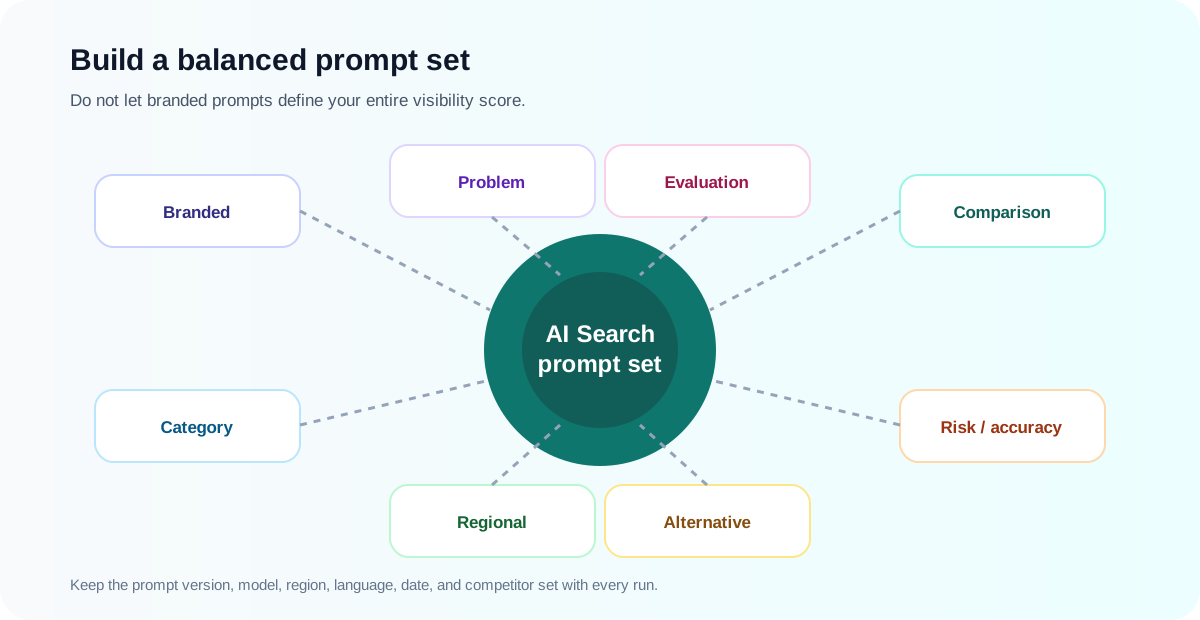
Start with the questions customers ask before choosing a product in your category, not just queries containing your brand name. A prompt set should represent the buying journey and the risks that matter to the business.
Category-level questions
Use prompts such as:
- What are the best tools for X?
- Which platforms help a team solve Y?
- What should a company look for when choosing Z?
These prompts show whether the brand appears when the user has not named it yet.
Problem and use-case questions
Ask about the underlying problem:
- How do I monitor AI citations?
- How can an agency report AI visibility?
- What is the best way to find sources used by ChatGPT?
Problem prompts are often more useful than a list of product-name searches because they represent discovery and education stages.
Comparison questions
Include prompts such as:
- X vs Y
- Alternatives to X
- Which is better for an agency, X or Y?
- Compare the pricing and limitations of X and Y.
Comparison answers reveal how an AI system frames strengths, weaknesses, price, and fit. They can also expose outdated or inaccurate descriptions.
Direct brand questions
Track prompts that ask about the brand specifically:
- What is X?
- Who is X best for?
- What does X cost?
- Is X a good alternative to Y?
These prompts are useful for accuracy and brand-integrity checks, but they should not make up the whole score. A brand can perform well on its own branded prompts and remain invisible for category discovery.
Risk and accuracy questions
For high-trust categories, add prompts that test potentially harmful errors:
- What are the limitations of X?
- Is X compliant with a relevant requirement?
- What is the current price of X?
- Does X support a specific integration?
- What should a buyer be careful about?
A response can be negative and accurate, or negative and false. The monitoring system should preserve the full answer so a person can make that distinction.
Regional and language variants
If the business operates across markets, repeat selected prompts by:
- Country
- Language
- Product market
- Local competitor set
- Regional regulation or terminology
Do not assume that one English-language result represents every market.
Designing a repeatable test
Before running a baseline, write down the methodology:
| Field | What to record |
|---|---|
| Prompt version | The exact wording and date of the prompt set |
| AI surface | ChatGPT, Perplexity, Google AI Overviews, Gemini, Claude, Copilot, or another surface |
| Model | The model or endpoint when the platform exposes it |
| Region | Country, language, and relevant location setting |
| Context | New conversation, follow-up, or saved workspace context |
| Competitors | The competitor universe used for share-of-voice analysis |
| Schedule | One-time, daily, weekly, or another interval |
| Evidence | Full answer, source URLs, screenshots or exports when appropriate |
Keep these fields stable when comparing results. If the prompt set or competitor list changes, label the data as a new measurement period rather than presenting it as a clean before-and-after comparison.
What to measure
Mention rate
How often did the brand appear in the sampled answers?
Mention rate is a useful starting signal, but it does not distinguish between a recommendation, a passing mention, and a negative description.
Position or recommendation order
Where did the brand appear relative to competitors?
Position is difficult to compare across answer formats. Some responses list products, some recommend one option in prose, and some mention several brands without an explicit order.
Share of voice
How often did the brand appear compared with a defined competitor set?
Share of voice depends on the prompts, competitors, models, and counting method. Always document the denominator.
Citation rate
How often did a sampled response contain a source connected to the brand or its content?
Define whether a citation means a direct URL, a named domain, a source panel entry, or another signal. A source can be present without a click or endorsement.
Source domains and pages
Which websites and pages appear most often?
This is often the most actionable view because it points toward:
- Pages to improve
- Third-party sources to understand
- Outdated sources to correct
- Editorial or PR opportunities
- Competitor authority gaps
Accuracy and sentiment
What does the answer say, and is it correct?
Do not let a sentiment score replace response review. A negative statement may be accurate and useful to a buyer. A positive statement may still contain a wrong price, feature, or claim.
The measurement workflow
Step 1: Establish a baseline
Choose a manageable prompt set and run it across the AI surfaces relevant to your customers. Save the complete answers and source information.
A baseline should answer:
- Where does the brand appear?
- Where is it absent?
- Which competitors appear instead?
- Which domains are cited?
- What facts are missing or incorrect?
- Which prompt groups deserve deeper attention?
Step 2: Inspect the underlying answers
Do not rely only on a dashboard score. Open the response and inspect:
- The exact wording of the brand mention
- The competitors included
- The cited source and page
- The tone and context
- Any incorrect facts
- Whether the answer addresses the user’s question
AI Search Console and ZipTie are examples of directory tools that emphasize answer, source, or citation analysis. Their features and coverage differ, so verify each platform’s current methodology before selecting one.
Step 3: Group the gaps
Classify findings into four groups:
Content gap
The site does not clearly answer a question that matters to customers.
Source gap
Relevant third-party pages cite competitors or provide stronger explanations.
Accuracy gap
The AI answer contains an incorrect, outdated, or misleading brand fact.
Measurement gap
The apparent change may be caused by prompt selection, model volatility, region, or a different sampling method.
This classification prevents a team from rewriting content when the real problem is an unbalanced test or an external source.
Step 4: Choose an action
Possible actions include:
- Improve an existing page that is already cited
- Create a direct-answer section for an important prompt group
- Update pricing, product, integration, or policy facts
- Add useful comparison and use-case content
- Improve internal links and entity clarity
- Correct an outdated third-party source where possible
- Build accurate, relevant third-party coverage
- Check technical access and canonical signals
Do not publish content only because an AI tool recommends a keyword. Review the underlying customer need, source evidence, and brand requirements first.
Step 5: Re-run the same test
After making a change:
- Keep the prompt wording stable.
- Keep the model and region stable where possible.
- Wait for a suitable observation period.
- Run the same prompts again.
- Compare full answers, sources, and accuracy.
- Check analytics separately for detectable referral changes.
One changed answer does not prove that a page update caused a durable improvement.
Connecting citations to traffic
A citation can influence a user without producing an immediately measurable referral. Users may read an answer, remember a brand, search for it later, or visit through a different device.
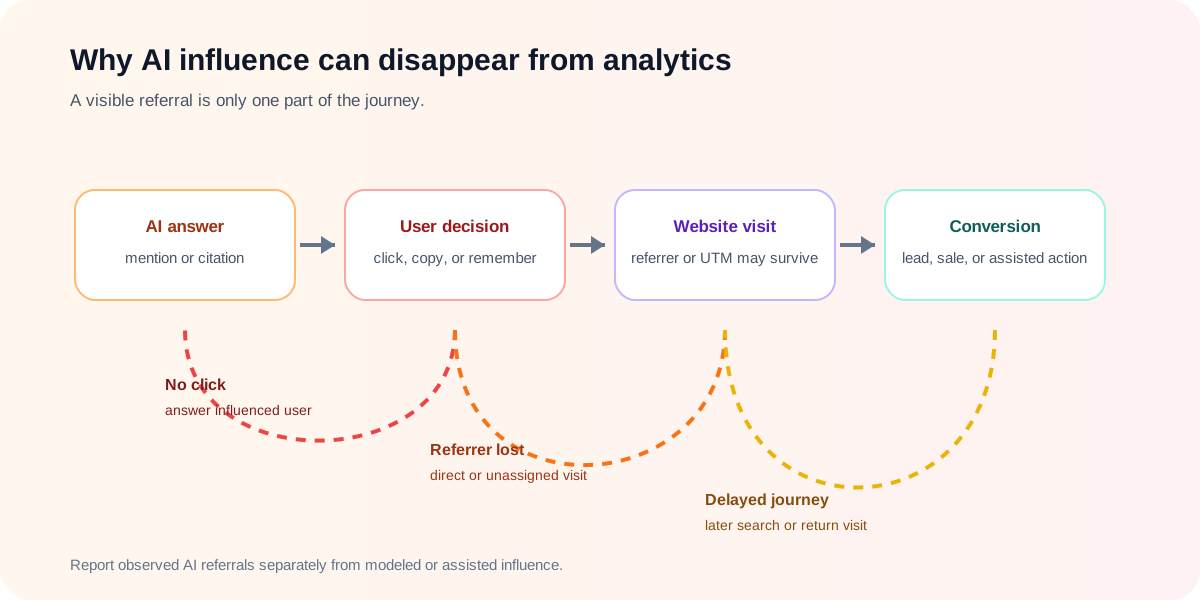
When an AI referral is observable, use analytics to examine:
- Source and medium
- Landing page
- Session engagement
- Return visits
- Lead or ecommerce conversion
- Assisted-conversion paths
Google Analytics campaign parameters can help identify tagged links. GA4 traffic-source dimensions explain how source and campaign information is represented in reporting.
The limitations are significant:
- Some apps and surfaces do not pass a stable referrer.
- Google AI Overviews may produce no separate AI referral when the user stays in Google.
- A user can copy a URL or return later through direct traffic.
- Privacy settings, redirects, and mobile apps can remove context.
- A crawler request is not a human session.
Report “observed AI-referred sessions” separately from “AI-influenced sessions” or “modeled revenue.” The latter require additional assumptions.
Comparing tools without comparing incompatible scores
AI Search tools may disagree because they use different:
- Prompt libraries
- Model and engine coverage
- Locations and languages
- Competitor lists
- Sampling frequency
- Citation definitions
- Share-of-voice formulas
- Response storage and filtering
Rankscale emphasizes broad engine coverage and configurable monitoring. Peec AI focuses on visibility, rankings, sentiment, and competitors. Otterly.AI is positioned as a practical monitoring option. PromptWatch adds crawler and AI-referral analytics. These are different measurement jobs, not simply different brands of the same score.
When comparing tools, run a shared test if possible:
- Use the same prompt set.
- Use the same competitor universe.
- Match the country and language.
- Record the exact date and model.
- Compare the underlying answers and sources.
- Document differences in definitions.
Reporting template
A useful monthly report can include:
Executive summary
- What changed?
- Which prompt group matters most?
- What should the team do next?
Visibility
- Mention rate
- Share of voice
- Position or recommendation order
- Competitor changes
- Model, region, and prompt coverage
Citations
- Citation rate
- Top cited pages
- Top third-party domains
- Competitor sources
- Incorrect or outdated sources
Traffic and outcomes
- Detectable AI referrals
- Landing pages
- Engagement
- Leads, sales, or assisted conversions
- Attribution limitations
Action plan
- Content fixes
- Technical checks
- Source or PR opportunities
- New prompts to add
- Experiments for the next period
The report should include the prompt-set version and the date range. Without that information, a score is difficult to reproduce.
Common mistakes
Checking only branded prompts
This tells you whether the model knows the brand, not whether it recommends the brand to a new category buyer.
Treating one answer as a rank
AI answers vary. A single result is an observation, not a stable universal position.
Counting every mention as a positive result
A mention can be inaccurate, negative, outdated, or irrelevant to the user’s intent.
Reporting citations as clicks
A link in an answer does not prove that a person opened it.
Treating crawler access as referral traffic
An automated request from an AI crawler is not evidence of a human visit. Cloudflare AI Crawl Control provides useful technical context for this distinction.
Changing the prompt set every week
If the sample changes constantly, the trend is difficult to interpret.
Claiming revenue impact too early
Attribution requires analytics, CRM, and ecommerce context. Visibility data alone cannot prove revenue.
Tool categories for citation monitoring
AICiteKit’s current directory includes several adjacent categories:
- Lightweight monitoring: Otterly.AI, Peec AI
- Broad AI engine monitoring: Rankscale
- Prompt and answer analysis: AI Search Console, ZipTie
- Crawler and referral analytics: PromptWatch
- Enterprise intelligence and action: Profound, AthenaHQ
- Content follow-through: Frase, Surfer AI Tracker, Writesonic GEO Suite
Choose based on the evidence surface you need: answers, sources, crawler access, referrals, content execution, or enterprise reporting.
FAQ
How often should AI citations be checked?
Use a schedule that matches the volatility and importance of the prompts. Weekly or more frequent checks can be useful for high-priority commercial or reputation prompts. A smaller set can be checked less often. Keep the schedule documented.
How many prompts should I track?
There is no universal number. Start with a balanced set covering branded, category, problem, comparison, evaluation, alternative, risk, and regional prompts. Expand when the results identify a meaningful gap.
Do I need to track every AI engine?
No. Start with the surfaces your customers actually use, then expand if your market or audience requires it. Record which engines were included so reports are not misread as universal coverage.
What is the difference between citation rate and mention rate?
Mention rate counts whether the brand appears in an answer. Citation rate usually counts whether a source link, named source, or other defined source signal is present. The definitions vary by tool, so check the methodology.
Can AI citation monitoring prove that GEO worked?
It can show that the observed answers or sources changed under a defined methodology. It cannot by itself prove that a content change caused more traffic, leads, or revenue.
Should I save screenshots?
Save the full answer and source URLs whenever possible. Screenshots can help preserve visual context, but structured exports make filtering and comparison easier.
Further reading and sources
- OpenAI Help: ChatGPT Search — official context for ChatGPT Search and sources.
- Google Search Central: AI features and your website — official guidance for AI features in Google Search.
- Google Search Help: AI Overviews — official explanation of Google AI Overview experiences.
- Google Analytics Help: Campaign URL Builder — official guidance for campaign parameters.
- Google Analytics Help: Traffic-source dimensions — official context for traffic attribution fields.
- Cloudflare: AI Crawl Control — technical context for AI crawler requests.
- Otterly.AI: How to Track AI Search Engine Citations and Sources — independent category guidance on citation and referral limits.
- AICiteKit: What Is GEO? — GEO fundamentals and optimization workflow.
- AICiteKit: AI Visibility vs AI Citations vs AI Traffic — metric definitions and attribution boundaries.
- AICiteKit AI Search Monitoring directory — related tool category.