Field notes / ai-search
AI Search Source Coverage Audit: How to Find Missing Evidence in Answer Citations
A practical AI Search source coverage audit for discovering which customer questions lack strong sources, checking citation support, and prioritizing evidence without claiming guaranteed visibility.
The short answer
An AI Search source coverage audit asks whether a defined set of real questions produces answers with sources that are relevant, current, independent where appropriate, and sufficient for the claim being made. It is not a contest to maximize the number of URLs beside an answer.
Use this sequence:
question set → answer capture → claim map → source-quality check → evidence gap → bounded actionA missing citation is a signal to investigate, not proof that a page is invisible. A citation is also not proof that the cited page supports every sentence around it. The audit has to preserve both the question and the evidence relationship.
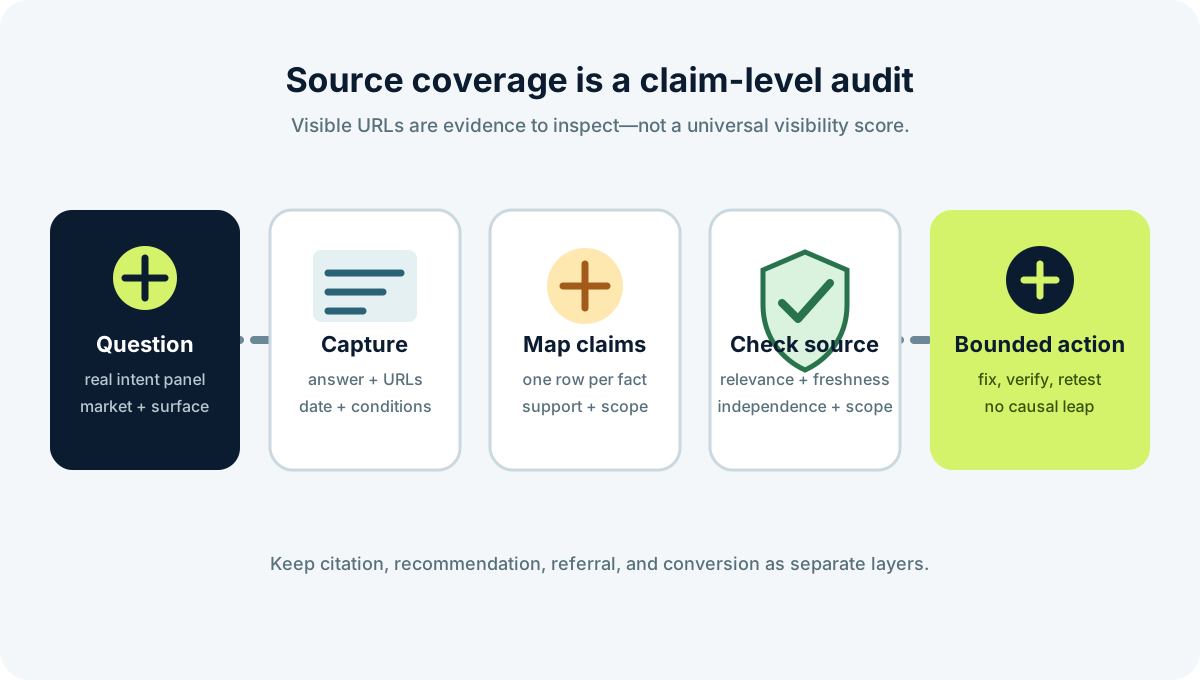
This guide addresses searches such as “why does AI Search cite competitors?”, “how do I audit AI citations?”, and “how can I find content gaps in ChatGPT answers?” It is a research and editorial workflow, not a guarantee of retrieval, citation, traffic, or revenue.
What source coverage can—and cannot—show
Google’s documentation for AI features, checked October 25, 2026, says that AI features may show links to supporting web resources and recommends foundational Search practices. It does not publish a universal source-coverage score or guarantee that a page will appear.
OpenAI’s web search documentation, checked October 25, 2026, documents sources and citations for a particular API tool. That supports inspecting the fields exposed by that tool; it does not establish that every ChatGPT surface or other answer engine uses identical retrieval and citation behavior.
Perplexity’s Search API quickstart, checked October 25, 2026, documents search results and returned source information in its API context. This is product-specific documentation, not a cross-platform standard.
The independent paper GEO: Generative Engine Optimization, checked October 25, 2026, provides research context for studying visibility in generative-engine responses. It does not validate a current commercial score, a universal citation rate, or a business outcome.
| Observation | Safe conclusion | Do not claim from it alone |
|---|---|---|
| A prompt returns no owned source | The owned source was absent in that captured answer | The site is universally invisible |
| A competitor URL appears | That URL was visible under the recorded conditions | The competitor is always preferred |
| A source supports one sentence | The source supports that claim within the checked scope | The source validates the whole answer |
| Several answers cite the same domain | The domain recurred in the declared sample | A market-wide source ranking |
| A page is crawlable | The page was reachable under the test | That it was retrieved or cited |
| An answer changes after an edit | Two observations differ | The edit caused the difference |
Keep mention, recommendation, citation, source support, referral, and conversion as separate evidence layers.
1. Define coverage before collecting answers
“Are we covered in AI Search?” is too broad to audit. Start with the decision:
- Which product facts need a source that buyers can inspect?
- Which category questions should include an independent comparison source?
- Which support or compliance claims are high risk if misstated?
- Which pages should be tested after a documentation release?
- Which questions matter in a specific market or language?
Build a small panel from real inputs: Search Console queries, sales calls, support tickets, site search, customer interviews, and existing answer observations. An LLM can generate prompt variants, but generated variants are not independent evidence of what customers ask.
| Prompt cohort | Example | Evidence question |
|---|---|---|
| Branded | “What does [product] do?” | Is the basic identity supported by a canonical source? |
| Category | “Which tools help a small team monitor AI citations?” | Does the answer show decision-relevant criteria and inspectable sources? |
| Comparison | “[Product A] vs [Product B] for an agency” | Are differences sourced, scoped, and current? |
| Fact | “Does [product] support [integration]?” | Is the exact capability and plan condition supported? |
| Risk | “What are the limitations of [product]?” | Are caveats and negative evidence represented? |
Version the panel. If the question, market, language, surface, or answer mode changes, treat it as a new observation rather than silently comparing unlike runs.
2. Capture the answer and its conditions
A source-coverage audit fails when the team saves only a score or a screenshot of a highlighted brand. For each run, retain as much of the following as the surface and applicable policies allow:
- Exact prompt text and panel version.
- Surface, mode, and model or product label when exposed.
- Country, language, device, account context, and location assumptions.
- Timestamp and time zone.
- Complete answer or permitted near-raw capture.
- Every visible source title and direct URL.
- Mentioned brands, recommendations, qualifiers, and answer omissions.
- Empty, failed, blocked, login-gated, and no-source states.
If a field is not exposed, record not exposed. Do not infer a hidden retrieval query, model, cache, or reason a source was selected.
A minimal observation record might look like this:
Prompt ID: COMP-07
Question: Which tools help a small agency monitor AI citations?
Surface: named interface; mode recorded when exposed
Market: US / English
Collected: 2026-10-25 UTC
Owned domain: mentioned; recommendation: unclear
Visible sources: 4; direct URLs retained
Boundary: one captured answer, not a universal ranking
3. Split the answer into claims
Source coverage is usually lost at the sentence level. One answer can contain a supported product fact, an unsourced recommendation, and a stale price in the same paragraph.
Create one row per material claim:
| Claim | Claim type | Source shown? | Scope check | Status |
|---|---|---|---|---|
| A plan includes an integration | Product fact | Yes / no | Plan, date, and region checked | Supported / unresolved |
| Tool A fits a small agency | Recommendation | Yes / no | Criteria and buyer constraints checked | Conditional / unsupported |
| Company B serves a market | Availability | Yes / no | Market and current source checked | Supported / stale risk |
| Tool C costs a stated amount | Commercial fact | Yes / no | Currency, billing interval, and date checked | Verify first-party source |
Then classify the relationship between the claim and source:
- Direct: the source states the same claim and scope.
- Partial: the source supports only part of the wording or lacks a condition.
- Contradicted: the source conflicts with the answer.
- Unavailable: the URL cannot be opened or the relevant passage is not accessible.
- Unverified: the answer provides no adequate source relationship.
A URL beside an answer is not proof that it supports every sentence. Locate the smallest relevant passage or section heading in the source, subject to the source’s terms and your internal review policy.
4. Evaluate source quality for the decision
“Source coverage” should not mean “more links.” A source may be relevant but outdated, current but promotional, authoritative for one fact but not another, or independent but outside the exact market.
Use a decision-specific matrix:
| Dimension | Questions to ask | Example evidence |
|---|---|---|
| Relevance | Does the source answer the same question? | Product page for a product fact; methodology page for a method claim |
| Scope | Does it cover the plan, region, version, and audience? | Exact eligibility and plan language |
| Freshness | Was it current when the answer was collected? | Update date, version, or checked page content |
| Independence | Is the source vendor-owned, commercial, community, or editorial? | Disclosure of publisher and relationship |
| Directness | Does it state the claim or require inference? | A visible limit versus a marketing adjective |
| Diversity | Does the answer rely on one source type? | First-party plus independent or community evidence where appropriate |
Source type is not a universal quality ranking. A vendor documentation page is often the right source for a current integration specification; it is not independent proof that the integration is useful. A third-party review may help with workflow observations; it may be stale or commercially biased. Label the relationship instead of flattening both into “trusted.”
5. Turn gaps into testable actions
A gap should produce a narrow next step, not an automatic rewrite. Use the gap type to choose the action:
| Gap | Possible action | What to retest |
|---|---|---|
| Important fact has no canonical source | Publish or designate a current first-party page | Whether the claim becomes inspectable and accurate |
| Source exists but answer uses a stale URL | Check redirects, duplicate pages, dates, and competing claims | Which URL appears under the same declared conditions |
| Citation is present but claim support is partial | Clarify the source wording and answer criteria | Whether the claim-source relationship improves |
| Category answer omits owned evidence | Compare page usefulness, external references, and prompt wording | Whether omission repeats across the panel |
| Answer relies on one source type | Add appropriate independent or community evidence | Whether source diversity changes, without assuming “more” is better |
| Product fact conflicts across pages | Assign an owner and canonical fact record | Whether the conflict is resolved in the source set |
Do not add unsupported claims, fake reviews, invented statistics, or keyword-heavy filler to force a citation. Improving inspectability may be worthwhile even when no answer change is observed; an answer change may also occur without proving which edit mattered.
6. Use monitoring tools as evidence collectors
Products such as AI Search Console, Peec AI, Otterly.AI, PromptWatch, and Profound may support different combinations of prompt monitoring, answer capture, source tracking, crawler context, and reporting. Their outputs are not automatically interchangeable.
Before relying on a dashboard, verify:
- Whether exact prompts, answers, and visible URLs are retained.
- Whether the tool distinguishes domains, URLs, mentions, recommendations, and citations.
- Whether surface, market, language, timestamp, and model or mode are exposed.
- How retries, failures, empty answers, and changed prompts are counted.
- Whether the numerator and denominator behind a coverage rate can be reconstructed.
- Whether exports preserve raw evidence or only a derived score.
- How refresh intervals, credits, plan limits, and retention affect the sample.
A monitoring product can make the workflow easier. It does not make an answer deterministic or prove that its metric predicts traffic or revenue. Ask for the evidence path behind the displayed number.
A practical source-coverage report
A useful report can be short if its scope is explicit:
- Decision and panel: what questions, market, surface, date range, and version were included.
- Coverage definition: whether coverage means mention, recommendation, visible URL, supported claim, or another declared event.
- Claim ledger: material claims, source URLs, support status, and freshness notes.
- Gap summary: missing, partial, stale, contradicted, unavailable, and unresolved cases.
- Action queue: the smallest change that could improve accuracy or inspectability.
- Retest design: same prompts and conditions where possible, with changed variables recorded.
- Boundary statement: what the sample does not establish about other users, prompts, platforms, clicks, or business outcomes.
Report denominators. “The brand was covered 60% of the time” is not inspectable without the number of prompts, runs, coverage definition, source rules, and exclusions. A claim-level support rate can be useful for a defined sample, but it is not a universal AI Search quality score.
What this audit does not prove
Even a careful audit cannot establish from answer captures alone:
- A universal ranking across users or answer engines.
- That a page was the hidden retrieval cause of an answer.
- That an accessible or cited source is factually correct in every context.
- That a content, schema, internal-link, or
llms.txtedit caused a later answer change. - That a citation produced a click, session, lead, subscription, or revenue.
For traffic, join answer observations to declared analytics records as a separate analysis. For accuracy, check the source and claim directly. For business impact, use an attribution design that supports the requested conclusion rather than renaming visibility as revenue.
Checklist
- Define the business or editorial decision before choosing prompts.
- Build and version prompt cohorts from real customer or audience questions.
- Record surface, market, language, timestamp, and exposed model or mode.
- Preserve answer text and every visible source URL where permitted.
- Split answers into material claims before scoring coverage.
- Check source relevance, scope, freshness, independence, and directness.
- Label partial, contradicted, unavailable, and unresolved evidence.
- Keep citation, mention, recommendation, referral, and conversion separate.
- Reconstruct denominators and exclusions behind every percentage.
- Retest the same panel after a bounded change, without claiming causality by sequence alone.
FAQ
What does source coverage mean in AI Search?
It means a defined set of answer claims has an inspectable source relationship under recorded conditions. Teams should define whether they measure a visible URL, a source that supports a claim, a domain mention, or another event. These are different metrics.
Why does AI Search cite a competitor instead of my site?
A captured answer may cite a competitor because of the question, source availability, relevance, freshness, answer-surface behavior, or conditions that are not exposed. A single observation cannot identify the reason. Compare matched prompts, source passages, page scope, and repeated runs before choosing an action.
Does adding more citations improve AI Search visibility?
Not necessarily. More links can make an answer less useful, and a citation does not guarantee retrieval or recommendation. The relevant goal is a source that is appropriate, current, and sufficient for the claim being made.
Can a GEO tool measure source coverage accurately?
A tool can measure the fields it captures under its own method. Accuracy depends on the prompt panel, surface, sampling, source definitions, retries, and exportability. Verify raw answer evidence and reconstruct the metric before comparing tools or reporting a trend.
Does source coverage predict traffic or revenue?
No. A visible source or supported claim is answer-level evidence. Traffic requires a detectable visit, and revenue requires a separately defined business measurement and attribution method. Do not convert a source-coverage rate into a causal business result.
Sources and verification
- Google Search Central: AI features and your website — official context for supporting links and the limits of appearance guarantees; checked October 25, 2026.
- OpenAI Developer Docs: Web search — product-specific source and citation fields; checked October 25, 2026.
- Perplexity Search API quickstart — product-specific search and source-return context; checked October 25, 2026.
- GEO: Generative Engine Optimization — independent research context for generative-engine visibility; checked October 25, 2026.
Last reviewed: October 25, 2026. Data confidence: High for the linked official documentation and academic paper descriptions; medium for the practical audit framework; low for any claim about an unseen engine’s source-selection reason. This article does not claim guaranteed retrieval, citations, traffic, conversions, or revenue.