How to Audit Brand Hallucinations in AI Search
A practical workflow for finding inaccurate AI descriptions of a brand, separating false claims from negative-but-accurate answers, and assigning evidence-backed fixes.
The short answer
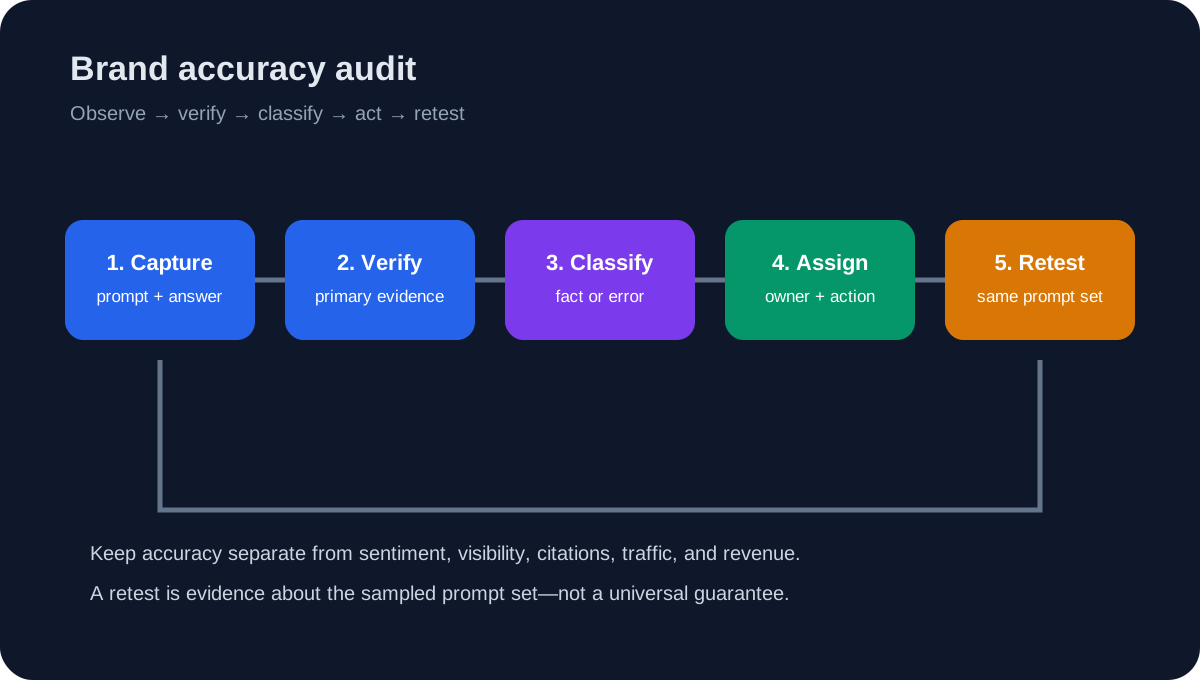
A brand-hallucination audit should test accuracy, not just sentiment. Freeze a prompt set, capture complete answers, verify each claim against current primary sources, classify the error, assign an owner, and retest the same prompt later.
A useful rule is:
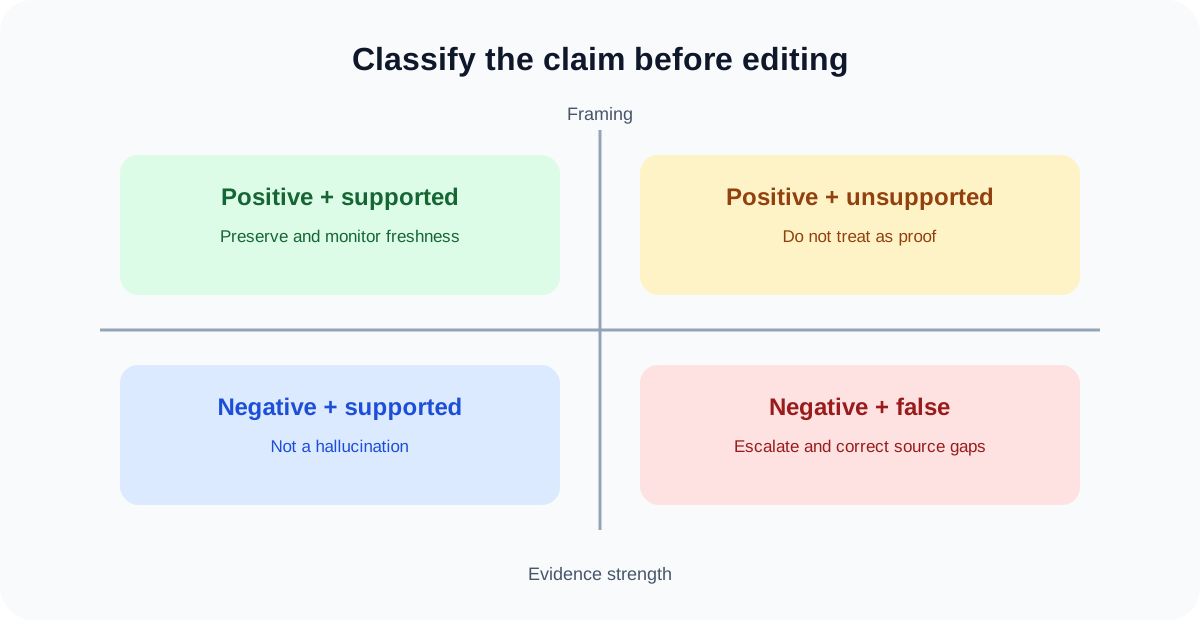
negative and accurate ≠ hallucinated
positive and unsupported ≠ trustworthy
An AI answer that says a product is expensive may be unpleasant but accurate. An answer that invents a discontinued plan, attributes a competitor’s feature to your company, or states an unsupported medical or financial claim is an accuracy problem. Neither visibility nor a favorable sentiment score proves that the answer is correct.
Why brand accuracy needs its own workflow
AI Search compresses many documents into a short answer. That makes an incorrect statement easy to miss and difficult to attribute. The answer may combine an official page, a review, a forum post, a stale cached document, and model-generated language.
A visibility tracker can tell you that a brand appeared. A citation report can show which URL was linked. Neither automatically proves that the description was accurate. Tools such as AthenaHQ, Profound, and PromptWatch may support different parts of the observation workflow, but buyers should verify their sampling and definitions rather than treating product labels as equivalent.
For source-level review, use the AI Search source quality framework. For metric boundaries, see AI Visibility vs AI Citations vs AI Traffic.
Step 1: Build an accuracy-focused prompt set
Do not audit only branded prompts such as “What is Brand X?” Include the questions that expose stale, conflated, or invented facts:
| Prompt group | Example purpose |
|---|---|
| Identity | What does the company do and who is it for? |
| Product facts | Which plans, integrations, models, or regions are supported? |
| Comparison | How does Brand X differ from Competitor Y? |
| Pricing | What does the product cost and what are the limits? |
| Risk | What are the main drawbacks, complaints, or compliance considerations? |
| Regional | Is the product available in a specific country or language? |
| Freshness | What changed recently and what is no longer offered? |
Record the exact wording, AI surface, model when available, country, language, device context, and date. A prompt set is a measurement instrument; changing it mid-audit changes the question.
Step 2: Capture the complete answer
Save more than a screenshot of the first sentence. Record:
- Full answer text
- Source links or source panel
- Prompt and follow-up context
- Model or surface
- Timestamp, region, and language
- Mentioned competitors
- The exact sentence that contains a questionable claim
If the answer changes between runs, preserve both observations. Non-determinism is a reason to sample consistently, not a reason to select the most favorable response.
Step 3: Verify the claim against the right evidence
Use the strongest available source for the claim:
- Current pricing and limits: official pricing and plan documentation
- Feature availability: current product documentation or a dated product page
- Company identity: official about, legal, and corporate pages
- User experience: independent review platforms and clearly identified user reports
- Regulatory or safety claims: primary regulators, standards bodies, or qualified sources
- Historical claims: dated announcements and archived material where appropriate
Label provenance explicitly. A vendor-selected customer story can support what the vendor says happened, but it is not independent proof of a typical outcome. A traditional SEO review does not automatically validate a new AI-visibility feature.
Step 4: Classify the finding
Use a small taxonomy so different reviewers reach comparable conclusions:
| Class | Definition | Example action |
|---|---|---|
| Accurate negative | Unfavorable but supported by evidence | Do not “correct” it; decide whether context is missing |
| Accurate positive | Favorable and supported | Preserve the source and monitor freshness |
| Incomplete | Important qualification or limit is missing | Improve the primary fact page |
| Stale | Previously true, now outdated | Update the source and record the effective date |
| Conflated | Facts from another product or competitor are merged | Clarify identity and comparison pages |
| Unsupported | Claim cannot be substantiated | Add evidence or request correction where appropriate |
| Fabricated | No credible source supports the claim | Escalate to content, PR, product, or legal owner |
Do not use “hallucination” as a synonym for “I dislike the answer.” The label should be reserved for a false or unsupported statement after a reasonable verification attempt.
Step 5: Assign the smallest useful fix
The fix depends on the cause:
- Owned-source gap: update a product, pricing, FAQ, or policy page.
- Structured-fact gap: make identity, product, organization, or offer facts explicit and validate structured data. Google documents structured-data requirements in its Search Central documentation, but structured data is not a guarantee of AI answer inclusion.
- Third-party error: document the incorrect claim and contact the publisher when appropriate.
- Model ambiguity: rewrite the source to distinguish similarly named products, discontinued plans, regions, or editions.
- High-risk claim: route to legal, compliance, medical, or security review rather than publishing an improvised SEO response.
Every action should include an owner, source URL, target claim, change date, and retest date.
Step 6: Retest without moving the goalposts
Run the same prompt set after a defined interval. Keep the original and new answers side by side. Report:
- Accuracy error rate by prompt group
- Stale-fact rate
- Unsupported-claim rate
- Competitor conflation rate
- Source coverage and source freshness
- Visibility and citation changes as separate observations
A lower error rate after an update is evidence of an observed change in the tested sample. It is not proof that the edit caused every improvement across every user, model, or region.
What the audit does not prove
A brand-accuracy audit does not prove:
- That all AI users see the same answer
- That a corrected answer will rank or be cited more often
- That positive sentiment produces traffic or revenue
- That a crawler request means a person saw the page
- That a vendor-selected case study is independent evidence
- That one successful retest generalizes to every prompt or location
Keep the evidence chain separate:
answer accuracy → source quality → visibility/citation → referral → business outcomeEach arrow requires its own observation and has its own failure modes.
A 30-minute audit checklist
- Select balanced identity, product, comparison, pricing, risk, and regional prompts.
- Freeze model/surface, location, language, date, and prompt wording.
- Capture complete answers and source URLs.
- Highlight one claim per review record.
- Verify against current primary and independent evidence.
- Classify the claim as accurate, incomplete, stale, conflated, unsupported, or fabricated.
- Assign an owner and the smallest useful source or workflow change.
- Retest the same prompt set and preserve both versions.
- Report accuracy separately from visibility, citations, traffic, and revenue.
FAQ
Is every negative AI answer a hallucination?
No. A negative answer can be accurate. First verify the claim and its date; only then classify it as false or unsupported.
Can structured data fix brand hallucinations?
It can make selected facts more explicit to eligible systems, but it cannot guarantee that an AI answer will use those facts. Review the source, answer, and measurement layers separately.
Should a brand ask a publisher to remove every unfavorable result?
No. Correct factual errors with evidence. Accurate criticism is not a hallucination and should be addressed through product, policy, or communications work rather than erased from reporting.
Which tools can help with an audit?
A monitoring or AI-intelligence tool can reduce manual collection, but the audit still needs a stable prompt set, provenance labels, human verification, and a retest plan. Compare Bluefish AI for an enterprise brand-reputation positioning, AthenaHQ for accuracy and action-layer questions, and Profound for enterprise AI-search intelligence. Verify current capabilities directly with each vendor.
Sources and verification
- Google Search Central: Introduction to structured data — checked August 15, 2026; structured-data scope and limitations.
- NIST AI Risk Management Framework — checked August 15, 2026; risk-management framing for documenting, measuring, and governing AI-system issues.
- OpenAI: Search and browse documentation — checked August 15, 2026; example of documented web-search/tool behavior and the need to distinguish product capabilities from observed answer behavior.
- AICiteKit: AI Search source quality — checked August 15, 2026; internal evidence-led source review method.
This article is a methodology guide, not a guarantee that any content change will alter AI answers or business performance.