AI Visibility vs AI Citations vs AI Traffic: What Each Metric Actually Proves
AI visibility, citations, and AI-referred traffic answer different questions. Learn what each metric measures, where attribution breaks down, and how to build a defensible AI Search reporting workflow.
The short answer
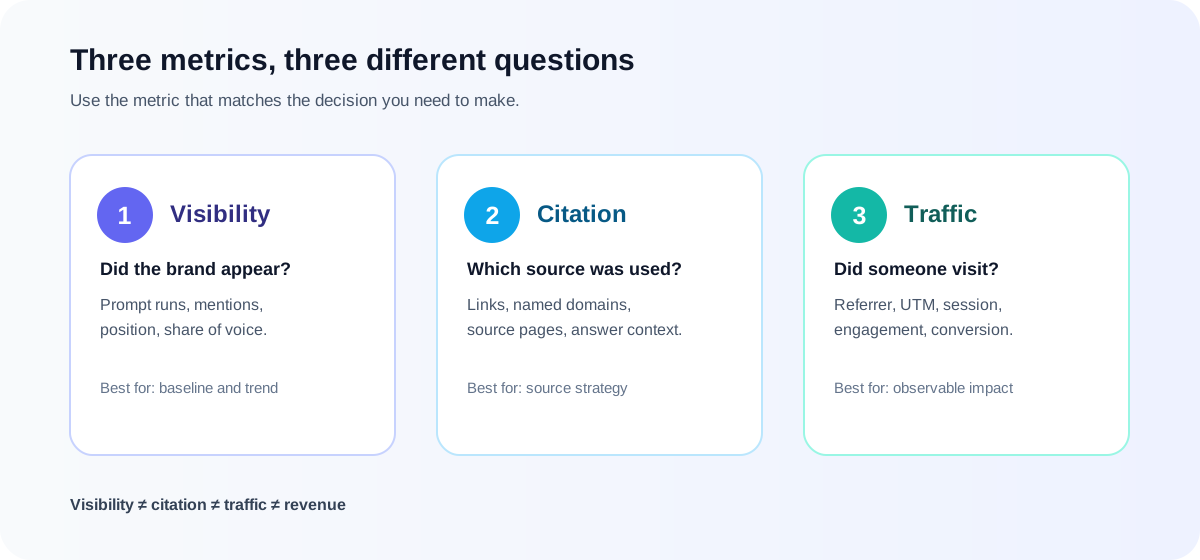
AI visibility, AI citations, and AI traffic are related, but they are not interchangeable metrics.
- AI visibility asks whether and how often a brand appears in sampled AI answers.
- An AI citation asks whether an AI answer links to, names, or uses a particular source.
- AI traffic asks whether a person reached a website from an AI surface and whether that visit produced a meaningful action.
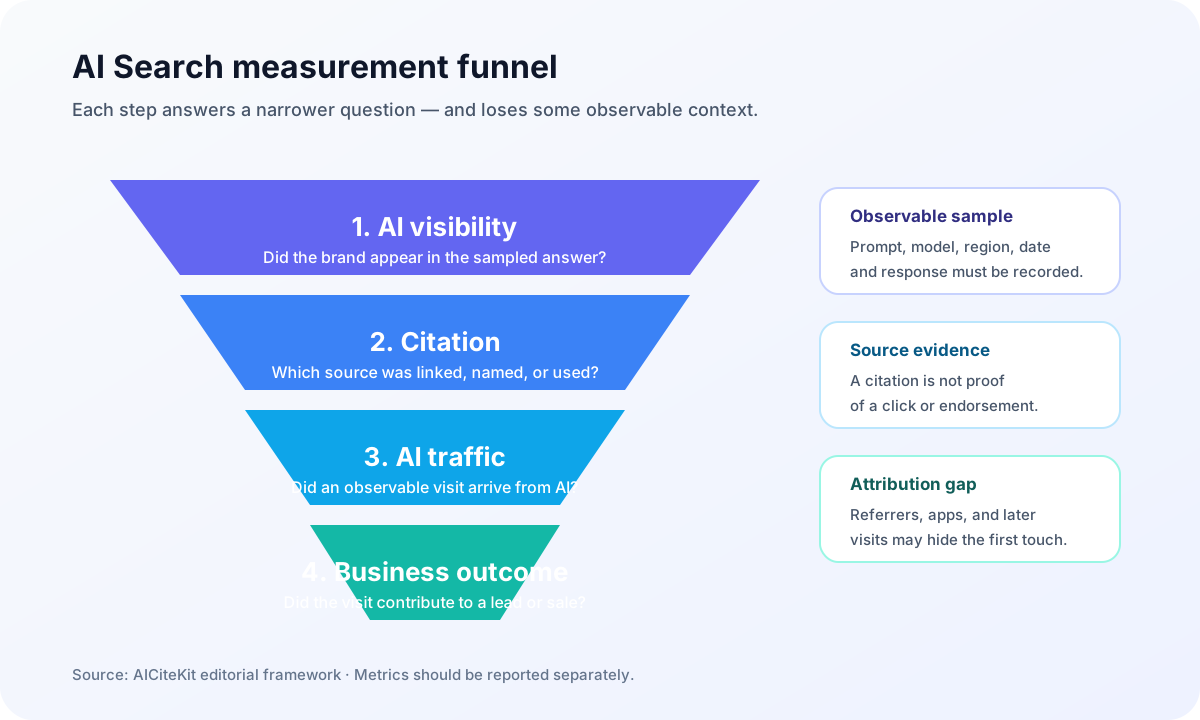
A useful reporting chain looks like this:
visibility → citation or source mention → click or visit → engagement → conversionEach step loses information. A brand can be visible without receiving a citation, cited without receiving a click, and receive AI-referred traffic without being able to prove that the visit caused a purchase or lead.
That is why a single “AI visibility score” should not be presented as traffic or revenue. The score may be useful for tracking a defined prompt set over time, but it is not a complete measurement of business impact.
Why the distinction matters
Traditional search already separates impressions, clicks, sessions, conversions, and revenue. AI Search makes the separation more important because an answer engine can synthesize information without sending a visitor to every source it used.
For a broader introduction to the channel, see What Is GEO?. This article focuses on measurement rather than on-page optimization.
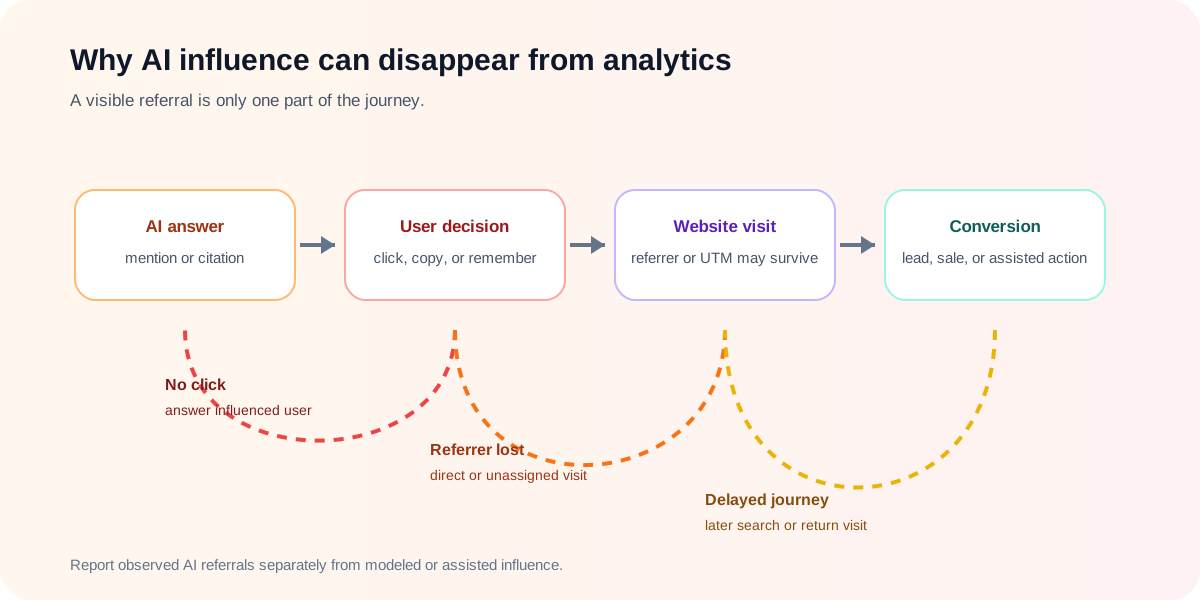
A user may:
- Ask ChatGPT, Perplexity, Gemini, or another system a question.
- See your brand mentioned in the answer.
- See a source link to your website, a publisher, a forum, or a competitor.
- Decide what to do without clicking any source.
- Open a browser later through a different channel.
- Return through a direct visit or branded Google search.
- Convert without a clean record of the original AI interaction.
That journey creates several valid business questions, but no single tool or analytics report necessarily answers all of them.
1. What AI visibility measures
AI visibility is an observation about a selected set of AI answers. A visibility system usually runs prompts against one or more AI surfaces and records whether a brand appears, where it appears, which competitors appear, and how the answer describes the brand.
A visibility workflow may include:
- Brand prompts
- Category prompts
- “Best tool” or recommendation prompts
- Comparison prompts
- Alternative prompts
- Product or service prompts
- High-intent evaluation prompts
- Region- or language-specific prompts
Common visibility metrics include:
- Mention rate
- Share of voice
- Position or recommendation order
- Competitor presence
- Sentiment or brand framing
- Visibility by model, topic, or region
- Change over time
What visibility can support
A well-designed visibility dataset can support conclusions such as:
- The brand appeared in 42 of 100 tracked responses this week.
- The brand appeared more often for category prompts than for comparison prompts.
- A competitor was recommended more frequently for a specific prompt group.
- The brand was present in ChatGPT samples but absent from the tested Perplexity samples.
- The same page or domain was repeatedly associated with the brand’s mentions.
- The wording of the brand description changed after a content or source update.
These are useful monitoring findings. They can help a team decide what to investigate next.
What visibility does not prove
Visibility does not automatically prove:
- The total number of people asking similar questions
- The brand’s visibility across every possible prompt
- A universal ranking across all users and locations
- Organic traffic growth
- A citation click
- A conversion or revenue increase
- That a content change caused an improved answer
The prompt set is part of the measurement. If the prompts are chosen to favor a brand, the resulting score can be inflated. If the prompts are too broad or unrelated to the buying journey, the score may be less useful for marketing decisions.
This is why AICiteKit recommends recording the prompt, model, location, language, date, response, and scoring method whenever possible.
2. What an AI citation measures
The word “citation” is used differently across products. In practice, an AI citation or source signal usually means that an AI answer links to, names, or draws attention to a source.
Depending on the platform, the relevant source may be:
- A website page
- A product page
- A news article
- A review site
- A forum post
- A video
- A social profile
- A document or other indexed source
Some AI answers include visible links. Others mention a source in text, show a source panel, or use information without making the source relationship fully transparent.
A citation monitoring workflow should therefore record more than “cited: yes.” It should capture:
- The complete answer
- The source URL or domain
- The position of the source in the answer or source list
- The statement supported by that source
- Whether the source is the brand’s own page or a third-party page
- Whether the answer is factually accurate
- Whether the source produced a click when analytics can observe one
What a citation can support
Citation data can help answer:
- Which domains are feeding answers about this category?
- Which of our pages are used when the brand is mentioned?
- Which third-party sources appear next to or instead of our brand?
- Is a competitor consistently supported by stronger sources?
- Are outdated or incorrect pages shaping the AI description?
- Did a source begin appearing more frequently after a content or PR change?
Citation intelligence is often more actionable than a raw mention count because it points toward sources, pages, and authority gaps.
What a citation does not prove
A citation does not automatically prove:
- That a user clicked the link
- That the user trusted the source
- That the AI system endorsed the brand
- That the source was the only input to the answer
- That the information was accurate
- That the citation caused a conversion
- That more citations will produce more revenue
A page can be cited while the answer still contains an inaccurate price or an incorrect product description. Conversely, a brand may be mentioned without a direct link to its own website.
3. What AI traffic measures
AI traffic is a web analytics observation. It usually means that a visit to a website was attributed to an AI service, an AI-related referral, a tagged link, or another detectable source signal.
Typical sources may include:
- ChatGPT or ChatGPT Search
- Perplexity
- Microsoft Copilot
- Gemini or other AI products
- AI-related browser or application referrals
- Links with UTM parameters
- Server or CDN logs identifying an AI crawler, which is not the same as a human visit
The last distinction is important:
AI crawler activity ≠ AI-referred human trafficA crawler request means that an automated system accessed a resource. It does not mean a person saw the page, clicked it, or converted.
What AI traffic can support
With clean analytics and referral data, a team may be able to measure:
- Sessions attributed to a detectable AI referral
- Landing pages visited by those sessions
- Engagement and return behavior
- Conversions associated with the session
- Revenue recorded after an AI-attributed visit
- Changes in AI referral volume over time
The quality of the conclusion depends on the analytics implementation. The Google Analytics campaign URL guidance explains how campaign parameters can identify traffic sources when tagged links are available.
What AI traffic may miss
AI referral data is incomplete for several reasons:
- Some AI surfaces do not pass a stable referrer.
- Some users copy a URL or return later through a different channel.
- Google AI Overviews can answer a question inside the search experience without producing a separate AI referral.
- Mobile applications may report traffic differently from web browsers.
- Privacy settings and redirects can remove attribution data.
- A direct visit may have started with an AI answer that the analytics system cannot observe.
For this reason, “AI traffic” in GA4 or another analytics platform should be described as observed or attributed AI-referred traffic, not as the total number of users influenced by AI Search.
4. The measurement chain
The three metrics fit into a funnel, but the funnel is not perfectly observable.
| Stage | Question | Typical evidence | Main limitation |
|---|---|---|---|
| Visibility | Did the brand appear in the sampled answer? | Prompt run and response | Depends on prompt set, model, date, and location |
| Citation | Was a source linked, named, or used? | Full response and source list | Source relationship may be incomplete or difficult to classify |
| Click | Did someone visit the site from an AI surface? | Referrer, UTM, analytics, or logs | Many visits are untagged or lose referral context |
| Engagement | Did the visitor read, return, or interact? | Analytics events and sessions | Cross-device and delayed journeys are hard to connect |
| Conversion | Did the visitor submit, buy, or become a lead? | CRM, ecommerce, or analytics conversion | Attribution model may over- or under-credit AI |
| Revenue | Did AI Search cause commercial value? | Revenue and multi-touch analysis | Correlation is not causal proof |
A good report should state which row it is measuring. It should not use a visibility number in the revenue column.
5. Why two AI visibility tools can disagree
Different tools can produce different visibility scores for the same brand without either tool being technically broken.
The main reasons are:
Prompt selection
One tool may use brand-specific prompts while another uses a broader category database. A brand-specific prompt set can produce more mentions than a generic category set.
Model and surface selection
ChatGPT, Perplexity, Google AI Overviews, Gemini, Claude, and Copilot can use different retrieval systems, source preferences, context windows, and response formats.
Location and language
AI answers can vary by country, language, account state, and query context. A brand can be visible in one market and absent in another.
Timing and response volatility
The same prompt may produce different answers on different days. A score measured after one response sample is not a permanent rank.
Scoring definitions
One platform may count any mention. Another may require a recommendation, a citation, a positive sentiment, or a position threshold.
Competitor universe
Share of voice depends on which competitors are included. A score calculated against three competitors cannot be compared directly with a score calculated against twenty.
The practical conclusion is to use one consistent methodology for trend tracking, and to be cautious when comparing absolute scores across platforms. The Otterly.AI citation-tracking guide also describes why source tracking and referral attribution do not behave like conventional blue-link SEO measurement.
6. A defensible AI Search measurement workflow
Step 1: Define the business question
Start with a question such as:
- Are we visible for category-level recommendations?
- Are competitors being recommended instead?
- Are AI systems describing our pricing accurately?
- Which third-party pages influence our category?
- Are detectable AI referrals producing qualified leads?
Do not begin with “What is our AI score?” without deciding what the score will be used for.
Step 2: Build a balanced prompt set
Include a mix of:
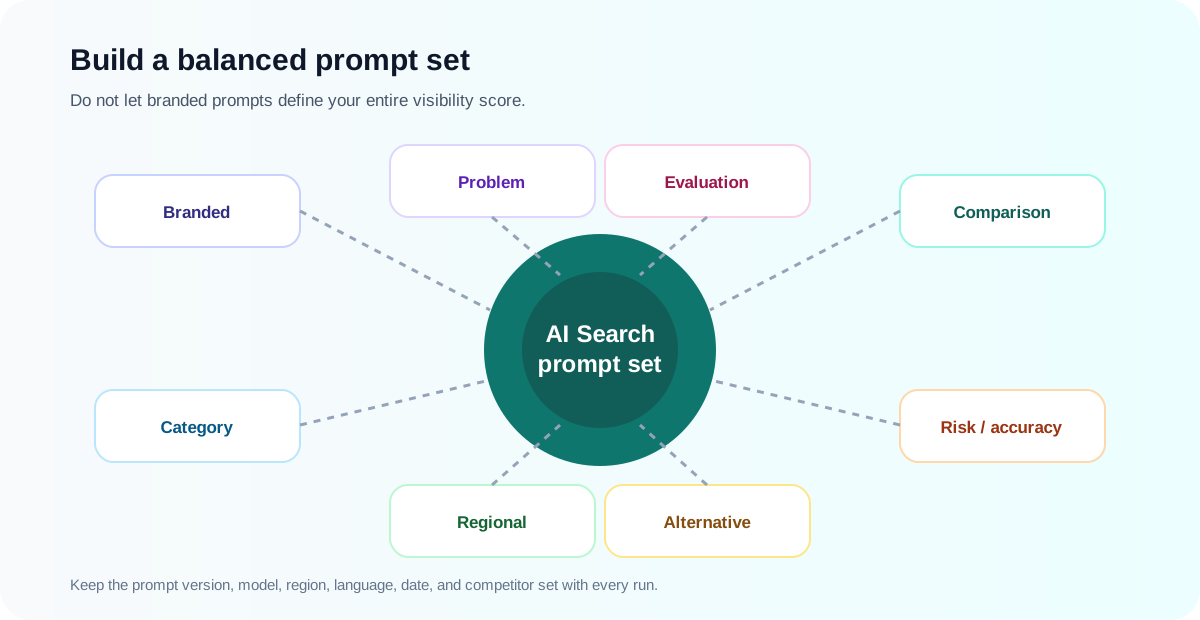
- Branded prompts
- Category prompts
- Problem-based prompts
- Comparison prompts
- Alternative prompts
- Evaluation-stage prompts
- Reputation or risk prompts
- Regional and language variants
Record the prompt set version. If the prompts change, the time-series comparison is no longer a clean before-and-after test.
Step 3: Keep the environment consistent
Record:
- AI surface or model
- Country and language
- Date and time
- Prompt wording
- Follow-up context
- Competitor list
- Sampling frequency
- Credit or response count
A tool such as Rankscale can help teams choose engines and schedules, while PromptWatch is designed around prompt and AI-crawler workflows. The products differ, so verify each plan’s coverage and methodology before comparing their outputs.
Step 4: Save the underlying answers
A score without the answer is difficult to audit. Save or export:
- Full response text
- Source links
- Mentioned brands
- Citation position
- Sentiment or framing
- Prompt and model metadata
ZipTie and AI Search Console are examples of tools that emphasize answer, prompt, source, or visibility analysis. This does not make their measurements automatically complete; it simply illustrates why answer-level evidence matters.
Step 5: Separate observation from interpretation
Write reports in two layers.
Observation:
The brand appeared in 38 of 100 sampled responses, and 21 of those responses included a link to the brand’s domain.
Interpretation:
The brand has a measurable presence in this prompt set, but the sample does not establish total market visibility or prove that the links generated traffic.
This separation makes the report more useful to SEO, PR, content, analytics, and leadership teams.
Step 6: Connect to analytics carefully
Use GA4, server logs, UTM parameters, and CRM or ecommerce records to investigate detectable AI referrals. Treat unattributed direct traffic, branded search growth, and assisted conversions as possible supporting signals rather than automatic proof of AI causation.
PromptWatch and AthenaHQ both emphasize connections between AI visibility, crawler or referral data, and business workflows. Confirm which data is observed, modeled, or inferred before presenting it to leadership.
Step 7: Review changes with a controlled prompt set
When content or authority work is completed:
- Keep the original prompt set stable.
- Wait an appropriate interval for the relevant surface.
- Run the same prompts again.
- Compare the complete answers, not just the score.
- Check citations, source quality, brand accuracy, and competitor framing.
- Compare with analytics, but do not claim causation from one before-and-after result.
7. Which metric should a team prioritize?
Prioritize visibility when
- You are establishing a baseline.
- You need to compare competitors.
- You are testing category and evaluation prompts.
- You have little reliable referral data.
- Your goal is to understand where the brand is absent or misrepresented.
Prioritize citations when
- You want to understand which sources shape AI answers.
- You need to improve content authority or digital PR.
- A brand is mentioned but its own pages are not cited.
- You need to audit whether the cited information is accurate.
Prioritize AI traffic when
- Your analytics setup can identify meaningful AI referrals.
- You have enough traffic to analyze landing pages and conversions.
- You need to investigate business impact rather than only answer visibility.
- You can reconcile analytics with CRM or ecommerce data.
Most mature programs should use all three, but they should not collapse them into one number.
8. A practical reporting template
A monthly AI Search report can use this structure:
Visibility
- Prompt-set version
- Models and regions tested
- Mention rate
- Share of voice
- Competitor changes
- Brand sentiment or framing
Citations
- Citation rate
- Most frequently cited brand pages
- Top third-party source domains
- Pages cited for competitors instead
- Incorrect or outdated sources
Traffic
- Detectable AI-referral sessions
- Landing pages
- Engagement and return rate
- Assisted or direct conversions
- Attribution limitations
Actions
- Content gaps to address
- Source or PR opportunities
- Brand-accuracy issues
- Technical access checks
- Prompts to add, remove, or rebalance
- Experiments for the next reporting cycle
Evidence note
Every report should include a short statement such as:
These visibility and citation figures describe the sampled prompts, models, regions, and dates listed in this report. They do not represent all AI Search activity and should not be interpreted as proof of traffic, revenue, or causal business impact without separate analytics evidence.
9. What to ask before buying an AI visibility tool
Before choosing a platform, ask:
- Which AI surfaces are included in the base plan?
- Can I see the full underlying responses?
- How are citations defined?
- How are credits or responses consumed?
- Can I control the prompt set and competitor list?
- Can I choose the country and language?
- Are results reproducible across runs?
- Can I export responses and source URLs?
- Does the platform measure crawler activity, human referrals, or both?
- Which traffic and revenue numbers are observed versus modeled?
- Are API, multi-region, and historical data features gated by plan?
- What evidence supports the vendor’s outcome claims?
For a starting point, compare the tools in the AICiteKit AI Search Monitoring directory by the measurement job you need rather than by a single universal score.
10. The main takeaway
AI visibility is a useful leading indicator. Citations provide evidence about the sources shaping AI answers. AI traffic shows the portion of the user journey that analytics can actually observe.
They answer different questions:
Visibility: Did the brand appear?
Citation: Which source was linked, named, or used?
Traffic: Did an observable visit arrive from an AI surface?
Business impact: Did that visit contribute to a meaningful outcome?
A strong GEO program keeps those questions separate, records the underlying answers, controls the prompt methodology, and states its evidence limits clearly.
The goal is not to find the biggest score. The goal is to build a measurement system that a content team, SEO lead, PR team, analyst, and executive can interpret without confusing presence with performance.
Related AICiteKit tools and guides
The right tool depends on which part of the measurement chain you need to observe. These pages are not interchangeable recommendations; each covers a different workflow or evidence surface.
Monitoring and answer analysis
- AI Search Console — prompt, answer, competitor, source, and visibility analysis.
- Otterly.AI — lightweight recurring AI search monitoring for brands and agencies.
- Peec AI — AI visibility, ranking, sentiment, and competitor analysis.
- Rankscale — broad engine coverage, citation analysis, and configurable monitoring schedules.
- ZipTie — live AI answer capture and source-impact analysis.
Crawler, referral, and enterprise workflows
- PromptWatch — prompt monitoring with crawler and AI-referred traffic analytics.
- AthenaHQ — AI visibility, brand accuracy, action recommendations, and enterprise workflows.
- Profound — enterprise-oriented AI Search Intelligence and reporting.
Content and technical follow-through
- Frase — SEO/GEO content research, optimization, and publishing workflows.
- Surfer AI Tracker — SEO content optimization with AI visibility tracking.
- Writesonic GEO Suite — AI content production and GEO-oriented workflows.
- Schema App — structured data, entities, and knowledge-graph support.
Related guides
- How to Track Whether AI Engines Are Citing Your Brand — a practical prompt and citation-monitoring workflow.
- What Is GEO? Generative Engine Optimization Explained — an introduction to the broader optimization discipline.
Use the underlying answer and source evidence when comparing products. A more detailed dashboard does not automatically mean better attribution, and a lower-cost tracker may be the better choice when the team only needs a small, stable prompt set.
Frequently asked questions
Is AI visibility the same as AI ranking?
No. Visibility is usually a score or observation derived from a selected sample of AI answers. It may include mentions, recommendations, position, or share of voice. It is not necessarily equivalent to a stable ranking across all prompts and users.
Does an AI citation mean that someone clicked my website?
No. A citation or source link shows a relationship between an answer and a source. It does not prove that a person clicked the link. Clicks require separate referral, UTM, analytics, or server evidence.
Can Google AI Overviews be measured as AI traffic?
Google AI Overviews can be measured as a visibility or citation surface by specialized monitoring workflows. A separate AI referral may not appear in analytics when the answer is displayed inside Google and the user does not click through. Treat Google organic traffic and AI Overview visibility as related but different observations.
Can AI visibility tools prove revenue growth?
Not by visibility data alone. A tool may connect to analytics or ecommerce systems and report attributed or assisted outcomes, but buyers should verify whether the values are observed, modeled, or correlated.
How many prompts should a brand track?
There is no universal number. Begin with a balanced, documented set that covers the category, brand, competitors, evaluation journey, and risk questions. Expand after learning which prompt groups are useful, and keep the set stable when comparing trends.
Why do AI visibility tools give different scores?
They may use different prompts, models, locations, competitors, sampling schedules, response handling, and score definitions. Compare methodology before comparing the numbers.
Sources and verification
- OpenAI Help: ChatGPT Search — official context for ChatGPT search and source behavior.
- Google Search Central: AI features and your website — official guidance on Google’s AI features and how they relate to Search crawling and indexing.
- Google Search Help: AI Overviews — official explanation of Google AI Overviews and links to supporting sources.
- Google Search Central: Structured data guidelines — official context for structured data as a technical source signal, not a citation guarantee.
- Perplexity Help Center — product context for Perplexity’s answer-and-source experience.
- Google Analytics Help: Campaign URL Builder — official guidance for identifying tagged traffic sources.
- Google Analytics Help: Traffic-source dimensions — official context for source, medium, and campaign attribution in GA4.
- Cloudflare: AI Crawl Control — technical context for distinguishing AI crawler requests from human referral traffic.
- Otterly.AI: How to Track AI Search Engine Citations and Sources — independent category guidance used for citation and referral-attribution limitations.
- AICiteKit: How to Track Whether AI Engines Are Citing Your Brand — related internal workflow article.
- AICiteKit AI Search Monitoring directory — related tool category.
- AICiteKit Rankscale review — engine, prompt, citation, and monitoring comparison context.
- AICiteKit PromptWatch review — prompt, crawler, and AI-referral workflow context.
- AICiteKit ZipTie review — answer capture and source-analysis context.
- AICiteKit AthenaHQ review — action-layer, brand-accuracy, and attribution caveats.