How AI Shopping Changes Product Visibility: A Practical Measurement Framework
AI shopping recommendations combine product facts, feeds, reviews, and model interpretation. Learn how to audit product visibility without confusing mentions, citations, clicks, and revenue.
The short answer
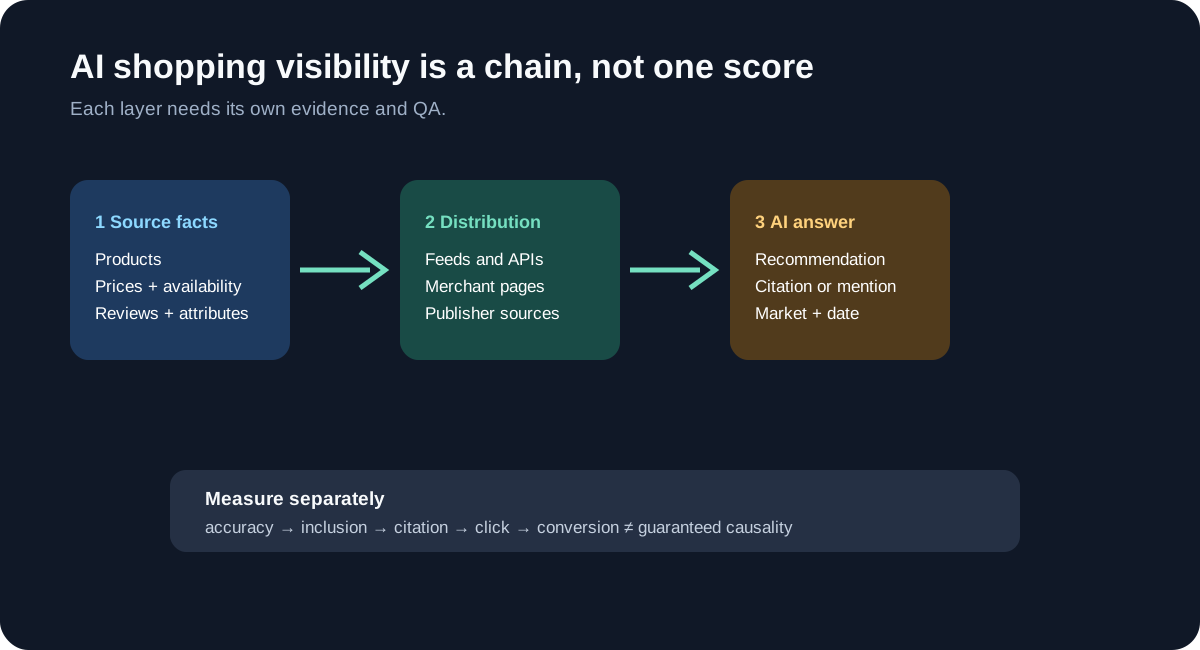
AI shopping changes product visibility from a page-ranking question into a chain of data and answer observations. A product may be eligible to appear in a shopping experience, be mentioned in an AI recommendation, receive a source citation, earn a click, and still produce no measurable sale. Those are different events.
A defensible workflow is:
product facts → feed and page quality → AI answer sampling → citation checks → referral and conversion analysisYext is relevant when the problem is governed product, location, or brand data at scale. Ahrefs Brand Radar and Peec AI are closer to answer-visibility monitoring, while PromptWatch can help connect answer observations with crawler and referral questions. These categories complement one another rather than replacing one another.
Why product visibility is changing
Traditional ecommerce SEO often starts with a product page, a query, a result, and a click. AI shopping experiences can synthesize product attributes, reviews, merchant data, publisher pages, and other sources into a recommendation or comparison. The answer may not expose every input, and the same question can produce different products by market, time, model, availability, and user context.
That creates four operational questions:
- Are the product facts correct and current?
- Can the relevant shopping or search system discover those facts?
- Does the product appear in a defined set of commercial prompts?
- Can the resulting visit or purchase be observed in analytics?
A tool that answers only question three should not be sold as proof of question four.
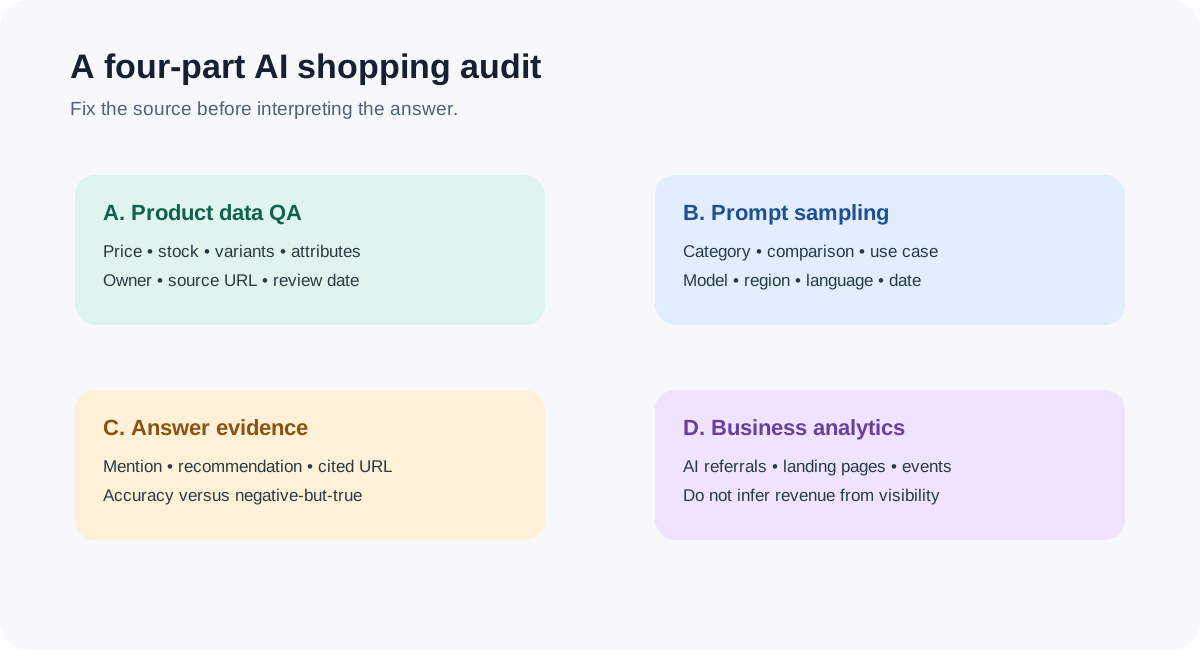
The four layers of an AI shopping audit
1. Product facts and catalog quality
Start with a bounded catalog rather than the entire inventory. Record the product name, SKU, canonical URL, price, currency, availability, variants, category, material or technical attributes, delivery constraints, and last verification date.
Also inspect:
- Product and offer structured data
- Visible page text versus feed values
- Variant and bundle relationships
- Returns, shipping, and warranty information
- Image and accessibility quality
- Reviews and their dates
- Country-specific availability
Google’s Product structured data documentation and Merchant Center product data guidance are useful technical references. They explain eligibility and data requirements; they do not promise inclusion in every AI answer.
If the page says one price while a feed says another, an AI shopping recommendation may be inaccurate even if the markup is syntactically valid. Product data governance is therefore a prerequisite, not a post-processing task.
2. Distribution and source coverage
A product can be accurate on its own site and still be absent from the sources an answer system retrieves. Check whether important information is available through the relevant merchant feeds, product pages, retailer or marketplace profiles, review sources, and authoritative third-party coverage.
Keep a source matrix:
| Fact | First-party page | Feed or destination | Owner | Last checked |
|---|---|---|---|---|
| Price | Product page | Merchant feed | Ecommerce | Date |
| Availability | Product page | Feed or retailer | Merchandising | Date |
| Use case | Guide or product page | Independent review | Content / PR | Date |
| Comparison claim | Comparison page | Third-party source | Marketing / legal | Date |
Do not respond to a missing citation by publishing unsupported claims on more pages. First identify which source type is missing and whether the claim itself is accurate.
3. Prompt and answer sampling
Build prompts around the customer’s decision, not only the product name. A useful set contains:
- Category discovery: “best [category] for [use case]”
- Attribute filtering: “[category] with [attribute] under [constraint]”
- Comparison: “[product A] vs [product B]”
- Alternative: “alternatives to [product]”
- Trust and risk: “is [product] reliable for [context]?”
- Regional and language variants
- Availability, price, shipping, or compatibility questions
For each run, record the exact prompt, engine or surface, model when known, region, language, date, answer text, recommended products, cited URLs, and whether the product facts were correct.
A sample of branded prompts is not enough to estimate category visibility. A product can appear whenever a user names it and disappear from unbranded discovery prompts. Report prompt classes separately.
4. Referrals and commercial outcomes
Use analytics to identify detectable visits from AI surfaces, but be careful with attribution. A user may see a recommendation in an app, search the brand later, and purchase through direct or organic traffic. That influence may be real while remaining unobservable in a standard last-click report.
Report observable events separately:
- AI-referred sessions
- Landing pages
- Engagement or product views
- Add-to-cart events
- Checkout starts
- Purchases and revenue
- Assisted or self-reported discovery signals, if available
Do not convert an increase in AI visibility into estimated revenue without a documented measurement design. Google’s AI features guidance explains that AI features are part of Search’s evolving presentation; it should not be read as a guarantee that structured data or optimization produces traffic.
What “visibility” can mean for a product
Teams often use one phrase for several signals:
| Signal | What it can support | What it does not prove |
|---|---|---|
| Product mentioned | The product appeared in a defined answer sample | Total market demand or recommendation quality |
| Product recommended | The sampled answer positioned it as an option | A purchase, ranking, or universal preference |
| Product cited | A source URL or product page was surfaced | A click or causal conversion |
| AI referral | A detectable session came from an AI surface | All AI-assisted visits |
| Conversion | A measurable purchase event occurred | That AI exposure caused it |
The core rule remains:
visibility ≠ citation
citation ≠ traffic
traffic ≠ revenue
A practical 30-day ecommerce workflow
Week 1: Choose a representative catalog
Select 20–50 products across high-margin, high-volume, new, and strategically important categories. Document facts and known customer questions. Fix critical product-page, feed, and availability errors before running an answer benchmark.
Week 2: Establish a prompt baseline
Run the same prompt set across the target surfaces. Save raw answers rather than only a score. Label each result as mention, recommendation, citation, correct fact, incorrect fact, or no appearance.
Week 3: Take focused actions
Prioritize actions linked to evidence:
- Correct a price or availability mismatch
- Clarify an ambiguous product attribute
- Improve a comparison page with verifiable specifications
- Add missing return, compatibility, or shipping information
- Resolve duplicate or inconsistent brand and product entities
- Improve independent source coverage where appropriate
Do not change every variable at once if the goal is learning.
Week 4: Re-run and interpret cautiously
Repeat the same prompts, market, language, and date protocol. Compare raw answer evidence and accuracy—not only a single index. Note external changes, including stock status, promotions, new reviews, model updates, and competitor actions.
A result can be useful without proving causality: “The product appeared in 8 more sampled answers after the catalog correction” is a valid observation. “The catalog correction caused revenue growth” requires stronger evidence.
Choosing tools by problem
- Product and entity governance: Yext, plus catalog and feed systems already used by the ecommerce team.
- Knowledge graph and semantic content: WordLift or InLinks.
- AI answer monitoring: Peec AI, AI Search Console, or Ahrefs Brand Radar.
- Crawler and referral questions: PromptWatch.
- Brand accuracy and response review: AthenaHQ.
This is a needs-based classification, not a universal ranking. Check the current model coverage, prompt limits, regions, exports, and pricing on each product’s official page.
What the evidence does not prove
Neither a product feed, a schema implementation, a vendor case study, nor an AI visibility score proves:
- Guaranteed product inclusion
- Guaranteed recommendations or citations
- Increased organic rankings
- Incremental AI traffic that analytics cannot observe
- Revenue growth caused by GEO work
- That a negative answer is a hallucination rather than an accurate limitation
An answer that says a product is not suitable may be correct. Accuracy audits must distinguish “negative but true” from “negative and false.”
Ecommerce checklist
- Product facts have a named owner and review date.
- Page, feed, and destination values agree for price and availability.
- The prompt set includes branded, category, comparison, alternative, risk, and regional questions.
- Raw answers, cited URLs, model, market, language, and date are archived.
- Mentions, recommendations, citations, referrals, and conversions are separate fields.
- Product accuracy is checked before visibility changes are interpreted.
- Vendor-selected case studies are labeled and not treated as independent proof.
- A trial tests the actual catalog, markets, and destinations that matter.
FAQ
Is AI shopping visibility the same as ecommerce SEO?
No. They overlap in product data and content quality, but AI shopping answers can synthesize more sources and may produce different observable events than a conventional result page.
Do product schema and merchant feeds guarantee AI recommendations?
No. They support eligibility and clearer product information, but inclusion and recommendation depend on the relevant system, data quality, availability, and other factors.
How many products and prompts should we test?
Start with a representative 20–50 product sample and enough prompts to cover the buying journey. Expand after the logging and QA process is repeatable; a small branded sample can mislead.
Should an ecommerce brand buy an AI visibility tool first?
Usually not if basic product facts are inconsistent. Fix source data and establish a baseline first, then choose monitoring based on the surfaces, regions, and evidence the team needs.
Sources and verification
- Google Product structured data — product data and markup guidance.
- Google Merchant Center product data specification — feed requirements and attributes.
- Google AI features and your website — official context for AI features in Search.
- Yext platform — example of entity and digital-knowledge infrastructure.
- Peec AI — example of AI visibility monitoring; see AICiteKit’s Peec AI review.
Verification date: August 11, 2026. Dynamic product prices, model coverage, and tool limits should be rechecked before a buying decision.