How to Track Whether AI Recommends Your Products
A practical framework for ecommerce teams tracking AI product recommendations: freeze product facts, build a balanced prompt panel, capture answers, and separate visibility from clicks and revenue.
The short answer
To track whether AI recommends your products, treat each recommendation as a dated answer observation—not as a ranking or a sale. Freeze the product facts first, test a balanced prompt panel across defined engines and markets, save the complete answer and sources, then reconcile the result with referral analytics and orders.
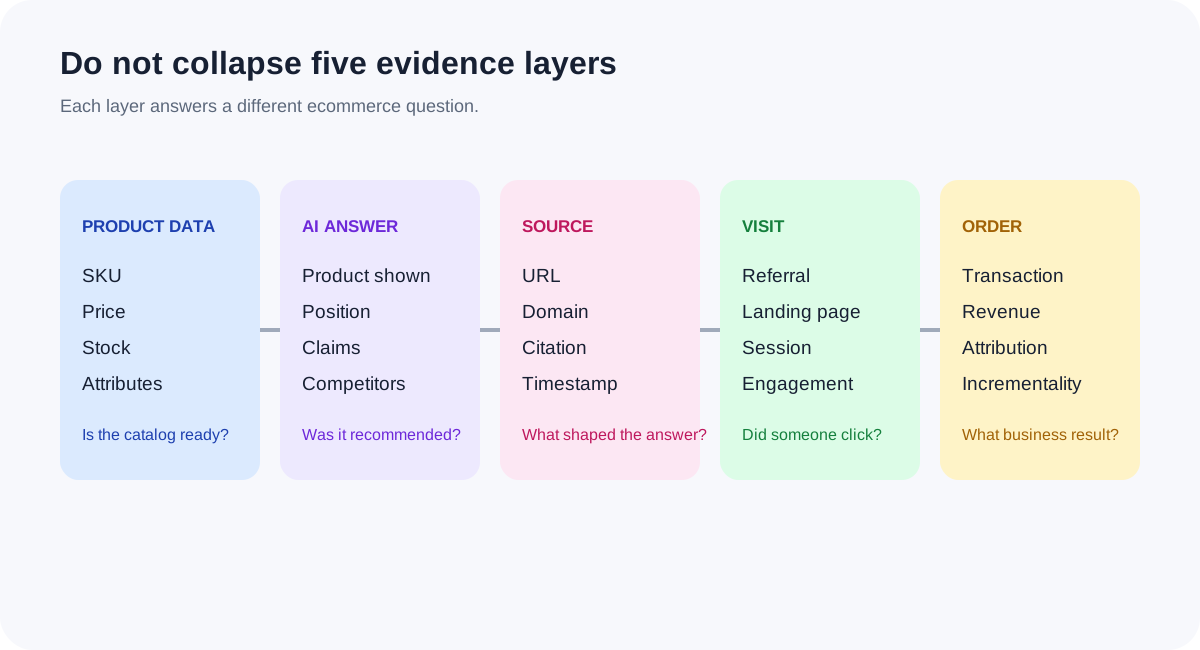
The measurement chain should remain explicit:
product data → AI answer → citation or source → detectable visit → orderA product can be recommended without being clicked. A citation can be present without a visit. A visit can be recorded without proving that the AI answer caused the order.
AI Shopping tools such as Yotpo Discover can accelerate answer monitoring, while Alhena AI illustrates a product-level visibility workflow. The method below also works with manual captures or another analytics stack.
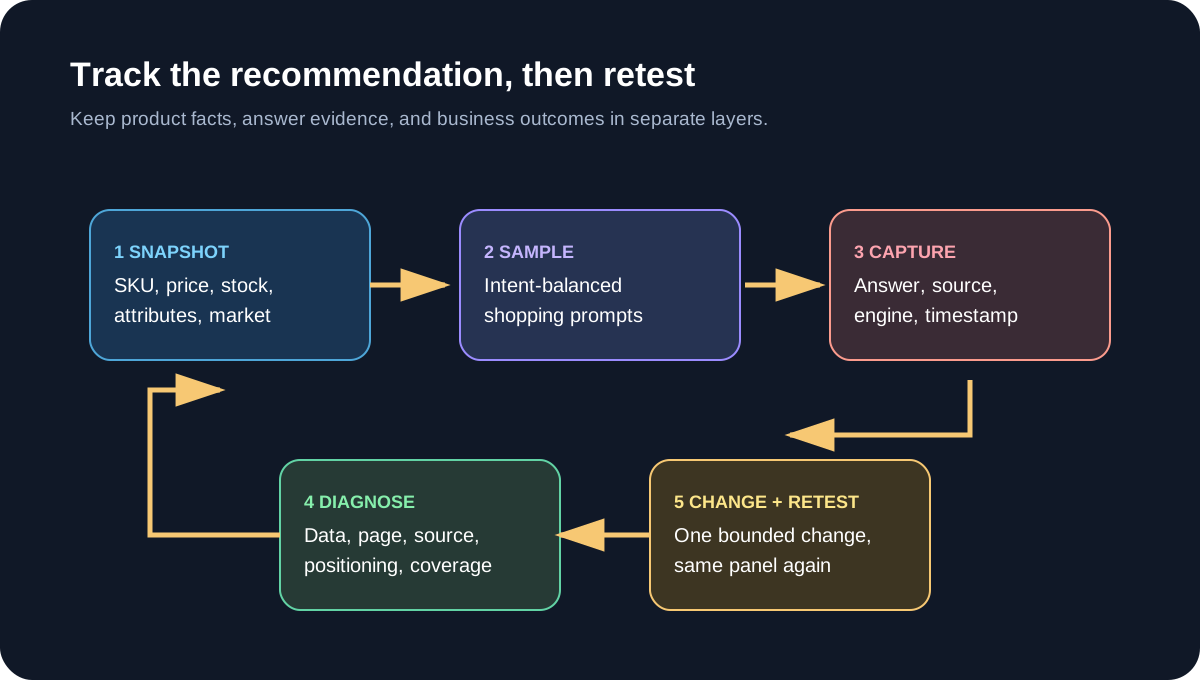
1. Freeze the product facts
Before asking whether an AI system recommends a product, create a dated catalog snapshot. At minimum record:
- SKU, variant, and canonical URL
- Price, currency, sale price, and availability
- Materials, dimensions, ingredients, compatibility, and key features
- Rating, review count, and review date range
- Shipping, returns, warranty, and fulfillment constraints
- Market, language, and inventory state
Google’s Product structured data documentation and Merchant Center product data specification provide useful field references. They do not guarantee an AI recommendation, but they help distinguish a missing product fact from an answer-system observation.
If the price changes during the test, label the comparison as contaminated rather than claiming that a content change altered visibility.
2. Build prompts around buying intent
A handful of branded prompts is not a product-discovery measurement plan. Build a panel that represents how a shopper might enter the category:
| Prompt family | Example question | What it tests |
|---|---|---|
| Category | “What are the best options for …?” | Broad discovery |
| Problem | “What should I buy to solve …?” | Need-to-product matching |
| Use case | “Which product works for …?” | Product attributes and fit |
| Comparison | “Compare A and B for …” | Differentiation and tradeoffs |
| Budget | “What is the best option under …?” | Price and value positioning |
| Alternative | “What is a good alternative to A?” | Substitution visibility |
| Risk | “Which products avoid …?” | Constraints and negative claims |
| Regional | “Which option ships to …?” | Market, currency, and fulfillment |
| Product-specific | “Is SKU A suitable for …?” | Exact product and variant facts |
Record the prompt, engine or surface, model when available, country, language, account context, date, and follow-up instructions. A result without those fields is difficult to reproduce.
3. Capture the complete answer
“Product appeared” is too coarse. Save the answer or an auditable capture and record:
- Exact product name, SKU, or variant
- Recommendation position or product-card placement
- Price, availability, and attributes shown
- Source links, cited domains, and source position
- Competitors shown beside the product
- Incorrect, stale, or missing claims
- Prompt, engine, model, market, language, and timestamp
Use a stable result taxonomy:
- Correct product, correct facts: positive answer observation; not a click or sale
- Correct product, stale facts: product-data freshness problem
- Brand mentioned, product absent: brand visibility without SKU visibility
- Competitor recommended: competitive observation requiring source and intent analysis
- Product cited, inaccurate description: source presence with an accuracy issue
- No product in sample: absence in this test, not universal invisibility
This evidence boundary matters because AI answers are variable. A single response cannot establish a market-wide ranking.
4. Diagnose the recommendation gap
Before rewriting a product page, classify the likely cause:
Data gap
Price, availability, variant, shipping, or product attributes are missing or stale. Fix the source of truth first.
Page gap
The product page does not answer a recurring use-case, comparison, compatibility, or constraint question clearly.
Source gap
Relevant third-party pages, reviews, or editorial sources do not describe or substantiate the product. A product feed cannot solve every authority problem.
Positioning gap
The product is factually available but indistinct for the tested prompt. Clarify audience, use case, tradeoffs, and differentiators without inventing claims.
Coverage gap
The test omitted the relevant market, language, engine, or buying intent. Expand the panel before concluding that the product is invisible.
Measurement gap
The capture does not preserve the answer, source, timestamp, or product identity. Improve the evidence record before taking action.
5. Make one change and retest
A useful test changes one meaningful variable: a product attribute, a comparison section, a feed field, an FAQ answer, or a source relationship. Keep the prompt panel, market, and observation window as stable as possible.
Then compare:
| Layer | Question | Safe conclusion |
|---|---|---|
| Product data | Are the facts current? | The catalog is or is not ready for testing |
| Answer | Was the product shown? | It appeared in this defined sample |
| Source | Was the product page or another source cited? | The answer included this source |
| Visit | Did analytics detect a session? | A measurable referral occurred |
| Order | Did a transaction follow? | A transaction was recorded under the chosen attribution rules |
Do not skip directly from the second row to the fifth. Even if an AI referral and order occur together, attribution depends on the analytics implementation, time window, identity resolution, and competing touchpoints.
What AI recommendation tracking can and cannot prove
A careful dataset can support statements such as:
- Product A appeared in 18 of 40 defined responses during the test window.
- Product B was shown more often for comparison prompts than for budget prompts.
- The model repeatedly displayed an outdated price.
- The product page was cited in some answers while a retailer page was cited in others.
- Detectable AI referrals increased after a change, subject to analytics limitations.
It cannot automatically prove:
- Universal visibility across all shoppers or prompts
- That the AI system used the product page rather than another source
- That a recommendation caused a click
- That a click caused an order
- Incremental revenue or return on ad spend
- That structured data alone created the recommendation
For a broader explanation of measurement boundaries, see AI Visibility vs AI Citations vs AI Traffic. For crawler evidence, see AI Crawler Analytics: What Logs Can and Cannot Tell You.
Tool selection by workflow
- Product-level AI Shopping monitoring: Yotpo Discover or Alhena AI
- Broader prompt and citation monitoring: Peec AI or PromptWatch
- Structured data and entity foundations: Schema App or WordLift
These categories solve different problems. A schema tool can improve machine-readable context but does not capture AI answers. A visibility tracker can capture answers but does not automatically repair product feeds. Compare the evidence each tool outputs.
Ecommerce recommendation-tracking checklist
Before publishing a report, confirm:
- Product and variant facts were frozen with a timestamp.
- Prompts include category, comparison, budget, regional, and product-specific intent.
- Engine, model, market, language, and date are recorded.
- Complete answers and source links are preserved.
- Product visibility is separated from citation, referral, order, and revenue.
- One change is tested against an unchanged prompt panel.
- Vendor case studies are labeled vendor-selected evidence.
- Any attribution claim states its model and limitations.
FAQ
How many prompts should an ecommerce brand track?
There is no universal number. Start with a balanced panel covering product categories, use cases, comparisons, budgets, alternatives, regional constraints, and exact products. Expand when the data shows that an important intent or market is missing.
Is an AI product recommendation the same as an AI citation?
No. A recommendation may name or display a product without linking to the product page. A citation is a source relationship. Record both separately.
Can product structured data make an AI system recommend a product?
Structured data can make product facts more explicit for systems that consume it, but it is not a guarantee of AI inclusion or recommendation.
How should AI-attributed revenue be reported?
Report observed referrals and transactions under a documented attribution model. Use cautious language such as “analytics recorded” or “was associated with,” unless a stronger causal design supports more. Do not present a vendor-selected case study as controlled revenue proof.
Sources and verification
- Yotpo Discover — product-level AI visibility context, checked August 16, 2026.
- Google Product structured data — product data field context, checked August 16, 2026.
- Google Merchant Center product data specification — feed field context, checked August 16, 2026.
- Google Analytics campaign and traffic-source documentation — analytics attribution context, checked August 16, 2026.
This article is a methodology guide. It does not claim that any named tool guarantees AI recommendations, traffic, or revenue.