AI Shopping Visibility: How to Audit Products, Prompts, and Revenue Evidence
A practical framework for measuring how products appear in AI shopping answers without confusing product visibility with clicks, orders, or causal revenue.
The short answer
An AI Shopping audit should answer four separate questions:
- Is the product data accurate and available to the systems that may use it?
- Does a defined AI prompt sample show the product or SKU?
- Does the answer cite or link to a product source, and is the description accurate?
- Can analytics observe a visit, order, or other business outcome?
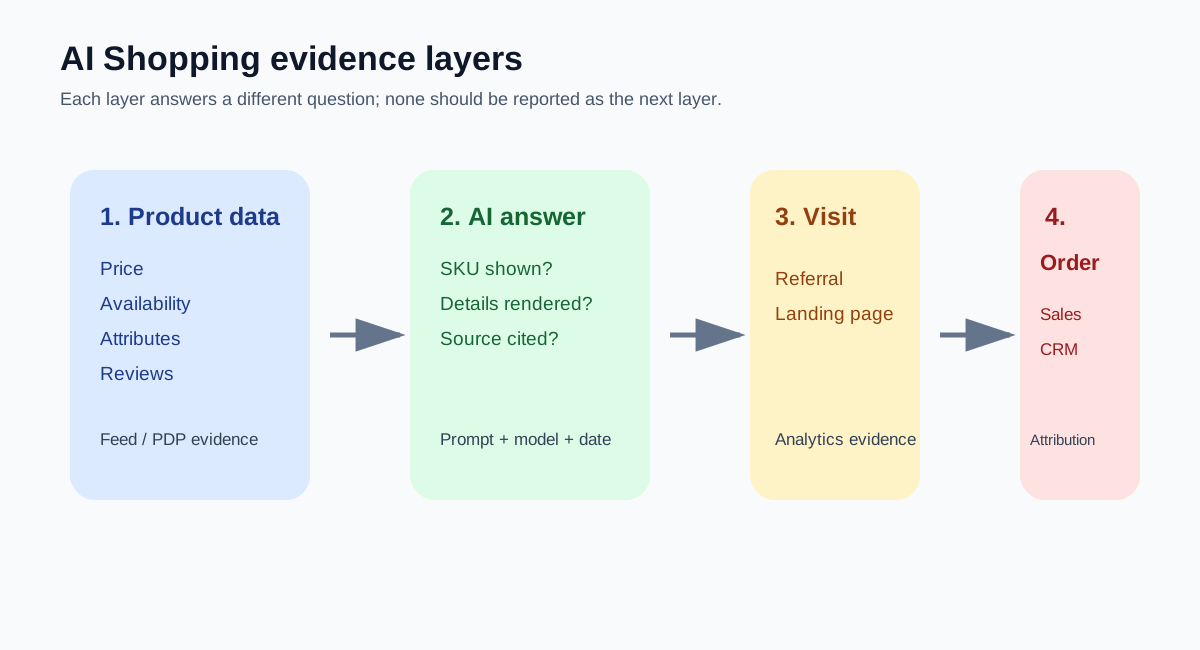
These are related, but they are not one metric:
product data → sampled AI answer → detectable visit → recorded orderA product appearing in ChatGPT, Gemini, Perplexity, or another AI shopping surface is an answer-level observation. It is not proof of a click or incremental revenue. Alhena AI is one example of a product-level AI Shopping workflow; the measurement framework below applies whether the data comes from a vendor, manual checks, feeds, or logs.
Why ecommerce needs a product-level audit
Brand-level visibility can hide the most important failure: an AI system may mention the brand but recommend the wrong product, an unavailable variant, an outdated price, or a competitor with clearer product facts.
An ecommerce audit should inspect:
- Product and variant identity
- Price, sale price, and currency
- Availability and inventory freshness
- Materials, dimensions, ingredients, compatibility, and use cases
- Ratings, reviews, shipping, returns, and warranty language
- Primary seller or brand ownership
- Product-page and third-party source consistency
Google’s Merchant Center product data specification and product structured-data documentation are useful source references for feed and markup fields. They do not guarantee inclusion in an AI answer, but they help define the information that should be checked before interpreting visibility.
1. Freeze the catalog before testing
Before asking whether AI recommends a product, create a snapshot. Record the SKU, variant, canonical URL, price, availability, key attributes, rating count, shipping promise, return policy, and date of extraction.
This prevents a common reporting error: comparing an AI answer from last week with a product page whose price or inventory changed yesterday.
For each product family, assign a data owner and classify fields as:
- Transactional: price, inventory, shipping, returns
- Descriptive: materials, dimensions, ingredients, features
- Positioning: audience, use case, differentiators
- Evidence: reviews, certifications, editorial mentions, third-party sources
A feed can be technically valid while the product narrative is incomplete. Conversely, a rich product page cannot fix an unavailable item. Report those as different issues.
2. Build a balanced shopping prompt set
Do not rely on a few branded prompts. A useful panel should represent the buying journey:
- Category: “What are the best products for …?”
- Problem: “What should I buy to solve …?”
- Use case: “Which product works for …?”
- Comparison: “Compare A and B for …”
- Budget: “What is the best option under …?”
- Alternative: “What is a good alternative to …?”
- Gift: “What should I buy for someone who …?”
- Risk: “Which products avoid …?”
- Regional: local currency, availability, language, and shipping prompts
- Product-specific: exact SKU, model, or variant questions
Record the prompt, engine, model or surface, country, language, account context where relevant, date, and follow-up instructions. The same wording can produce a different answer later.

3. Capture the complete answer
“Product appeared” is too vague. Save the complete response or an auditable capture, including:
- Exact product name, SKU, or variant
- Position in a recommendation list or product card
- Price, availability, and product attributes shown
- Source links and cited domains
- Competitors shown beside it
- Warnings, caveats, or inaccurate claims
- Engine, model, country, language, timestamp, and prompt
Classify the result with a small, stable taxonomy:
| Result | Meaning |
|---|---|
| Correct product, correct facts | Strong answer observation, still not a click or sale |
| Correct product, stale facts | Product-data freshness issue |
| Brand mentioned, SKU absent | Brand visibility without product visibility |
| Competitor recommended | Competitive answer observation; investigate sources and intent |
| Product cited but inaccurate | Citation/source presence with an accuracy problem |
| No product or source | Absence in this sample, not universal invisibility |
This is where product-level tools can differ from generic AI visibility trackers. For example, Peec AI and PromptWatch can support broader answer or referral workflows, while an ecommerce-specific product may focus on SKU rendering and product actions. Compare the evidence captured, not just the dashboard label.
4. Diagnose before changing the PDP
An answer gap is not automatically a copywriting problem. Use the evidence to classify the likely cause:
- Data gap: price, availability, variant, or attribute is missing or stale.
- Page gap: the product page does not clearly answer a recurring question.
- Source gap: relevant third-party sources do not describe or validate the product.
- Positioning gap: the product is accurate but poorly differentiated for the prompt.
- Coverage gap: the test does not include the right market, engine, language, or intent.
- Measurement gap: the answer capture or source relationship is incomplete.
A generated FAQ or PDP brief may accelerate execution, but human review is necessary for claims about health, safety, performance, compatibility, price, shipping, or legal guarantees.
5. Connect visibility to traffic carefully
Use analytics to measure detectable AI-referred sessions, landing pages, engagement, and recorded conversions. Keep a separate definition for:
- Direct referral from an AI surface
- Tagged campaign traffic
- Organic or branded search after an AI interaction
- Direct visits with unknown prior influence
- Assisted conversions in a chosen attribution model
A crawler request is not a shopper session. A citation is not proof of a click. A click is not proof that AI caused the order. Use AI Crawler Analytics: What Server Logs Can—and Cannot—Tell You for the technical boundary between automated access and human traffic.
For a broader metric framework, see AI Visibility vs AI Citations vs AI Traffic. It explains why visibility, citations, traffic, and revenue need different denominators and evidence sources.
What an ecommerce AI Shopping report should include
A useful weekly or monthly report can contain:
Product-data layer
- Catalog snapshot date
- Feed and PDP errors
- Price and availability freshness
- Missing attributes and variant issues
Answer layer
- Prompt-set version
- Engines and markets tested
- Product appearance rate
- Correct-fact rate
- Citation and source domains
- Competitor appearance
- Inaccurate or risky answer examples
Business layer
- Detectable AI-referred sessions
- Landing pages and product views
- Add-to-cart and conversion events
- Revenue under the stated attribution model
- Unattributed or likely-influenced journeys kept separate
Never place an answer appearance rate in the revenue column. The report should make the evidence boundary visible to executives and clients.
A practical experiment design
When changing a product page, feed, FAQ, or third-party authority asset:
- Choose a bounded product family and market.
- Freeze the prompt panel and catalog snapshot.
- Capture baseline answers and source links.
- Make one material change with an owner and timestamp.
- Wait an appropriate interval for the relevant feed and AI surface.
- Re-run the same prompts under the same setup.
- Compare full answers, facts, sources, referrals, and orders separately.
- Document alternative explanations such as seasonality, price changes, stock, promotions, or model updates.
A before-and-after improvement can be a useful operational signal. It is not automatically causal proof, especially without a control group or stable external environment.
What the evidence does not prove
- A product feed does not guarantee AI Shopping inclusion.
- Structured data does not guarantee a recommendation or citation.
- Product visibility does not equal market-wide visibility.
- A citation does not prove a click.
- AI-referred traffic does not capture every influenced visit.
- An AI-attributed order does not prove incremental revenue or causation.
- A vendor case study is not independent validation; label it vendor-selected customer evidence.
Checklist
- Snapshot product, variant, price, inventory, reviews, shipping, and returns.
- Test category, use-case, comparison, budget, alternative, gift, regional, and risk prompts.
- Record engine, model/surface, market, language, date, and exact wording.
- Save complete answers and source links.
- Classify product, fact, source, positioning, coverage, and measurement gaps.
- Keep optimization credits, prompt counts, and catalog size as separate limits.
- Reconcile detectable referrals with analytics and ecommerce records.
- Report visibility, citations, traffic, orders, and revenue separately.
FAQ
Is AI Shopping visibility the same as ecommerce SEO?
No. Product SEO and feeds create discoverable, structured information; AI Shopping visibility is an observed outcome in selected AI answers. They overlap, but one does not prove the other.
How many prompts should an ecommerce team track?
There is no universal number. Start with a balanced panel that covers priority categories, products, markets, and buying intents. Record the denominator and expand when the sample no longer represents the decisions you need to make.
Should a brand optimize for product cards or citations?
Measure both when the surface exposes both. A product card may show useful details without a clear source; a citation may point to a page that contains inaccurate or stale information. The business goal is accurate, useful product representation—not a single dashboard event.
Can AI Shopping tools prove revenue growth?
They can contribute visibility observations and, where analytics is configured, detectable referral or conversion data. They do not by themselves prove incremental or causal revenue. Use a defined attribution model and acknowledge unobserved influence.
Sources and verification
- Google Merchant Center product data specification — product-feed fields and freshness context; checked August 13, 2026.
- Google Search Central product structured data — markup and eligibility boundaries; checked August 13, 2026.
- Alhena AI Visibility — internal product review and plan-specific questions.
- AI Crawler Analytics guide — distinction between crawler requests and human referrals.
This is a methodology guide. It does not claim that any specific tool guarantees product recommendations, citations, clicks, or revenue.