How Do Product Reviews Impact AI Search Visibility?
Learn how product reviews, ratings, review freshness, third-party sources, and product data can influence AI shopping answers—and how to measure the evidence without overstating causality.
The short answer
Product reviews can contribute to AI search visibility, especially when a shopper asks an AI engine to compare products, find the best option for a use case, or evaluate whether a product is trustworthy. But reviews are not a standalone ranking switch, and a higher star rating does not guarantee more mentions or recommendations.
AI shopping answers usually combine several kinds of evidence:
product facts + availability + review evidence + source quality + question intent
→ recommendation or comparison answer
A review program is therefore a visibility asset only when it helps an AI system understand the product, the customers it serves, and the evidence supporting those claims. It should not be treated as a shortcut around product quality, accurate catalog data, or independent validation.
Yotpo Discover is one example of an ecommerce-focused platform that connects reviews and commerce signals with AI visibility monitoring. Alhena AI takes a broader commerce approach across product discovery, support, and AI visibility. Those product claims describe vendor capabilities, not independent proof that adding reviews will increase citations or revenue.
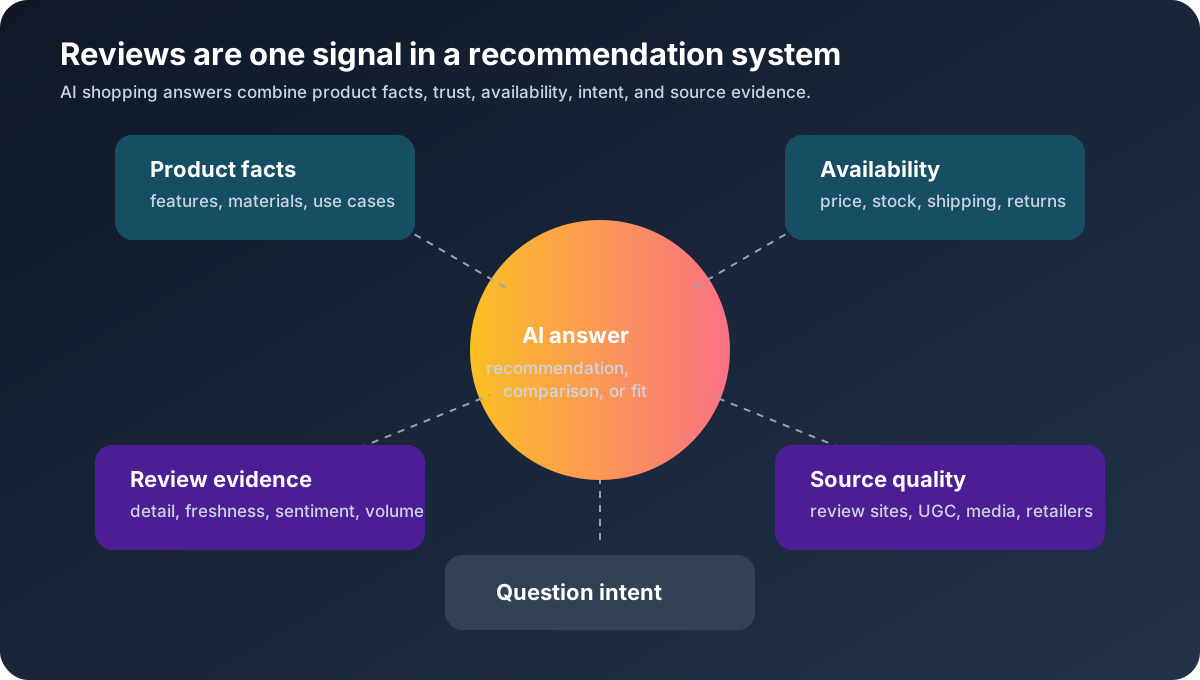
Why reviews matter in AI shopping answers
A traditional search result can send a shopper to a product page where the shopper reads reviews directly. An AI answer may perform more synthesis before showing a recommendation. It can combine a product catalog, retailer information, editorial coverage, customer feedback, community discussions, and the wording of the question.
Reviews are useful in that process because they can provide evidence about aspects that a product description often leaves vague:
- How the product performs in a real situation;
- Whether the product fits a particular user or use case;
- Common strengths and recurring complaints;
- Durability, comfort, setup difficulty, or support experience;
- Trade-offs between similar products;
- Language that customers use when describing the problem.
This does not mean an AI engine uses every review or calculates a universal review score. Different engines have different indexes, retrieval systems, shopping integrations, freshness windows, and answer-generation behavior. A product can have excellent reviews and still be absent from an answer because the product is not available in the relevant market, the question is ambiguous, the source is not retrieved, or a competitor better matches the requested use case.
Which review signals can affect visibility?
Review volume is a coverage signal, not a quality guarantee
A product with no review coverage may be harder to evaluate than a product with a meaningful body of customer experience. Volume can also help reveal whether feedback covers multiple variants, use cases, and time periods.
But volume alone is weak evidence. A large collection of short, repetitive, or unverified reviews does not prove that the product is better or that an AI engine will cite it. Report volume alongside:
- Number of products and variants covered;
- Number of distinct review sources;
- Time period represented;
- Review completion and moderation policy;
- Proportion of reviews with useful detail;
- Whether the reviews describe the actual product being compared.
Average rating is a context signal
A rating can help summarize customer sentiment, but an average hides distribution and context. Two products with a 4.5 average may have very different evidence:
- One may have a stable mix of detailed positive and negative reviews;
- The other may have a small sample dominated by a single campaign;
- One may receive high marks for comfort but poor marks for durability;
- The other may be praised by experts but criticized by a specific user segment.
For AI visibility analysis, capture rating together with count, date range, distribution, variant, market, and review text themes. Do not write “the highest-rated product wins AI recommendations” unless a defined experiment supports that conclusion.
Review detail helps explain product fit
Detailed reviews contain attributes that can connect a product to a natural-language prompt. For example, a buyer may ask for:
running shoes for flat feet that work for long walksA product page may list cushioning and support, while customer experiences may describe comfort after several hours, sizing issues, or performance on a particular surface. Those details can make a product easier to evaluate for a specific use case.
The important distinction is that detail supports interpretation; it does not guarantee retrieval or citation. Reviews should remain accurate, authentic, and compliant with the policies of the review platform.
Freshness shows whether the evidence is still relevant
A product’s formula, materials, packaging, sizing, compatibility, warranty, and availability can change. Old reviews may describe a previous version. New reviews can also be noisy if the product has only recently launched.
Track freshness by:
- Product version;
- Review date;
- Market and retailer;
- Variant or size;
- Whether the product changed materially;
- Whether recent reviews confirm or contradict older themes.
A useful audit does not simply ask how many reviews exist. It asks whether the current review evidence describes the current product.
Source diversity makes the evidence less dependent on one platform
Reviews can appear on a brand’s site, retailer marketplaces, specialist publications, comparison sites, community forums, and video platforms. These sources differ in editorial control, first-hand experience, moderation, incentives, and accessibility to AI retrieval systems.
Source diversity does not mean copying the same review everywhere. It means understanding where genuine customer and expert evidence exists and whether the product is represented in the sources that appear for relevant shopping questions.
For source-gap analysis, Peec AI can be evaluated alongside citation-monitoring tools such as Otterly.AI. Neither a source list nor a citation chart proves that a review caused a recommendation; they show where evidence appeared in a defined sample.
Negative reviews can improve answer quality
A credible product recommendation should include trade-offs. Repeated complaints may help an AI system distinguish which shoppers are a good or bad fit for a product. Removing every negative review can make the evidence less trustworthy and can conceal important product limitations.
The goal is not to maximize positive sentiment at any cost. The goal is to make the product’s strengths, limitations, and best-fit audience clear enough for a buyer—and for an answer system—to evaluate responsibly.
Product reviews are not the same as product-review articles
There are at least three different things people call “product reviews”:
| Review type | Example | Primary visibility question |
|---|---|---|
| Customer review | A buyer describes using a product | Is there credible first-hand experience? |
| Editorial review | A publication tests or compares products | Which independent sources evaluate the product? |
| Review article or listicle | A writer recommends products for a use case | Does the article provide original analysis and evidence? |
These should not be mixed in reporting. Google’s reviews system documentation describes a system intended to reward high-quality review content with insightful analysis and original research. Google’s guidance on writing high-quality reviews also emphasizes first-hand supporting evidence when making recommendations.
Those Google documents are relevant evidence about Google’s search guidance. They do not prove that ChatGPT, Gemini, Perplexity, or another AI engine applies the same system or weights reviews in the same way.
How AI engines may use review evidence
A cautious model of the workflow is:
1. Retrieve candidate product and source information
The system may retrieve product pages, feeds, retailer data, reviews, editorial pages, or other documents. Access, indexing, freshness, geography, and product identity all affect what can be retrieved.
2. Resolve the product and variant
A review for a previous model, a different size, or a similarly named product can be misleading. Product identifiers, brand names, model numbers, SKU relationships, and structured data help reduce ambiguity.
3. Match evidence to the question
“Best travel backpack” and “best lightweight travel backpack for a petite user” require different evidence. A review may be useful for one question and irrelevant for another.
4. Summarize strengths and trade-offs
The answer may combine positive and negative themes, price, availability, warranty, shipping, and user-fit information. The wording of the answer can change even when the underlying product pages do not.
5. Cite or link to selected sources
A cited review page demonstrates that the page appeared as a source in that answer sample. It does not demonstrate that the review caused the product recommendation, that all reviews were considered, or that the citation generated traffic.
This distinction is central:
review exists
≠ review was retrieved
≠ review was cited
≠ product was recommended because of the review
≠ recommendation caused a purchase
How to audit product reviews for AI visibility
Step 1: Define the shopping questions
Start with real buyer language, not only product names. Build a prompt set across:
- Category discovery;
- Best-for-use-case questions;
- Comparison questions;
- Budget and value questions;
- Problem and pain-point questions;
- “Is this worth it?” questions;
- Availability and compatibility questions;
- Negative or skeptical questions.
Record product, category, market, language, model, date, and prompt version. A single “best product” query is not enough to measure visibility.
Step 2: Map the review ecosystem
For each priority product, record:
- Owned review pages;
- Retailer and marketplace pages;
- Specialist editorial reviews;
- Independent comparison pages;
- Community discussions;
- Video reviews;
- Review syndication partners;
- Product feeds and structured data;
- Review dates and product versions.
This map helps distinguish a review-volume problem from a source-coverage problem.
Step 3: Verify product identity and review integrity
Check that the review is attached to the correct:
- Product;
- Variant;
- Model year;
- Size or compatibility;
- Retailer;
- Market;
- Product version.
Also check moderation and incentive practices. Incentivized reviews may be legitimate when disclosed and managed according to applicable rules, but they should not be presented as independent evidence without qualification.
Step 4: Capture answer-level evidence
Run the same prompt set across the selected AI engines and record:
- Whether the product was mentioned;
- Whether it was recommended;
- The position or order when the answer gives one;
- The cited URLs;
- The review or source themes reflected in the answer;
- Competitors shown above it;
- Model, region, language, date, and sample count.
Profound and AirOps represent broader visibility and content-operation workflows, while Yotpo Discover is more directly oriented toward ecommerce products and shopping prompts. Compare the actual evidence fields rather than assuming that all “AI visibility” dashboards measure the same thing.
Step 5: Compare source patterns, not just scores
Ask questions such as:
- Are cited sources mostly owned, retailer, editorial, or community pages?
- Are products with more detailed review evidence cited more often in this sample?
- Do answers mention recurring review themes?
- Are competitors winning because of review evidence, price, availability, or stronger product-market fit?
- Does the pattern hold across engines and regions?
- Does it persist after the prompt set is rerun?
A correlation in a small sample is a hypothesis for further testing, not a causal result.
Step 6: Make one bounded change and retest
Possible changes include:
- Clarifying product attributes and use cases;
- Fixing product and variant identifiers;
- Improving review visibility and pagination;
- Adding useful review summaries without hiding the underlying evidence;
- Responding accurately to recurring product questions;
- Correcting outdated product facts;
- Expanding legitimate third-party review coverage;
- Improving product feeds and structured data.
Do not change every product page, review platform, and prompt at once. Freeze the prompt panel, document the change, and compare a defined before-and-after window.
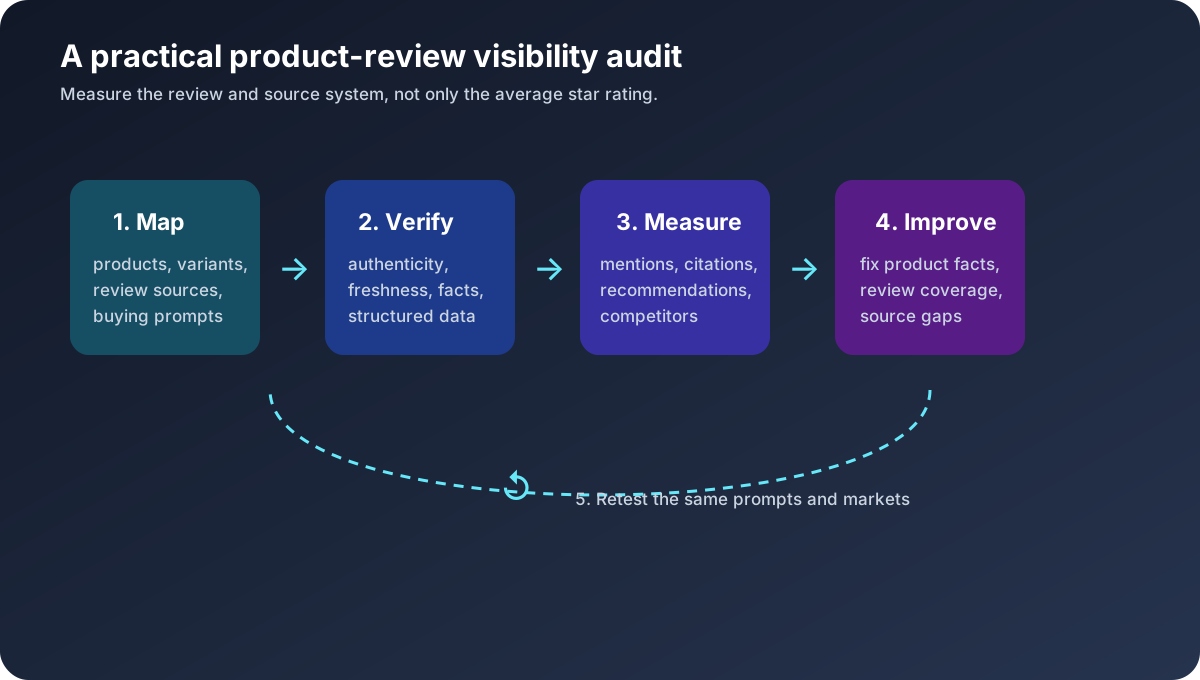
What to measure
| Metric | What it can show | What it cannot prove |
|---|---|---|
| Review count | Amount of available customer feedback | That the feedback is detailed, current, or influential |
| Average rating | Aggregate sentiment under a platform’s rules | That the product will be recommended |
| Review freshness | Whether evidence reflects the current product | That newer reviews are more trusted by every engine |
| Review source diversity | Breadth of platforms and perspectives | That every source is independently credible |
| Brand or product mention rate | Presence in sampled answers | Why the product was mentioned |
| Product recommendation rate | Recommendation frequency in a defined prompt set | Universal market preference or purchase intent |
| Cited review URLs | Which sources appeared in sampled answers | That the cited page caused the answer |
| AI referral sessions | Detectable visits from AI sources | Unobserved influence or revenue causality |
| Revenue attributed to AI | Outcomes under an attribution model | That reviews caused the revenue |
Use denominators and dates. “Reviews improved AI visibility” is incomplete without naming the products, prompts, engines, markets, sample size, and comparison window.
Common mistakes
Treating star rating as a universal ranking factor
AI systems do not expose one shared review formula. Rating should be treated as context, not a guaranteed ranking input.
Publishing thin, repetitive review text
A large number of near-identical reviews can provide less useful evidence than a smaller set of specific, authentic experiences. Avoid generating review copy or encouraging customers to use predetermined language.
Hiding negative feedback
Selective presentation can reduce trust and obscure the trade-offs buyers need. Address legitimate product problems instead of attempting to make every signal positive.
Confusing review syndication with independent validation
The same review appearing across multiple storefronts is not automatically multiple independent sources. Track provenance and disclose syndication relationships.
Assuming structured data creates AI citations
Product, Offer, and AggregateRating markup can help machines interpret page content when it is accurate and eligible, but markup does not guarantee rich results, retrieval, citation, or recommendation.
Measuring only owned-site reviews
AI answers may draw on retailers, editorial sources, forums, videos, and other pages. An owned review widget is only one part of the evidence environment.
Claiming revenue causality from visibility movement
A product can gain mentions while sales decline because of stock, price, seasonality, distribution, or competitor activity. Connect AI signals to analytics and CRM carefully, and label the result as attribution rather than proof of causality.
Choosing tools for this workflow
Choose the tool based on the question you need to answer:
- Product and shopping visibility: Yotpo Discover and Alhena AI are relevant starting points for ecommerce teams that need product-level and shopping-oriented analysis.
- Source-gap and citation analysis: Peec AI is useful when the question is which external sources appear to influence answers and where competitors have stronger coverage.
- Broad prompt and citation monitoring: Otterly.AI is better suited to ongoing multi-engine monitoring across a wider set of prompts.
- Citation-to-content operations: AirOps is relevant when the next step is turning visibility findings into content briefs, refreshes, and workflows.
- Enterprise answer intelligence: Profound may fit teams that need larger-scale monitoring and reporting.
- Crawl and referral analysis: Scrunch AI is more relevant when the question concerns AI crawlers or detectable referral traffic rather than review influence alone.
Before buying, ask whether the tool exposes the underlying answer, cited URL, prompt, engine, region, date, and sample definition. A dashboard that displays a score without evidence is difficult to use for a review-source investigation.
FAQ
Do more product reviews guarantee better AI visibility?
No. Reviews may improve the evidence available for product evaluation, but visibility also depends on retrieval, product data, availability, question intent, source quality, competition, and engine behavior.
Do higher star ratings make AI engines recommend a product?
Not necessarily. Rating is one context signal. An engine may prefer a product that better matches the use case, has stronger independent testing, is available in the requested market, or has more relevant evidence despite a similar or lower average rating.
Should brands focus on collecting positive reviews?
Brands should focus on authentic, useful, policy-compliant feedback and on fixing recurring product problems. A credible review profile includes trade-offs and helps buyers understand fit.
Are customer reviews more important than editorial reviews?
Neither is universally more important. Customer reviews provide usage evidence at scale, while editorial reviews may provide structured testing and comparison. Their relevance varies by product, query, source, and AI engine.
Can review structured data improve AI Search visibility?
Accurate structured data can make product and review information easier for search systems to interpret, but it does not guarantee an AI citation or recommendation. It must match visible page content and comply with the relevant search guidelines.
How do I prove that reviews caused an AI recommendation?
Usually you cannot prove that from a visibility dashboard alone. You can document that a review source was cited in a sampled answer and then separately measure detectable traffic or conversions. A causal claim requires a stronger experiment with controls and a well-defined attribution model.
Sources and verification
- Google Search’s reviews system — official guidance on high-quality review content and original analysis; checked August 18, 2026.
- Google: Write high-quality reviews — official guidance on first-hand evidence and useful review content; checked August 18, 2026.
- Yotpo Discover — vendor documentation describing product-level AI visibility, shopping prompts, reviews, and commerce signals; checked August 18, 2026.
- Alhena AI: AI visibility for ecommerce — vendor documentation describing product visibility, citation strategy, and revenue attribution claims; checked August 18, 2026.
- AICiteKit Yotpo Discover review — internal analysis of product scope, evidence, and limitations.
- AICiteKit Alhena AI review — internal analysis of ecommerce AI visibility and attribution boundaries.
This article explains a measurement framework. It does not claim that review count, rating, or any particular review platform causes AI recommendations, citations, traffic, or revenue.