Knowledge Graphs for GEO: What Entity SEO Can—and Cannot—Prove
A practical framework for using entities, structured data, and knowledge graphs to improve content clarity without confusing semantic foundations with AI citations or traffic.
The short answer
A knowledge graph can make a site’s entities, relationships, and first-party facts more explicit. That can support technical interpretation and editorial consistency, but it cannot prove that an AI engine will cite, recommend, or send traffic to the site.
The useful chain is:
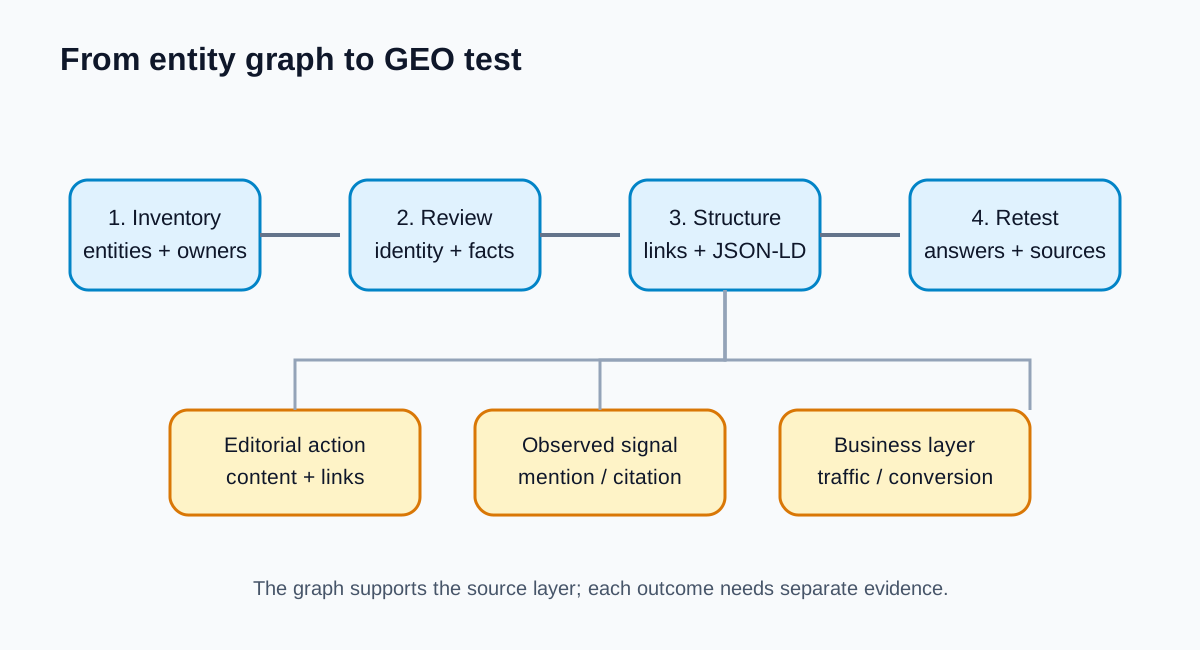
entity inventory → relationship review → structured context → content and link action → separate AI-answer retestWordLift is one example of an entity-first workflow. InLinks and Schema App address adjacent semantic and schema needs, while AI Search Console and AthenaHQ help test answer evidence or factual accuracy. None of those categories should be treated as interchangeable.
Why entities matter in AI Search
A page is not only a string of keywords. It may describe an organization, product, person, place, problem, category, feature, price, or relationship between them. If those facts are inconsistent or ambiguous, a reader—and potentially a search or answer system—has more work to do.
Entity work can help a team ask:
- Which name refers to which real-world thing?
- Is the product distinct from the company that sells it?
- Which pages are authoritative for price, features, authorship, and support?
- Which concepts belong in the same content cluster?
- Are competitors and alternatives described accurately?
That is an information-architecture and content-quality problem before it is a “GEO score” problem.
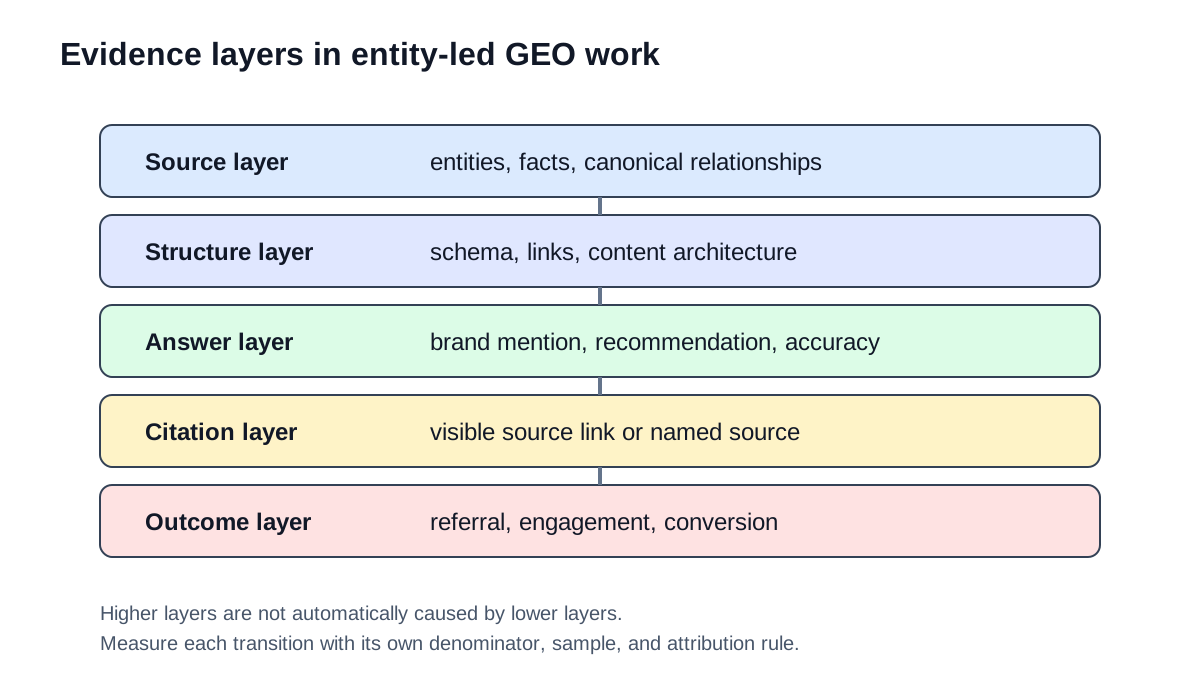
Four layers that should stay separate
| Layer | What it can observe or improve | What it does not prove |
|---|---|---|
| Entity inventory | Names, types, canonical identities, relationships | That an engine uses every entity |
| Structured data | Machine-readable context that matches page content | Eligibility, ranking, or citation |
| AI visibility | Brand appearance in a defined prompt sample | Total AI demand or market share |
| AI referral and conversion | Detectable sessions and chosen attribution events | Unobserved influence or causal revenue |
The operational rule is simple:
entity clarity ≠ citation
citation ≠ traffic
traffic ≠ revenue
Google’s structured-data guidance explains the role and limits of markup. It should be read alongside the AI-features guidance rather than used as a promise that a schema change will produce an answer inclusion.
A five-step knowledge-graph workflow
1. Create an entity inventory
Start with the pages that matter commercially or reputationally. Record the entity name, type, canonical URL, owner, source of truth, and last review date.
Useful initial entity groups include:
- Organization and sub-brands
- Products and product variants
- Authors and experts
- Categories and problems
- Features, integrations, and limitations
- Locations and service areas
- Competitors and alternatives
- Pricing, availability, and support facts
Do not attempt to graph the entire site before testing the workflow on a bounded cluster.
2. Resolve ambiguity
Automated extraction is a starting point. Review names that could refer to multiple companies, products, people, or places. Check whether a relationship is factual, editorial, or merely inferred from co-occurrence.
For brand accuracy, preserve the difference between:
- “The product has a free trial”
- “The product is free”
- “The product is suitable for a free-trial buyer”
A graph that collapses these statements may be technically connected but factually harmful.
3. Connect pages to relationships
Map which page is authoritative for each fact and which pages should link to each other. A useful relationship should help a reader or clarify a concept, not merely increase link count.
Examples:
| Relationship | Good supporting page |
|---|---|
| Product → integration | Integration documentation |
| Organization → product | Product overview |
| Author → topic | Author profile and relevant articles |
| Category → alternative | Comparison or alternatives page |
| Feature → limitation | Documentation or support page |
Review anchor text, destination, freshness, and duplication. Approve changes in a CMS workflow rather than publishing every suggestion automatically.
4. Add structured context carefully
Use JSON-LD and relevant Schema.org types when they accurately describe visible content. Keep canonical URLs and identity references consistent. Check for duplicate markup from plugins, themes, and tag managers.
Validation is necessary but not sufficient. A parser can confirm that markup is syntactically readable; it cannot confirm that every factual claim is current or that a search engine will show a rich result.
5. Retest AI answers separately
After a controlled content or markup change, run a stable prompt panel. Include branded, category, comparison, alternative, risk, and regional prompts. Save the engine, model where known, location, language, date, complete answer, mentions, citations, and accuracy notes.
Use Peec AI, Rankscale, or Otterly.AI when recurring monitoring is the job. Use AthenaHQ when the central question is whether the answer describes the brand correctly. The choice depends on the evidence needed, not on which product has the most GEO language on its landing page.
What a graph-based audit should report
A defensible report can include:
- The pages and entity types in scope.
- Ambiguities found and how they were resolved.
- Approved relationships and their source pages.
- Schema changes and validation results.
- Internal-link changes and editorial rationale.
- AI-answer observations before and after the change.
- Citation and source changes, if observed.
- Traffic and conversion data under a separately stated attribution model.
- External events and model changes that could explain volatility.
Avoid replacing this evidence chain with a single “entity authority” number. A composite score may be useful operationally, but its denominator and calculation must be visible.
Common mistakes
Treating schema as a ranking switch
Structured data can clarify content, but valid markup does not guarantee rankings, rich results, citations, or traffic.
Graphing co-occurrence as truth
Two entities appearing on one page does not necessarily mean they have a meaningful relationship. Editorial review protects against accidental claims.
Measuring only branded prompts
Branded prompts are valuable for accuracy. They are weak evidence for category discovery if they dominate the sample.
Applying traditional SEO reviews to GEO outcomes
A positive review of an entity-SEO product supports usability or workflow observations. It does not automatically validate a newer AI-visibility feature or prove citation growth.
Confusing a negative answer with a hallucination
An answer can be unfavorable and accurate. The audit should flag incorrect prices, outdated capabilities, false comparisons, and missing critical facts—not punish every negative description.
Expecting a graph to replace source quality
AI systems may draw on third-party reviews, documentation, communities, and other sources. A first-party graph is useful, but it does not control the full evidence environment.
When entity SEO is worth prioritizing
Prioritize it when:
- Multiple pages describe the same product or organization inconsistently.
- A site has many related entities but weak internal linking.
- Structured data is duplicated, incomplete, or disconnected from visible content.
- The business operates across brands, locations, languages, or product variants.
- A factual accuracy audit identifies recurring identity and relationship errors.
Prioritize prompt monitoring first when the main question is simply “where do we appear?” Prioritize crawler analytics when the question is automated access. Prioritize analytics when the question is detectable referral or conversion. The categories complement one another.
A practical checklist
- Entity names, types, and canonical URLs have an owner.
- Ambiguous products, people, brands, and locations were manually reviewed.
- Each important fact has a source-of-truth page and review date.
- Internal links help users and do not merely increase counts.
- JSON-LD matches visible content and has no duplicate conflicts.
- The prompt panel includes non-branded discovery and comparison questions.
- Answer text, citations, model/engine, location, and date are preserved.
- Visibility, citation, traffic, and revenue remain separate metrics.
- No vendor case study or rating is presented as causal proof.
- The retest window accounts for model and sampling volatility.
FAQ
Can a knowledge graph improve AI visibility?
It can improve the clarity and consistency of the site’s source layer, which is a reasonable hypothesis for testing. It cannot establish a guaranteed or causal AI-visibility improvement by itself.
Should every website use an entity platform?
No. A small, well-structured site may need only careful content governance and appropriate schema. Entity platforms become more useful as relationships, languages, brands, and page volume make manual management difficult.
Is WordLift better than an AI visibility tracker?
They solve different problems. WordLift is relevant to entities, semantic content, and structured context. A visibility tracker samples AI answers. Choose based on the decision you need to support.
How long should a retest run?
Use enough repeated runs to observe the defined sample under stable prompts and settings. The correct window depends on engine volatility, update frequency, and the business risk. A single before-and-after answer is not a reliable causal study.
Related AICiteKit tools
- WordLift — entity and knowledge-graph workflow.
- InLinks — entity SEO, links, and schema.
- Schema App — schema-focused governance.
- AI Search Console — answer and citation-oriented analysis.
- AthenaHQ — brand-accuracy workflow.
Sources and verification
- WordLift — official entity SEO and knowledge-graph positioning; checked August 10, 2026.
- WordLift documentation — official implementation context; checked August 10, 2026.
- Google: Introduction to structured data markup — what structured data is and its limits; checked August 10, 2026.
- Google Search Central: AI features and your website — AI-feature and foundational SEO context; checked August 10, 2026.
- Schema.org — vocabulary reference for types and properties; checked August 10, 2026.
- G2 WordLift reviews — independent review surface; current rating and count should be checked before use because this article makes no unverified rating claim.
This article is AICiteKit editorial guidance. It does not claim that entity SEO, structured data, or any listed tool guarantees rankings, citations, traffic, or revenue.