AI Search Credit Budgeting: How to Plan Queries, Platforms, and Refreshes
A practical method for budgeting AI Search measurement when tools charge by query, platform, model, or refresh—and for reporting coverage without overstating what the sample proves.
The short answer
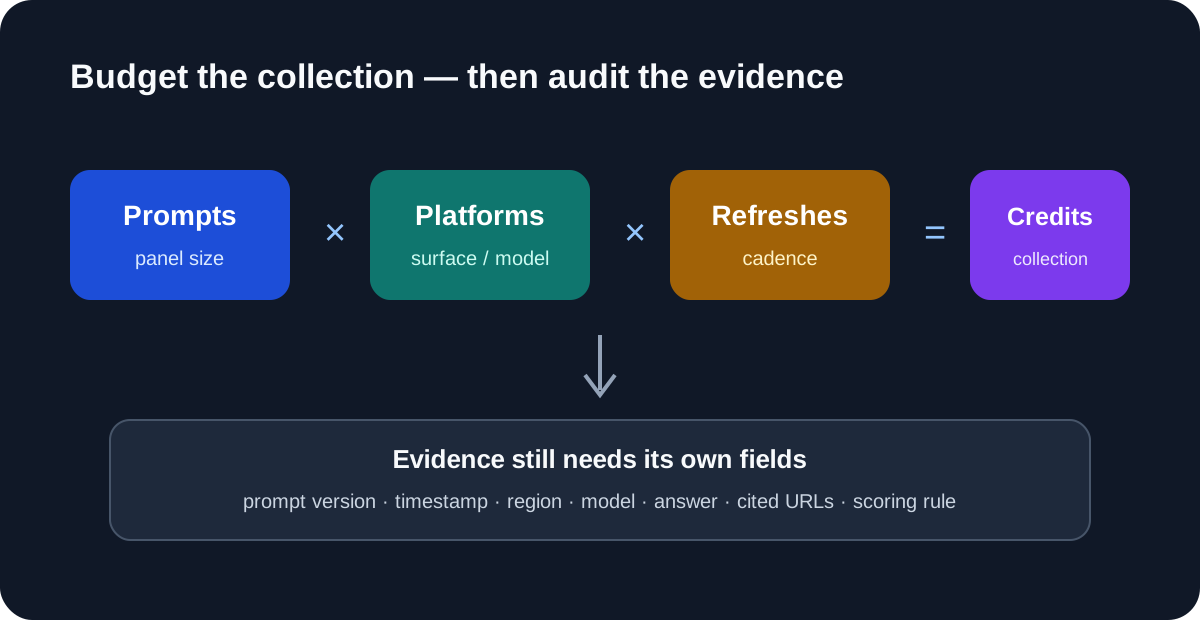
AI Search monitoring budgets should be planned around decision coverage, not the largest possible number of credits. A useful estimate is:
monthly credits = prompts × platforms × refreshes × runsThat formula is only the cost layer. A credible measurement plan also records which prompts were sampled, which platforms and models were used, where the run occurred, and what the answer actually contained. More credits can produce more observations; they do not automatically make the sample representative of all AI Search behavior.
This guide is for teams comparing AI visibility tools, agencies building client scopes, and marketers deciding whether to expand a prompt panel. It complements AI Visibility vs AI Citations vs AI Traffic, which explains why visibility observations should not be reported as revenue.
Why credit counts are easy to misread
Different products use different units. One vendor may call a prompt run a query, another may charge separately for each platform, and another may combine platform, model, and refresh into a credit. A plan with 20,000 credits may therefore provide much less or much more coverage than a plan with 3,500 credits.
Before comparing plans, normalize these fields:
| Field | Question to ask |
|---|---|
| Prompt | Does one credit run one question or a batch? |
| Platform | Is each AI surface charged separately? |
| Model | Does a model or browsing mode consume another unit? |
| Refresh | Is a daily, weekly, or manual rerun a new charge? |
| Project | Are credits shared across brands, domains, or workspaces? |
| Answer | Are empty, duplicate, or failed responses charged? |
| History | Are raw answers and source URLs retained for the whole period? |
The public pricing page for Search Atlas defines one LLM visibility credit as one query × one platform × one refresh, while listing different platform availability by plan. That is a useful example of explicit accounting, but buyers still need to verify model, region, retention, and overage terms.
1. Begin with the decision, not the plan
A budget should answer a business question:
- Do category buyers see the brand at all?
- Which competitors are recommended instead?
- Are product or service facts accurate?
- Which sources are cited for a category?
- Did a bounded content change alter a fixed answer sample?
Each question needs a different prompt mix. A brand-accuracy audit can use fewer prompts than a multinational category study, but it may need more languages and regions. An agency report may need multiple client projects but not every platform for every client.
2. Build a minimum viable prompt panel
Start with a versioned panel rather than an unbounded keyword list. A practical first panel includes:
- 10–20 category or problem prompts
- 5 branded prompts
- 5 comparison or alternative prompts
- 5 recommendation or evaluation prompts
- 5 risk, accuracy, or pricing prompts when relevant
- Regional or language variants only where the business operates
The exact count is editorial judgment, not a universal standard. Keep the denominator stable and record the prompt-set version. How to Build a Reliable AI Search Prompt Set explains how to balance branded, category, competitor, comparison, evaluation, risk, and regional questions.
Do not make every prompt a brand query. Branded prompts can make a visibility report look healthy while leaving category discovery unmeasured.
3. Choose platforms by decision value
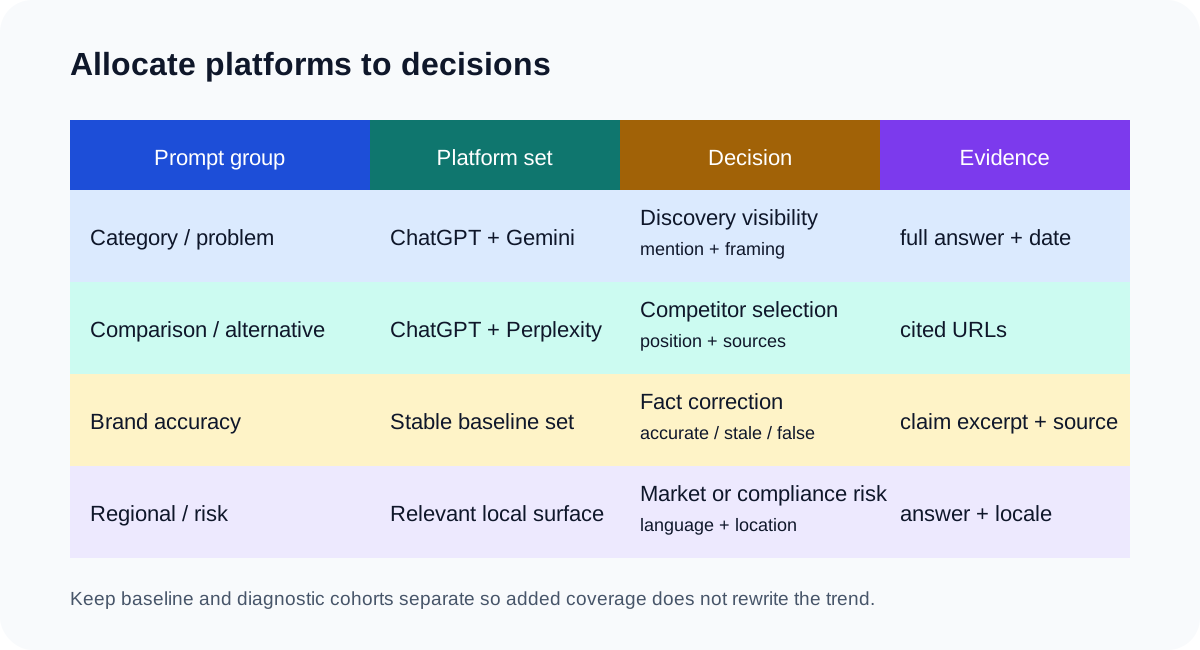
Do not pay for every platform by default. Map each platform to a question and document the limitation:
| Need | Initial platform choice | What to preserve |
|---|---|---|
| General conversational discovery | ChatGPT or Gemini | Prompt, model, date, answer |
| Search-grounded source discovery | Perplexity or a search-enabled surface | Cited URLs and source position |
| Google ecosystem observation | AI Overviews or AI Mode where available | Region, query, trigger behavior |
| Microsoft audience | Copilot | Market and account context |
Platform labels are not enough. Ask whether the vendor uses a consumer surface, an API, a browsing endpoint, or a modeled estimate. A result from one environment should not be presented as equivalent to a result from another.
Rankscale is positioned around broad engine coverage, while PromptWatch emphasizes prompt, citation, crawler, and analytics signals. These are category examples, not proof that one vendor’s credits are comparable to another’s.
4. Calculate a baseline and an expansion budget
Create two budgets:
Baseline budget
Use a stable panel and a small set of platforms for trend measurement. The goal is repeatability. Run often enough to see changes without allowing the prompt denominator to drift.
Diagnostic budget
Reserve extra credits for a suspected issue: a regional audit, a competitor comparison, a product category, or a post-change retest. Do not silently mix diagnostic prompts into the baseline score.
A simple worksheet looks like this:
| Variable | Example | Notes |
|---|---|---|
| Prompts | 40 | Versioned panel |
| Platforms | 3 | Selected for the decision |
| Refreshes per month | 4 | Weekly baseline |
| Diagnostic runs | 2 | Kept in a separate cohort |
| Baseline observations | 480 | 40 × 3 × 4 |
| Diagnostic observations | 240 | 40 × 3 × 2 |
The arithmetic describes collection volume, not statistical confidence. Answers are non-deterministic, platform coverage may be uneven, and a 40-prompt panel may still miss important customer language.
5. Report utilization and evidence separately
An agency or internal dashboard should show at least four sections:
- Budget: credits purchased, consumed, remaining, and overage rule.
- Coverage: prompts, platforms, models, regions, languages, and run dates.
- Answer evidence: mentions, recommendation position, cited URLs, and accuracy observations under defined rules.
- Business data: observable referrals, engagement, leads, orders, or revenue from separate analytics systems.
Do not put “80% of credits used” beside “80% visibility” as if the numbers were related. Utilization is a billing measure; visibility is an observation from a defined sample.
For reporting, AI Search Console and Peec AI illustrate answer and prompt-monitoring workflows, while the actual export fields and plan limits must be checked for the current account.
What credit budgeting does not prove
Even a large, carefully logged sample does not prove:
- Market-wide AI visibility
- Guaranteed citations or rankings
- That a cited page received a click
- That an AI-referred session caused a conversion
- That a content change caused a revenue increase
- That a crawler request became a user-facing answer
The strongest defensible statement is narrower: “In this prompt panel, platform set, market, and period, the observed rate changed from X to Y under the stated scoring rule.”
Trial checklist
Before buying a credit-based AI Search tool, ask:
- What exactly consumes one credit?
- Can the same prompt be rerun without changing its wording or hidden parameters?
- Are platform, model, region, language, and browsing mode visible in exports?
- Are raw answers, cited URLs, and timestamps retained?
- What happens when a request fails or returns an empty answer?
- Are credits shared across projects and do they roll over?
- Can baseline and diagnostic prompt cohorts be separated?
- Is API access included, rate-limited, or enterprise-only?
- Can the tool distinguish AI crawler activity from human referrals?
- Can the team reconcile observations with GA4, server logs, CRM, or ecommerce data?
FAQ
How many prompts should a small team monitor?
Start with a small, balanced panel that reflects the decisions you need to make. A stable 30–50 prompt panel is often easier to audit than a large list nobody reviews, but the appropriate size depends on markets, products, languages, and risk.
Is a higher credit allowance always better?
No. Higher credits allow more combinations of prompts, platforms, and refreshes. They do not guarantee better model coverage, representative sampling, or more useful recommendations.
Should every platform be refreshed at the same frequency?
Not necessarily. Use a stable cadence for the baseline, then record exceptions. If platform refreshes differ, report each cohort separately rather than blending incomparable time series.
Can AI Search credits be used to prove ROI?
No. Credits measure collection capacity. ROI requires separate evidence about referrals, engagement, conversions, costs, and—where possible—the limits of attribution.
Sources and verification
- Search Atlas pricing — checked August 23, 2026 for the published credit definition, plan prices, and platform matrix.
- Google Analytics campaign URL guidance — campaign parameters can help identify tagged referrals but do not make all AI influence observable.
- AICiteKit: AI Visibility vs AI Citations vs AI Traffic — measurement boundaries and attribution limits.
- AICiteKit: How to Build a Reliable AI Search Prompt Set — prompt taxonomy and panel design.
Verification date: August 23, 2026. Pricing and platform coverage can change; verify the live plan before purchase.