Which GEO Tools Connect AI Insights to Content Briefs?
Compare GEO and content platforms that turn AI visibility data, citation gaps, and prompt insights into content briefs, refreshes, and measurable workflows.
The short answer
The best tool depends on where your workflow currently breaks. If you need AI visibility data to flow directly into content refreshes and production, AirOps is the strongest starting point. If you want AI-search evidence plus prescriptive actions in a specialized GEO workspace, AthenaHQ is worth evaluating.
For teams that primarily need strong content briefs and topic modeling, MarketMuse, Frase, Clearscope, and Surfer are more natural fits. They can help turn search and competitive research into outlines, coverage requirements, and optimization guidance, but their AI-citation data and workflow depth differ.
Semrush and Profound can provide valuable AI visibility or prompt insights, but the handoff to a content brief may involve an export, a separate content product, or a manual workflow depending on the plan and setup. The important buying question is not whether a platform says it has “AI insights.” It is whether the insight retains enough evidence to produce a defensible brief.
A useful chain looks like this:
AI prompt evidence
→ cited-source gap
→ content opportunity
→ structured brief
→ human-reviewed content
→ publication or refresh
→ repeat measurement
A visibility score alone is not a content brief. It becomes useful only when the team can explain what changed, why the change matters, what evidence supports it, and how success will be tested.
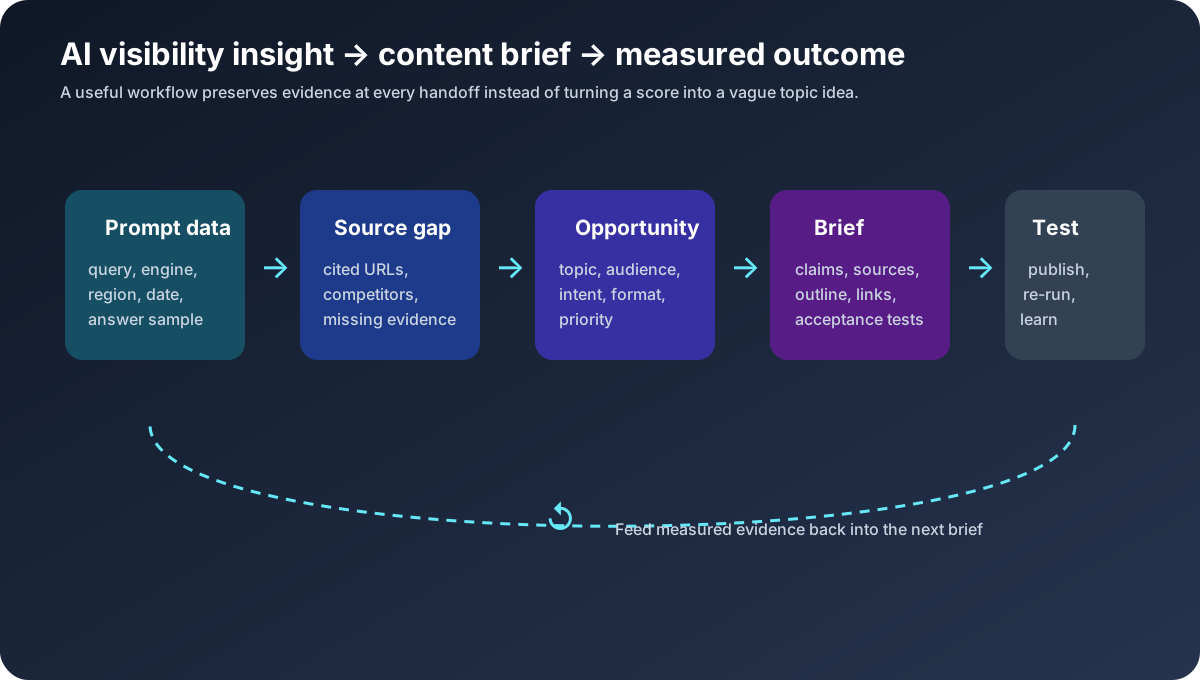
What does it mean to connect AI insights to a content brief?
A real connection has more than a button that says “create content.” It should carry useful context from the measurement layer into the planning layer.
At minimum, the handoff should answer:
- Which prompt or question revealed the opportunity?
- Which AI engine, region, language, and date were involved?
- Was the brand absent, mentioned, recommended, or cited?
- Which competitors appeared instead?
- Which URLs or source types did the answer cite?
- What information was missing or unclear on the brand’s current site?
- Is the opportunity a new page, a refresh, a product-page change, or an off-site source problem?
- What should the writer or editor produce?
- How will the team retest the outcome?
A useful brief might include:
Opportunity: competitor is cited for a recurring use-case question
Audience: mid-market buyers comparing implementation options
Evidence: 12 fixed prompts, 3 engines, US English, four-week sample
Source gap: independent comparison and implementation evidence are missing
Action: refresh existing guide and add a comparison section
Acceptance test: answer capture, cited URL, internal links, factual review
Without this context, “write an article about topic X” is an idea, not an evidence-based GEO brief.
The two different jobs inside this workflow
Tools in this category often combine two jobs that should be evaluated separately.
Job 1: Discover the AI visibility opportunity
This layer measures or investigates:
- Brand mentions;
- Product or service recommendations;
- Citation frequency;
- Cited URLs;
- Competitor presence;
- Prompt-level answer differences;
- Source categories;
- Regional or language differences;
- AI crawler or referral signals.
The quality questions are about sampling and evidence. Can you see the actual answer? Is the prompt set stable? Are the cited URLs available? Are model, date, region, and language recorded?
Job 2: Turn the opportunity into content work
This layer plans and executes:
- Topic selection;
- Search intent;
- Audience and funnel stage;
- Brief structure;
- Required facts and sources;
- Internal links;
- Content format;
- Writer or reviewer assignment;
- CMS workflow;
- Refresh schedule;
- Acceptance criteria.
A tool can be excellent at one job and weak at the other. A powerful AI visibility dashboard may still require a strategist to create the brief. A strong content editor may produce excellent outlines without showing which cited source caused the opportunity.
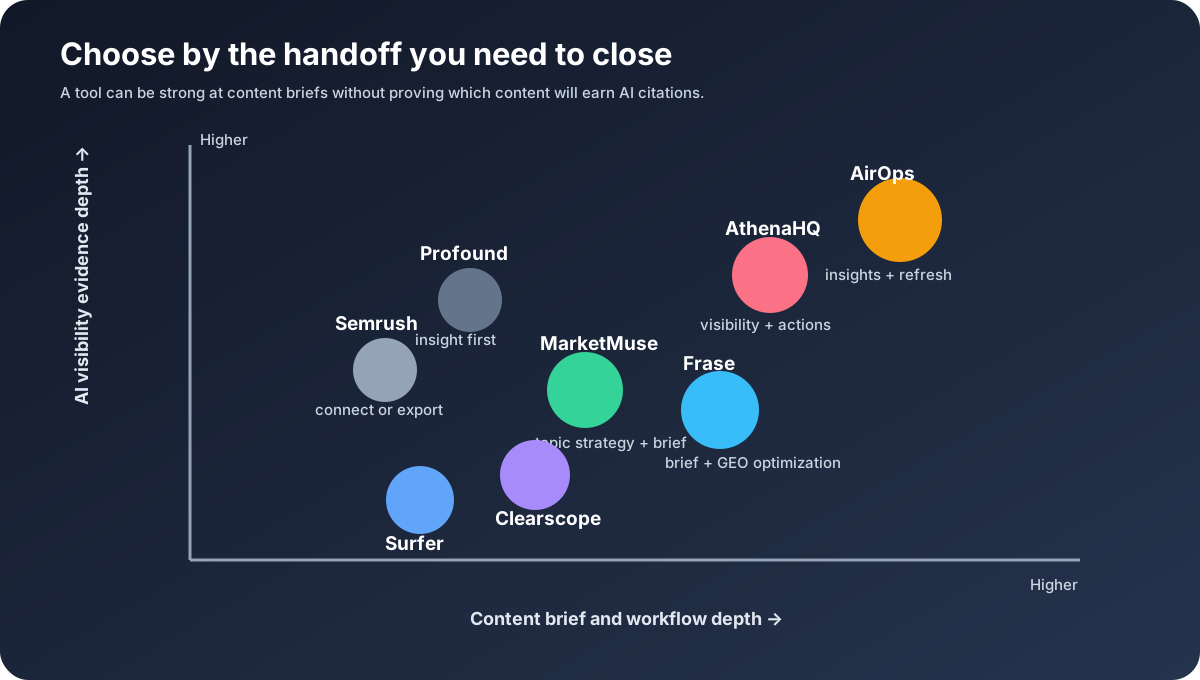
Tool comparison at a glance
| Tool | Strongest handoff | AI visibility depth | Brief or workflow depth | Best fit |
|---|---|---|---|---|
| AirOps | AI insights to refreshes, briefs, and production workflows | High | High | Teams wanting a closed operating loop |
| AthenaHQ | Citation and visibility gaps to recommended actions | High | Medium to high | GEO specialists and marketing teams |
| MarketMuse | Topic research and competitive gaps to briefs | Low to medium | High | Content strategy and topical authority |
| Frase | Search and GEO research to briefs, drafts, and optimization | Medium | High | Content teams wanting one workspace |
| Clearscope | Search/content data to briefs and optimization | Medium | High | Editorial teams and SEO-led workflows |
| Surfer | SERP/topic data to outlines and content optimization | Medium | High | Teams focused on execution speed |
| Semrush | AI visibility or prompt data to adjacent content workflows | Medium to high | Medium | Existing Semrush customers |
| Profound | Enterprise AI visibility intelligence to planned actions | High | Medium | Enterprise research and reporting |
The labels are directional, not a universal scorecard. Vendor capabilities, limits, and integrations can vary by plan and change over time.
AirOps: strongest for a connected insight-to-action loop
AirOps is the closest fit when the team wants AI Search insights to drive content planning, refreshes, and production in one operating workflow.
Its public documentation describes a platform that combines SEO, AI search, analytics, content strategy, briefs, workflows, content refreshes, and human-in-the-loop creation. AirOps also describes Insights, Page360, Playbooks, Grids, and Actions as parts of the broader system.
The useful workflow is:
visibility or performance signal
→ prioritized opportunity
→ brief or refresh task
→ human review
→ CMS publication
→ measurement
Why it fits this query
- It treats the brief as part of an operating system rather than a static document;
- It can connect content performance and AI search signals;
- It supports refresh workflows as well as new content;
- It is relevant for teams with repeated production requirements;
- It can connect research, brand context, and content actions.
Limitations
AirOps vendor examples and customer stories are not independent proof that a refresh caused a particular visibility or subscription result. Its “AI-attributed” metrics should be treated as attribution signals, not automatic causal revenue evidence. Teams should also verify which prompts, engines, integrations, content tasks, and reporting fields are available on their plan.
Choose AirOps when the hard problem is not merely finding a topic, but getting a validated insight into an owned content workflow.
AthenaHQ: strong for specialized GEO action planning
AthenaHQ positions itself as a command center for AI Engine Optimization, with cross-platform visibility tracking, citation source analysis, content recommendations, and workflow management.
This makes it relevant when a strategist starts with a question such as:
Why is a competitor cited for this prompt while our page is not?A useful output would identify:
- The prompt and answer sample;
- The competing source;
- The missing or weaker evidence;
- The page or content type that could address the gap;
- The recommended action;
- The next measurement window.
Why it fits this query
- It is designed around GEO questions rather than only traditional keyword rankings;
- Citation source analysis can inform a source-aware brief;
- Its action-oriented positioning reduces the gap between diagnosis and execution;
- It may suit teams that already have writers and editors but need better prioritization.
Limitations
AthenaHQ’s public claims about citation prediction and content recommendations need to be separated from independently verified outcomes. A predicted citation probability is not a citation, and a recommended content change is not evidence that the change will work. Verify how the platform defines citation, what data it exposes, and whether the output can be exported into your existing editorial process.
MarketMuse: strong for topic strategy and content briefs
**MarketMuse is primarily a content strategy and planning platform. Its public materials describe research, planning, content briefs, topic modeling, content inventories, and optimization workflows.
MarketMuse is a natural fit when the question is:
Which topics and subtopics should we cover to build authority in this area?Its brief-oriented workflow can help define:
- Topic scope;
- Subtopics;
- Questions;
- Competitive coverage;
- Internal links;
- Content type;
- Suggested structure;
- Gaps in the current inventory.
Why it fits this query
- Strong topic modeling and content planning orientation;
- Useful for building clusters rather than one-off articles;
- Briefs can give writers a more complete coverage target;
- Content inventory context can support refresh decisions.
Limitations
A topic model built from search and competitive content is not the same as AI citation evidence. If the goal is to understand why an AI answer cites a particular publisher, MarketMuse should be paired with prompt monitoring and source analysis. It may be the content-planning layer in a larger GEO stack rather than a complete AI visibility-to-brief system.
Frase: strong for briefs, drafting, and GEO-aware optimization
**Frase combines search research, content briefs, drafting, optimization, and public GEO positioning. Its public product materials describe workflows that aim to support both traditional search and AI citation visibility.
Frase is a fit when the team wants one workspace for:
query research
→ brief
→ draft
→ SEO and GEO optimization
→ publish
→ monitor
Why it fits this query
- Strong bridge between research and drafting;
- Briefs and optimization exist in the same workflow;
- GEO positioning makes it relevant to AI citation goals;
- Useful for teams that need to move from idea to draft quickly.
Limitations
A content optimization score does not prove that a page will be cited. Review whether the product shows the prompt, answer, cited URL, engine, date, and sample definition behind any AI visibility output. Also verify the difference between a page being optimized for likely retrieval and a page actually appearing in a captured answer.
Clearscope: strong editorial brief and optimization layer
**Clearscope is an established content optimization platform that has expanded its public positioning toward AI visibility, brand visibility, and prompt tracking.
Its content workflow is relevant when a team already has a clear topic and needs:
- A structured brief;
- Search-intent alignment;
- Topic and term coverage;
- Editorial guidance;
- A writing and optimization workspace;
- A way to connect content work with visibility monitoring.
Why it fits this query
Clearscope can be a strong editorial layer for teams that want consistency across writers and pages. Its value is greatest when the brief is used to improve factual coverage, clarity, structure, and usefulness rather than to chase a score.
Limitations
Verify how its prompt tracking connects to content recommendations in the plan being evaluated. A platform can track brand visibility and still require a human strategist to translate a cited-source gap into a useful brief. Traditional content scores and AI citation evidence should remain separate columns in reporting.
Surfer: strong for execution-oriented content optimization
**Surfer is built around content research, outlines, real-time optimization, and broader SEO and AI-search positioning. Its Content Editor provides guidance around content relevance, topic coverage, entities, links, and related factors.
Surfer is useful when a team needs to move quickly from:
SERP and topic research
→ outline
→ optimized draft
→ content refresh
Why it fits this query
- Strong execution and editor workflow;
- Useful for writers and editors who need live guidance;
- Can support new pages and refreshes;
- Relevant for teams balancing traditional SEO and AI-search goals.
Limitations
Optimization recommendations derived from ranking pages are not equivalent to evidence from AI answers. If the brief is meant to win more AI mentions, add a source-evidence section manually or connect Surfer to a separate citation-monitoring workflow. Do not use Content Score as a proxy for citation probability.
Semrush: useful when AI visibility and content tools already live together
**Semrush AI Visibility Toolkit can help existing Semrush customers connect AI mention and prompt research with the broader Semrush content ecosystem.
Semrush is a reasonable choice when a team wants one vendor for:
- Traditional SEO research;
- AI visibility monitoring;
- Prompt research;
- Site and content audits;
- Competitor analysis;
- Content workflow support.
Why it fits this query
The advantage is ecosystem continuity. A team may already have keyword, site, competitor, and content data inside Semrush and prefer to add AI visibility rather than introduce a new platform.
Limitations
The AI Visibility Toolkit and the Content Toolkit should not be treated as one seamless evidence-to-brief system without checking the current workflow. Public product and third-party descriptions indicate that some optimization work may happen in adjacent tools or manual processes. Also, reviews of the broader Semrush product do not automatically prove the effectiveness of its newer AI visibility features.
Profound: strong intelligence layer for enterprise teams
Profound is relevant when the organization needs enterprise-scale answer intelligence, prompt monitoring, competitive research, source analysis, and reporting.
Profound can contribute to a brief by providing context such as:
- Which questions matter;
- How often a brand or competitor appears;
- Which sources are cited;
- How answers differ by engine or market;
- Which content types appear in the answer environment.
Why it fits this query
Enterprise teams may value the depth of the intelligence layer before deciding what content to create. It can help a strategist avoid writing from keyword volume alone and instead investigate the evidence environment around a business question.
Limitations
An enterprise intelligence platform may still require a separate content planning or production system. Some public comparisons are vendor-authored and therefore should not be treated as neutral evidence. Confirm whether the current product creates native briefs, exports structured recommendations, or expects the customer to connect an external editorial workflow.
What a good AI-informed content brief should contain
Regardless of the tool, ask for these fields.
Evidence and scope
- Target question;
- Prompt variants;
- AI engines;
- Region and language;
- Date range;
- Sample size;
- Complete answer or answer capture;
- Cited URLs;
- Competitors shown;
- Confidence and limitations.
Audience and intent
- Audience segment;
- Funnel stage;
- Use case;
- Pain point;
- Product or category context;
- Questions the page must answer;
- Questions the page should not answer.
Content requirements
- Proposed title and format;
- Primary claim;
- Supporting claims;
- First-party evidence;
- Independent sources;
- Required examples;
- Comparison criteria;
- Internal links;
- Structured data needs;
- Author or subject-matter reviewer;
- Update trigger.
Measurement plan
- Which prompts will be rerun;
- Which engines and markets;
- Baseline answer and citation data;
- Expected change;
- Review window;
- Traffic and conversion metrics;
- What would count as failure;
- What cannot be attributed causally.
A practical tool-selection framework
Use the following decision rules:
Choose AirOps when execution is the bottleneck
Pick AirOps when you already have many content opportunities and need a repeatable system for briefs, refreshes, production, approvals, and measurement.
Choose AthenaHQ when GEO diagnosis is the bottleneck
Pick AthenaHQ when the team needs specialized answers about citation gaps, competitor visibility, and prescriptive GEO actions.
Choose MarketMuse when topic strategy is the bottleneck
Pick MarketMuse when the main problem is deciding which topic clusters and coverage areas deserve investment.
Choose Frase when research-to-draft speed is the bottleneck
Pick Frase when writers need research, briefs, drafting, and SEO/GEO optimization in one workspace.
Choose Clearscope or Surfer when editorial consistency is the bottleneck
Pick either when the main requirement is helping writers produce and refresh pages against clear coverage and optimization guidance. Add a separate citation-monitoring layer if AI answer evidence is central.
Choose Semrush when the existing ecosystem is the bottleneck
Pick Semrush when your team already relies on its SEO and content products and the integration cost of another platform would be high.
Choose Profound when enterprise intelligence is the bottleneck
Pick Profound when prompt-level answer intelligence, competitive research, and reporting matter more than native content production.
Common mistakes when connecting AI insights to briefs
Turning a visibility score into a topic
A score does not tell a writer what the audience needs, which source is missing, or what claim should be supported. Preserve the underlying prompt and source evidence.
Treating cited competitors as templates to copy
A cited competitor page may win because it has original data, a different audience, stronger distribution, or a relevant experience that your brand cannot replicate. Diagnose the evidence gap before copying its structure.
Creating content for every missing mention
Not every absence is a content problem. The cause may be availability, weak product identity, missing third-party evidence, regional coverage, or a prompt that does not fit your offer.
Using one prompt as a measurement program
Answers vary. Use a stable prompt panel, multiple engines, defined regions, and repeated dates before turning an observation into a priority.
Claiming that a brief will create citations
A brief can improve relevance and evidence coverage. It cannot guarantee retrieval, citation, recommendation, traffic, or revenue.
Automating publication without human review
AI-generated briefs can contain wrong competitors, unsupported claims, stale prices, and invented source relationships. Require a subject-matter review and source verification before publication.
FAQ
Which GEO tool is best for turning AI insights into content briefs?
AirOps is the strongest starting point when the goal is to connect AI visibility data with content briefs, refreshes, workflows, and measurement. AthenaHQ is worth evaluating for specialized GEO action planning. MarketMuse, Frase, Clearscope, and Surfer are stronger when the primary need is content strategy, briefing, or editorial optimization.
Can Semrush create content briefs from AI visibility data?
Semrush can connect AI visibility and traditional SEO workflows, but the exact handoff depends on the current product and plan. Verify whether the workflow produces a native evidence-backed brief or requires a separate Content Toolkit step or manual export.
Is a content optimization score the same as an AI citation score?
No. A content score usually evaluates coverage, structure, relevance, or similarity to a comparison set. Citation evidence requires captured answers, cited URLs, prompt context, model or engine, date, region, and a defined sample.
Should every AI citation gap become a new article?
No. The correct action may be a product-page update, a comparison section, a technical fix, an independent review, an improved source relationship, or no action if the query is not strategically relevant.
How do we measure whether a brief worked?
Freeze the prompt panel, record a baseline, publish one bounded change, and rerun the same prompts across the defined engines and markets. Track mentions, recommendations, citations, referral sessions, and business outcomes separately.
Do these tools prove that content changes cause AI visibility gains?
Generally no. They can provide monitoring and attribution signals. Causal claims require a stronger experiment and must account for changes in prompts, model behavior, competitors, distribution, availability, and seasonality.
Sources and verification
- AirOps documentation — platform documentation describing content strategy, briefs, insights, actions, workflows, and content refresh use cases; checked August 19, 2026.
- AirOps Content Refresh — vendor description of AEO/SEO refresh workflows; checked August 19, 2026.
- MarketMuse Content Briefs — vendor description of topic research and brief capabilities; checked August 19, 2026.
- Frase GEO Content Optimization — vendor description of SEO/GEO optimization and citation-oriented workflows; checked August 19, 2026.
- Clearscope — vendor description of SEO, AI visibility, prompt tracking, and content workflows; checked August 19, 2026.
- Surfer Content Editor — vendor description of content editing, topic coverage, and optimization guidance; checked August 19, 2026.
- AthenaHQ — vendor description of GEO workflow management, visibility tracking, citation analysis, and recommendations; checked August 19, 2026.
- Semrush AI Visibility — vendor description of AI mention tracking and visibility opportunities; checked August 19, 2026.
- AICiteKit AirOps review — internal analysis of AI Search insights, content refresh, workflow, and evidence boundaries.
- AICiteKit AthenaHQ review — internal analysis of visibility monitoring and GEO action claims.
This article compares workflow roles and public product capabilities. It does not claim that any tool or content brief guarantees AI citations, rankings, traffic, or revenue.