AI Search Monitoring vs Content Optimization: Which Workflow Do You Need?
AI Search monitoring and content optimization solve different problems. Learn how to choose the right evidence layer, combine both workflows, and avoid treating a content score as proof of citations.
The short answer
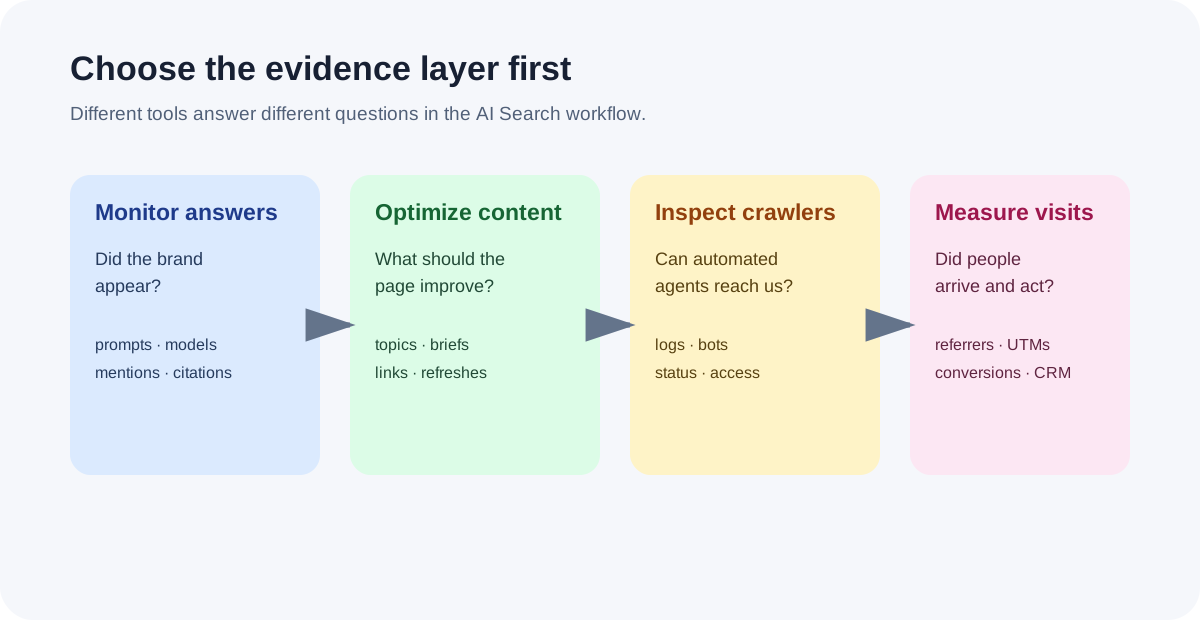
AI Search monitoring tells you what sampled answers say about a brand. Content optimization helps a team decide what to research, write, improve, publish, and refresh. Most teams need both eventually, but they should not buy them for the same reason.
monitoring = observe the answer
optimization = improve the page
analytics = measure detectable visits
A visibility score does not prove a citation. A citation does not prove a click. A content score does not prove that an AI engine will use or recommend a page.
Why the categories are easy to confuse
GEO software is often described with the same words—visibility, optimization, citations, AI Search, and content. The words can hide different data sources:
- A prompt tracker runs questions and records answers.
- A content optimizer analyzes pages and topic coverage.
- A crawler analytics tool reads server or CDN logs.
- Web analytics records detectable human visits.
- A CRM or ecommerce system records business outcomes under an attribution model.
These layers can be connected in a workflow, but one cannot silently stand in for another. An AI bot request is not a human visit. A page score is not a ranking. A mention is not a citation.
For a measurement framework, see AI Visibility vs AI Citations vs AI Traffic. For the broader category definition, see What Is GEO?.
1. What AI Search monitoring is for
Monitoring is useful when the question is about the answer surface:
- Is the brand mentioned for category prompts?
- Which competitors are recommended?
- Which domains or pages are cited?
- Is the brand described accurately?
- Does the answer differ by engine, region, language, or date?
A defensible monitoring record includes the prompt, model or surface, location, language, date, complete answer, source links, competitor set, and scoring rule. Without those fields, a percentage may be hard to reproduce.
Monitoring is especially valuable for baseline work, brand accuracy audits, competitive research, and citation-source discovery. Tools such as Peec AI, AI Search Console, Otterly.AI, and Rankscale represent this general category, with different coverage and methodologies.
What monitoring does not prove
A sample can support “the brand appeared in 38 of 100 tracked responses.” It cannot automatically support “38% of the market sees the brand,” “the brand gained traffic,” or “the monitoring tool caused revenue growth.”
AI answers are variable. Keep the prompt panel stable when measuring a trend, and report changes in the sample rather than presenting them as a universal rank.
2. What content optimization is for
Content optimization is useful when the question is about execution:
- Which topic deserves a page?
- What questions and concepts should the page answer?
- Where is existing coverage thin or outdated?
- Which pages should be refreshed or internally linked?
- How can an editor move from research to a reviewed publishable draft?
The workflow usually combines topic research, a brief, drafting, page-level recommendations, internal links, publishing, monitoring, and refreshes. Clearscope is an example of this content-optimization category with a public AI Search prompt-tracking layer. Frase, Surfer AI Tracker, and Writesonic GEO Suite overlap with the same execution question in different ways.
What a content score does not prove
A content grade measures alignment with a product’s criteria. It does not prove that:
- Google will rank the page
- ChatGPT or Gemini will cite the page
- A model has read the page
- The page is more accurate than its competitors
- Traffic or revenue will increase
An optimizer can help make a page clearer and more complete. The causal chain from edit to AI answer is still affected by retrieval, authority, freshness, competition, model behavior, and time.
3. A practical selection framework
Choose monitoring first when
- You do not know how AI systems currently describe the brand.
- Competitors appear in answers and you need source-level diagnosis.
- The team needs an engine, prompt, region, or sentiment baseline.
- Brand accuracy and reputation are higher priority than content production.
- You need to observe whether a later change coincides with changed answers.
Choose optimization first when
- The organization already knows which pages need to be created or refreshed.
- Research, briefs, writing, and publishing are the bottleneck.
- Editors need topic coverage and internal-link guidance.
- AI Search is one of several content-distribution objectives.
- The team can supply subject-matter review and original evidence.
Choose both when
- Monitoring identifies a citation or topic gap and the content team can act on it.
- You can preserve a stable prompt set before and after a content change.
- Analytics, SEO, and editorial teams agree on separate success metrics.
- The organization can review outputs rather than turning on unexamined automation.
4. The combined workflow
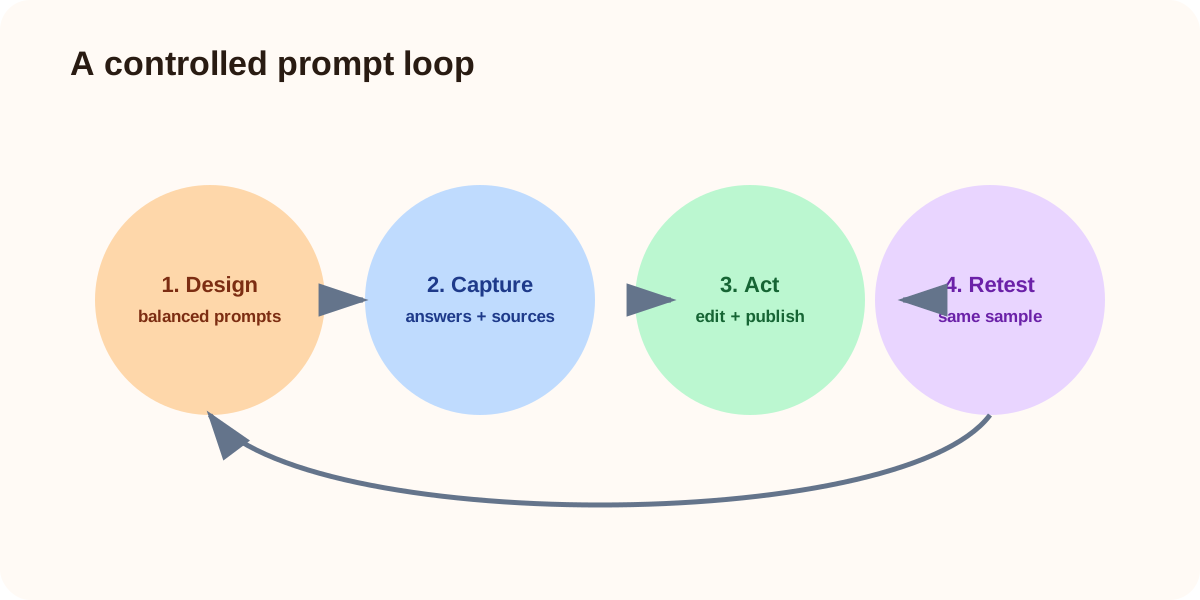
Step 1: Define the business question
Start with a decision, not a dashboard. Examples include “Which comparison prompts omit us?” or “Which product pages need clearer evidence?” The question determines whether monitoring, optimization, or analytics comes first.
Step 2: Build a balanced prompt set
Use branded, category, problem, comparison, alternative, evaluation, regional, and risk prompts. Do not build the entire baseline from branded questions. Record a version number so a changed prompt set is not mistaken for a performance change.
Step 3: Capture answer evidence
Save the full answer, source URLs, mention wording, citation position, model, date, region, and competitor context. A screenshot or score alone is difficult for an editor to action.
Step 4: Diagnose the gap
Classify the finding:
| Finding | Likely next investigation |
|---|---|
| Brand absent from a category answer | Topic coverage, authority, competing sources, and prompt intent |
| Brand mentioned but not linked | Source structure, page usefulness, and citation context |
| Incorrect price or feature | First-party facts, freshness, structured data, and third-party corrections |
| Competitor consistently cited | What evidence and page types those sources provide |
| AI crawler accesses nothing | robots.txt, hosting, CDN, status codes, and log interpretation |
Do not assume every answer gap can be fixed by adding keywords to one page.
Step 5: Create or refresh the page
Use an optimizer to structure research and editorial work. Add original evidence, direct sources, clear definitions, useful tables, and a strong answer to the reader’s question. Do not copy competitor phrasing merely to increase a score.
Step 6: Publish with a baseline
Record the URL, publication date, target prompt group, organic metrics, conversions, and the pre-change answer sample. Keep SEO, AI visibility, AI referrals, and revenue in separate columns.
Step 7: Retest and interpret cautiously
Run the same prompts after a reasonable interval. Compare complete answers, sources, framing, and accuracy. If a visibility change coincides with a page change, report the association and the competing explanations; do not call it causal from one before-and-after observation.
5. How to compare products fairly
Compare tools using the same questions:
- Which engines and models are included in the purchased plan?
- How many prompts, pages, users, projects, and regions are allowed?
- Are answers and source URLs exportable?
- What is the refresh frequency and history length?
- Does the product observe prompts, crawlers, referrals, or modeled estimates?
- Can content recommendations be connected to a CMS or editorial approval step?
- What are the extra costs for prompts, pages, drafts, seats, API, and white labeling?
- Does independent evidence concern the specific GEO feature or only the older SEO product?
For example, Clearscope’s public pricing page lists 50 tracked prompts on Essentials, 300 on Business, and names ChatGPT and Gemini. That is useful commercial information, but it is not evidence that Clearscope covers every AI Search surface or guarantees citations. Ask for the exact plan matrix during a trial.
6. Metrics to keep separate
| Layer | Metric examples | What it can support | What it cannot prove alone |
|---|---|---|---|
| Answer | Mention rate, position, sentiment | Presence in a defined sample | Total market visibility |
| Source | Citation rate, cited URLs, source domains | Which sources appear in answers | A click or endorsement |
| Content | Grade, topic coverage, refresh status | Alignment with an optimization workflow | A future rank or citation |
| Web | AI referrals, sessions, landing pages | Detectable visits from identifiable sources | All AI-influenced visits |
| Business | Leads, sales, revenue | Outcomes under an attribution model | Causal AI impact without stronger design |
The Google Analytics campaign URL guidance is relevant when tagged links exist, but tagging cannot recover every AI-influenced journey. AI crawler requests should remain in a separate technical dataset.
7. Common buying mistakes
Buying a content score as a visibility guarantee
A score is a product’s recommendation system. Test whether the changes improve clarity and usefulness, then observe answers independently.
Buying a tracker without a content owner
A dashboard full of missing mentions is not a plan. Assign owners for source research, page edits, PR, technical fixes, and retesting.
Comparing incompatible numbers
Two tools may use different prompts, models, competitors, regions, samples, or scoring definitions. Use one consistent methodology for trends and treat cross-tool numbers as directional.
Treating customer stories as independent proof
Official customer stories are vendor-selected evidence. They can explain a workflow, but do not establish general causality for traffic, citations, or revenue.
Ignoring the cost of execution
The software subscription is not the whole program. Include editorial time, subject-matter review, analytics implementation, content production, PR, technical work, additional seats, and usage overages.
Checklist before purchase
- We can state the decision the tool will support.
- The engine, model, region, language, and history requirements are written down.
- We know whether the product returns raw answers and source URLs.
- We have a balanced prompt panel rather than only branded queries.
- Content owners can act on findings within an approval workflow.
- SEO, AI Search, analytics, and CRM metrics will be reported separately.
- Trial tests include accuracy, repeatability, export, limits, and total cost.
- We will not claim guaranteed citations, traffic, or revenue.
FAQ
Is AI Search monitoring more important than content optimization?
Neither is universally more important. Monitoring is the better first step when the brand does not understand its current answer presence. Optimization is the better first step when the team has clear page gaps and production is the bottleneck.
Can a content optimization score improve AI visibility?
It may help a team improve clarity, coverage, and structure, but the score itself does not prove improved AI visibility. Use a stable prompt set and independent answer checks to observe any change.
Should a small team buy both tools?
Start with the smallest workflow that answers the current decision. A content team may begin with optimization plus a small prompt panel; a reputation-led team may begin with monitoring. Avoid paying for overlapping features before testing the actual workflow.
Is a citation the same as AI traffic?
No. A citation may be visible without a click, and analytics may miss an AI-influenced visit. Report citations and detectable referrals separately.
Sources and verification
- Clearscope — product workflow and AI Search positioning checked August 17, 2026.
- Clearscope pricing — plan limits, prompt quotas, and trial terms checked August 17, 2026.
- Google Analytics campaign URL guidance — campaign attribution context.
- Google Search Central: AI features and your website — official guidance for AI features in Google Search.
- AICiteKit: AI Visibility vs AI Citations vs AI Traffic — measurement distinctions and limitations.