AI Search Visibility Scores: How to Measure Them Without Inventing a Ranking
Learn what an AI Search visibility score can measure, how to audit its denominator and evidence, and why it does not automatically prove rankings, traffic, or revenue.
The short answer
An AI Search visibility score is a summary of observations from a defined set of prompts, answer surfaces, markets, dates, and scoring rules. It can help a team compare a brand’s presence in a sample. It is not automatically a universal ranking, a probability of being recommended, a citation guarantee, or proof of traffic or revenue.
Before trusting the headline number, ask for this measurement contract:
prompt set + surface/model + market/language + collection dates + scoring rule + denominatorThen inspect the raw answers behind the score. Separate brand mentions, recommendations, list position, cited URLs, factual accuracy, AI-referred visits, and business outcomes. They answer different questions and should not be silently collapsed into one metric.
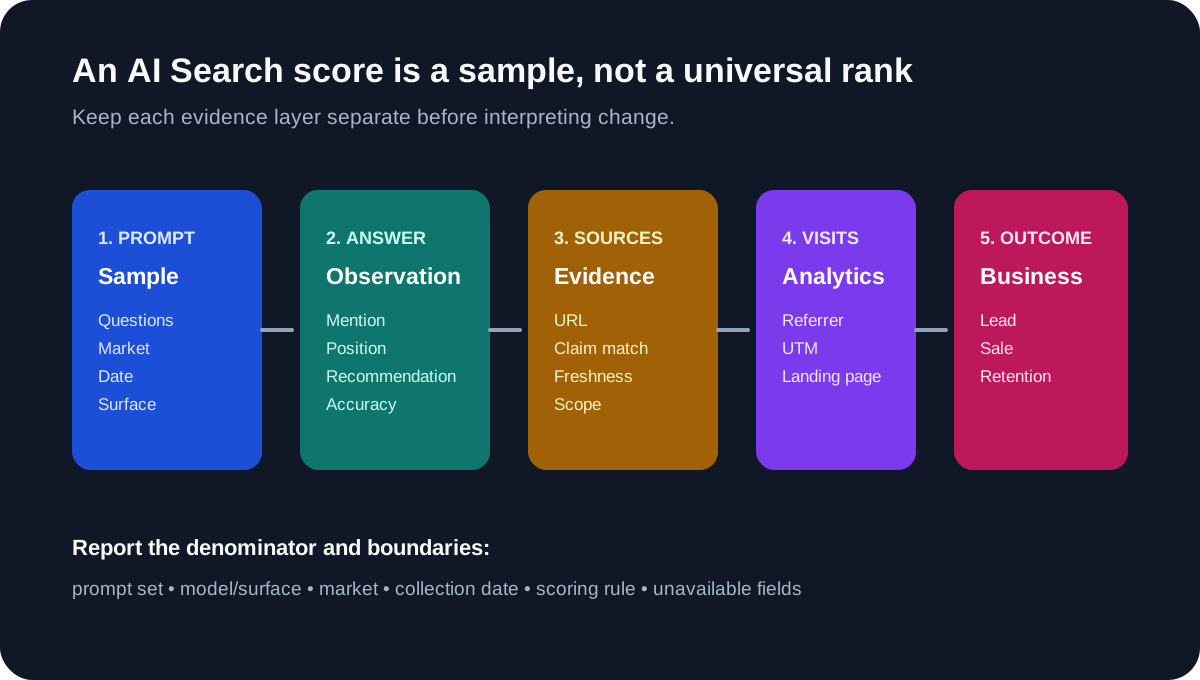
This guide addresses searches such as “what is AI Search visibility?”, “how do I calculate AI share of voice?”, and “does an AI visibility score prove my brand ranks?” It complements AI Search Benchmarks, AI Visibility vs AI Citations vs AI Traffic, and How to Evaluate AI Search Visibility Tools.
What a visibility score can mean
The phrase “visibility” is not a single industry-standard measurement. A vendor, agency, or internal analyst may calculate it from different answer fields.
| Possible component | Example rule | What it supports | What it does not prove |
|---|---|---|---|
| Mention rate | Brand appears in qualifying answers ÷ qualifying answers | Presence in the sampled answers | Preference, demand, or market-wide awareness |
| Recommendation rate | Brand is recommended for a defined use case ÷ qualifying answers | Recommendation observation under that prompt set | That users will choose the brand |
| Position | Defined list position when the brand appears | Relative order in captured answers | A stable cross-surface rank |
| Share of voice | Brand’s counted mentions ÷ all counted brand mentions | Relative share inside the stated sample | Share of all AI answers or category demand |
| Citation rate | Answers with a qualifying target URL ÷ qualifying answers | Visible source-link presence | A click, endorsement, or conversion |
| Accuracy rate | Checked claims that match the current source of truth ÷ claims reviewed | Factual quality of sampled answers | That the brand caused the answer |
A score is interpretable only when the provider defines the components, weighting, qualifying-answer rule, and denominator. “Visibility increased 12%” is incomplete without those details.
The denominator is the first audit
The denominator controls the story. A brand can appear stronger when a report removes difficult category prompts, adds branded questions, changes the competitor set, or switches from answer-level counting to mention-level counting.
Record at least:
- Prompt-set version and exact prompt text
- Number of prompts, runs, and answers included
- Brand and competitor names counted, including spelling variants
- Whether one answer can contribute multiple mentions
- Surface, model, search mode, and account state when disclosed
- Country, language, device, and collection date
- Treatment of empty answers, failed runs, duplicate answers, and unavailable results
- Position and recommendation rules
For example, these are different calculations:
answer mention rate = answers mentioning the brand ÷ qualifying answers
mention share = brand mentions ÷ all counted brand mentions
recommendation rate = answers recommending the brand ÷ recommendation prompts
Do not call all three “share of voice.” Publish the formula beside the result.
Google’s documentation for AI features in Search, checked September 18, 2026, says AI features may show links to supporting web resources and recommends foundational Search practices. It does not define a universal AI visibility score or promise that an eligible page will appear.
Build a useful prompt sample
A score built from only “What is [brand]?” measures branded recall more than category discovery. A decision-oriented panel should include prompts that reflect how people actually compare options.
| Prompt group | Example intent | Useful observation |
|---|---|---|
| Category | “What tools help a small team monitor AI citations?” | Discovery and competitor set |
| Problem | “How can an agency audit AI brand visibility?” | Relevance to a job to be done |
| Comparison | “Compare tool A and tool B for source tracking.” | Positioning and tradeoffs |
| Recommendation | “Which tool fits a lean content team?” | Recommendation conditions |
| Product fact | “Does tool A support export and team access?” | Accuracy and source support |
| Risk | “What are the limitations of AI visibility tools?” | Negative coverage and caveats |
| Regional or language | Localized versions of the same intent | Context-specific differences |
Freeze the panel before collecting a baseline. If prompts are replaced after a poor result, report a new panel version rather than a clean improvement. AI Search Prompt Set provides a related prompt-design framework.
Capture the answer, not just the score
A dashboard value without the underlying answer is difficult to audit. For each run, preserve a record similar to:
prompt_id: GEO-021
prompt_set_version: v3
prompt: exact text
surface/model: disclosed label, or “not disclosed”
market/language: United States / English
run_date: 2026-09-18 UTC
answer: full captured text where permitted
mentioned_brands: normalized list
recommendation: yes / no / unclear
position_rule: first named brand, or defined alternative
source_urls: exact visible URLs
score_inputs: fields included in the calculation
A source URL appearing beside an answer supports the observation that the surface displayed that link. It does not prove that every sentence came from the URL. Open the page and check the relevant claim, scope, and freshness. AI Search Answer Provenance explains this claim-to-source step in more detail.
OpenAI’s web search documentation, checked September 18, 2026, documents source and citation fields for an OpenAI API web-search tool. That is product-specific documentation for an exposed API tool; it should not be generalized to every ChatGPT experience, model, or other answer surface.
Separate visibility from citations and traffic
A brand can be mentioned without its site being cited. A site can be cited without receiving a measurable visit. A visit can occur without proving that the citation caused it.
Use a layered report:
- Answer visibility: Did the brand appear in this defined answer sample?
- Recommendation visibility: Was it suggested for a defined need?
- Source visibility: Which URLs were visibly linked, and what did they support?
- Referral observation: Did analytics record a visit with an identifiable referrer or campaign marker?
- Business outcome: Was a lead, sale, or other outcome recorded, and what attribution method was used?
Google Analytics’ campaign URL guidance, checked September 18, 2026, explains how campaign parameters can identify tagged links. It does not make every AI-influenced visit observable, and it does not turn correlation into causal attribution.
The GEO research paper by Aggarwal et al., checked September 18, 2026, provides academic context for generative-engine optimization experiments. It is not evidence that a commercial visibility score predicts production rankings, traffic, or revenue.
How to compare two tools fairly
Tools such as Peec AI, Otterly.AI, AI Search Console, PromptWatch, and Profound may expose overlapping terms while measuring different samples or fields. Their numbers are not comparable merely because both dashboards use “visibility.”
During a trial, ask each vendor to explain:
- Which surfaces and model labels are included
- Whether collection uses live answers, stored results, an API, or another method
- How prompts, markets, languages, and refreshes affect credits or coverage
- Whether raw answer text and exact source URLs can be exported
- How mentions, recommendations, position, and sentiment are defined
- Whether failed, empty, or unavailable runs remain in the denominator
- How competitor names and variants are normalized
- Whether historical values are recalculated when the methodology changes
- Which fields are observed directly versus inferred or modeled
Run the same small, versioned panel where the products allow it. Differences are useful only after you document the prompt, surface, date, market, and metric definition. A disagreement does not by itself show that one tool is wrong. See Why Two GEO Tools Rank Differently for a reconciliation workflow.
Interpreting changes without claiming causality
A visibility score can move because of:
- A model or search-surface change
- Different retrieval results or answer composition
- Prompt edits or competitor-set changes
- Market, language, account, or personalization differences
- A source page update
- A vendor methodology or normalization change
- Random variation in a small sample
Treat a before-and-after result as an observation unless the test isolates the cause. A useful change log records the panel version, collection conditions, content changes, source changes, and any product methodology update.
Use a simple report format:
Baseline: v3, 40 prompts × 3 runs, US English, collected Sep 1–7
Retest: v3, 40 prompts × 3 runs, same declared conditions, Sep 15–18
Observed: mention rate changed from A/B to C/D
Source evidence: URLs and answer excerpts changed in N runs
Known confounders: model label not disclosed; one source page updated
Conclusion: sampled change observed; cause not isolated
The smaller the prompt panel, the more carefully you should describe the result. A percentage with a small or shifting denominator can look precise while remaining unstable.
A practical audit checklist
Before publishing or buying around an AI Search visibility score, verify:
- The score has a named formula and denominator.
- The prompt panel reflects category, problem, comparison, and fact intents where relevant.
- Branded prompts are not presented as category demand.
- Collection dates, markets, languages, surfaces, and model labels are visible.
- The report states how empty, failed, duplicate, and unavailable answers are treated.
- Mention, recommendation, position, citation, traffic, and outcomes are separate fields.
- Raw answers or auditable excerpts are available for sampled results.
- Exact source URLs can be inspected and mapped to claims.
- Historical methodology changes are annotated.
- Conclusions say “in this sample” when that is the evidence boundary.
If several checks fail, treat the number as an internal directional indicator rather than a market-wide KPI.
Who should use this framework?
This is useful for SEO teams, content leads, agencies, and product marketers who need to prioritize source coverage, factual corrections, prompt research, or controlled retests. It is also useful when comparing GEO tools before procurement.
It is not a substitute for customer research, analytics, search-console data, or a representative study of every AI answer. Teams without a stable prompt panel should start with a small manual baseline and a written measurement contract instead of buying a dashboard for an undefined score.
FAQ
Is an AI Search visibility score the same as a ranking?
No. It is usually a derived result from a defined sample. It may describe mention presence, recommendation, position, citations, or a weighted combination. Call it a ranking only when the ranking construct, sample, and comparison rules are explicit.
What is a good AI visibility score?
There is no universal threshold. A useful value depends on the prompt set, objective, competitor universe, surface, market, and calculation. Compare consistent versions of the same panel and inspect answer evidence rather than importing a generic benchmark.
Does being cited mean the brand is visible?
It is one form of source visibility, but it is not identical to a brand mention or recommendation. A page may be cited without the brand being recommended, and a brand may be named without a source URL to its site.
Can a visibility score prove more traffic or revenue?
No. It can report an answer-level observation. Traffic requires analytics evidence, and revenue requires a separately defined attribution method. Even linked visits do not automatically establish that a score change caused a business outcome.
How often should I measure AI Search visibility?
Choose a cadence based on decision speed, volatility, and collection cost. Keep a stable core panel for comparison and add exploratory prompts separately. A more frequent run with changing prompts may be less useful than a less frequent, well-documented retest.
Evidence snapshot
| Source | Public signal | What it supports | Confidence |
|---|---|---|---|
| Google Search Central: AI features and your website | Official documentation on AI features and supporting links | Search-product context and the absence of a published universal visibility formula | High for documented guidance |
| OpenAI Developer Docs: Web search | Official API documentation for web-search sources and citations | Product-specific context for exposed source fields | High for the API documentation; limited beyond that surface |
| Google Analytics: Campaign URL builder | Official analytics guidance on campaign parameters | Tagged referral measurement boundaries | High for the documented feature; not proof of complete AI attribution |
| Aggarwal et al., GEO | Independent academic research | Context for generative-engine optimization experiments | Medium; not validation of a commercial score |
| AICiteKit editorial framework | Prompt contract, evidence layers, and audit checklist in this article | Conditional measurement and buying guidance | Editorial |
Sources and verification
The following sources were checked on September 18, 2026:
- Google Search Central: AI features and your website — official guidance on AI-feature links and foundational Search practices.
- OpenAI Developer Docs: Web search — official documentation for an OpenAI API web-search tool and its citation fields.
- Google Analytics: Campaign URL builder — official guidance on campaign parameters and referral identification.
- Aggarwal et al., “GEO: Generative Engine Optimization,” arXiv — independent academic research context.
Last reviewed: September 18, 2026
Data confidence: High for the linked official source descriptions; medium for the measurement framework, which is AICiteKit editorial guidance and depends on what each answer surface or tool exposes.
This article does not guarantee rankings, citations, recommendations, traffic, or revenue.