How to Build a Reliable AI Search Prompt Set
Learn how to build a balanced AI Search prompt set for GEO and AI visibility measurement, including category, branded, comparison, competitor, regional, and risk prompts.
A reliable prompt set is the foundation of AI Search measurement
An AI Search prompt set is a documented collection of questions used to monitor how AI systems describe, recommend, compare, and cite a brand or category.
It is the foundation for almost every AI visibility report. If the prompt set is too small, too branded, or too inconsistent, the resulting visibility score can look precise while measuring very little.
A useful prompt set should answer four questions:
- Does the brand appear when people discover the category?
- How is the brand described when a buyer evaluates it?
- Which competitors and sources appear instead?
- Are important facts accurate across markets, languages, and high-risk situations?
The most important rule is simple:
A brand prompt set should represent the buying journey,
not just the brand's preferred keywords.
This is why visibility does not equal citation, and why a result based only on branded prompts should not be presented as broad AI Search visibility.
Why prompt design changes the result
AI visibility is not a single universal ranking. It is an observation produced by a combination of:
- Prompt wording
- AI surface and model
- Country, language, and location
- Date and response context
- Competitor list
- Sampling frequency
- Citation and mention definitions
- Scoring methodology
Change the prompt set and you change the measurement universe.
For example, compare these two samples:
Branded sample
- What is AICiteKit?
- Is AICiteKit good for GEO?
- What does AICiteKit cost?
This can test brand accuracy and product understanding. It cannot tell you whether AICiteKit appears when a buyer asks for GEO tools without naming it.
Balanced category sample
- What are the best AI visibility tools for a small SaaS team?
- How can an agency track AI citations?
- What should I compare before buying a GEO platform?
- Which tools monitor ChatGPT, Perplexity, and Google AI answers?
This is more useful for category discovery and competitive visibility, although it still represents only the selected questions and surfaces.
A high branded share can coexist with weak category visibility. A low mention rate can coexist with strong performance on a narrow, high-value use case. The prompt taxonomy needs to make those differences visible.
The eight prompt groups every starting set should consider
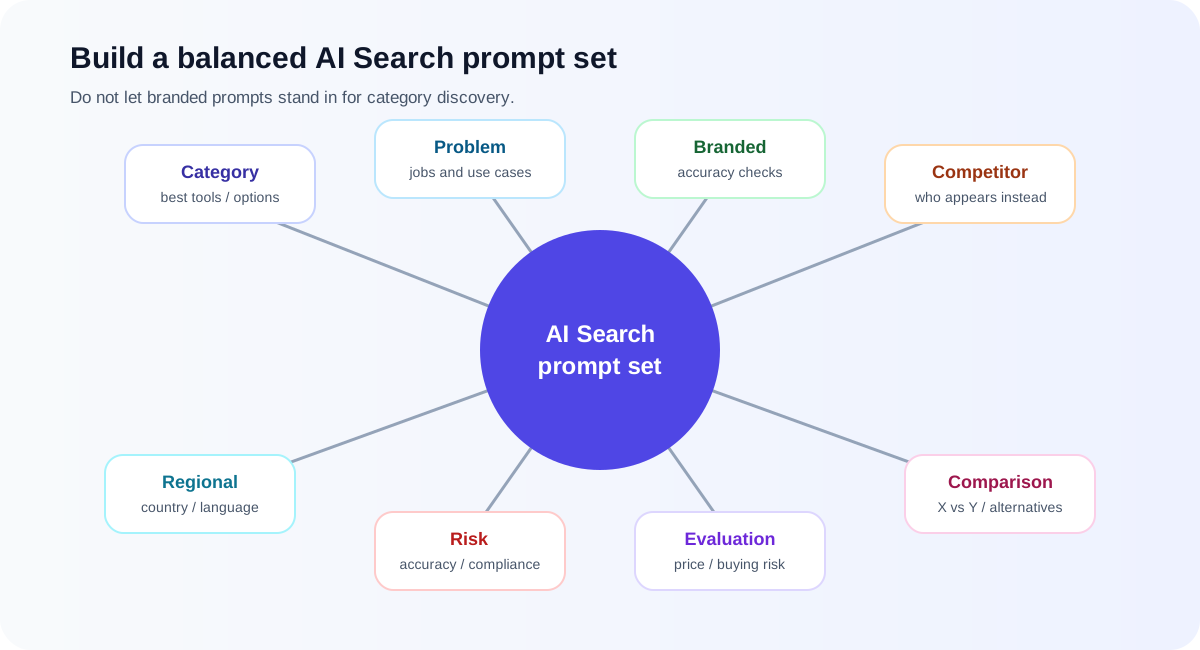
1. Category prompts
Category prompts ask an AI system to recommend or explain options without naming your brand.
Examples:
- What are the best AI visibility tools for a mid-market company?
- Which platforms track AI citations and brand mentions?
- What software helps an agency report GEO performance?
Category prompts are important because they represent discovery. They are also competitive: a brand may be absent while several alternatives are recommended.
2. Problem and use-case prompts
Problem prompts describe what the user is trying to accomplish.
Examples:
- How do I find which websites ChatGPT cites for my category?
- How can a marketing team monitor brand accuracy in AI answers?
- What is the best way to track AI-referred traffic?
These prompts are often more natural than product-name queries. They can also reveal whether the brand is associated with a specific job, audience, or outcome.
3. Branded prompts
Branded prompts name the company, product, or domain directly.
Examples:
- What is [brand]?
- Who is [brand] best for?
- What does [brand] cost?
- Is [brand] a good alternative to [competitor]?
Use branded prompts for accuracy, positioning, price, feature, and reputation checks. Keep them in the set, but do not let them dominate the result.
A branded prompt is especially useful for finding:
- Wrong prices
- Outdated features
- Incorrect product comparisons
- Missing limitations
- Unsupported performance claims
- Confusion between a company and a product
4. Competitor prompts
Competitor prompts investigate how named competitors are described and where they appear.
Examples:
- What are the main alternatives to [competitor]?
- Which tools compete with [competitor] for agencies?
- How does [competitor] compare with other AI Search platforms?
The goal is not to monitor competitors for its own sake. It is to understand the source and prompt gaps behind their visibility.
5. Comparison prompts
Comparison prompts place two or more options in the same decision.
Examples:
- [Brand] vs [Competitor]: which is better for an agency?
- Compare [Brand], [Competitor], and [Competitor] for citation tracking.
- What are the differences between an AI visibility tool and an AI content optimization platform?
Comparison prompts can reveal positioning, price framing, strengths, weaknesses, and recommendation order. They can also expose whether the AI answer is using outdated third-party information.
6. Evaluation and purchase prompts
Evaluation prompts reflect a buyer who is closer to a decision.
Examples:
- What should I check before buying an AI visibility tool?
- Which GEO platform has API access and agency reporting?
- What is the cheapest AI Search tool for a small team?
- Which AI visibility tool supports multiple countries?
These prompts should include price, team size, implementation, export, support, integration, and procurement considerations. They are useful for content planning and for checking whether an AI system understands important buying constraints.
7. Risk and accuracy prompts
Risk prompts test claims where an incorrect answer can create customer, legal, compliance, or reputation problems.
Examples:
- What are the limitations of [brand]?
- Is [product] suitable for a regulated industry?
- Does [tool] support [integration]?
- What is the current price of [product]?
- What should a buyer be careful about with [category]?
A negative answer is not automatically a hallucination. If the answer correctly describes a limitation, it may be useful. The monitoring process must distinguish “negative but accurate” from “negative and false.”
8. Regional and multilingual prompts
Regional prompts test how the brand appears in a specific market, language, or local context.
Examples:
- What are the best AI visibility tools for companies in the UK?
- Welche GEO-Tools eignen sich für ein deutsches SaaS-Unternehmen?
- What AI Search tools support agencies in Singapore?
- Which products are recommended for healthcare teams in the United States?
Do not assume that a direct translation has the same intent. Local terminology, competitors, price expectations, and regulations can change the answer.
A practical starting allocation
There is no universal ratio for every business, but a starting baseline can be distributed like this:
| Prompt group | Starting share | Why it matters |
|---|---|---|
| Branded | 20% | Accuracy, product facts, sentiment, and reputation |
| Category | 20% | Unbranded discovery and recommendation visibility |
| Problem / use case | 15% | Customer jobs and practical relevance |
| Comparison | 15% | Competitive positioning and alternatives |
| Competitor | 10% | Named competitor framing and source gaps |
| Evaluation / purchase | 10% | Price, limits, integrations, and buying decisions |
| Risk / regional | 10% | High-trust facts and market differences |
This is not a benchmark or a claim that every brand should use exactly these percentages. It is a way to stop the easiest branded prompts from consuming the whole sample.
For an early 25-prompt plan, this might mean:
5 branded
5 category
4 problem/use-case
4 comparison
3 competitor
2 evaluation/purchase
2 risk or regional
The number of prompts is less important than the coverage and the reason each prompt is included.
How to prioritize prompts
A long list of possible questions is not automatically a useful monitoring set. Prioritize prompts before assigning them to a tool or schedule.
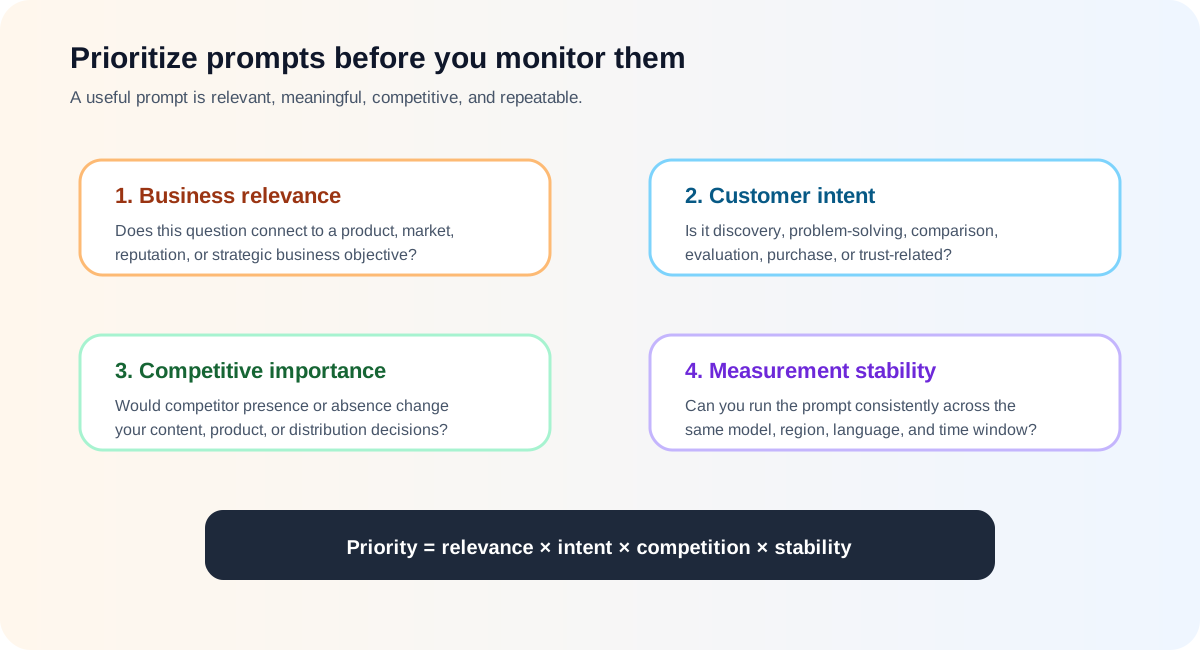
Business relevance
Ask whether the answer could change a business decision:
- Does it concern an important product or market?
- Does it reflect a high-value customer problem?
- Does it affect brand trust or reputation?
- Is it connected to a content, product, sales, or support objective?
Customer intent
Classify the prompt as discovery, education, comparison, evaluation, purchase, support, or risk. A prompt with clear intent is easier to connect to an action than a vague topic phrase.
Competitive importance
Prioritize prompts where competitor presence would change your strategy. If the answer is unlikely to affect content, distribution, messaging, or product decisions, it may belong in a secondary research set rather than the core tracker.
Measurement stability
Ask whether you can repeat the test with the same:
- Prompt wording
- Model or AI surface
- Country and language
- Location context
- Date window
- Follow-up state
A prompt can be strategically important but difficult to compare if the surface changes dramatically between runs. Keep it, but label the measurement limitation.
A simple editorial scoring model is:
Prompt priority = business relevance
                × customer intent
                × competitive importance
                × measurement stability
This is a prioritization framework, not a platform metric. Do not present it as a proven formula for AI visibility.
How to write better prompts
Use natural questions
Write prompts as a buyer or researcher might ask them. Avoid stuffing every product keyword into one sentence.
Weak:
best AI GEO citation tracking software AI visibility tool platformBetter:
What are the best tools for tracking which sources AI search engines cite?Preserve intent while varying wording
Create a small group of variants for important questions:
- What are the best tools for tracking AI citations?
- Which platforms monitor citations in ChatGPT answers?
- How can I see which domains Perplexity cites for my category?
Variants can show whether a result depends on one exact phrase. Do not silently replace the original prompt every time a result is inconvenient.
Include constraints when they matter
A buyer may care about:
- Team size
- Budget
- Region
- Industry
- Integration
- API access
- Reporting
- Privacy or compliance
Add these constraints to selected prompts, not every prompt. Otherwise the set becomes too narrow to represent category discovery.
Avoid leading prompts
Leading prompt:
Why is [brand] the best AI visibility tool?More useful alternatives:
What are the strengths and weaknesses of [brand]?
Which teams should and should not choose [brand]?
How does [brand] compare with other AI visibility tools?
A monitoring set should investigate the answer, not instruct the system to praise the brand.
Prompt versioning and change control
Treat a prompt set like a small research instrument. Give it a version and keep a change log.
Example:
Prompt set v1.0 — baseline
Prompt set v1.1 — added regional questions
Prompt set v1.2 — corrected outdated product name
Prompt set v2.0 — changed the competitor universe
Record:
- Version number
- Date changed
- Prompt added, removed, or rewritten
- Reason for the change
- Owner
- Affected market, model, or tool
- Whether the new period remains directly comparable
A typo correction may be a minor revision. Replacing all category prompts or changing the competitor set is a new measurement period.
How often should a prompt set change?
Use two layers:
Core monitoring set
Keep this stable for a defined comparison period. It should contain high-priority prompts that are useful for trend analysis.
Exploration set
Add new prompts from customer research, sales calls, Search Console queries, support tickets, competitor pages, and emerging topics. Explore them before promoting them into the core set.
A practical rhythm is:
- Review the exploration set weekly or monthly;
- Keep the core set stable for the reporting period;
- Archive prompts that no longer represent the market;
- Document major changes instead of pretending the series is continuous.
Do not update every prompt whenever one answer looks surprising. First determine whether the issue is a real content or accuracy gap, a model change, or sampling noise.
Using customer and search data to create prompts
Good prompt ideas can come from:
- Sales call notes
- Customer support questions
- Site search logs
- Google Search Console queries
- Product reviews
- Community discussions
- Competitor comparison pages
- Pricing and implementation objections
- Internal search and help-center data
Google Search Console remains useful for discovering language that real users use in traditional search. It should not be treated as a complete record of how people phrase questions in AI systems, but it can provide grounded vocabulary and intent clues.
Combine internal data with human review. Do not upload confidential customer information into an AI tool merely to generate prompts.
Running the same prompt set across tools
A prompt set is also useful for comparing AI visibility platforms, but only when the comparison is controlled.
Before comparing tools, match:
- Exact prompt wording
- Competitor list
- Country and language
- AI surface or model
- Date range
- Refresh schedule
- Definition of mention
- Definition of citation
- Exported answer evidence
Current AICiteKit tools support different workflows:
- Semrush AI Visibility Toolkit — Semrush-native prompt research, visibility, competitor, brand, and AI Search audit workflows;
- AI Search Console — prompt, citation, competitor, and reporting workflows;
- Peec AI — visibility, competitor, and reporting analysis;
- Rankscale — broad AI engine, prompt, citation, and rank monitoring;
- PromptWatch — prompt monitoring with crawler and AI referral context;
- ZipTie — answer capture and source analysis;
- Otterly.AI — focused prompt and AI Search monitoring;
- Profound — enterprise AI Search intelligence;
- AthenaHQ — visibility, brand accuracy, and action-oriented workflows.
These tools should not be assumed to produce comparable scores just because they all use terms such as visibility, mention, or citation.
How to evaluate a prompt set after the first run
After running the baseline, review the sample itself.
Coverage check
Does it include branded and unbranded discovery? Does it cover the questions that sales, support, and product teams care about?
Intent check
Can you label why a user would ask each prompt? If not, the prompt may be too vague for an action-oriented report.
Bias check
Are most prompts leading, branded, or written by the marketing team rather than customers? Are competitors represented fairly?
Evidence check
Can you save the full answer, source URLs, model, region, and date? If a tool only provides a score, mark the evidence limitation.
Action check
Would a change in the result lead to a decision? Examples include updating a price page, correcting a product fact, creating a comparison, improving internal links, or investigating a cited third-party source.
Reproducibility check
Can another person run the same prompt and understand what changed? If the answer depends on hidden context or a follow-up conversation, record that context.
Common prompt-set mistakes
Tracking only branded prompts
This measures brand recognition and accuracy, not broad discovery.
Using only “best tools” prompts
Recommendation prompts are useful but can overrepresent listicle-style intent. Include problem, comparison, evaluation, support, and risk questions.
Changing all prompts after every result
This destroys the ability to distinguish a real trend from a changed sample.
Treating AI prompt volume as search volume
A platform’s prompt or topic volume is a product-specific research signal. It is not automatically equivalent to Google search volume or total AI usage.
Mixing countries and languages without labeling them
A US-English result and a German-language result should not be combined into one unexplained score.
Ignoring follow-up context
A follow-up answer can be influenced by the first answer. New conversation and follow-up conversation are different test conditions.
Writing prompts to produce a desired answer
A leading prompt can make visibility look better while reducing the validity of the measurement.
Measuring without storing the answer
A score without the underlying answer and sources is difficult to audit or act on.
A prompt-set checklist
Before adding a prompt to the core tracker, confirm:
- It represents a real customer, market, or brand question.
- Its intent is documented.
- It belongs to a defined prompt group.
- It is not simply a duplicate of another wording.
- It is not unnecessarily leading.
- Its country and language are specified when relevant.
- Its competitor context is fair and documented.
- Its business relevance is clear.
- It can be run consistently enough to interpret.
- The expected action is known if the result changes.
- It has a prompt-set version and owner.
FAQ
How many prompts do I need?
There is no universal number. Start with a balanced set that represents the buying journey. A focused brand may begin with 20–30 core prompts, while an agency, enterprise, or multi-market company may need separate sets by product, market, and intent.
Should branded prompts be included?
Yes, but they should be one group among several. Branded prompts are important for accuracy and reputation, but they cannot represent category discovery on their own.
How often should I update the prompt set?
Keep the core set stable during a reporting period and maintain a separate exploration set for new questions. Review new prompts regularly, but document major changes rather than silently replacing the baseline.
Should every AI engine have a different prompt set?
Start with a shared core set so results can be compared conceptually, then add surface-specific prompts when the user experience or coverage differs. Record which surfaces were tested.
Do prompts need to be exact quotes from customers?
No. They should be grounded in real customer language where possible, but edited prompts can make a test more consistent. Preserve the original intent and document material changes.
Should I include follow-up questions?
Use follow-ups when they represent a real journey, such as asking for sources, limitations, or alternatives. Keep them in a separate conversation-flow test because they are not directly comparable with first-turn prompts.
Is prompt volume the same as AI search demand?
No. Prompt volume shown by a platform is a platform-specific estimate or research signal. It should not automatically be treated as total user demand, search volume, or traffic potential.
Can a prompt set prove that GEO increased traffic?
No. It can make selected AI answer observations more repeatable. Traffic and revenue require separate analytics, CRM, and commerce evidence, and even then attribution may remain incomplete.
Can I use one prompt set for every client?
Use a reusable taxonomy, not one identical list. Each client needs prompts tied to its category, audience, competitors, markets, products, and risks.
Further reading and sources
- Google Search Central: AI features and your website — official context for AI features and search fundamentals.
- OpenAI Help: ChatGPT Search — official context for ChatGPT Search and source presentation.
- Google Analytics Help: Traffic-source dimensions — useful when connecting AI referral observations to analytics.
- Semrush AI Visibility Toolkit — official example of prompt research, tracking limits, regional coverage, and update schedules.
- AICiteKit: What Is GEO? — GEO fundamentals and the relationship between SEO and GEO.
- AICiteKit: How to Track Whether AI Engines Are Citing Your Brand — answer and citation monitoring workflow.
- AICiteKit: AI Visibility vs AI Citations vs AI Traffic — what each metric can and cannot prove.