AI Search Recommendation Criteria: How to Audit Why a Brand Gets Chosen
A practical framework for auditing the criteria behind AI Search recommendations, validating cited evidence, and separating observed mentions from market-wide rankings or revenue.
The short answer
When an AI Search system recommends a brand, the visible answer is only the end of a chain. The useful audit question is not “How do we make the model choose us?” It is:
Which criteria appeared in the prompt and answer, which sources supported them, and which facts can we verify?
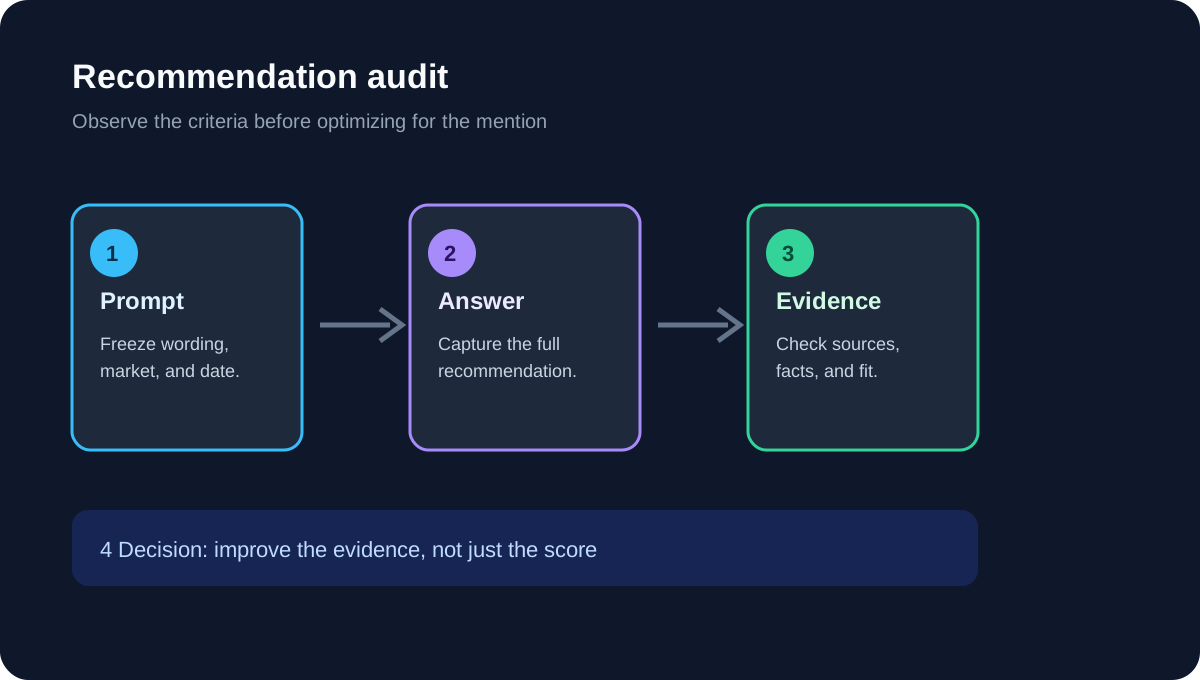
Freeze a prompt panel, capture the complete answer, extract the selection criteria, check every material claim against appropriate sources, and retest without changing the measurement conditions. Treat the result as an observation from a defined surface and date—not as a universal ranking.
This guide targets marketers and SEO teams searching for how to monitor AI recommendations, why a competitor is recommended instead, and how to improve AI Search visibility without inventing ranking claims. It complements AI Search Competitor Analysis and How to Track Whether AI Recommends Your Products.
What a recommendation observation can prove
A captured answer can support a narrow statement such as:
“On this surface, with this prompt, market, language, and collection date, the answer recommended Brand A and described price transparency as one selection criterion.”
It cannot establish, by itself:
- A stable ranking across all users or AI surfaces
- That the system used a single, consistent algorithm
- That the recommendation was factually correct
- That a cited source caused the recommendation
- That the brand received a click, lead, order, or revenue
- That a content edit caused a later recommendation
Google’s guidance for AI features says the same foundational practices apply to pages appearing in Search, while noting that Search results can vary and that eligibility is not a guarantee of appearance (Google Search Central: AI features and your website, checked September 1, 2026). This supports a discoverability and content-quality baseline; it does not publish a universal AI recommendation score.
The independent GEO research paper by Aggarwal and colleagues studies visibility in generative engines (GEO: Generative Engine Optimization, checked September 1, 2026). It is useful research context, but it does not validate any vendor’s dashboard metric or prove a causal production outcome for a specific brand.
1. Define the recommendation question
A vague prompt creates a vague audit. Write down the decision a buyer is trying to make:
| Intent | Example prompt pattern | Criteria worth extracting |
|---|---|---|
| Category discovery | “What tools help with [problem]?” | Use case, audience, capabilities |
| Shortlist | “Which [category] tools should a small team consider?” | Budget, setup, team size, limits |
| Comparison | “Compare A and B for [workflow].” | Feature fit, tradeoffs, integrations |
| Risk review | “What are the drawbacks of [product]?” | Missing features, support, privacy, lock-in |
| Regional fit | “Which provider works for [market]?” | Availability, language, location, compliance |
Keep branded prompts separate from category prompts. A branded question tests identity and product facts; it does not measure whether the brand is discovered when the user does not name it.
Record the exact wording, prompt-set version, surface, model or mode when disclosed, region, language, account context where relevant, and timestamp. A changed prompt is a changed measurement input.
2. Capture more than the winning brand
For each run, preserve the complete answer or permitted export, not only the first recommendation. Record:
- Every brand or product mentioned
- Order or grouping, without calling it a ranking unless the answer explicitly ranks items
- Selection criteria stated by the system
- Claims about price, plans, integrations, capabilities, availability, or limitations
- Cited URLs and the claim each URL appears to support
- Follow-up questions or conversation context
- Surface, model/version when available, market, language, and date
A screenshot can preserve presentation but may not be searchable or reproducible. If raw answer export is unavailable, label the record accordingly and reduce confidence. Do not reconstruct an exact quote from a chart label.
AI Search Console, Peec AI, and Otterly.AI represent different monitoring workflows. Their metrics and collection methods should not be assumed interchangeable. During a trial, verify whether the product preserves raw answers, exact source URLs, prompt versions, and the context needed to interpret a recommendation.
3. Turn the answer into a criteria ledger
Separate what the answer says from what the evidence supports:
| Field | Example record | Evidence status |
|---|---|---|
| Recommendation | Brand A included in the shortlist | Observed in one run |
| Stated criterion | “Good for agencies” | Answer claim; needs definition |
| Product fact | “Includes client reporting” | Verify in current documentation |
| Source | Exact help or pricing URL | Check relevance and freshness |
| Competitive claim | “More affordable than B” | Requires same-date plan comparison |
| Interpretation | “Likely selected for reporting fit” | Editorial hypothesis |
Do not collapse these fields into a single “AI rank” score. A recommendation may be accurate but poorly sourced. A citation may be relevant but stale. A favorable description may contain an unsupported feature claim. A negative statement may be accurate and useful to the buyer.
4. Verify each criterion with the right source
Use source type according to claim type:
- Current features and limits: official documentation, product pages, or help center
- Price and billing: official pricing page checked on the same research pass
- Availability and policy: official availability, terms, and policy pages
- User experience: G2, Capterra, TrustRadius, Product Hunt, Reddit, or clearly identified independent reviews
- Market or technical context: independent research, standards bodies, or reputable third-party analysis
- Performance outcomes: controlled experiments or independently documented evidence—not a vendor-selected case study alone
Structured data can make facts machine-readable, but Google’s structured-data documentation says it helps Search understand page content and does not guarantee that a rich result will appear (Introduction to structured data markup, checked September 1, 2026). Schema.org’s Product vocabulary provides a shared description of product information (Schema.org Product, checked September 1, 2026); it does not prove that an AI system will select or recommend the product.
When a recommendation cites a third-party article, evaluate the article’s independence and date. A competitor-authored comparison can reveal practical tradeoffs, but its commercial position should be disclosed. Vendor-selected customer evidence is not independent proof of traffic, citations, or revenue.
5. Score evidence, not popularity
A lightweight review rubric can make audits more consistent:
| Dimension | 0 | 1 | 2 |
|---|---|---|---|
| Criterion fit | Not connected to the prompt | Partly connected | Directly answers the decision |
| Factual support | Unverified or contradicted | Partly supported or dated | Supported by current primary evidence |
| Source quality | No usable source | Relevant but limited or commercially biased | Relevant and appropriately independent |
| Freshness | Clearly stale | Date or change status uncertain | Current as of the check date |
This is an AICiteKit editorial rubric, not a platform standard. It helps a reviewer explain why a recommendation deserves follow-up; it does not create a comparable score across AI systems.
6. Diagnose why a competitor was selected
Use hypotheses that can be tested rather than declarations about hidden model behavior:
| Observation | Plausible hypothesis | Next check |
|---|---|---|
| Competitor appears for a category prompt | Its sources describe the buyer’s criteria more directly | Compare cited pages and claims |
| Brand appears but feature is wrong | First-party facts conflict, are stale, or were misinterpreted | Reconcile documentation, pricing, and structured data |
| Brand appears in one market only | Availability, language, source mix, or sampling differs | Rerun matched regional prompts |
| Recommendation changes between runs | Answer or retrieval variation | Repeat under fixed conditions |
| Citation points to an old page | Historical page remains discoverable or parser selected it | Inspect canonical, redirects, and freshness |
The observation does not identify the cause by itself. Avoid rewriting a page solely to add keywords, repeating a claim, or copying a competitor’s wording. First determine whether the issue is factual accuracy, source coverage, prompt design, page accessibility, or normal answer variation.
7. Test one bounded change
A useful experiment has a fixed baseline and one material change:
- Capture the current prompt and answer evidence.
- Record the exact criterion or factual gap being addressed.
- Change one relevant source layer: documentation, comparison content, product facts, or access issue.
- Publish and record the date.
- Rerun the same prompts under the same documented conditions.
- Compare answer text, recommendation set, criteria, and cited URLs.
- Report the result as an observed before-and-after pattern, not proof of causality unless the design supports it.
Use AI Search Experiment Backlog to keep hypotheses, owners, and retests separate from unplanned prompt exploration.
Evidence boundaries for common metrics
| Metric | What it can describe | What it cannot prove alone |
|---|---|---|
| Mention rate | Brand appeared in the sampled answers | Market-wide visibility or preference |
| Recommendation rate | Brand was included under a defined rule | A universal rank or purchase intent |
| Criteria match | Answer included a chosen decision factor | That the factor caused selection |
| Citation rate | A source URL appeared in captured answers | Source quality, clicks, or endorsement |
| AI crawler requests | A crawler requested a resource | That a user saw or clicked an answer |
| Referral sessions | Analytics recorded tagged or attributed visits | That every visit came from a specific answer |
Keep answer observations, Search reporting, server logs, and analytics as separate evidence layers. AI Crawler Analytics: What Server Logs Can—and Cannot—Tell You explains why a crawler request is not a citation or a visit.
Recommended operating cadence
Weekly: review material errors
Prioritize wrong prices, unavailable features, incorrect integrations, identity confusion, safety claims, and misleading comparisons. These can harm a buyer even when the brand is visible.
Monthly: refresh the criteria ledger
Check whether prompt wording, platform behavior, model labels, source URLs, and plan facts changed. Keep exploratory prompts outside the stable panel.
After a product or content change: retest deliberately
Use the same prompt version and preserve both answers. If the recommendation changes, report what changed in the sample and what remains unresolved.
Trial checklist for recommendation monitoring
- Can the tool distinguish a mention from a recommendation?
- Is “rank” defined, or is the interface showing answer order only?
- Can you export full answers and exact cited URLs?
- Are prompt wording, surface, model, market, language, and timestamp retained?
- Can branded and category prompts be reported separately?
- Can you inspect the criterion or sentence associated with a recommendation?
- Are failed, empty, and non-comparable runs identified?
- Does the tool preserve historical answers when its parser or definition changes?
- Can you annotate verified, stale, contradicted, and unknown product facts?
- Can recommendation observations be reconciled with referrals without claiming unsupported attribution?
FAQ
Is an AI recommendation a ranking?
Not necessarily. If the answer explicitly orders products, you can report the observed order under the recorded conditions. Otherwise, describe inclusion, grouping, or recommendation language rather than inventing a rank.
Why is a competitor recommended when our product has better features?
“Better” depends on the prompt and criteria. The answer may use different evidence, audience assumptions, prices, availability, or source coverage. Capture the criteria and cited claims before deciding that the model is wrong.
Should I add more keywords to get recommended?
There is no reliable basis for promising that keyword insertion will produce a recommendation. Fix unclear or conflicting product facts, improve useful source coverage, and test a defined change instead.
Does structured data make a brand more likely to be recommended?
Structured data can help systems interpret page content when they use it, but it is not a guarantee of inclusion, citation, or recommendation. Validate the facts and maintain visible, accessible page content as well.
Can recommendation monitoring prove revenue impact?
No. It can document answer-level observations. Revenue analysis needs separate referral, engagement, conversion, cost, and attribution evidence, with the limits of each system stated.
Sources and verification
| Source | Public signal | What it supports | Confidence |
|---|---|---|---|
| Google Search Central: AI features and your website | Official guidance on AI features and Search fundamentals | Discoverability and content-quality context; not a recommendation guarantee | High |
| Google Search Central: Introduction to structured data markup | Official structured-data documentation | Structured data can help Search understand page content; not guaranteed display or AI selection | High |
| Schema.org Product | Open vocabulary documentation | Product-entity and offer fields; not proof of model usage | High |
| GEO: Generative Engine Optimization | Independent academic research paper | Research context for generative-engine visibility; not validation of vendor metrics or outcomes | Medium |
| Search Engine Journal: What Is Generative Engine Optimization? | Third-party industry explainer | Terminology and practitioner context; not independent proof of a recommendation effect | Medium-low |
The official documentation, research paper, and third-party explainer above were checked on September 1, 2026. AICiteKit has not independently audited the internal collection methods of the monitoring tools named in this article. Public sources support the stated context and methodology; they do not establish causal effects for a particular site.
This is AICiteKit editorial methodology. It does not claim that any tool, structured-data implementation, or content change guarantees rankings, citations, recommendations, traffic, or revenue.