Field notes / ai-search
AI Search Documentation Audit: How to Make Product Facts Easier to Verify
A practical audit for product documentation that may be discovered, cited, or summarized by AI Search: map facts, stabilize sources, test retrieval, and preserve evidence boundaries.
The short answer
An AI Search documentation audit is not a request to make every help article “AI friendly.” It is a controlled check that important product facts are clearly stated, supported by stable first-party pages, and observable when a defined question is asked.
Use this sequence:
fact inventory → source ownership → retrieval test → claim verification → bounded updateThe goal is not a guaranteed citation. Google says its AI features use the same foundational technical requirements as Search and that appearing in an AI feature is not guaranteed (AI features and your website, checked October 3, 2026). The goal is a documentation system that gives readers and answer systems a better chance of finding the right fact—and gives your team evidence when an answer gets it wrong.
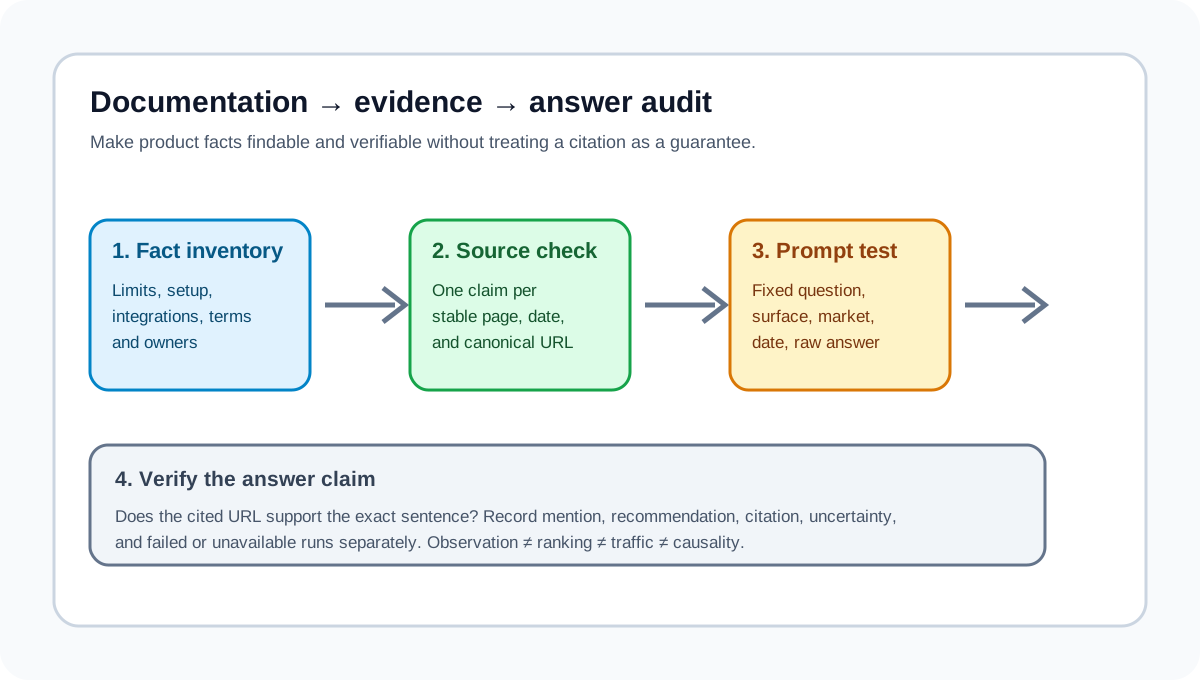
This guide addresses searches such as “how do I optimize product documentation for AI search?”, “how can I stop AI answers from using outdated product facts?”, and “how do I verify whether an AI citation supports a product claim?” It applies to SaaS documentation, developer docs, knowledge bases, pricing explanations, and setup guides.
What documentation can—and cannot—prove
Clear documentation can reduce ambiguity for a human reader and create a more inspectable source for a retrieval system. It cannot prove that a model used the page, that a citation caused a visit, or that a documentation change caused a later answer change.
| Observation | What it supports | What it does not support |
|---|---|---|
| A page states a current plan limit | The company publishes that fact on that page | That an AI system will retrieve or cite it |
| A crawler can fetch a documentation URL | The URL was reachable under that test | That every AI search surface can access it |
| An answer cites the page | The page was shown as a source in that captured answer | That the page caused the recommendation or conversion |
| An answer repeats an incorrect fact | A factual discrepancy worth investigating | That the documentation alone caused the error |
| A before/after answer differs | Two observations differ under recorded conditions | That one edit caused the difference |
OpenAI’s web-search documentation describes citations and source information for a particular API tool (Web search, checked October 3, 2026). Perplexity’s documentation describes search and source use in its own API context (Search Quickstart, checked October 3, 2026). These are useful examples of documented surfaces, not evidence that all consumer AI answers use the same retrieval process.
1. Build a product-fact inventory
Start with facts that influence evaluation, setup, purchase, or safe use. Do not begin by rewriting every article.
| Fact group | Example questions | Risk if stale or ambiguous |
|---|---|---|
| Availability | Which regions, environments, or operating systems are supported? | A buyer may select an unusable product |
| Limits | How many seats, projects, requests, or records are included? | An answer may misstate the practical plan fit |
| Integrations | Which systems connect natively, through an API, or not at all? | A comparison may overstate compatibility |
| Workflow | What does a user configure first, and what output is produced? | Product recommendations become vague |
| Commercial terms | Is a feature included, metered, add-on, or enterprise-only? | Pricing and procurement answers drift |
| Security and compliance | Which commitments are documented and in which scope? | High-risk claims may be repeated without context |
Assign every high-impact fact an owner, review date, source URL, and status. A simple record can look like this:
Fact ID: INT-014
Claim: Native Slack integration is available on the documented plan
Owner: Product marketing
Source: canonical integration page
Checked: 2026-10-03
Status: current / needs verification / retired
Evidence needed: exact plan and setup conditions
A fact inventory is an internal control, not an AI ranking signal. Its value is that it exposes contradictions before a buyer—or an answer system—encounters them.
2. Give each important claim a canonical source
A product fact is easier to verify when one page is clearly responsible for explaining it. This does not mean deleting useful context from guides. It means linking explanations back to a current source rather than allowing several pages to publish slightly different values.
For each claim, check:
- One canonical URL: Is there an obvious page a reviewer can open?
- Explicit wording: Does the page state the fact directly rather than requiring inference from a screenshot?
- Scope: Does it name plan, region, version, audience, or other conditions?
- Date or version: Can a reader tell whether the information is current?
- Ownership: Does someone know who updates the claim?
- Consistency: Do pricing, docs, comparison, and support pages agree?
Do not add a date merely as decoration. A “last updated” label is useful only when the underlying fact was actually reviewed. Also avoid moving every claim into a single giant page: a source should be authoritative and contextually relevant, not merely large.
3. Separate product facts from marketing conclusions
Documentation often becomes difficult to verify when a factual statement and an outcome claim share a sentence.
| Risky form | More inspectable form |
|---|---|
| “The platform guarantees better AI visibility.” | “The platform records the configured prompts and reported sources; visibility outcomes vary by surface and collection conditions.” |
| “Our integration makes setup effortless.” | “The integration supports [documented action] after [documented prerequisites].” |
| “Customers save 40% of their time.” | “The vendor reports a 40% time saving in a vendor-selected customer example; independent validation is not established here.” |
| “The API supports all major models.” | “The API documentation lists these models and endpoint conditions: [specific list].” |
A documentation audit should flag unsupported superlatives, guarantees, and causal claims. This is not a style preference: a concise fact can be checked against a source, while an outcome claim may require an entirely different evidence record.
4. Test retrieval with a fixed question set
Create prompts from real customer language, not only from page headings. Include:
- Category questions: “What does this type of product do?”
- Evaluation questions: “Which tool supports [constraint]?”
- Product-fact questions: “Does Product X support [integration]?”
- Setup questions: “How do I configure [workflow]?”
- Risk questions: “What should I verify before buying or deploying it?”
- Change-sensitive questions: pricing, limits, availability, and release behavior
Record the exact wording, surface, mode, market, language, timestamp, and run ID. Keep branded and unbranded prompts separate. “What is Product X?” tests recognition and factual accuracy; it does not measure category discovery.
A useful answer record includes:
Prompt: Does Product X export citation-level source URLs?
Surface/mode: recorded at collection time
Collected: 2026-10-03 UTC
Answer: exact captured text or permitted export
Mention: yes/no
Recommendation: yes/no/not applicable
Cited URLs: exact URLs shown
Claim check: supported / partial / contradicted / unclear
Unavailable state: recorded separately
Products such as AI Search Console, Peec AI, Otterly.AI, PromptWatch, and Profound may expose different combinations of prompt, answer, source, citation, and derived reporting data. Their workflows are not interchangeable. During a trial, verify whether the product preserves the raw answer, exact source URL, timestamp, prompt context, and unavailable runs.
5. Check what a citation actually supports
A visible source is not automatically support for every sentence in an answer. Use a claim-level review:
- Copy the exact answer sentence.
- Identify the factual proposition it makes.
- Open the cited URL, not only the search-result label.
- Find the relevant passage and record its scope.
- Mark the relationship as supported, partially supported, contradicted, or not verifiable.
- Record whether the page is first-party, independent, vendor-selected, or unclear.
A citation can support a narrow feature description while failing to support a comparison, ranking, price, or outcome claim added by the answer. If the answer combines multiple propositions, split them before reviewing.
For a reusable claim-level method, see AI Search Answer Claim Audit and AI Search Answer Provenance. Neither method establishes why a system selected a source; both help define what the captured source does and does not support.
6. Fix the smallest verified gap
Choose the update based on the evidence:
| Finding | Bounded action |
|---|---|
| The canonical page is unreachable | Fix access, redirects, sitemap references, or deployment errors |
| The fact exists but lacks scope | State plan, region, version, prerequisites, or exceptions |
| Several pages conflict | Select an owner and reconcile the conflicting values |
| The cited page supports only part of a claim | Narrow the copy or add the missing evidence |
| The answer uses a retired URL | Redirect, update links, and check whether the old page remains indexable |
| No page is cited in a small sample | Expand or stabilize the sample before rewriting |
| A third-party source is wrong | Publish a clear first-party fact; do not claim control over the third-party page |
Avoid changing headings, schema, copy, internal links, and navigation all at once if your objective is to learn what changed. A bounded edit is easier to review. It is still not a causal experiment unless collection conditions and competing changes are controlled.
Google’s structured-data documentation describes how markup can help Google understand page content, while also stating that structured data does not guarantee a particular search appearance (Introduction to structured data markup, checked October 3, 2026). Treat schema as a representation aid and eligibility input where applicable—not as a citation switch.
7. Report the evidence boundary
A useful internal report should distinguish:
- Documentation state: what the company currently publishes
- Access state: what the test could fetch
- Answer observation: what the selected surface returned
- Source relationship: what the cited page actually supports
- Action: what was changed and why
- Uncertainty: what the sample, tool, or surface cannot establish
Use counts and exact conditions. For example:
In 6 of 12 fixed US-English product-fact captures collected on October 3, 2026, the answer mentioned the product. Two captures showed a first-party URL. The result describes this prompt set and collection condition; it is not a universal visibility rate, ranking, traffic estimate, or proof that the documentation caused the answer.
Do not convert “the page was cited” into “the page ranked,” “the citation drove traffic,” or “the update increased revenue.” Those are separate measurements.
A practical monthly documentation audit
- Export the fact inventory and identify claims due for review.
- Reconcile pricing, plan, integration, and availability pages.
- Check canonical URLs, redirects, sitemap references, and access controls.
- Run a fixed product-fact prompt panel and preserve raw evidence.
- Review citations at claim level, including scope and source type.
- Fix one high-impact contradiction or missing condition.
- Retest the same panel and label the new run.
- Add new customer questions to an exploratory cohort rather than silently changing the baseline.
- Report observations, actions, and boundaries separately.
FAQ
Does updating documentation guarantee AI citations?
No. Clearer and more current documentation may improve human and machine interpretability, but a citation depends on the surface, query, retrieval state, source selection, and other conditions. Official guidance does not provide a guarantee of appearance.
Should every help article target an AI Search prompt?
No. Start with high-impact customer decisions and product facts. A documentation system should serve users first; prompt testing helps identify gaps and contradictions rather than dictating every page title.
Is a sitemap enough to make documentation retrievable?
No. A sitemap can help communicate URL discovery, but it does not guarantee crawling, indexing, retrieval, or citation. Check access, canonicalization, page quality, and the actual answer evidence separately.
Should I put product facts in structured data?
Use structured data only when it accurately describes visible page content and matches the relevant documentation. It can help systems interpret content in supported contexts, but it is not a guarantee of a citation or AI answer inclusion.
What should I verify in an AI visibility tool trial?
Verify the exact prompt, surface, market, timestamp, raw answer, cited URLs, claim-to-source relationship, failed runs, and export behavior. Also check how credits are counted. A derived score without inspectable evidence is a weak basis for a documentation decision.
Sources and verification
- Google Search Central: AI features and your website — checked October 3, 2026; used for foundational AI-feature and appearance boundaries.
- Google Search Central: Introduction to structured data markup — checked October 3, 2026; used for the limits of structured data claims.
- OpenAI Developer Docs: Web search — checked October 3, 2026; used for the boundary around one documented web-search tool and source information.
- Perplexity API Docs: Search Quickstart — checked October 3, 2026; used as a separate documented search-surface example, not as evidence about all AI Search systems.
- Aggarwal et al., GEO: Generative Engine Optimization — checked October 3, 2026; independent research context for generative-engine visibility, not proof of a current vendor metric or business outcome.
Last reviewed: October 3, 2026 Evidence confidence: Medium for the documented search and structured-data guidance; low-to-medium for generalization across AI answer surfaces because their retrieval and citation behavior is not standardized.