AI Search Entity Disambiguation: How to Prevent Similar Brands Being Confused
A practical audit for separating similarly named companies, products, and locations in AI Search—using canonical facts, corroborating sources, and controlled retests.
The short answer
AI Search entity disambiguation is the process of helping an answer system distinguish your company, product, person, location, or organization from similarly named entities. The goal is not to force a preferred description into every answer. It is to make the entity’s identity, relationships, scope, and current facts easier to verify.
A defensible workflow is:
- List the collisions customers and search systems could make.
- Create a canonical fact record with stable identifiers and source URLs.
- Check whether important first-party and independent references agree.
- Test realistic prompts across defined markets and surfaces.
- Make one bounded clarification, then retest without claiming causation.
A confused entity can produce a wrong address, a competitor’s feature, a stale product description, or a recommendation for the wrong business. One answer is an observation—not proof of a universal AI ranking or a site-wide identity failure.
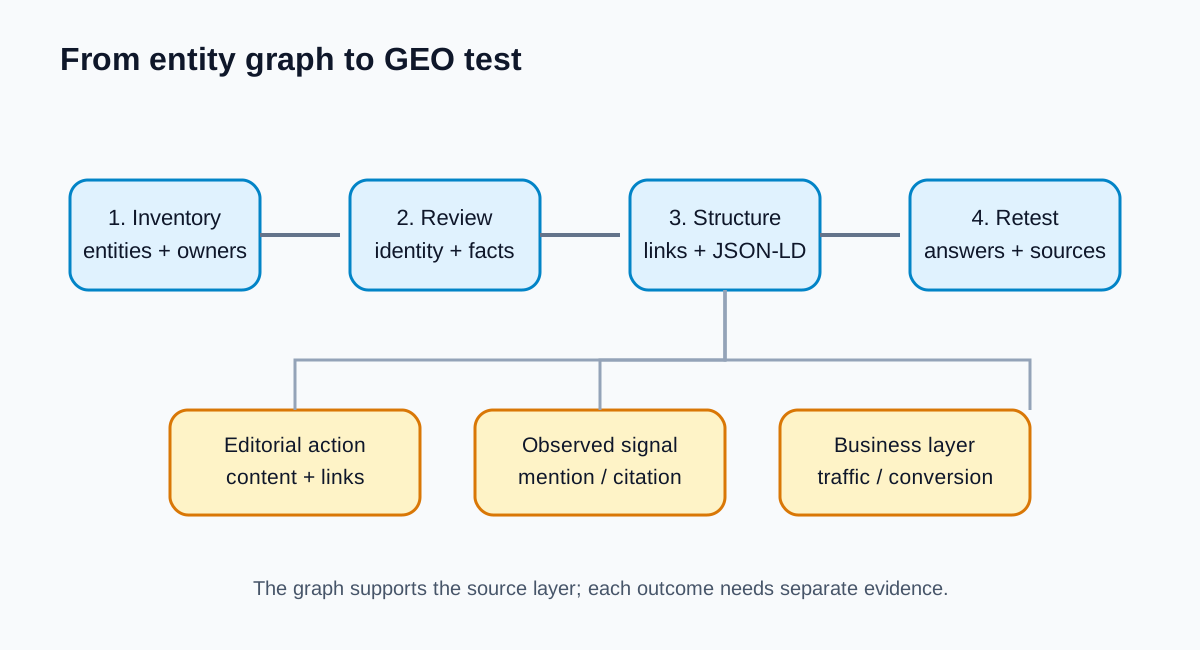
What entity confusion looks like
Do not label every incomplete answer as entity confusion. The defining signal is that information belonging to another entity, product version, market, or location has been attached to the subject being asked about.
| Observation | Likely issue | What to verify |
|---|---|---|
| A competitor’s feature is attributed to your product | Product collision | Product name, domain, documentation, and comparison wording |
| The answer gives another company’s address | Organization or local collision | Legal name, location, phone, and business-profile evidence |
| Two products with the same name are merged | Product-variant collision | Manufacturer, category, version, and release date |
| A parent company is treated as the operating brand | Relationship ambiguity | Ownership and “operated by” language |
| A former name is treated as current | Historical collision | Rebrand announcement and current canonical naming |
| A broad answer omits your brand | Not necessarily confusion | Prompt scope, category fit, and visibility evidence |
The distinction matters because the fix differs. A collision calls for identity clarification. An omission may call for better category evidence, a different prompt panel, or no change at all.
Why names alone are weak identifiers
Names are useful labels but poor disambiguators when they are shared, abbreviated, translated, or used for both a company and a product. Add relationships and attributes that answer systems can cross-check:
- Official name and common name
- Canonical website and relevant product URLs
- Organization type and founding or operating market, when material
- Product category and intended customer
- Parent, subsidiary, brand, or “part of” relationship
- Headquarters or service areas, if publicly relevant
- Distinctive integrations, formats, or use cases
- Alternative spellings and known abbreviations
- Identifiers used consistently in supported directories or knowledge systems
Only publish facts you can substantiate. An identifier added to markup or a profile is not evidence that an AI system will use it, and a profile’s existence does not prove that its details are current.
The canonical entity record
Create one internal record before editing public pages. Give every statement an owner and verification date.
| Field | Example of a useful record |
|---|---|
| Entity ID | Internal stable ID, not a guessed external ID |
| Preferred name | Current public name |
| Name variants | Former name, abbreviation, spelling variants |
| Entity type | Company, product, person, place, organization |
| Canonical URL | Main first-party page |
| Product relationship | “Product X is offered by Company Y” |
| Market and language | Countries and locales actually served |
| Distinguishing facts | Category, audience, integrations, or location |
| Exclusions | Similar entities that must not be merged |
| Evidence URLs | First-party and independent corroborating sources |
| Last verified | Date and reviewer |
The exclusions field is especially useful. Write explicit boundaries such as “not the similarly named mobile app” or “not the former regional distributor.” Those boundaries can guide copy, support responses, and manual review even when an AI surface does not expose its entity model.
Audit the source graph, not just the homepage
A homepage may identify a brand but leave product relationships and regional scope implicit. Inspect the pages and sources that answer systems are likely to encounter:
- About and legal pages
- Product and documentation pages
- Pricing, availability, and support pages
- Press releases and rebrand announcements
- Organization or product structured data where appropriate
- Reputable industry directories and independent references
- Local business profiles for location-specific entities
- Social profiles that use consistent names and links
Google’s documentation says structured data helps Search understand page content, while also making clear that it does not guarantee a rich result or a particular search treatment (Introduction to structured data markup). Use markup to express facts already present on the page; do not use it to assert unsupported identity claims.
Build a source matrix:
| Fact | First-party source | Independent corroboration | Conflict | Decision |
|---|---|---|---|---|
| What the entity is | URL and section | URL and date | None or describe it | Use precise wording |
| Who owns or operates it | URL and section | URL and date | Record scope | Clarify relationship |
| Where it serves | URL and date | Local or industry source | Region mismatch | Limit the claim |
| What the product does | Documentation | Independent review or directory | Feature mismatch | Use current docs |
| Current name | Legal/about page | Recent external reference | Rebrand lag | Add former name carefully |
Independent corroboration supports existence and public understanding; it does not override current first-party product documentation on a feature. Conversely, first-party claims should not be presented as independent validation.
Build an entity-focused prompt panel
Test the collisions that matter to customers. Keep prompt wording, location, language, surface, model when disclosed, and date in the record.
Identity prompts
- “What is [exact name]?”
- “What does [name] do, and who is it for?”
- “Is [name] the company, the product, or both?”
Separation prompts
- “Is [name] the same as [similar name]?”
- “Compare [product] with [similarly named product].”
- “Which company makes [product name]?”
Relationship prompts
- “How is [brand] related to [parent or subsidiary]?”
- “Which products does [company] offer?”
- “Does [brand] operate in [market]?”
Local and multilingual prompts
- “Where is [business] located in [city]?”
- Use the customer’s local spelling and language, not only an English translation.
A balanced panel should include direct questions and the natural recommendation or comparison questions in which confusion would have a business consequence. Avoid treating the prompt count as a universal statistical threshold.
Capture answers as evidence
For every run, preserve:
- Exact prompt and follow-up context
- Surface, mode, and model/version when shown
- Country, city, language, and locale
- Date, time zone, and run number
- Full answer and visible citations
- Exact source URLs, not only domain names
- The sentence where the identity is assigned
- Expected entity and the evidence for that expectation
Use a classification that separates identity errors from ordinary uncertainty:
| Result | Meaning | Recommended response |
|---|---|---|
| Correctly separated | The answer identifies the intended entity and relationships | Preserve and monitor |
| Correct but incomplete | Identity is right but an important scope is absent | Improve the canonical source if material |
| Ambiguous | Wording could describe multiple entities | Add distinguishing language |
| Conflated | Facts from another entity are attached to the subject | Correct source inconsistencies and retest |
| Unverifiable | Evidence is insufficient to decide | Record uncertainty; do not rewrite speculatively |
A citation to your domain does not prove that the answer identified your entity correctly. Inspect the linked page and the claim it supposedly supports.
The smallest useful corrections
Choose the correction that matches the collision:
- Put the exact organization and product relationship in visible text.
- Use consistent names in title, headings, navigation, and documentation.
- Explain former names without presenting them as current.
- Add a concise “not to be confused with” note when customers genuinely encounter a named collision.
- Separate regional entities, distributors, and subsidiaries.
- Link product claims to current documentation rather than a generic homepage.
- Correct contradictory names or descriptions across first-party pages.
- Validate structured data syntax and consistency after the content change.
Do not create pages solely to repeat a competitor’s name. Do not add fake identifiers, invented partnerships, or unsupported “official” language. A clarification is useful only when it is true, necessary, and supported.
Retest and report the boundary
Rerun the same prompt panel after a defined interval. Keep the old and new answers side by side. Report the result by prompt group and context:
| Report field | Why it matters |
|---|---|
| Entity and variant | Shows what was tested |
| Prompt version | Keeps the question stable |
| Surface/model | Answers may differ by environment |
| Market/language | Local sources and names can change results |
| Runs and dates | Shows whether this is one answer or a pattern |
| Correctly separated | Direct identity outcome |
| Conflated or ambiguous | Actionable error categories |
| Source coverage | Shows whether claims were inspectable |
| Caveat | Limits what the sample supports |
A changed result after an edit is a before-and-after observation. It is not proof that the edit caused the change: model routing, source freshness, retrieval timing, or an unrelated page change may explain it.
Where tools fit
Tools can reduce collection and tagging work, but they do not create a universal entity truth. AI Search Console, Peec AI, and PromptWatch represent different monitoring workflows; verify whether each preserves raw answers, exact citations, prompt context, and historical versions. Kalicube is relevant to entity-oriented workflows, but its product claims and coverage should be checked directly rather than inferred from the category.
During a trial, test one known collision and ask:
- Can the system distinguish the two names in the same prompt?
- Can you inspect the answer and source that produced the classification?
- Are aliases, negations, and parent-child relationships handled?
- Can you export the evidence for a client or content ticket?
- Are model, region, language, and refresh changes visible in history?
A dashboard label such as “brand mentioned” is not equivalent to “correct entity identified.”
FAQ
Does entity SEO guarantee AI Search visibility?
No. Clear entity information may improve the evidence available to search and answer systems, but no public source here establishes guaranteed inclusion, citation, recommendation, or ranking for a specific entity.
Should I create a knowledge panel to fix confusion?
Not as a first step. Start with accurate, consistent, and verifiable first-party information and investigate the actual collision. A knowledge panel, directory listing, or structured-data change is not a substitute for evidence review.
How do I handle a rebrand?
State the current name clearly, record the former name with an effective date, and link to the official announcement where appropriate. Test both names, because users may continue to search with the old name.
What if two legitimate businesses share a name?
Add disambiguating attributes such as category, city, country, product, or official domain. Do not imply that one entity owns the other. Test prompts using the wording customers actually use.
Can a citation prove the answer used the right entity?
No. The cited page may be relevant to one sentence but not another, or it may itself be ambiguous. Check the exact claim, URL, date, and entity relationship.
Related AICiteKit tools and guides
- Kalicube — entity-oriented workflows and knowledge-panel context.
- AI Search Console — prompt, competitor, source, and citation tracking.
- Peec AI — visibility, position, sentiment, and citation analysis.
- PromptWatch — visibility, crawler, API, and MCP-oriented workflows.
- Knowledge Graphs for GEO — what entity structures can and cannot prove.
- AI Search Source Quality — evaluating source reliability before changing content.
Sources and verification
- Google Search Central: Introduction to structured data markup — official scope and limitations of structured data; checked September 7, 2026.
- Google Search Central: AI features and your website — official guidance on AI features and supporting web content; checked September 7, 2026.
- GEO: Generative Engine Optimization — independent academic research context; checked September 7, 2026.
The sources support the stated documentation and research context. AICiteKit has not independently audited the internal entity resolution or retrieval systems of any AI Search platform or named tool. This article does not claim guaranteed disambiguation, visibility, citations, traffic, conversions, or revenue.