AI Search Source Decay: How to Monitor When Citations Disappear
A practical framework for detecting AI Search source decay, reviewing missing citations, and separating answer evidence from rankings, clicks, and revenue.
The short answer
AI Search source decay is a recurring observation in which a page, domain, or source that appeared in an answer is no longer cited under a comparable prompt and collection context. It is not a formal platform metric, and a missing citation does not prove that a page lost rankings, traffic, or business value.
A useful response is an evidence-preserving loop:
stable prompt → captured answer → source comparison → bounded verificationRecord the exact prompt, AI surface, market, date, answer, and source URLs. Then classify the change as source loss, answer variation, measurement change, or an unresolved observation. Only after that should the team decide whether to review content, technical access, product facts, or the measurement setup.
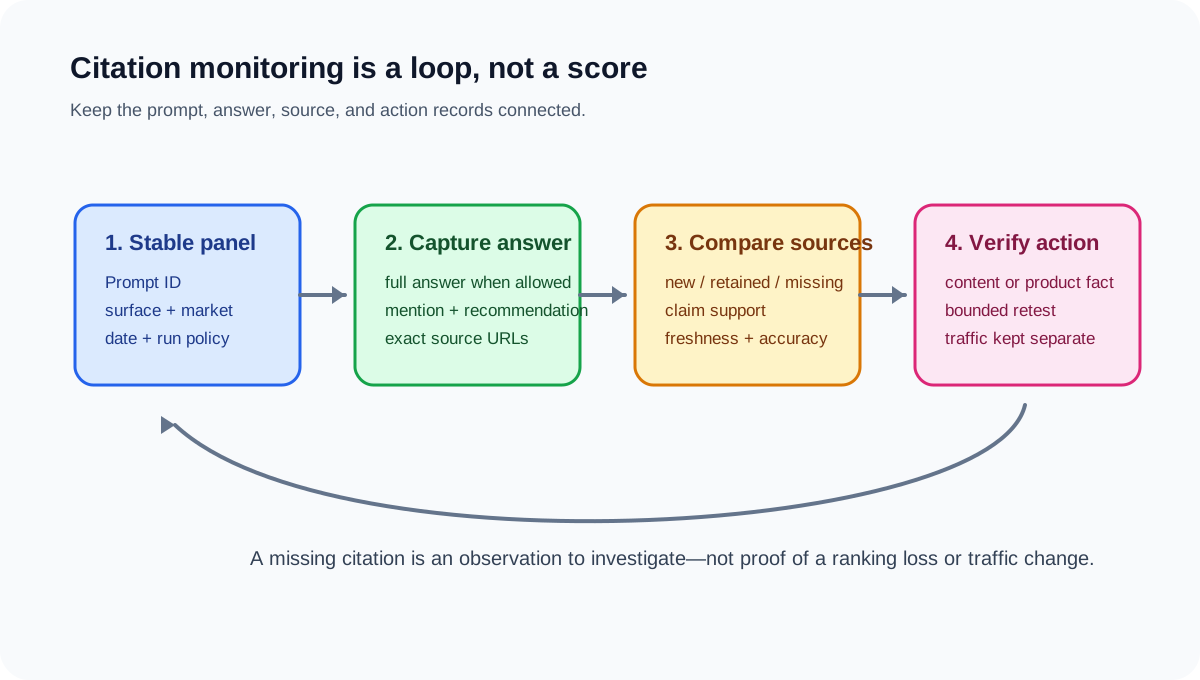
This topic matches a practical search intent for marketers asking why AI citations disappear, how to track citations over time, and whether a cited page can lose AI visibility. The framework is vendor-neutral and complements How to Track AI Citations Without Overclaiming Traffic and AI Visibility vs AI Citations vs AI Traffic.
What source decay does—and does not—mean
A citation is an observed source link in a particular answer. It is not automatically a ranking position, endorsement, click, or conversion. Google’s official guidance describes AI features as part of Search and recommends the same foundational practices for making pages accessible, useful, and understandable (Google Search Central: AI features and your website, checked August 29, 2026). That guidance does not publish a universal citation-retention score or guarantee that an eligible page will be shown.
Likewise, OpenAI documents ChatGPT Search as a web-search experience that may provide links to sources (ChatGPT search, checked August 29, 2026). This supports the product-level fact that source links can be part of the experience; it does not establish that every user receives the same answer or that a source link produces a visit.
Use precise language:
| Observation | Defensible description | Not established by itself |
|---|---|---|
| Source URL appeared in run 1 but not run 2 | The source was absent from run 2 under the recorded conditions | A universal visibility loss |
| Domain remained but page URL changed | The answer used a different page from the same domain | That the new page is better or more authoritative |
| Several sources changed | Source composition varied between observations | A content edit caused the change |
| Citation appeared and analytics later recorded a referral | A referral was observed in the analytics system | That the citation caused every downstream action |
Why citations disappear
1. The answer or retrieval context changed
AI answers can vary with wording, location, language, search mode, model routing, account state, and collection time. If any of these fields changed, the comparison is not clean. A prompt such as “best enterprise GEO platforms” is not equivalent to “best GEO platforms for a small agency,” even if both are labelled “category.”
2. The source list changed while the answer stayed similar
An answer may retain the same recommendation but cite a different supporting page. A domain-level report can hide this change. Store exact URLs and the claim each URL appears to support; “domain cited” is weaker evidence than “this page was linked beside this claim.”
3. The page changed or became less accessible
A changed title, canonical, redirect, robots directive, server response, rendered content, or publication date may affect how a retrieval system sees the page. These are hypotheses to check, not explanations to assert from a dashboard trend. Search Console and server logs can provide adjacent evidence, but neither is a transcript of every AI answer.
4. The claim became stale or less useful
A pricing page, feature page, product comparison, or policy page can remain indexable while its facts become outdated. For high-risk claims, review the source for accuracy and freshness. Do not rewrite solely to insert keywords or schema; no source supports the claim that a particular edit guarantees a citation.
5. The measurement layer changed
A vendor may change its parser, answer capture, platform integration, or citation definition. A dashboard can therefore report a different citation count without the underlying answer behavior being directly comparable. Ask whether historical results were recalculated and whether raw answers remain available.
A four-layer source-decay ledger
Keep the observation small enough for another reviewer to audit.
| Layer | Minimum fields | Review question |
|---|---|---|
| Prompt | Stable ID, exact wording, intent, language, market | Did the question remain comparable? |
| Surface | Product, mode, model/version when disclosed, account context | Did the collection environment change? |
| Answer | Capture time, full answer or permitted export, mentions, recommendations | Did the answer itself change? |
| Sources | Exact URL, domain, position, claim supported, first/last seen | Did the source disappear, move, or change? |
A useful source record looks like this:
Prompt: CAT-014 v2
Surface: named AI Search surface; web-search mode recorded when disclosed
Collected: 2026-08-29 10:00 UTC
Source: https://example.com/research-page
Status: absent in current run
Prior evidence: cited in 3 of 5 matched runs
Confidence: medium; raw answer captured, model version unavailable
Next check: rerun matched prompt and inspect page access/freshness
Do not use example.com as an actual source record. It is only a schema illustration.
How to investigate a missing citation
Step 1: Freeze the comparison
Save the old and new prompt versions, platform, mode, language, market, date, and run policy. If the new run used an exploratory prompt, label it exploratory instead of adding it to the stable trend.
Step 2: Compare answer-level evidence
Check whether the answer changed in all of these ways:
- Brand or product mention
- Recommendation order or wording
- Claim associated with the source
- Exact URL and canonical destination
- Number and type of sources
- Caveats, dates, prices, or availability statements
If the raw answer is unavailable, write “raw answer unavailable” and lower confidence. Do not reconstruct a quote from a metric label.
Step 3: Check the source itself
Review the page’s status, canonical, redirects, indexability signals, visible content, structured data where relevant, and factual freshness. Check server logs or search reporting as separate evidence. A crawler request is not a citation, and a search impression is not proof that an AI answer used the page.
Step 4: Repeat before acting
One missing link is a weak signal. Repeat the same observation under the same documented conditions, then compare a small set of related prompts. A repeated pattern across matched prompts is more useful for prioritization, but it remains a sampled observation rather than a market-wide measurement.
Step 5: Choose one bounded action
Examples include updating a stale factual section, clarifying a comparison table, fixing an access issue, improving source attribution, or testing a new prompt version. Change one material variable where possible, record the date, and define the retest before publishing.
Metrics that help without pretending to be universal
Use rates only with their denominator and context:
source retention rate = matched prompts where the source reappeared ÷ matched prompts where it was previously observedFor a stable panel, report:
- Prompt IDs and versions included
- Platforms, modes, markets, and languages
- Number of matched runs
- Exact citation rule
- Source URL and domain separately
- Missing, unavailable, and non-matched observations
- Examples of retained and replaced sources
A source-retention rate is a property of the defined sample. It is not “our AI ranking,” “market share,” or “probability of being cited by all models.” Keep source retention separate from:
- Visibility: whether a brand or page appeared in the sampled answer set
- Citation: whether an answer linked to a source
- Traffic: whether analytics recorded a visit
- Conversion: whether a business event was recorded
The academic GEO paper by Aggarwal and colleagues studied generated-engine visibility and proposed optimization methods (GEO: Generative Engine Optimization, arXiv, checked August 29, 2026). It is useful independent research context, but it does not validate a vendor’s score, prove a production causal effect, or guarantee citations.
Where tools fit
Monitoring products can reduce collection work, but the buyer should compare their evidence model rather than the presence of a “citation” label.
- AI Search Console is a relevant comparison for prompt, answer, source, and citation workflows.
- Peec AI and Otterly.AI represent recurring visibility monitoring workflows.
- PromptWatch is relevant when prompt evidence is evaluated alongside crawler or referral analytics.
- Rankscale is a comparison point for broader engine and visibility monitoring.
These internal pages describe different products; their scores and source records should not be assumed interchangeable. During a trial, verify exact prompt export, raw answer access, source URL retention, version history, platform context, and whether historical data changes after a parser update.
A practical operating cadence
Weekly: review exceptions
Look for newly absent sources, changed product facts, and non-matched runs. Triage high-risk pages first: pricing, availability, safety, legal, and product capability pages.
Monthly: audit the stable panel
Check prompt membership, source retention, answer samples, parser changes, and denominator. Keep exploratory discoveries in a separate appendix.
After a material content change: retest deliberately
Capture a pre-change baseline, publish the change, allow a reasonable observation window, and rerun the same prompts. If the source appears later, report the sequence as an observed before/after pattern—not proof that the edit caused the result unless stronger controls support that conclusion.
What source-decay monitoring cannot prove
Even a well-maintained ledger cannot prove:
- That every person sees the same AI answer
- A universal ranking across AI surfaces
- That a missing citation caused a traffic decline
- That a cited source caused a click, lead, order, or revenue
- That a content edit caused a citation change without stronger experimental design
- That AI crawler activity means the page appeared in an answer
- That a vendor-selected case study is independent evidence
The evidence boundary is part of the result. A useful report may conclude that a source was absent from a matched sample while leaving the cause unresolved.
Trial checklist for citation monitoring tools
- Can the tool export exact prompts and stable IDs?
- Does it preserve raw answers, screenshots, or compliant answer exports?
- Are exact source URLs available, rather than only domains?
- Are surface, mode, model, language, market, and timestamps recorded?
- Can prompt versions and exploratory panels be separated?
- What happens when a request fails or a source parser changes?
- Are mentions, recommendations, source position, and citations defined separately?
- Can the tool show a source’s first seen, last seen, and matched-run history?
- Can you annotate an observation as unknown or unavailable?
- Can the export be reconciled with Search Console, server logs, and analytics without treating them as the same evidence?
FAQ
Is a missing AI citation proof that my page lost rankings?
No. It is a missing source in a defined observation. Check prompt comparability, answer variation, source changes, page accessibility, and measurement changes before forming a ranking hypothesis.
How often should AI citations be monitored?
Use a cadence that matches the decision and volatility of the information. A stable weekly or monthly panel can be more auditable than frequent runs with changing prompts. Risk-sensitive facts may justify additional checks.
Should I optimize a page every time a citation disappears?
No. First confirm that the observation is comparable and repeated. Then choose one bounded action tied to a plausible issue, such as stale facts or unclear source coverage, and define a retest.
Can AI crawler logs prove a citation?
No. Logs can show that a crawler requested a resource. Only answer-level evidence can show that a source link appeared in a captured answer, and even that is limited to the surface, prompt, time, and collection method.
Is source retention a better KPI than AI visibility?
Neither is universally better. Source retention is useful when the question is whether a known source reappears. Visibility is useful when the question is whether a brand or page appears. Report both with definitions and denominators when they support different decisions.
Sources and verification
| Source | Public signal | What it supports | Confidence |
|---|---|---|---|
| Google Search Central: AI features and your website | Official guidance on AI features, links to supporting resources, and Search fundamentals | Search and webmaster context; not a citation guarantee | High |
| ChatGPT search | Official OpenAI help documentation | ChatGPT Search and source-link context; not a universal answer model | High |
| GEO: Generative Engine Optimization | Independent academic research paper hosted on arXiv | Background on generative-engine visibility research; not validation of vendor metrics or outcomes | Medium |
| Google Search Console performance report | Official reporting documentation | Search-performance context; not a transcript of every AI answer | High |
| Bing Webmaster Guidelines | Official webmaster guidance | Discoverability and quality context; not a generated-answer guarantee | High |
The official pages and paper above were checked on August 29, 2026. AICiteKit has not independently audited the internal collection methods of the tools named in this article. Public documentation supports the stated product and research context; it does not establish causal effects for a specific site.
This is AICiteKit editorial methodology. It does not claim that any tool or content change guarantees rankings, citations, traffic, or revenue.