AI Search Mentions vs Recommendations: How to Measure the Difference
A practical framework for separating brand mentions from genuine recommendations in AI Search answers, with prompt design, evidence rules, reporting examples, and clear limits.
The short answer
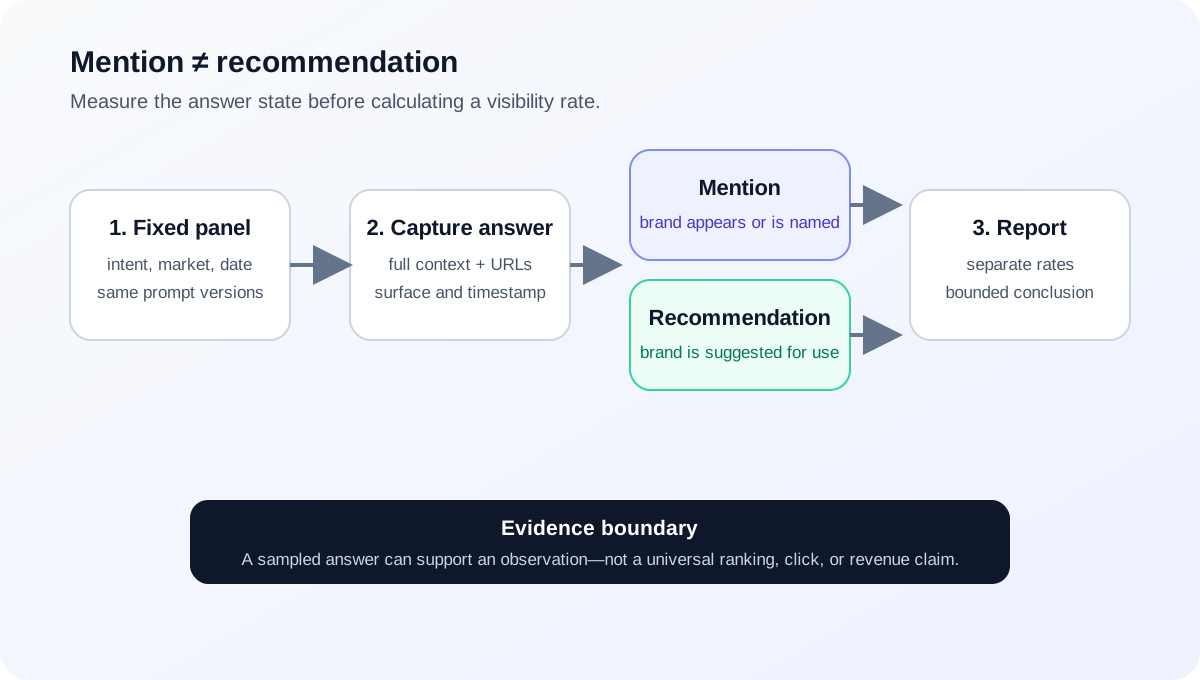
A brand mention and a recommendation are different observations. A model may name a company in a source list, compare it with alternatives, describe it as an example, or actively suggest it for a stated need. Counting all of those as recommendations inflates the result and makes the report difficult to audit.
Use this measurement sequence:
fixed prompt panel → captured answer → state classification → source check → bounded reportA defensible report should show at least three separate states:
- Mention: the brand appears in the answer or visible source context.
- Recommendation: the answer presents the brand as a suitable option for the prompt’s use case.
- Citation: a visible source URL or source label is associated with the answer.
These states can overlap, but none automatically proves a click, preference across the market, ranking, or revenue.
This guide targets searches such as “how do I measure AI brand mentions?”, “is my brand recommended in ChatGPT?”, and “what is the difference between AI visibility and recommendation share?” It is a measurement framework, not a promise that changing a content or visibility metric will produce a business outcome.
Why the distinction matters
Consider these answer fragments:
| Answer behavior | Safe label | Why it matters |
|---|---|---|
| “The report cites Brand A’s documentation.” | Mention and possibly citation | The brand may be present only as a source. |
| “Brand A is one example of a product in this category.” | Mention | An example is not necessarily an answer to the buyer’s need. |
| “For a small agency that needs weekly monitoring, consider Brand A.” | Recommendation, if the context supports it | The product is presented as a fit for the stated use case. |
| “Brand A and Brand B have different approaches.” | Mention or comparison | Comparative inclusion does not identify a winner. |
| “I cannot recommend a vendor without more information.” | No recommendation | A brand named elsewhere in the answer would not change this state. |
The classification depends on the answer context and the prompt. A single sentence is sometimes insufficient; preserve the surrounding answer when you review it.
Google describes AI features in Search as experiences that can show links to supporting web resources (AI features and your website, checked September 14, 2026). OpenAI describes ChatGPT search as a web-search experience that may provide links to sources (ChatGPT search, checked September 14, 2026). These official descriptions support inspecting answer context and source links; they do not establish a shared industry definition of recommendation rate.
The academic paper GEO: Generative Engine Optimization studies visibility in generative-engine responses (Aggarwal et al., arXiv, checked September 14, 2026). It provides research context, not validation of a commercial dashboard or a universal recommendation formula.
Define the measurement contract first
Before opening a tool, write a short contract. It should answer:
- Which surfaces and modes are included?
- Which markets, languages, and dates are included?
- What counts as a mention?
- What counts as a recommendation?
- Are source-only appearances counted separately?
- How are ties, refusals, missing answers, and regenerated answers handled?
- What business decision will the sample inform?
For example:
A recommendation is counted when the captured answer presents the brand as a suitable option for the prompt’s stated use case. A brand named only in a source list, historical example, or neutral comparison is a mention but not a recommendation. Each prompt run contributes one classification, and unavailable runs are reported separately.
This is an editorial rule, not a platform standard. The value is consistency and inspectability. If a vendor uses another definition, record the vendor definition and do not silently combine its score with your own.
Build prompts that expose the difference
Branded prompts alone are not enough. Include unbranded discovery prompts, comparisons, and fact questions.
| Prompt group | Example | Primary observation |
|---|---|---|
| Category discovery | “Which tools help a small SaaS team monitor AI citations?” | Whether the brand is suggested without being named |
| Fit-based | “What should an agency use for weekly client AI Search reporting?” | Whether the answer connects the brand to a use case |
| Comparison | “Compare Brand A with two alternatives for prompt monitoring.” | Inclusion, differentiation, and recommendation language |
| Brand fact | “What does Brand A do and who is it for?” | Accuracy of the description, not category share |
| Alternative | “What are alternatives to Brand A for citation tracking?” | Whether the brand is framed as the reference point or omitted |
| Risk | “What should I verify before buying an AI visibility tool?” | Caveats, limitations, and unsupported claims |
| Regional | “Which AI Search tools support teams in [market]?” | Market and language differences |
Freeze the exact prompt text and version it. Record the surface, mode or model when disclosed, location, language, date, and whether the answer was regenerated. A result from one prompt set should not be generalized to all AI answers.
Capture the answer, not just the score
For every run, preserve enough evidence for another reviewer to repeat the classification:
- Exact prompt and prompt-set version
- Surface, mode, model label when available, and market context
- Full answer or a faithful permitted excerpt
- Visible source URLs and source labels
- Timestamp and time zone
- Mention state
- Recommendation state
- Citation state
- Reason for an unavailable or excluded run
A dashboard number can be useful for triage. It is not a substitute for the underlying answer when the classification is disputed. Products such as AI Search Console, Peec AI, Otterly.AI, PromptWatch, and Profound may expose different combinations of prompts, answers, citations, and derived metrics. Compare their evidence contracts rather than assuming their labels mean the same thing.
Use a classification ladder
A simple ladder reduces false positives:
1. Not present
The brand does not appear in the answer or visible source context.
2. Source-only mention
The brand or its URL appears in a source list, citation, or reference, but the answer does not present it as a solution.
3. Neutral mention
The answer names the brand in an example, definition, historical statement, or factual description without matching it to the decision in the prompt.
4. Comparative inclusion
The brand is discussed alongside alternatives and the answer describes differences, but does not clearly advise the reader to choose it.
5. Conditional recommendation
The answer suggests the brand for a stated situation, with qualifications such as team size, budget, workflow, or required feature.
6. Direct recommendation
The answer clearly presents the brand as a suitable choice for the user’s stated need.
The last two categories are still observations from a sample. They do not establish that the recommendation is correct, unbiased, stable, or influential.
Separate recommendation from accuracy
A recommendation can be factually wrong. A negative comparison can be accurate. Add a second review layer:
| Review layer | Question | Evidence needed |
|---|---|---|
| Presence | Did the brand appear? | Captured answer and source context |
| Intent | Was it offered for the prompt’s need? | Surrounding recommendation language |
| Accuracy | Are the product facts current? | Current official documentation and dated checks |
| Evidence | Does the answer show a supporting source? | Visible URL or source label |
| Outcome | Did a person click or convert? | Separate analytics and attribution records |
Do not turn a favorable recommendation into a quality guarantee. Do not turn an unfavorable answer into a hallucination finding without verifying the underlying claim. For a deeper accuracy workflow, see How to Audit Brand Hallucinations in AI Search.
Report the denominator and the overlap
A useful report might look like this:
| Metric | Definition | Report separately |
|---|---|---|
| Mention rate | Runs where the brand appeared under the stated rule ÷ valid runs | Yes |
| Recommendation rate | Runs classified as conditional or direct recommendation ÷ valid runs | Yes |
| Citation rate | Runs with a visible source URL or label meeting the stated rule ÷ valid runs | Yes |
| Recommendation among mentions | Recommendation runs ÷ mention runs | Yes, with sample size |
| Unavailable rate | Runs not captured or not classifiable ÷ scheduled runs | Yes |
These are formulas for a defined sample, not universal market statistics. Report raw counts alongside percentages. “12 of 30 valid runs” is more informative than “40% visibility” when the reader also knows the prompt mix and excluded runs.
Do not hide the overlap. A brand may be recommended without a visible citation, cited without being recommended, or both recommended and cited. A small matrix makes this visible:
| Citation present | No citation observed | |
|---|---|---|
| Recommendation | ||
| No recommendation |
Fill the cells with counts and include the prompt and surface scope. The empty template is intentional: the numbers must come from your own captured sample, not from a generic benchmark.
What tools can and cannot tell you
A monitoring tool may help collect answers, normalize prompt runs, compare competitors, or identify sources. Those functions can reduce manual work. They do not remove the need to inspect definitions.
Ask each vendor:
- Is “mention” based on the answer text, source list, domain match, or another field?
- Is “recommendation” classified by a rule, a model, or an analyst?
- Can the exact answer and source URLs be exported?
- Are prompt, model, market, date, and refresh details retained?
- How are refusals, empty answers, duplicate sources, and regenerated answers handled?
- Can first-party and third-party sources be separated?
- Can the product distinguish a cited brand URL from a brand recommendation?
A vendor-defined score may be operationally useful, but label it as vendor-derived. Do not present it as comparable with an internally classified score until the definitions and denominators match.
Evidence boundaries
Keep the following conclusions separate:
| Observation | Defensible conclusion | Unsupported leap |
|---|---|---|
| Brand appeared in 18 of 40 captured answers | It appeared in that sample under the stated rule | 45% of all AI answers mention the brand |
| Brand was recommended in 8 of 40 valid runs | It was recommended in those runs | Buyers prefer it across the market |
| Recommendation rate rose after an edit | The sampled rate changed after the edit | The edit caused the change |
| A visible source URL accompanied a recommendation | The answer exposed that source | The source caused the recommendation or a click |
| A tool reports a higher score | Its defined metric increased | The brand gained traffic or revenue |
| A user clicked from an AI surface | A visit was recorded under the analytics rule | The AI mention caused the whole conversion |
Causal claims require a stronger design than before-and-after observation. At minimum, document the prompt version, timing, competing changes, sample limitations, and the separate analytics definition. In many cases, the correct conclusion is simply that more evidence is needed.
Recommended workflow
Step 1: State the decision
Decide whether the question is category visibility, product accuracy, competitive positioning, source coverage, or traffic attribution. Do not combine all of them into one score.
Step 2: Freeze a balanced panel
Include discovery, fit, comparison, fact, risk, and regional prompts relevant to the business. Version the panel before collecting results.
Step 3: Run and archive
Capture answers, source context, dates, surfaces, and unavailable runs. Keep raw evidence or a permitted near-raw representation.
Step 4: Classify twice
Have one reviewer classify mention and recommendation separately. For important reports, have a second reviewer resolve ambiguous cases and record the reason.
Step 5: Verify material facts
Check pricing, limits, integrations, and product descriptions against current official pages. A recommendation based on stale facts is an accuracy issue, not proof of competitor bias.
Step 6: Report counts before rates
Show valid runs, excluded runs, raw counts, definitions, and overlap. Add the time period and prompt scope to every chart.
Step 7: Retest a bounded change
If you update a page or correct a fact, rerun the same panel after a documented interval. Treat the result as an observation about the panel, not as a guaranteed effect.
Who needs this workflow?
This framework is most useful for teams that already have recurring prompts, named markets, and a decision to support. Agencies can use it to keep client reporting from collapsing mentions, recommendations, and citations into one number. Product and content teams can use it to prioritize accuracy fixes and source review.
It may be excessive for a one-off exploratory search. It is also a poor fit for anyone seeking guaranteed recommendations, universal share of voice, or a dashboard that replaces customer research and analytics. Start with a small manual baseline when the prompt contract is not yet stable.
FAQ
Is a brand mention a recommendation?
No. A brand can be named as a source, example, comparison subject, or historical reference without being recommended. Inspect the surrounding answer and classify the role the brand plays in the response.
Does a citation mean the brand was recommended?
No. A citation is a source relationship observed in the answer. The cited page may support a fact without the answer recommending the organization, and a recommendation may appear without a visible citation.
What should count as a recommendation?
Use a written rule. A practical rule is that the answer must present the brand as suitable for the prompt’s stated use case. Record conditional recommendations separately from direct recommendations, and preserve ambiguous cases rather than forcing them into a positive bucket.
Can I compare recommendation rates across AI platforms?
Only after checking that the surfaces, prompts, markets, answer formats, collection dates, and classification rules are sufficiently aligned. Even then, report them as sampled observations, not as a universal platform ranking.
Do recommendations prove business impact?
No. Recommendation evidence can support an awareness or answer-quality report. Clicks, conversions, and revenue need separate analytics definitions and attribution assumptions.
Evidence snapshot
| Source | Public signal | What it supports | Confidence |
|---|---|---|---|
| Google Search Central: AI features and your website | Official documentation on AI features and links to supporting resources | The need to inspect the search surface and supporting links | High for the documented behavior; not a recommendation-rate definition |
| OpenAI Help: ChatGPT search | Official product-context documentation | ChatGPT search may provide web sources and links | Medium-high for product context; not evidence of a universal metric |
| Aggarwal et al., GEO: Generative Engine Optimization | Independent academic research | Research context for visibility experiments in generative engines | Medium; not validation of a commercial tool |
| AICiteKit: How to Audit Brand Hallucinations in AI Search | Editorial workflow | Separating recommendation from accuracy review | Editorial |
| AICiteKit: How to Evaluate an AI Search Visibility Tool | Editorial trial framework | Questions for checking prompt, answer, source, and export evidence | Editorial |
Sources and verification
- Google Search Central: AI features and your website — checked September 14, 2026 for official guidance on AI features and supporting links.
- OpenAI Help: ChatGPT search — checked September 14, 2026 for official product-context language about web search and sources.
- Aggarwal et al., GEO: Generative Engine Optimization — checked September 14, 2026 for independent research context.
- AICiteKit: How to Audit Brand Hallucinations in AI Search — related accuracy workflow.
- AICiteKit: How to Evaluate an AI Search Visibility Tool — related tool-evaluation framework.
Last reviewed: September 14, 2026
Data confidence: Medium for the measurement framework and cited documentation; low for any vendor-specific recommendation metric unless the current answer sample and definitions are independently reconciled.
This is AICiteKit editorial guidance. It does not guarantee visibility, recommendations, rankings, traffic, or revenue.